Within Music
Who Gets Credit For AI Made Music?
Machine-made or machine-assisted songs force platforms, labels and listeners to decide what counts as authorship.
On this page
- Human input and machine output
- Platform rules and labeling
- Authorship, value and listener trust
Page outline Jump by section
Introduction
AI-generated songs test authorship because they split a song into parts that used to feel naturally joined: the human idea, the vocal identity, the melody, the production, the training data, the prompt, the platform upload and the commercial credit. A listener may hear a convincing “new” track, but the industry has to ask harder questions: did a person write it, did a machine generate it, was a real artist’s voice copied, were recordings used without permission, and should the track be labelled, paid, promoted or removed?
This matters because music is not only sound. It is a system of attribution and trust. Credits decide who is recognised; copyright decides who can control and monetise a work; platform rules decide what listeners see; and labels or unions decide when a synthetic performance crosses from creative tool into impersonation. The most important authorship question is no longer simply “who made the song?” It is “which human choices, rights and identities are embedded in the output, and are they visible enough for listeners and markets to judge fairly?”
Why AI songs make authorship harder to locate
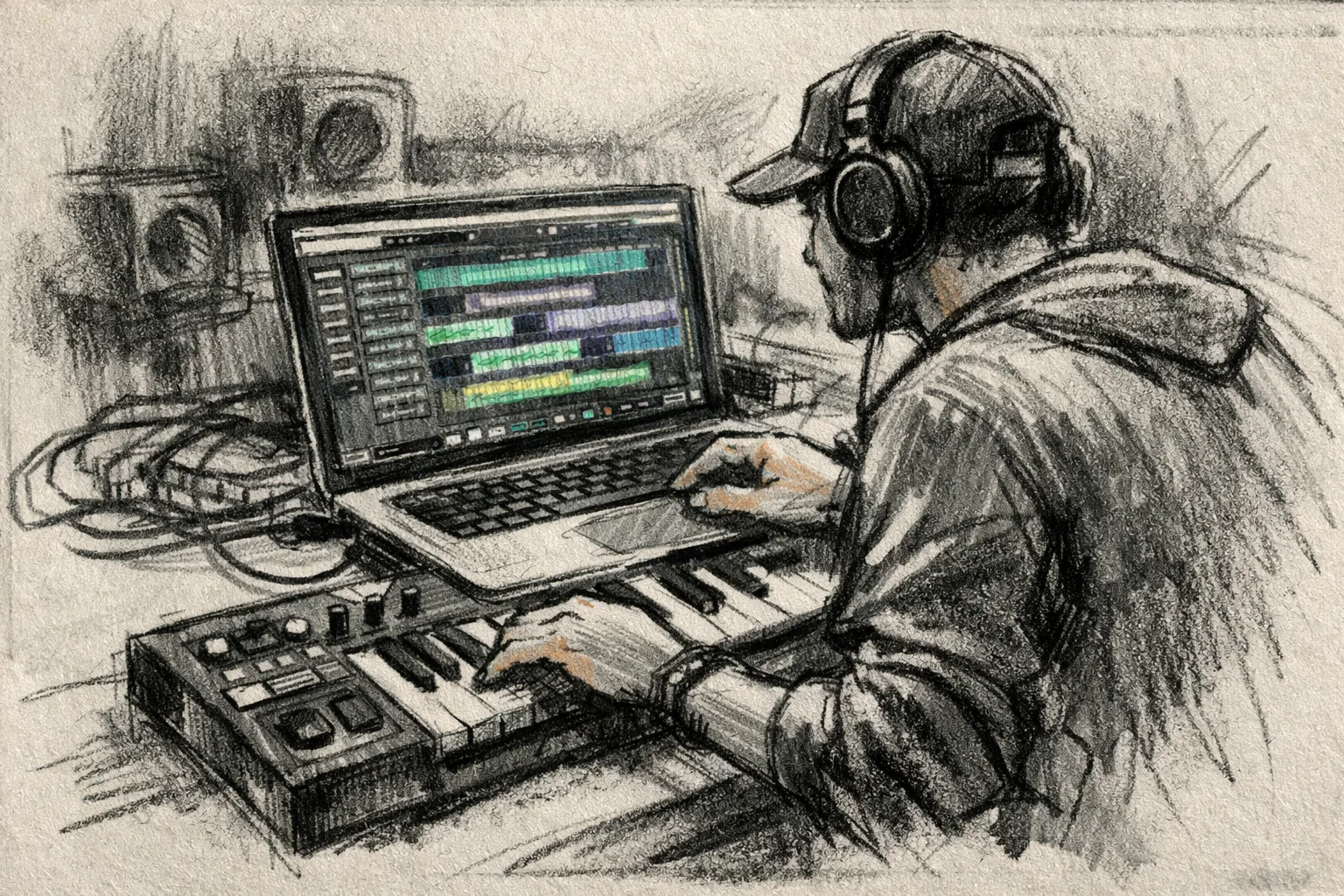
Traditional music credits are already layered. A hit can involve songwriters, topliners, producers, performers, featured artists, session musicians, engineers, publishers, labels and sample clearances. AI adds a new layer because a system can generate lyrics, melody, instrumental backing, vocal tone or full audio from short instructions. The human role may range from deep composition and editing to a simple prompt such as “make a sad pop song in the style of…”.
That range is why “AI-made music” is too blunt a label. There is a major difference between a disabled musician using AI to turn hummed ideas into demos for human players, and an anonymous uploader generating thousands of near-disposable tracks to exploit streaming royalties. In one recent example, AP reported that London musician Samuel Smith, who has Parkinson’s disease, used tools such as Suno and Udio to help translate hummed melodies into demos after his ability to play guitar was affected; the AI assisted communication of musical intent rather than replacing his lyrics or authorship.[AP News]apnews.comHis second album, "The Art of Letting Go," features the instrumental track “Horizon,” for which he used AI music generators like Suno and…
The authorship problem begins when the machine output is treated as if it has the same creative status as a human performance. A useful way to read an AI song is to separate four questions:
- Who made the expressive choices? This covers lyrics, melody, arrangement, structure, editing and selection.
- Whose identity is being heard? This matters when a synthetic vocal resembles a real singer or rapper.
- Whose recordings or compositions trained the system? This is the core dispute in major label lawsuits against music AI firms.
- Who is being paid and promoted? Platforms must decide whether AI tracks enter royalty pools, recommendations and editorial playlists.
Those questions do not always point to the same person. A user may prompt the system, the model may generate most of the music, another artist’s voice may be imitated, and the training data may include recordings owned by labels or created by musicians who never consented. AI therefore turns authorship from a single credit line into a governance problem.

Human input and machine output
The clearest emerging rule is that human contribution still matters most. The US Copyright Office’s January 2025 report on copyrightability concluded that generative AI outputs can be protected by copyright only where a human author has determined sufficient expressive elements; it specifically said that prompts alone are not enough, while human-authored material, creative arrangement or meaningful modification may be protectable.[U.S]copyright.govCopyright OfficeNewsNet Issue 1060 | U.S. Copyright Office29 Jan 2025 — It concludes that the outputs of generative AI can be protected b…. Copyright Office
For music, that distinction has practical consequences. A songwriter who writes lyrics and melody but uses AI for a temporary demo vocal is in a different position from someone who clicks “generate” until a usable track appears. A producer who edits, rearranges, records new vocals and makes distinctive musical decisions may be able to point to human authorship. A fully generated track with minimal human intervention may be harder to protect, even if the prompt took effort.
The line is not always obvious, because music creation often involves iteration. Human producers already use drum machines, software instruments, pitch correction, sample libraries and automated mixing tools. AI does not become controversial merely because it is a tool. It becomes controversial when the tool appears to supply the expressive core of the work while the human role is reduced to requesting, selecting or distributing the output.
That is why many policy debates now use the distinction between AI-assisted and AI-generated music. PRS for Music, the UK collecting society for songwriters, notes that the distinction is still developing but says it is updating registration systems so members can declare, for example, when lyrics are AI-generated but the composition is human-created, or when the reverse is true.[PRS for Music]prsformusic.comPRS for Music AI Policy and registering music created with AIUS Copyright Office copyright and works made with AI report published in January 2025. Can I register works if I create music and AI gene… This is a governance move as much as an administrative one: it treats AI involvement as something that must be declared in the chain of credit rather than hidden behind a normal songwriter field.
The fake-voice problem: when authorship sounds like someone else
The case that made the issue vivid was “Heart on My Sleeve”, the viral 2023 track credited to Ghostwriter977 and made with AI-generated vocals resembling Drake and The Weeknd. It was pulled from platforms including TikTok, Spotify and YouTube after Universal Music Group objected, even though the legal theory was not as simple as “this is an unauthorised cover”. The song forced a public distinction between writing a new track, copying a recording, and imitating a recognisable vocal identity.[The Guardian]theguardian.comThe GuardianAI song featuring fake Drake and Weeknd vocals pulled…April 18, 2023 — 18 Apr 2023 — AI song featuring fake Drake and Week…
That distinction matters because a voice is not always protected in the same way as a composition or sound recording. Copyright may protect the song and the recording; publicity or personality rights may protect identity; platform policies may fill gaps where legal routes are slow or fragmented. Harvard Law School’s discussion of the case noted that a right-of-publicity claim could be relevant where there is intentional imitation of artists for commercial use, but such claims do not offer the same fast takedown pathway as a standard copyright notice.[Harvard Law School]hls.harvard.eduSource details in endnotes.
For listeners, synthetic voice imitation can feel like a collaboration that never happened. For artists, it can be reputationally risky: a fake song can attach unwanted lyrics, political messages, poor-quality work or commercial activity to their public identity. For labels, it threatens catalogue value and control over artist brands. For platforms, it creates a moderation problem: a track may not be an exact copy of an existing recording, yet it may still deceive listeners by sounding like a real artist.
This is why artist-voice rules are becoming stricter than general AI-use rules. Spotify announced in September 2025 that unauthorised vocal impersonation is not allowed and said it would improve enforcement against AI voice clones, deepfakes and fraudulent uploads to official artist profiles.[Spotify]newsroom.spotify.comStrengthens AI Protections for Artists, SongwritersStrengthens AI Protections for Artists, Songwriters YouTube similarly announced that labels and distributors would be able to request removal of AI-generated content that mimics an artist’s unique singing or rapping voice.[The Guardian]theguardian.comThe GuardianAI song featuring fake Drake and Weeknd vocals pulled…April 18, 2023 — 18 Apr 2023 — AI song featuring fake Drake and Week…
Platform rules are becoming authorship rules
Streaming services are not courts, but their policies increasingly decide how AI songs are treated in practice. A platform can remove a track, label it, downrank it, exclude it from recommendations, deny payment for manipulated streams or require better metadata. These are authorship decisions because they shape whether a song is presented as human-made, synthetic, authorised, spammy, fraudulent or artist-approved.
Deezer has taken one of the most visible platform-level approaches. In April 2026 it said AI-generated tracks represented 44% of all new music uploaded to the service, around 75,000 tracks per day. It also said it tags AI-generated music, removes such tracks from recommendations, excludes them from editorial playlists and has stopped storing high-resolution versions of AI tracks.[Deezer Newsroom]newsroom-deezer.comDeezer Newsroom Deezer: AI-generated tracks now represent 44% of all newDeezer Newsroom Deezer: AI-generated tracks now represent 44% of all new
The scale is important because it shows that AI music is not just a few novelty songs. It has become an upload-volume problem. Deezer said fully AI-generated music accounted for only 1–3% of streams, but that up to 85% of streams generated by fully AI tracks were fraudulent in 2025; manipulated streams are excluded from royalty payments.[Deezer Newsroom]newsroom-deezer.comDeezer Newsroom Deezer: AI-generated tracks now represent 44% of all newDeezer Newsroom Deezer: AI-generated tracks now represent 44% of all new That connects authorship to economics: if a machine-generated catalogue can be uploaded at scale and streamed by bots, it can divert attention, data and money from human artists.
Spotify’s 2025 response took a different but related path. It said it would support DDEX, an industry standard for AI disclosures in music credits, so labels, distributors and music partners can indicate whether AI was used for vocals, instrumentation or post-production.[Spotify]newsroom.spotify.comStrengthens AI Protections for Artists, SongwritersStrengthens AI Protections for Artists, Songwriters Spotify also announced a spam filter targeting mass uploads, duplicates, search-engine-style manipulation and artificially short tracks, saying AI accelerates older forms of platform abuse.[The Guardian]theguardian.comThe GuardianAI song featuring fake Drake and Weeknd vocals pulled…April 18, 2023 — 18 Apr 2023 — AI song featuring fake Drake and Week…
These approaches reveal two competing models of governance:
- Detection-led governance: the platform tries to identify AI-generated music itself, label it and limit its influence in recommendations or royalties.
- Disclosure-led governance: the supply chain — artists, labels, distributors and metadata systems — declares how AI was used.
Detection can catch undisclosed AI but risks false positives and technical arms races. Disclosure respects legitimate AI-assisted music but depends on honesty and enforcement. Most platforms are likely to need both.
Copyright fights over training data shape future credit
Authorship is not only about the final song. It is also about the recordings and compositions used to build the systems that generate new music. In June 2024, major record companies sued Suno and Udio, alleging that the companies copied copyrighted sound recordings at scale to train music-generation models without permission. The RIAA described the cases as landmark actions against mass infringement by commercial AI music services.[RIAA]riaa.comOpen source on riaa.com.
The complaints matter because they shift the authorship debate upstream. If a model can generate plausible songs because it absorbed huge quantities of human-created music, should the output be treated as independent, derivative, licensed, infringing, or something else? The labels argue that unlicensed training competes with and devalues the recordings used to create the model. Suno and Udio have argued that their systems generate new outputs and that training can be protected by fair use. Reuters reported that the labels sought statutory damages of up to $150,000 per copied work and alleged that the systems could recreate recognisable elements of well-known music.[Reuters]reuters.comMusic labels sue AI companies Suno, Udio for US copyright infringementMusic labels sue AI companies Suno, Udio for US copyright infringement
The legal landscape is moving towards licensing deals as well as litigation. Reuters reported in November 2025 that Warner Music Group settled its copyright case with Suno and reached a deal for licensed AI music models, while Universal had already reached a similar settlement with Udio.[Reuters]reuters.comWarner Music Group settles copyright case with Suno for licensed AI musicAs part of the deal, Suno will implement restrictions: songs created via its free tier will be limited to play and share functions, while… AP reported that Universal and Udio’s agreement included plans for a controlled creation and streaming platform, but also caused backlash from users when Udio stopped offering downloads of generated songs.[AP News]apnews.comHis second album, "The Art of Letting Go," features the instrumental track “Horizon,” for which he used AI music generators like Suno and…
Those deals show what “authorship” may become in commercial AI music: not a single creator’s signature, but a permissions stack. A future AI-generated track may carry information about the human prompt user, licensed catalogues, authorised artist likenesses, model provider, songwriters, performers, rights holders and distribution limits. The key question is whether those layers will be visible to listeners or buried in business-to-business metadata.
Listener trust depends on clear labelling
Listeners do not all object to AI music. Some care mainly whether a track sounds good. Others care deeply whether a song expresses a human experience, whether the singer is real, whether an artist consented to a voice clone, or whether streaming royalties are being drained by synthetic spam. Labelling is the bridge between those positions because it lets listeners make their own judgement.
But labelling has to be specific to be useful. “AI” can mean mastering assistance, stem separation, a generated backing track, a synthetic guest vocal, AI-written lyrics, a cloned voice or a fully generated song. A vague label may create stigma for ordinary studio tools while failing to identify the real harms. A useful disclosure system should tell listeners what role AI played, not merely place a warning sticker on the track.
This is why the DDEX-style credit approach matters. If a credit can distinguish AI-generated vocals from AI-assisted post-production, it helps preserve a space for legitimate creative tools while making synthetic authorship more transparent. Spotify has said the standard is intended to show where and how AI played a role rather than penalise responsible use.[Spotify]newsroom.spotify.comStrengthens AI Protections for Artists, SongwritersStrengthens AI Protections for Artists, Songwriters
Trust also depends on platform behaviour after disclosure. If AI-generated tracks are labelled but still flood recommendations, users may feel the label is cosmetic. Deezer’s decision to remove AI-generated tracks from algorithmic recommendations and editorial playlists is a stronger intervention because it affects discovery, not just information.[TechCrunch]techcrunch.comTech Crunch Deezer says 44% of songs uploaded to its platform dailyTech Crunch Deezer says 44% of songs uploaded to its platform daily The trade-off is that this approach may be criticised by AI music creators who see it as a blanket demotion rather than a quality-based judgement.
The value question: what are listeners paying for?
AI songs expose a deeper tension in music’s value system. If a track is enjoyable, does it matter whether a human wrote or performed it? In some contexts, perhaps less: background music, functional playlists, game prototypes, advertising mock-ups or quick demos may value usefulness over biography. But in artist-led music, authorship is part of the product. Fans often care who lived the lyric, who sang the take, who played the part, who made the creative risk and who deserves credit.
This is why the word “authenticity” can be both important and slippery. A human song can be heavily edited, commercially calculated or performed by session musicians. An AI-assisted song can still express a human writer’s intent. The problem is not technology itself; it is misrepresentation. A synthetic track that pretends to be a real artist’s release, hides machine generation, or draws from unlicensed human work without consent creates a trust gap even if the audio is polished.
Music unions and advocacy groups have framed this around consent, credit and compensation. SAG-AFTRA says its AI guardrails centre on clear consent, fair compensation and control over performances.[sagaftra.org]sagaftra.orgOpen source on sagaftra.org. The Musicians’ Union in the UK similarly argues that music should not be used to train commercial AI systems without consent, credit and fair compensation for creators.[Musicians' Union]musiciansunion.org.ukSource details in endnotes. These demands are not anti-tool in themselves; they are attempts to keep human labour and identity attached to the value AI systems extract.
The policy challenge is to avoid two bad outcomes. One is a free-for-all where synthetic catalogues imitate artists, dilute royalty pools and hide their origins. The other is an overbroad backlash that treats any AI-assisted workflow as illegitimate, even when a human artist is clearly directing the work. Good authorship rules need enough detail to separate assistance from substitution, imitation from homage, and licensed experimentation from exploitation.
What a fair credit system needs to show
A credible authorship system for AI-made music does not need to solve every philosophical question about creativity. It needs to answer the practical questions that affect listeners, artists and payment. The minimum useful disclosure would identify whether AI was used in the composition, lyrics, vocals, instrumentation, production or post-production. It would also distinguish between a generic synthetic voice and a voice designed to resemble a real person.
For music platforms and distributors, the strongest systems are likely to combine:
- Granular credits: AI involvement should be described by role, not hidden under a single all-purpose tag.
- Consent markers: if a real artist’s voice or likeness is used, the metadata should show that it was authorised.
- Training and licensing records: commercial AI music services should be able to document whether relevant catalogues were licensed.
- Fraud controls: AI-generated volume should not be allowed to manipulate streaming payments through bots, duplicate uploads or artificial short-track strategies.
- Listener-facing labels: disclosures should appear where people actually make listening choices, not only in back-end paperwork.
The unresolved issue is enforcement. Honest artists may disclose AI use accurately, while bad actors may mislabel or omit it. Detection tools can help, but they are not magic; model outputs change, and platforms need appeal processes for mistakes. A fair system must protect human artists from impersonation and fraud while avoiding automatic suspicion of every creator who uses AI as part of a legitimate workflow.

The authorship test AI music leaves behind
AI-generated songs do not end authorship, but they make lazy authorship impossible. A credit line that says “artist” or “producer” may no longer explain enough. The music ecosystem now needs to know which parts were made by humans, which were generated, which identities were imitated, which rights were licensed, and whether listeners are being asked to believe in a performance that never happened.
The best answer is not to pretend that AI music is all fake or all harmless. It is to treat authorship as a set of visible responsibilities. Human creators should be credited for meaningful creative choices. Artists should control commercial replicas of their voices. Rights holders should have enforceable routes for licensing or refusing training uses. Platforms should label, filter and police synthetic uploads in ways that preserve listener trust. Listeners should be able to tell when they are hearing a human performance, a machine-generated track, or a hybrid of the two.
In that sense, AI songs are less a novelty than a stress test. They reveal which parts of the music system were already fragile: opaque credits, uneven royalty flows, weak metadata, slow identity-rights protections and platform incentives that reward volume. The future of AI music will depend not only on how convincing the songs become, but on whether the people and systems around them can make authorship clear enough to trust.
Amazon book picks
Further Reading
Books and field guides related to Who Gets Credit For AI-Made Music?. Use these as the next step if you want deeper reading beyond the article.
All You Need to Know About the Music Business
Useful for copyright and attribution questions.
eBay marketplace picks
Marketplace Samples
Example marketplace items related to this page. Use the search link to explore similar finds on eBay.




Endnotes
1.
Source: copyright.gov
Link:https://www.copyright.gov/newsnet/2025/1060.html
Source snippet
Copyright OfficeNewsNet Issue 1060 | U.S. Copyright Office29 Jan 2025 — It concludes that the outputs of generative AI can be protected b...
2.
Source: hls.harvard.edu
Link:https://hls.harvard.edu/today/ai-created-a-song-mimicking-the-work-of-drake-and-the-weeknd-what-does-that-mean-for-copyright-law/
3.
Source: newsroom.spotify.com
Title: Strengthens AI Protections for Artists, Songwriters
Link:https://newsroom.spotify.com/2025-09-25/spotify-strengthens-ai-protections/
4.
Source: riaa.com
Link:https://www.riaa.com/record-companies-bring-landmark-cases-for-responsible-ai-againstsuno-and-udio-in-boston-and-new-york-federal-courts-respectively/
5.
Source: reuters.com
Title: Music labels sue AI companies Suno, Udio for US copyright infringement
Link:https://www.reuters.com/technology/artificial-intelligence/music-labels-sue-ai-companies-suno-udio-us-copyright-infringement-2024-06-24/
6.
Source: reuters.com
Title: Warner Music Group settles copyright case with Suno for licensed AI music
Link:https://www.reuters.com/legal/litigation/warner-music-group-settles-copyright-case-with-suno-licensed-ai-music-2025-11-25/
Source snippet
As part of the deal, Suno will implement restrictions: songs created via its free tier will be limited to play and share functions, while...
7.
Source: techcrunch.com
Title: Tech Crunch Deezer says 44% of songs uploaded to its platform daily
Link:https://techcrunch.com/2026/04/20/deezer-says-44-of-songs-uploaded-to-its-platform-daily-are-ai-generated/
8.
Source: sagaftra.org
Link:https://www.sagaftra.org/contracts-industry-resources/member-resources/artificial-intelligence
9.
Source: riaa.com
Title: Udio Complaint 6.24.241
Link:https://www.riaa.com/wp-content/uploads/2024/06/Udio-Complaint-6.24.241.pdf
10.
Source: riaa.com
Title: Suno complaint file stamped20
Link:https://www.riaa.com/wp-content/uploads/2024/06/Suno-complaint-file-stamped20.pdf
11.
Source: riaa.com
Title: human artistry campaign launches announces ai principles
Link:https://www.riaa.com/human-artistry-campaign-launches-announces-ai-principles/
12.
Source: copyright.gov
Link:https://www.copyright.gov/ai/
13.
Source: techcrunch.com
Title: spotify updates ai policy to label tracks cut down on spam
Link:https://techcrunch.com/2025/09/25/spotify-updates-ai-policy-to-label-tracks-cut-down-on-spam/
14.
Source: youtube.com
Link:https://www.youtube.com/watch?v=EcwCBRgLDmU
15.
Source: youtube.com
Link:https://www.youtube.com/watch?v=YEQtjzr6f78
16.
Source: youtube.com
Link:https://www.youtube.com/watch?v=0_PKc5c4Nq8
17.
Source: youtube.com
Title: Suno AI Lawsuit Just Settled
Link:https://www.youtube.com/watch?v=u9lnUyXsAIE
18.
Source: sagaftra.org
Link:https://www.sagaftra.org/videos/digital-replicas-deepfakes-synthetic-humans
19.
Source: youtube.com
Title: Can You Copyright AI-Generated Music? (Legal Breakdown)
Link:https://www.youtube.com/watch?v=F3l3i1-G_wQ
Source snippet
AI Music and Copyright Law: The Biggest Legal Issues...
20.
Source: youtube.com
Title: AI Music and Copyright Law: The Biggest Legal Issues
Link:https://www.youtube.com/watch?v=Y0957rX404A
Source snippet
Who Owns AI Music? The Fight Over Authorship...
21.
Source: youtube.com
Title: Who Owns AI Music? The Fight Over Authorship
Link:https://www.youtube.com/watch?v=lT4w4iJ5_uU
Source snippet
Is AI-Generated Music Legal? Understanding Copyright and Fair Use...
22.
Source: youtube.com
Title: Is AI-Generated Music Legal? Understanding Copyright and Fair Use
Link:https://www.youtube.com/watch?v=8V-Pj6-n72w
Source snippet
The Future of Music: How AI is Breaking Copyright...
23.
Source: youtube.com
Title: The Future of Music: How AI is Breaking Copyright
Link:https://www.youtube.com/watch?v=xS61sF6M90A
24.
Source: apnews.com
Link:https://apnews.com/article/ac2a6ed263256c12f68eb827f7e8238a
Source snippet
His second album, "The Art of Letting Go," features the instrumental track “Horizon,” for which he used AI music generators like Suno and...
25.
Source: prsformusic.com
Title: PRS for Music AI Policy and registering music created with AI
Link:https://www.prsformusic.com/works/how-copyright-works/ai-and-music-copyright
Source snippet
US Copyright Office copyright and works made with AI report published in January 2025. Can I register works if I create music and AI gene...
Published: January 2025
26.
Source: theguardian.com
Link:https://www.theguardian.com/music/2023/apr/18/ai-song-featuring-fake-drake-and-weeknd-vocals-pulled-from-streaming-services
Source snippet
The GuardianAI song featuring [fake Drake]({{ 'fake-drake/' | relative_url }}) and Weeknd vocals pulled...April 18, 2023 — 18 Apr 2023 — AI song featuring fake Drake and Week...
Published: April 18, 2023
27.
Source: theguardian.com
Title: The Guardian You Tube to offer option to flag AI-generated songs that
Link:https://www.theguardian.com/technology/2023/nov/14/youtube-to-offer-option-to-flag-ai-generated-songs-that-mimic-artists-voices
28.
Source: newsroom-deezer.com
Title: Deezer Newsroom Deezer: AI-generated tracks now represent 44% of all new
Link:https://newsroom-deezer.com/2026/04/ai-generated-tracks-represent-44-of-new-uploaded-music/
29.
Source: theguardian.com
Link:https://www.theguardian.com/music/2025/sep/25/spotify-removes-75m-spam-tracks-past-year-ai-increases-ability-make-fake-music
Source snippet
To combat this, Spotify is introducing a music spam filter to tag and restrict spam uploads from being recommended. Although AI-made musi...
30.
Source: apnews.com
Link:https://apnews.com/article/b90f9f5f968101ef617e41c5369da02a
31.
Source: musiciansunion.org.uk
Link:https://musiciansunion.org.uk/all-campaigns/artificial-intelligence-and-the-music-industry
32.
Source: facebook.com
Link:https://www.facebook.com/TechCabal/posts/spotify-now-wants-listeners-to-know-when-ai-has-helped-create-a-song-heres-every/1652575650210724/
33.
Source: facebook.com
Link:https://www.facebook.com/bandwagonasia/posts/spotify-is-rolling-out-ai-credits-artists-can-now-disclose-if-parts-of-a-song-li/1591674062962789/
34.
Source: reddit.com
Link:https://www.reddit.com/r/truespotify/comments/1nq5adq/spotify_is_finally_taking_steps_to_address_its_ai/
35.
Source: consequence.net
Title: spotify ai protections
Link:https://consequence.net/2025/09/spotify-ai-protections/
36.
Source: theguardian.com
Title: record labels sue ai song generator apps copyright infringement lawsuit
Link:https://www.theguardian.com/music/article/2024/jun/25/record-labels-sue-ai-song-generator-apps-copyright-infringement-lawsuit
37.
Source: soundraw.io
Title: spotifys new ai protections what it means for artists
Link:https://soundraw.io/blog/post/spotifys-new-ai-protections-what-it-means-for-artists
38.
Source: instagram.com
Link:https://www.instagram.com/p/DPMe5_4kfXs/
39.
Source: instagram.com
Link:https://www.instagram.com/reel/DPBzQm1Df4c/
40.
Source: entertainment.slashdot.org
Title: spotify announces new ai safeguards says its removed 75 million spammy tracks
Link:https://entertainment.slashdot.org/story/25/09/25/2211230/spotify-announces-new-ai-safeguards-says-its-removed-75-million-spammy-tracks
41.
Source: musicbusinessworldwide.com
Title: spotify has deleted 75m spammy tracks as it unveils new ai music policies
Link:https://www.musicbusinessworldwide.com/spotify-has-deleted-75m-spammy-tracks-as-it-unveils-new-ai-music-policies/
42.
Source: variety.com
Title: spotify new ai safeguards 1236528493
Link:https://variety.com/2025/digital/news/spotify-new-ai-safeguards-1236528493/
43.
Source: billboard.com
Title: spotify launches ai credits music
Link:https://www.billboard.com/pro/spotify-launches-ai-credits-music/
44.
Source: undetectr.com
Title: spotify ai credits 2026
Link:https://undetectr.com/blog/spotify-ai-credits-2026
45.
Source: blog.recordjet.com
Title: spotify ki update neue regeln gegen fake uploads und deepfakes
Link:https://blog.recordjet.com/en/spotify-ki-update-neue-regeln-gegen-fake-uploads-und-deepfakes/
Additional References
46.
Source: musicbusinessworldwide.com
Link:https://www.musicbusinessworldwide.com/75000-ai-generated-tracks-now-flood-deezer-daily-representing-44-of-all-new-music-uploaded-to-the-platform-says-streamer/
47.
Source: impalamusic.org
Link:https://www.impalamusic.org/wp-content/uploads/2023/07/onestepahead-artificialintelligence.pdf
48.
Source: facebook.com
Link:https://www.facebook.com/TechCabal/posts/as-ai-generated-music-grows-spotify-is-introducing-new-rules-around-impersonatio/1641341748000781/
49.
Source: linkedin.com
Link:https://www.linkedin.com/posts/christopherwieduwilt_ai-music-is-allowed-on-streaming-platforms-activity-7439660583890862081-x3b9
50.
Source: x.com
Link:https://x.com/Pirat_Nation/status/2046529878363885753
51.
Source: lesi.org
Link:https://lesi.org/article-of-the-month/from-performance-to-replica-navigating-consent-[ownership
52.
Source: instagram.com
Link:https://www.instagram.com/reel/DK-zC5Sqyza/?hl=en
53.
Source: humanartistrycampaign.com
Link:https://www.humanartistrycampaign.com/
54.
Source: creativesunite.eu
Link:https://creativesunite.eu/article/human-artistry-campaign-core-principles-for-artificial-intelligence-applications
55.
Source: reddit.com
Link:https://www.reddit.com/r/musicindustry/comments/1jiztmc/is_this_serious_ai_generated_music_allowed_on_all/
Topic Tree