Within Algorithms
How mood playlists changed music discovery
Mood-based systems turn discovery into a moment-by-moment match between music, activity, and emotional setting.
On this page
- Why context matters in streaming recommendations
- How mood systems combine signals and curation
- What artists gain and lose when songs become mood fits
Page outline Jump by section
Introduction
Music discovery increasingly begins with a feeling rather than a name. Instead of searching for a specific artist, many listeners now open a streaming service looking for music to study to, unwind with, exercise to, focus with, or match a particular emotional state. Mood playlists and context-aware recommendations have transformed discovery from a search for genres and performers into a search for experiences.
 This shift represents one of the most significant changes in recommendation systems. Rather than asking what music a listener likes in general, platforms increasingly ask what kind of music fits the current moment. Mood-based listening has helped streaming services make enormous catalogues easier to navigate, but it has also changed how songs are categorised, surfaced, and valued.[arXiv]arxiv.orgarXiv Flow Moods: Recommending Music by Moods on DeezerFlow Moods: Recommending Music by Moods on DeezerJuly 15, 2022…
Why context matters in streaming recommendations
For much of recorded music history, discovery revolved around artists, albums, genres, radio formats, or local scenes. Streaming introduced a different challenge: listeners suddenly had access to tens of millions of tracks. Recommendation systems responded by organising music around situations as much as musical categories.
The appeal is straightforward. People often choose music to support an activity or emotional goal rather than to explore a genre. A commuter may want calm music for a crowded train. A student may want concentration music. Someone exercising may want energy and momentum. Research on music listening behaviour consistently shows that listeners use music for mood regulation, motivation, focus, relaxation, and emotional management, making context a powerful predictor of what they will choose next.[PMC]pmc.ncbi.nlm.nih.govDo the shuffle: Exploring reasons for music listening through…by KRM Sanfilippo · 2020 · Cited by 33 — This project aims to explore…
Mood playlists simplify discovery because they remove the need for specialised musical knowledge. A listener does not need to know the difference between dream pop, ambient electronica, or contemporary classical music to find suitable background music for concentration. Instead, they can simply select “Focus” or “Deep Work” and let the platform assemble the experience.[Medium]medium.comExperiencing mood on SpotifyThe mood playlists curated by Spotify are used occasionally by participants, offering a listening pathw…
As a result, playlists labelled by emotional states and activities have become some of the most widely used discovery surfaces in streaming. Mood categories frequently cut across traditional genre boundaries, allowing jazz, electronic, indie, classical, and pop tracks to coexist if they serve a similar listening purpose.[Medium]medium.comA Deep Dive into Spotify's Recommendation AlgorithmThe overarching goal of Spotify's recommendation algorithm is to increase user engagem…
How mood systems combine signals and curation
Mood recommendations are not usually generated from a single source of information. Modern systems blend algorithmic prediction with human judgement.
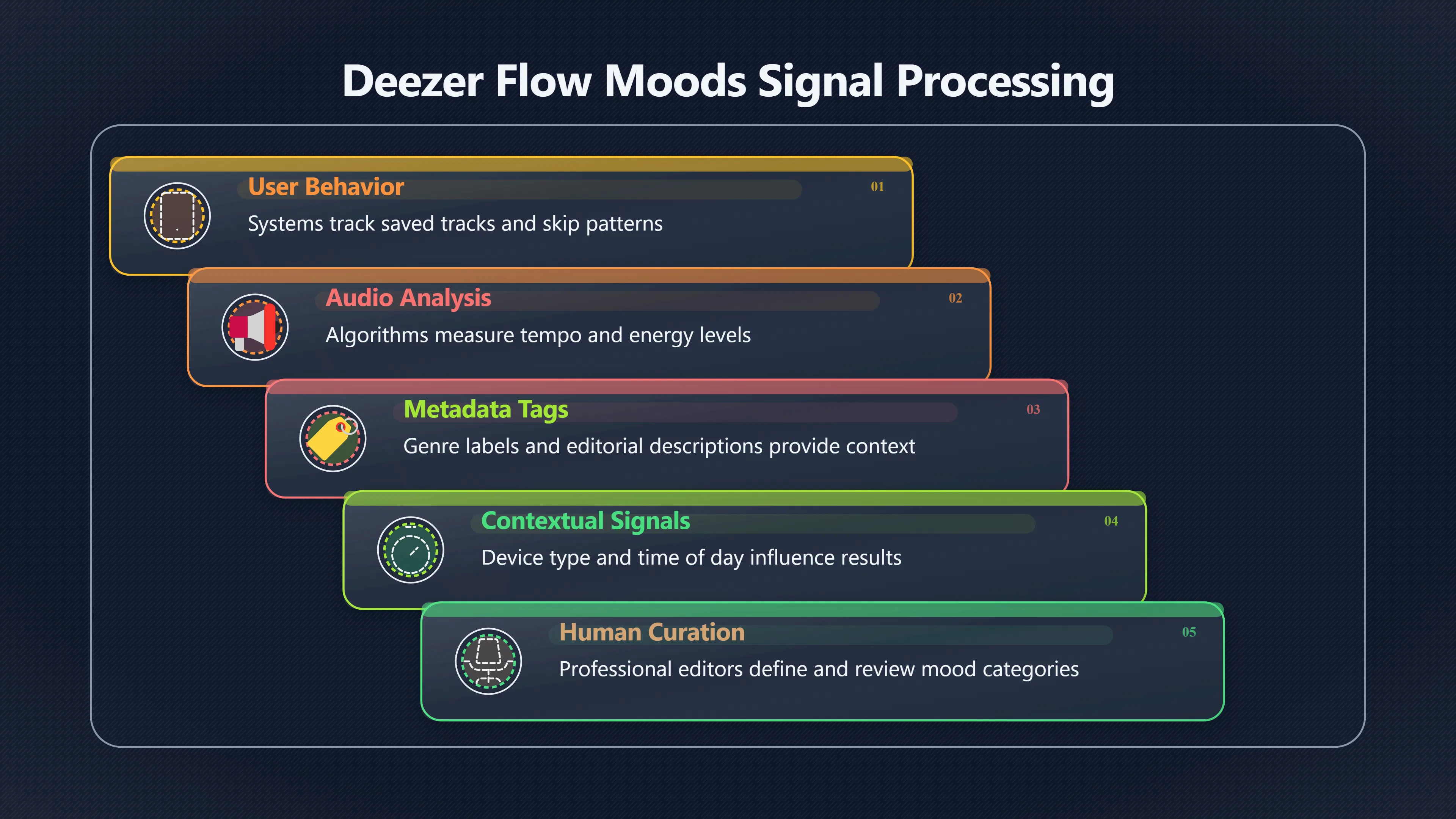
A useful example comes from Deezer’s Flow Moods system. According to the company’s published research, the platform combines collaborative filtering, audio analysis, and mood annotations supplied by professional music curators. Users can select moods such as “Chill”, “Focus”, “Motivation”, or “Party”, and the system generates personalised playlists tailored to both the chosen mood and the individual’s listening history.[arXiv]arxiv.orgarXiv Flow Moods: Recommending Music by Moods on DeezerFlow Moods: Recommending Music by Moods on DeezerJuly 15, 2022…
In practice, mood recommendation systems often draw on several layers of information:
- Listening behaviour: what users save, replay, skip, or finish.
- Audio characteristics: tempo, energy, loudness, rhythm, and other measurable features.
- Metadata and tags: genre labels, editorial descriptions, and mood classifications.
- Contextual signals: device type, time of day, listening session patterns, and related behavioural cues.
- Human curation: editors who define mood categories and review playlist quality.[arXiv]arxiv.orgarXiv Flow Moods: Recommending Music by Moods on DeezerFlow Moods: Recommending Music by Moods on DeezerJuly 15, 2022… Spotify The result is a hybrid system. Algorithms can scale recommendations across millions of users[spotify.com]spotify.comunderstanding recommendationsUnderstanding recommendations on SpotifyMar 12, 2026 — Example: If you listen to classical music while using the Spotify desktop c…, while editorial teams help define what concepts such as “Relax”, “Confidence Boost”, or “Late Night Drive” actually mean within the platform.
The move from taste profiles to moment profiles
Traditional recommendation systems attempted to model a listener’s enduring preferences. Context-based systems increasingly model temporary states as well.
Spotify’s published descriptions of recommendation technology indicate that recommendations can vary according to contextual factors such as device usage and listening environment. More recent research from the company describes recommendation approaches that incorporate temporal signals such as time of day and contextual features such as device type alongside long-term taste information. Spotify[Spotify Research]research.atspotify.comcalibrated recommendations with contextual bandits on spotify homepageSpotify ResearchCalibrated Recommendations with Contextual Bandits on…Sep 18, 2025 — Context is represented through temporal signals (…
This reflects an important implementation change. A listener may enjoy heavy metal, jazz, and ambient music, but not in every circumstance. Context-aware systems attempt to predict which part of a person’s musical identity is relevant at a specific moment.
The recommendation target therefore shifts from “What music does this user like?” to “What music does this user want right now?”

Why mood playlists became powerful discovery engines
Mood playlists succeed because they lower the cost of exploration.
A listener entering through a mood category often encounters artists they would never have searched for directly. Someone browsing a focus playlist may discover a contemporary composer. A workout playlist may introduce an independent electronic producer. The recommendation pathway starts with a use case and ends with artist discovery.
This process differs from older forms of discovery because the artist is often secondary to the immediate function of the music. Discovery happens indirectly. The listener first seeks a mood or activity soundtrack and only later notices particular songs or performers.[Sage Journals]journals.sagepub.comSage JournalsCultivating Moods and Emotions through Playlists on Spotifyby I Siles · 2019 · Cited by 99 — This article bridges work on me…
Mood categories also help platforms bridge familiar and unfamiliar music. Recommendations can remain emotionally coherent while introducing tracks outside a listener’s established genres. From the platform’s perspective, this creates opportunities to increase listening diversity without forcing abrupt stylistic jumps.[Spotify Research]research.atspotify.comcalibrated recommendations with contextual bandits on spotify homepageSpotify ResearchCalibrated Recommendations with Contextual Bandits on…Sep 18, 2025 — Context is represented through temporal signals (…
What artists gain when songs become mood fits
For many artists, mood-based discovery creates valuable opportunities.
Tracks that may never receive radio play or prominent genre coverage can find large audiences through contextual playlists. Instrumental music, ambient recordings, lo-fi productions, neo-classical compositions, and atmospheric electronic tracks often perform particularly well because they suit common listening situations such as studying, working, sleeping, or relaxing.[WIRED]wired.comMusic has been shown to inspire and boost productivity, largely by facilitating a "mind wandering" mode that helps our brains become more…
Mood playlists can also extend the lifespan of music. A track may continue attracting listeners for years if it consistently satisfies a recurring context. Unlike news-driven releases or trend-based hits, context-oriented songs can remain relevant whenever listeners seek a particular emotional or functional experience.
For emerging artists, this creates an alternative route to visibility. Success may come not from becoming a household name but from becoming a reliable fit for widely used listening scenarios.
What artists lose when context becomes the primary filter
The same mechanisms can also create tensions.
When music is consumed primarily as a mood tool, listeners may pay less attention to artist identity, album structure, lyrical content, or creative context. Critics have argued that some playlist ecosystems encourage passive listening in which songs function more as atmosphere than as artistic statements. Bridge Ratings Media Research[The Atlantic]theatlantic.comThe book argues that Spotify's playlists and recommendation algorithms have created a controlled and market-driven music experience, focu…
This concern has become prominent in discussions of streaming culture. Journalist Liz Pelly’s widely discussed work on Spotify’s playlist ecosystem argues that mood-focused recommendations can favour music that is unobtrusive, predictable, and suitable for background listening. Critics worry that recommendation systems may reward tracks that fit playlists efficiently rather than tracks that challenge listeners or demand focused attention.[The Atlantic]theatlantic.comThe book argues that Spotify's playlists and recommendation algorithms have created a controlled and market-driven music experience, focu…
The issue is not that mood playlists eliminate discovery. Rather, they may redefine what discovery means. Instead of leading listeners toward new scenes, movements, or artistic visions, discovery can become a search for ever more precise emotional matches.
The future of context-based listening
Mood recommendations are evolving beyond static playlists. Recommendation research increasingly focuses on richer contextual understanding, combining long-term taste with short-term behavioural signals and situational cues. Platforms are also experimenting with more explicit user control, allowing listeners to steer recommendations through prompts, preferences, and adjustable taste profiles. Spotify[MusicRadar At the same time]musicradar.comThis tool allows users to create personalized playlists using text prompts, aiming to return more control to listeners wary of algorithmi…, researchers continue exploring emotion-aware recommendation systems that account for differences in how people interpret moods and use music emotionally. Evidence suggests that emotional preferences vary substantially between individuals, making mood recommendation a more complex problem than simply assigning songs to categories such as happy or sad.[arXiv]arxiv.orgarXiv Flow Moods: Recommending Music by Moods on DeezerFlow Moods: Recommending Music by Moods on DeezerJuly 15, 2022…
The broader trend appears clear. In streaming, music discovery increasingly happens through context. Listeners still follow artists and genres, but recommendation systems are increasingly organised around moments, activities, and emotional needs. The playlist has become less a collection of songs and more a personalised response to a situation, turning music discovery into a continuous process of matching sound to everyday life.[arXiv]arxiv.orgarXiv Flow Moods: Recommending Music by Moods on DeezerFlow Moods: Recommending Music by Moods on DeezerJuly 15, 2022…[Spotify]spotify.comunderstanding recommendationsUnderstanding recommendations on SpotifyMar 12, 2026 — Example: If you listen to classical music while using the Spotify desktop c…
Amazon book picks
Further Reading
Books and field guides related to How mood playlists changed music discovery. Use these as the next step if you want deeper reading beyond the article.
This Is Your Brain On Music
Explains emotional responses that underpin mood-based playlists.

eBay marketplace picks
Marketplace Samples
Example marketplace items related to this page. Use the search link to explore similar finds on eBay.


Endnotes
1.
Source: arxiv.org
Title: arXiv Flow Moods: Recommending Music by Moods on Deezer
Link:https://arxiv.org/abs/2207.11229
Source snippet
Flow Moods: Recommending Music by Moods on DeezerJuly 15, 2022...
Published: July 15, 2022
2.
Source: spotify.com
Title: understanding recommendations
Link:https://www.spotify.com/safetyandprivacy/understanding-recommendations
Source snippet
Understanding recommendations on SpotifyMar 12, 2026 — Example: If you listen to classical music while using the Spotify desktop c...
3.
Source: pmc.ncbi.nlm.nih.gov
Link:https://pmc.ncbi.nlm.nih.gov/articles/PMC7004375/
Source snippet
Do the shuffle: Exploring reasons for music listening through...by KRM Sanfilippo · 2020 · Cited by 33 — This project aims to explore...
4.
Source: medium.com
Link:https://medium.com/music-x-tech-x-future/experiencing-mood-on-spotify-5c58eeb9fa5a
Source snippet
Experiencing mood on SpotifyThe mood playlists curated by Spotify are used occasionally by participants, offering a listening pathw...
5.
Source: wired.com
Link:https://www.wired.com/story/music-productivity-playlist-spotify-pandora
Source snippet
Music has been shown to inspire and boost productivity, largely by facilitating a "mind wandering" mode that helps our brains become more...
6.
Source: arxiv.org
Link:https://arxiv.org/pdf/2207.11229
Source snippet
Flow Moods: Recommending Music by Moods on Deezerby T Bontempelli · 2022 · Cited by 44 — In this paper, we present Flow Moods, an im...
7.
Source: newsroom.spotify.com
Title: taste profile beta announcement
Link:https://newsroom.spotify.com/2026-03-13/taste-profile-beta-announcement/
Source snippet
A New Era of Personalization: Shape Your Taste Profile on...Mar 13, 2026 — Taste Profile lets you see how Spotify understands you...
8.
Source: musicradar.com
Link:https://www.musicradar.com/music-tech/a-new-way-to-put-meaningful-control-of-the-algorithm-directly-in-your-hands-can-spotifys-prompted-playlist-feature-put-you-back-in-the-driving-seat-when-it-comes-to-your-music-listening
Source snippet
This tool allows users to create personalized playlists using text prompts, aiming to return more control to listeners wary of algorithmi...
9.
Source: arxiv.org
Link:https://arxiv.org/abs/2406.14090
Source snippet
Emotion-aware Personalized Music Recommendation with a Heterogeneity-aware Deep Bayesian NetworkJune 20, 2024...
Published: June 20, 2024
10.
Source: arxiv.org
Link:https://arxiv.org/html/2508.20289v1
Source snippet
Flow Moods: Recommending Music by Moods on Deezer. In Proceedings of the 16th ACM Conference on Recommender Systems (Seattle, WA, USA)...
11.
Source: arxiv.org
Link:https://arxiv.org/pdf/2501.05894
Source snippet
In: Proceedings of the 16th ACM Conference on Recommender Systems. pp. 452–455 (2022).Read more...
12.
Source: arxiv.org
Link:https://arxiv.org/html/2307.03045v1
Source snippet
Flow Moods: Recommending Music by Moods on Deezer. In Proceedings of the 16th ACM Conference on Recommender Systems. 452–455. Brauwers an...
13.
Source: arxiv.org
Link:https://arxiv.org/html/2406.14090v1
Source snippet
Flow moods: Recommending music by moods on deezer. In Proceedings of the 16th ACM Conference on Recommender Systems (RecSys '22'). ACM, N...
14.
Source: ads.spotify.com
Link:https://ads.spotify.com/en-NL/stream-context-guide-everyday-audio-moments
Source snippet
of Context: A guide to everyday audio momentsWe asked users why and how they listen in order to more fully understand their streaming con...
15.
Source: ads.spotify.com
Title: mindshare spotify 2022
Link:https://ads.spotify.com/en-US/news-and-insights/mindshare-spotify-2022
Source snippet
streaming unlocks people's identity and brings...18 Jan 2023 — Mindshare has partnered with Spotify to uncover how identity is linked to...
16.
Source: community.spotify.com
Link:https://community.spotify.com/t5/Live-Ideas/New-feature-quot-Playlist-Moods-quot/idi-p/7360609
Source snippet
feature! "Playlist Moods"3 Mar 2026 — I think this would allow for some really creative spotify playlists where you can express your mood...
17.
Source: medium.com
Link:https://medium.com/%40payne.max867/a-deep-dive-into-spotifys-recommendation-algorithm-c1efeead50cc
Source snippet
A Deep Dive into Spotify's Recommendation AlgorithmThe overarching goal of Spotify's recommendation algorithm is to increase user engagem...
18.
Source: medium.com
Link:https://medium.com/beyond-the-build/the-inner-workings-of-spotifys-ai-powered-music-recommendations-how-spotify-shapes-your-playlist-a10a9148ee8d
Source snippet
mpo, genre, mood, and more, forming the basis for creating...Read more...
19.
Source: journals.sagepub.com
Link:https://journals.sagepub.com/doi/10.1177/2056305119847514
Source snippet
Sage JournalsCultivating Moods and Emotions through Playlists on Spotifyby I Siles · 2019 · Cited by 99 — This article bridges work on me...
20.
Source: research.atspotify.com
Title: calibrated recommendations with contextual bandits on spotify homepage
Link:https://research.atspotify.com/2025/9/calibrated-recommendations-with-contextual-bandits-on-spotify-homepage
Source snippet
Spotify ResearchCalibrated Recommendations with Contextual Bandits on...Sep 18, 2025 — Context is represented through temporal signals (...
21.
Source: research.atspotify.com
Title: generalized user representations for large scale recommendations
Link:https://research.atspotify.com/2025/9/generalized-user-representations-for-large-scale-recommendations
Source snippet
Spotify ResearchGeneralized user representations for large-scale...Sep 18, 2025 — At this scale, delivering great recommendations depend...
22.
Source: research.atspotify.com
Link:https://research.atspotify.com/algorithmic-effects-on-the-diversity-of-consumption-on-spotify
Source snippet
Spotify ResearchAlgorithmic Effects on the Diversity of Consumption on SpotifyDec 3, 2020 — How do algorithmic recommendations affect the...
23.
Source: bridgeratings.com
Title: spotifys playlist ecosystem the mood machine at work
Link:https://www.bridgeratings.com/blog/2025/3/6/spotifys-playlist-ecosystem-the-mood-machine-at-work
Source snippet
Bridge Ratings Media ResearchSpotify's Playlist Ecosystem: The Mood Machine at Work6 Mar 2025 — Spotify's playlists function as a passive...
24.
Source: theatlantic.com
Link:https://www.theatlantic.com/culture/archive/2025/02/mood-machine-liz-pelly-spotify-review/681636/
Source snippet
The book argues that Spotify's playlists and recommendation algorithms have created a controlled and market-driven music experience, focu...
25.
Source: research.atspotify.com
Title: contextualized recommendations through personalized narratives using llms
Link:https://research.atspotify.com/2024/12/contextualized-recommendations-through-personalized-narratives-using-llms
Source snippet
Spotify ResearchContextualized Recommendations Through Personalized...Dec 18, 2024 — In this blog post, we explore two use cases that il...
26.
Source: journals.sagepub.com
Link:https://journals.sagepub.com/doi/10.1177/20539517251338742
Source snippet
Sage JournalsIdentifying listening modes as reflexive practices in music...29 Apr 2025 — This study aims to identify the factors that le...
27.
Source: beatstorapon.com
Title: Music preference isn’t static – it can depend heavily on context.Read more
Link:https://beatstorapon.com/blog/ultimate-guide-to-spotify-music-algorithm/
Source snippet
Spotify's Music Recommendation Algorithm: The Complete...Mar 1, 2025 — Context-Aware Recommendations (Time of Day, Location, and Listeni...
Additional References
28.
Source: researchgate.net
Link:https://www.researchgate.net/publication/380983963_Context_Aware_Music_Recommendation_and_Playlist_Generation
Source snippet
(PDF) Context Aware Music Recommendation and Playlist...PDF | There are many reasons people listen to music, and the type of music is la...
29.
Source: catalyzex.com
Link:https://www.catalyzex.com/author/Mathieu%20Morlon
Source snippet
Mathieu MorlonIn this paper, we present Flow Moods, an improved version of Flow that addresses this limitation. Flow Moods leverages coll...
30.
Source: ajqr.org
Link:https://www.ajqr.org/download/switching-to-music-streaming-services-understanding-college-students-music-listening-habits-on-music-16556.pdf
Source snippet
Understanding College Students' Music Listening Habits...by F Jia · 2025 · Cited by 1 — The result of this study showed that participant...
31.
Source: GOV.UK
Link:https://www.gov.uk/government/publications/research-into-the-impact-of-streaming-services-algorithms-on-music-consumption/the-impact-of-algorithmically-driven-recommendation-systems-on-music-consumption-and-production-a-literature-review
Source snippet
impact of algorithmically driven recommendation...by D Hesmondhalgh · Cited by 58 — Pedersen (2020) argues that algorithmic recommendati...
32.
Source: researchgate.net
Link:https://www.researchgate.net/publication/342854806_Just_the_Way_You_Are_Linking_Music_Listening_on_Spotify_and_Personality
Source snippet
(PDF) “Just the Way You Are”: Linking Music Listening on...13 Jul 2020 — We investigated the link between personality traits and music l...
33.
Source: guillaumesalhagalvan.com
Link:https://guillaumesalhagalvan.com/publications/
Source snippet
T. Bontempelli, B. Chapus, F. Rigaud, M. Morlon, M. Lorant, G. Salha-Galvan 16th ACM Conference on...Read more...
34.
Source: research.atspotify.com
Title: contextual and sequential user embeddings for music recommendation
Link:https://research.atspotify.com/2021/04/contextual-and-sequential-user-embeddings-for-music-recommendation
Source snippet
and Sequential User Embeddings for Music...Apr 26, 2021 — Using a music listening dataset from Spotify, we observe that consumption from...
35.
Source: youtube.com
Title: User profiling from Music Recommendation Systems
Link:http://www.youtube.com/watch?v=UHzSFCI_MKw
Source snippet
How music recommendation systems use mood and context How Spotify Recommendations work for 500,000,000 users Gaurav Sen...
36.
Source: dl.acm.org
Link:https://dl.acm.org/doi/10.1007/978-3-031-56069
Source snippet
the Discoverability of New Releases on Deezerby L Briand · 2024 · Cited by 10 — Flow Moods: Recommending Music by Moods on Deezer...
37.
Source: pmc.ncbi.nlm.nih.gov
Link:https://pmc.ncbi.nlm.nih.gov/articles/PMC9522267/
Source snippet
we move to: Spotify audio features and reasons for...by D Duman · 2022 · Cited by 69 — We investigated the relationships between Spotify...
Topic Tree