Within Music
Why Bad Music Data Costs Creators Money
Credits, ownership splits and setlists must be accurate or royalties can be delayed, misallocated or lost.
On this page
- Credits, splits and identifiers
- Setlists and public performance data
- How errors delay payment
Page outline Jump by section
Introduction
Bad music metadata costs creators money because royalties are paid by matching usage data to the right song, recording, writer, performer, publisher and owner. If those links are missing or wrong, the money may be delayed, placed on hold, matched to the wrong party, or pushed into unclaimed and unallocated pools. The problem is not just a streaming-era annoyance. It affects public performance, live gigs, DJ sets, broadcast reporting, mechanical royalties, neighbouring rights and catalogue administration. The UK Government’s music streaming metadata agreement states the core issue plainly: incomplete or inaccurate metadata can cause significant delays in creators being paid, and in some cases can mean they are not paid at all.[GOV.UK]GOV.UKU K industry agreement on music streaming metadataUK industry agreement on music streaming metadataMay 31, 2023 — 31 May 2023 — The UK industry agreement on music streaming metadata sets…
Metadata sounds like paperwork, but in music it is closer to the payment address for a creative work. A listener sees a track title and artist name. The royalty system needs much more: the recording identifier, the musical work identifier, writer and publisher shares, performer details, ownership claims, setlists, usage reports and the identifiers that distinguish one person or company from another. When that information is clean, money can move. When it is fragmented, the system has to guess, hold, research or redistribute.
The payment chain depends on matching, not just listening
Modern music royalties are created when music is used, but they are paid when that use can be matched to the correct rightsholders. A stream, radio play, club performance or live set produces data. That data then has to connect to a recording, a composition, and the people or companies entitled to income from each side.
This is why metadata failures can be so costly. A streaming service may know that a sound recording was played, but the publishing royalty still needs a link from that recording to the underlying musical work. A venue may have paid for a live music licence, but the performing rights organisation still needs to know which songs were performed. A performer may have played on a recording, but a neighbouring rights organisation still needs the performer credit and role data required to allocate the performer share.
The UK music streaming metadata agreement was created because the industry recognised that metadata for songwriters and compositions is often less complete and timely than recording and artist data. Its commitments include improving the quality and timeliness of work and songwriter metadata associated with new recordings, creating a core data set, and supporting education and technical working groups.[GOV.UK]GOV.UKunited kingdom industry agreement on music streaming metadataUnited Kingdom Industry Agreement on Music Streaming…2 Nov 2023 — This document sets out a roadmap for how industry and Government wil…
That matters because music has several overlapping rights. The recording and the composition are separate assets. The visible artist credit on a streaming service may help listeners find a track, but it is not enough to pay everyone. A songwriter, producer, session musician, featured artist, publisher, label, administrator or estate may all depend on different fields in different databases.
Credits, splits and identifiers are the royalty map
The most important music metadata is not decorative. It tells the industry what the asset is, who made it, who owns it, and how income should be divided.
An ISRC, or International Standard Recording Code, identifies a specific sound recording or music video. IFPI, the international ISRC authority, says ISRC identifies recordings and music videos, not compositions, performers or products. Its handbook describes ISRC as a unique identifier in which one code is allocated to each version of a recording.[ifpi-isrc]isrc.ifpi.orgisrc Isrc@ifpiisrc Isrc@ifpi
An ISWC, or International Standard Musical Work Code, identifies the underlying musical work: the song or composition rather than a particular recording of it. The official ISWC site describes it as a unique, permanent and internationally recognised reference number for musical works. CISAC, the global confederation of authors’ societies, has described the ISWC as a code that helps remunerate creators and publishers.[ISWC]iswc.orgSource details in endnotes.
An IPI number identifies interested parties such as songwriters, composers, lyricists and music publishers. ASCAP describes an IPI as a unique international identification number, while BMI says the IPI/CAE number is used to identify participants on a work. The MLC explains that it uses IPIs as part of its effort to distribute royalties to the correct rightsholder. ASCAP[BMI.com]bmi.comSource details in endnotes.
These identifiers do different jobs. The royalty chain becomes fragile when they are missing, duplicated, misspelled or not linked together:
- Recording data: ISRC, artist name, label, release title, version, distributor and recording ownership.
- Composition data: ISWC, song title, alternative titles, writers, publishers, administrators and splits.
- Party data: IPI or equivalent identifiers for writers, publishers and other rightsholders.
- Contribution data: performers, producers, musicians, featured artists, conductors and other roles.
- Usage data: streams, downloads, broadcasts, setlists, cue sheets, venue reports and DJ tracklists.
The key risk is that each system may only see part of the picture. A distributor may deliver an ISRC to a streaming platform; a publisher may register a work with an ISWC; a collecting society may hold writer and publisher shares; a venue may submit performance information. Royalties are most vulnerable where these datasets fail to meet.
Splits can freeze money even when the song is known
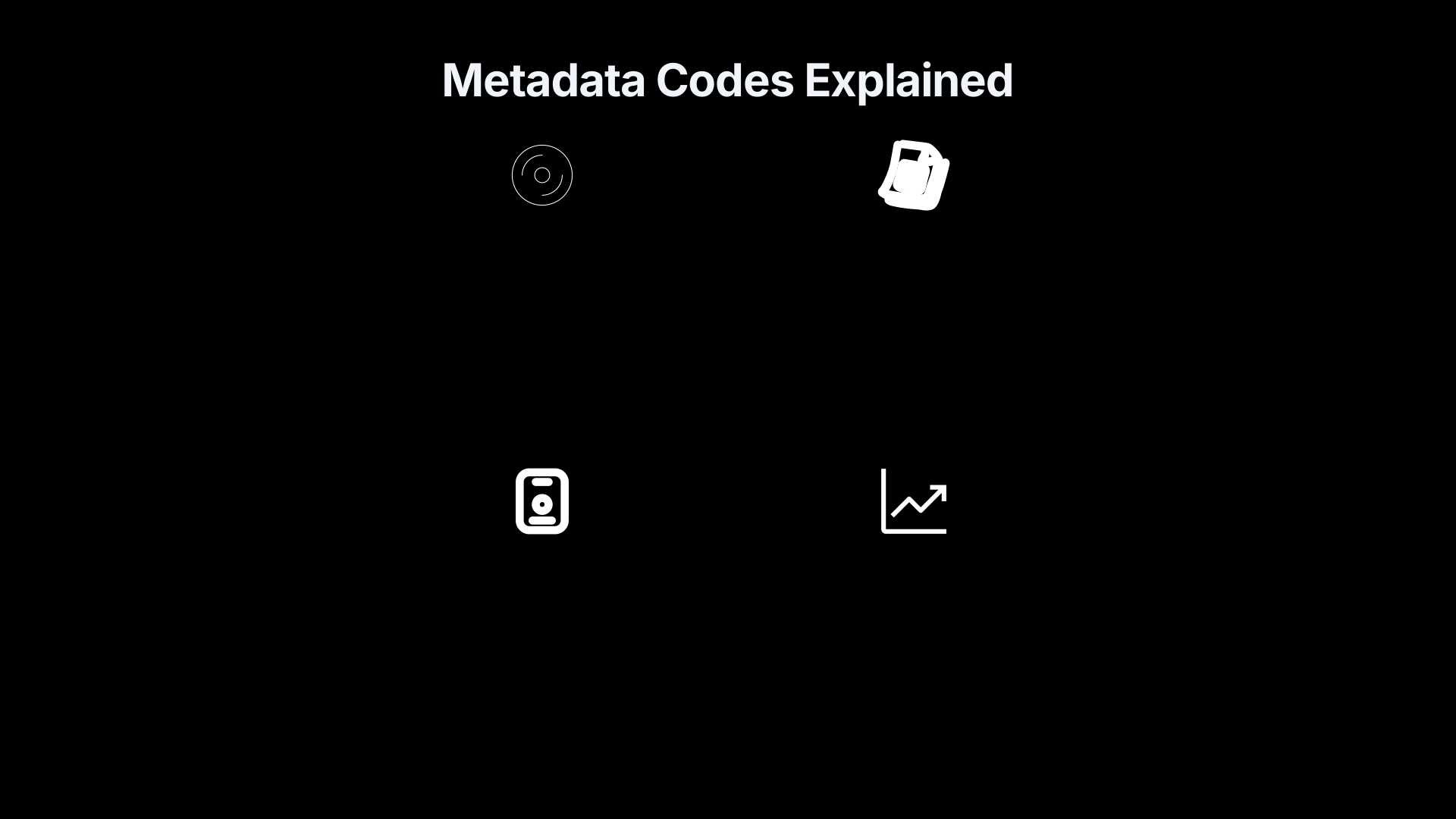
Ownership splits decide who receives what percentage of a royalty. For songwriters, this means the agreed shares between co-writers and publishers. For recordings, it can include label ownership, performer entitlements, neighbouring rights and contractual royalty shares.
The Mechanical Licensing Collective in the United States gives a concrete example of the problem. Its Distributor Unmatched Recordings Portal gives distributors visibility into recordings that The MLC has been unable to fully match to musical works registered with it. The data comes from usage reports delivered by digital service providers, containing metadata supplied by distributors. The purpose is to help pay associated unclaimed royalties to the correct rightsholders.[Mechanical Licensing Collective]themlc.comSource details in endnotes.
This is not a theoretical database tidying exercise. The MLC’s public materials explain that unmatched or unclaimed royalties from usage after 1 January 2021 are held for at least three years while efforts continue to find and pay the rightful owner.[Mechanical Licensing Collective]themlc.comSource details in endnotes. In 2021, the US Copyright Office’s unclaimed royalties report discussed the need to help rightsholders organise works data so they could register and claim royalties properly.[U.S. Copyright Office]copyright.govU.S. Copyright Office
The scale is large enough to show how serious metadata gaps can become. In a July 2025 letter to the US Copyright Office, The MLC said it had matched nearly $314 million of $397.20 million in historical unmatched royalties transferred to it in February 2021, and had distributed approximately $223.42 million of that historical pool.[U.S. Copyright Office]copyright.govU.S. Copyright Office A later 2025 meeting summary gave similar figures, saying The MLC had matched nearly $317 million of $397 million and distributed about $228.36 million.[U.S. Copyright Office]copyright.govU.S. Copyright Office
Those numbers are important because they show both sides of the metadata story. Better matching can unlock large sums. But the fact that such sums had to be matched after the event shows how easily royalties can become separated from the people who earned them.
Setlists turn live music into payable data
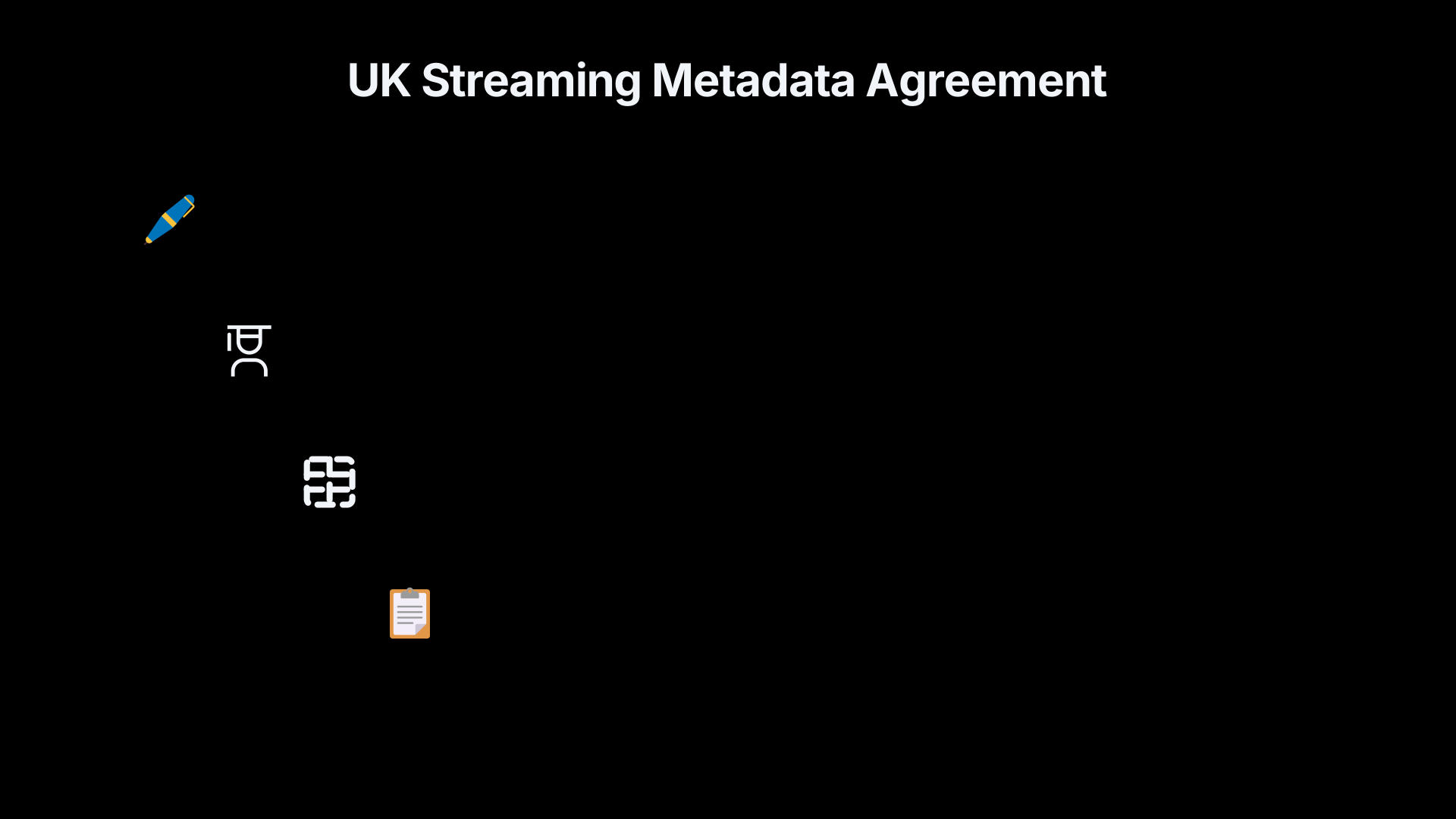
Live music creates performance royalties for songs, but those royalties depend on knowing what was played. A venue or promoter licence may collect money from a concert, pub gig, theatre show or festival, but setlists and performance reports are what connect that money to the actual songwriters.
PRS for Music’s live performance guidance explains that it collects, matches and pays out for live performances, with different calculation methods depending on the type of performance. For small licensed venues under its Gigs and Clubs scheme, it pays a set royalty for each reported event, shared between PRS writers whose works were performed.[PRS for Music]prsformusic.comPRS for Music Reporting live performancesPRS for Music Reporting live performances ASCAP’s OnStage programme similarly allows writer members who perform their own songs live to submit eligible performance claims.[ASCAP]ascap.comOpen source on ascap.com.
The Musicians’ Union guidance on reporting live performances to PRS shows how metadata enters the process at a practical level. Before reporting performances, writers must register songs with details of co-writers, publishers and percentage splits; when reporting a show, they add the setlist using song title, tune code or ISWC, and should include cover songs too.[Musicians' Union]musiciansunion.org.ukhow to report live performances to prs for musichow to report live performances to prs for music
The risk is obvious: if the setlist is not submitted, or if songs are not registered properly, the royalty society may not know which works to pay. For a grassroots songwriter, the live royalty may be modest per gig, but repeated missed reports across tours, support slots and festivals can turn into meaningful lost income. For cover versions, the effect can be even less visible: the performing artist may not be the songwriter, so the person owed the money may never know that the song was played.
DJ sets show the weakness of old reporting systems
DJ performances expose the metadata problem especially sharply. A band set might contain ten or fifteen songs. A DJ set may contain dozens of tracks, blends, edits, remixes and partial uses, often by other producers. The rightsholder who should be paid is frequently not the person on stage.
PRS for Music says it can pay royalties for music played by DJs at licensed venues and festivals when it receives accurate setlists from licensees or DJs. Where it has not received a setlist, it gathers usage information through researchers and combines that with similar broadcast data or other play-count methods. Since 2018 it has used Music Recognition Technology at some licensed venues and festivals to improve distribution accuracy.[PRS for Music]prsformusic.comPRS for Music Reporting live performancesPRS for Music Reporting live performances
Recent reporting on UK electronic music illustrates the stakes. The Guardian reported in November 2025 on research by Fair Play suggesting that electronic music artists, producers and songwriters in the UK lose out on more than £5.7 million annually because royalties are wrongly allocated. The same report said only 28% of fees paid by UK nightclubs were being correctly distributed to the creators of the music played, while payment accuracy could rise sharply when music recognition technology or accurate DJ tracklists were used.[The Guardian]theguardian.comFair Play found that when music recognition technology is used, payment accuracy improves to 90%, but fewer than 7% of UK clubs have adop…
MusicRadar’s coverage of the same research reported that only 36% of UK electronic music performances resulted in the correct creator receiving payment, with approximately £11.25 million generated annually from UK nightclub royalties and about £5.7 million misallocated after costs. It also reported that music recognition technology was estimated at 90% accuracy where used, while voluntary DJ tracklist submission was estimated at 95% accuracy but used regularly by only a small minority of DJs.[MusicRadar]musicradar.comThe main issues stem from the lack of standardized music reporting in clubs, relying largely on unreliable methods like analogous distrib…
The lesson is not that live royalty societies are doing nothing. It is that data collection methods built around bands, venues and conventional setlists can struggle with the reality of modern electronic music. When the system lacks direct track data, it may fall back on proxies. Those proxies can favour more visible or mainstream tracks rather than the underground records actually being played.
Bad data delays payment before it loses payment
Not every metadata error leads to permanent loss. Often the first effect is delay. A royalty may be placed on hold while a society investigates conflicting claims, missing identifiers, incomplete shares or disputed ownership.
The MLC’s public resources state that it places royalties on hold when a substantiated ownership dispute has been raised, and that the parties must resolve questions of ownership.[Mechanical Licensing Collective]themlc.comSource details in endnotes. That is a sensible safeguard: paying the wrong party too quickly can create its own injustice. But for creators relying on royalty cash flow, a hold can feel very similar to non-payment.
The UK Intellectual Property Office’s metadata work also highlights delay as a central problem. A WIPO-hosted UK IPO update described songwriters being paid slowly, sometimes over periods from six months to two years, and sometimes not being paid at all because of poor or missing metadata. It also noted that creators are often not fully credited on streaming platforms and that some registries for musical works and creators are not readily accessible to all relevant stakeholders.[WIPO]wipo.intSource details in endnotes.
The delay problem tends to be worse for creators with less administrative support. A major publisher may have staff dedicated to cleaning registrations, chasing unmatched income and resolving conflicts. A self-releasing artist, bedroom producer or songwriter without a publisher may not even know which database contains the missing field.

Standards help, but they do not fix human workflow
The music industry has not ignored metadata. It has standards, identifiers and data exchange systems. DDEX, the Digital Data Exchange standards body, provides formats for sharing music metadata between companies. Its recording data and rights standard enables the exchange of metadata about recordings, contributors and rights claims between record companies, performer representatives and licensing companies.[DDEX]ddex.netRecording Data and RightsRecording Data and Rights DDEX also says studio metadata is important for attribution and for ensuring royalties, where due, are allocated to the correct people.[DDEX]ddex.netCollection of Studio MetadataCollection of Studio Metadata
The problem is that standards only help if the data exists, is correct, is supplied at the right time, and survives the journey through the supply chain. A songwriter split written in a notes app, a producer credit agreed verbally, a missing IPI number, or a remix uploaded with the wrong ISRC can all break the chain before any standardised exchange begins.
The UK industry agreement on streaming metadata therefore focuses not only on technical fixes, but on education, best practice, shared core data and working groups. It also led to the Get Paid Guide, backed by PRS for Music, The Ivors Academy, the Music Publishers Association and the Intellectual Property Office, to help creators understand what data they need and why.[GOV.UK]GOV.UKU K industry agreement on music streaming metadataUK industry agreement on music streaming metadataMay 31, 2023 — 31 May 2023 — The UK industry agreement on music streaming metadata sets…
That combination is important. Metadata reform is not just a software problem. It is a behaviour problem across writing rooms, studios, distributors, labels, publishers, collecting societies, platforms, venues and creators themselves.
The common failure points creators should recognise
For a reader trying to understand why music data decides payment, the most useful way to think about metadata is as a chain of avoidable weak links. The same song can be perfectly popular and still poorly paid if the administrative connections are broken.
The highest-risk errors include:
- Unregistered works: A recording is released, but the underlying composition is not registered with the relevant society or mechanical licensing body.
- Missing splits: Co-writers have not agreed or submitted their percentage shares, so royalties are held or disputed.
- Wrong identifiers: An ISRC is duplicated, missing or attached to the wrong version; an ISWC is absent or not linked to the recording.
- Name confusion: Writers use different names, aliases or spellings without the correct IPI links.
- Incomplete credits: Producers, session musicians, featured performers or arrangers are omitted from the recording data.
- Bad version control: Radio edits, remixes, live versions, remasters and alternate language versions are not distinguished clearly.
- Unreported performances: Setlists, DJ tracklists, cue sheets or venue data are missing.
- Conflicting claims: Publishers, administrators or societies receive inconsistent ownership information and place royalties on hold.
The practical consequence is that the music may still be heard, streamed, played or performed, but the royalty system cannot confidently answer the most important question: who should receive the money?
Why the metadata problem is also a fairness problem
Bad metadata does not affect everyone equally. Large catalogues, major publishers and established labels usually have better administrative resources, richer historical data and more leverage to resolve conflicts. Smaller creators may have to discover errors themselves, learn several systems and correct data after money has already gone unmatched.
This is why metadata debates often become fairness debates. If unclaimed or unidentified royalties are eventually redistributed by market share, sample data or proxy usage, the money may flow towards already visible catalogues rather than the exact creators whose music generated the use. In live and DJ contexts, poor track reporting can mean underground or local scenes subsidise better-documented mainstream repertoire.[The Guardian]theguardian.comFair Play found that when music recognition technology is used, payment accuracy improves to 90%, but fewer than 7% of UK clubs have adop…
The fair answer is not simply to blame one party. Platforms need usable data. Distributors need to pass it cleanly. Publishers and societies need accurate work registrations. Venues and promoters need to report performances. DJs and artists need workable tracklist tools. Creators need to capture splits and identifiers before release, not years later.
Metadata decides who gets paid because it is the evidence layer between music use and money. In a small scene, that evidence might be a handwritten setlist. In global streaming, it might be an ISRC, an ISWC, several IPI numbers and a chain of DDEX messages. The principle is the same: royalties can only travel to the right people when the data tells the system where to send them.
Amazon book picks
Further Reading
Books and field guides related to Why Bad Music Data Costs Creators Money. Use these as the next step if you want deeper reading beyond the article.
All You Need to Know About the Music Business
Explains royalty flows, rights ownership and payment systems.

How to make it in the new music business
Covers metadata, distribution and digital revenue.
eBay marketplace picks
Marketplace Samples
Example marketplace items related to this page. Use the search link to explore similar finds on eBay.




Endnotes
1.
Source: GOV.UK
Title: U K industry agreement on music streaming metadata
Link:https://www.gov.uk/government/publications/uk-industry-agreement-on-music-streaming-metadata
Source snippet
UK industry agreement on music streaming metadataMay 31, 2023 — 31 May 2023 — The UK industry agreement on music streaming metadata sets...
Published: May 31, 2023
2.
Source: GOV.UK
Title: united kingdom industry agreement on music streaming metadata
Link:https://www.gov.uk/government/publications/uk-industry-agreement-on-music-streaming-metadata/united-kingdom-industry-agreement-on-music-streaming-metadata
Source snippet
United Kingdom Industry Agreement on Music Streaming...2 Nov 2023 — This document sets out a roadmap for how industry and Government wil...
3.
Source: isrc.ifpi.org
Title: isrc Isrc@ifpi
Link:https://isrc.ifpi.org/
4.
Source: ifpi.org
Link:https://www.ifpi.org/wp-content/uploads/2021/02/ISRC_Handbook.pdf
5.
Source: iswc.org
Link:https://www.iswc.org/iswc
6.
Source: cisac.org
Title: new improved music identifier will help creators all important digital
Link:https://www.cisac.org/Newsroom/news-releases/new-improved-music-identifier-will-help-creators-all-important-digital
7.
Source: ascap.com
Link:https://www.ascap.com/help/registering-your-music/ipi-faqs
8.
Source: bmi.com
Link:https://www.bmi.com/faq/entry/what_is_an_ipi_cae_number
9.
Source: pages.themlc.com
Link:https://pages.themlc.com/ipi-numbers
10.
Source: copyright.gov
Link:https://www.copyright.gov/policy/unclaimed-royalties/unclaimed-royalties-final-report.pdf
11.
Source: copyright.gov
Title: U.S. Copyright Office
Link:https://www.copyright.gov/rulemaking/mma-designations/MLC-to-USCO-July-21-2025.pdf
12.
Source: copyright.gov
Title: U.S. Copyright Office MLC-Ex-Parte-Meeting
Link:https://www.copyright.gov/rulemaking/mma-designations/2024/MLC-Ex-Parte-Meeting-Summary-2025-11-20.pdf
13.
Source: ascap.com
Link:https://www.ascap.com/music-creators/ascap-onstage
14.
Source: musicradar.com
Link:https://www.musicradar.com/music-tech/uk-electronic-musicians-arent-getting-the-royalties-they-deserve-and-underground-scenes-are-subsidising-mainstream-producers-according-to-a-new-report
Source snippet
The main issues stem from the lack of standardized music reporting in clubs, relying largely on unreliable methods like analogous distrib...
15.
Source: wipo.int
Link:https://www.wipo.int/edocs/mdocs/copyright/en/wipo_webinar_cr_2022_18/wipo_webinar_cr_2022_18_www_591431.pdf
16.
Source: ddex.net
Title: Recording Data and Rights
Link:https://ddex.net/standards/recording-data-and-rights/
17.
Source: ddex.net
Title: Collection of Studio Metadata
Link:https://ddex.net/standards-2023/collection-of-studio-metadata/
18.
Source: ddex.net
Link:https://ddex.net/tools-for-capturing-creator-credits/
19.
Source: cisac.org
Title: launches major project upgrade international musical work identifier
Link:https://www.cisac.org/Newsroom/news-releases/cisac-launches-major-project-upgrade-international-musical-work-identifier
20.
Source: copyright.gov
Title: mlc and dlc
Link:https://www.copyright.gov/rulemaking/mma-implementation/ex-parte/mlc-and-dlc.pdf
21.
Source: copyright.gov
Link:https://www.copyright.gov/rulemaking/mma-transition-reporting/
22.
Source: copyright.gov
Title: The MLC Reply Submission 07 29 24
Link:https://www.copyright.gov/rulemaking/mma-designations/The-MLC-Reply-Submission-07-29-24.pdf
23.
Source: copyright.gov
Link:https://www.copyright.gov/rulemaking/mma-implementation/copyright-office-letters/2020-5-june-30-2020.pdf
24.
Source: copyright.gov
Link:https://www.copyright.gov/policy/unclaimed-royalties/glossary.pdf
25.
Source: copyright.gov
Link:https://www.copyright.gov/rulemaking/mma-implementation/copyright-office-letters/responses/mlc-3.pdf
26.
Source: copyright.gov
Title: mlc initial submission 2024
Link:https://www.copyright.gov/rulemaking/mma-designations/2024/initial-submissions/mlc-initial-submission-2024.pdf
27.
Source: ascap.com
Title: iswc number work codes faq
Link:https://www.ascap.com/help/registering-your-music/iswc-number-work-codes-faq
28.
Source: ascap.com
Link:https://www.ascap.com/help/royalties-and-payment
29.
Source: ascap.com
Link:https://www.ascap.com/help/royalties-and-payment/payment/monetaryawards
30.
Source: ascap.com
Link:https://www.ascap.com/news-events/articles/2015/03/maximize-your-membership-ascap-onstage
31.
Source: ascap.com
Link:https://www.ascap.com/help
32.
Source: ipo.blog.gov.uk
Title: music metadata matters how to get paid and credited
Link:https://ipo.blog.gov.uk/2025/04/26/music-metadata-matters-how-to-get-paid-and-credited/
33.
Source: isrc.ifpi.org
Title: music videos
Link:https://isrc.ifpi.org/why-use-isrc/music-videos
34.
Source: artist.tools
Title: what is music metadata essential guide for artists labels
Link:https://www.artist.tools/post/what-is-music-metadata-essential-guide-for-artists-labels
35.
Source: themlc.com
Link:https://www.themlc.com/durp-initiative
36.
Source: themlc.com
Link:https://www.themlc.com/dataprograms
37.
Source: themlc.com
Title: Mechanical Licensing Collective Resources
Link:https://www.themlc.com/resources-publishers
38.
Source: prsformusic.com
Title: PRS for Music Reporting live performances
Link:https://www.prsformusic.com/royalties/report-live-performances
39.
Source: musiciansunion.org.uk
Title: how to report live performances to prs for music
Link:https://musiciansunion.org.uk/working-performing/gigs-and-live-performances/how-to-report-live-performances-to-prs-for-music
40.
Source: prsformusic.com
Link:https://www.prsformusic.com/royalties/dj-royalties
41.
Source: theguardian.com
Link:https://www.theguardian.com/music/2025/nov/18/musicians-wrongly-allocated-uk-royalties
Source snippet
Fair Play found that when music recognition technology is used, payment accuracy improves to 90%, but fewer than 7% of UK clubs have adop...
42.
Source: themlc.com
Title: Mechanical Licensing Collective Resources
Link:https://www.themlc.com/resources-songwriters
43.
Source: theguardian.com
Link:https://www.theguardian.com/business/2025/jul/04/songwriters-royalties-uk-gigs-prs-for-music
44.
Source: themlc.com
Link:https://www.themlc.com/
45.
Source: Wikipedia
Title: International Standard Recording Code
Link:https://en.wikipedia.org/wiki/International_Standard_Recording_Code
46.
Source: Wikipedia
Title: International Standard Musical Work Code
Link:https://en.wikipedia.org/wiki/International_Standard_Musical_Work_Code
47.
Source: facebook.com
Link:https://www.facebook.com/PRSforMusic/posts/our-ceo-andrea-czapary-martin-reflecting-on-live-royalties-and-the-importance-of/1504353401060344/
48.
Source: soundcharts.com
Title: music metadata
Link:https://soundcharts.com/en/blog/music-metadata
49.
Source: musosoup.com
Title: music metadata
Link:https://musosoup.com/blog/music-metadata
Additional References
50.
Source: researchgate.net
Link:https://www.researchgate.net/publication/387948806ISRC-International_Standard_Recording_Code_A_Need_of_Today%27s_Music_Industry_-A_Study
51.
Source: studenttheses.uu.nl
Link:https://studenttheses.uu.nl/bitstream/handle/20.500.12932/49359/Atmis%2C%20Dilan%200517100%20-%20APLM%20Masters%20Thesis%202025%20-%20Music%20Metadata%20Challenges%20and%20Potential%20Solutions.pdf?isAllowed=y&sequence=1
52.
Source: instagram.com
Link:https://www.instagram.com/reel/DNA7Tf7M0pO/
53.
Source: facebook.com
Link:https://www.facebook.com/groups/ttgigs/posts/2736459873200979/
54.
Source: linkedin.com
Link:https://www.linkedin.com/top-content/supply-chain-management/ensuring-data-quality/ensuring-accurate-music-metadata-for-royalties/
55.
Source: ivorsacademy.com
Link:https://ivorsacademy.com/campaign/fix-streaming/
56.
Source: instagram.com
Link:https://www.instagram.com/p/DXG9AJqGk_v/
57.
Source: linkedin.com
Link:https://www.linkedin.com/posts/prs-for-music_the-story-of-a-setlist-activity-7392163184037556224-xJvg
58.
Source: musicrightsmanagement.in
Link:https://www.musicrightsmanagement.in/blog/how-can-bad-metadata-impact-royalty-tracking
59.
Source: apraamcos.com.au
Link:https://www.apraamcos.com.au/resources/get-paid/performance-reports
Topic Tree