Within Melody
Why Do Choruses Stay in Your Head?
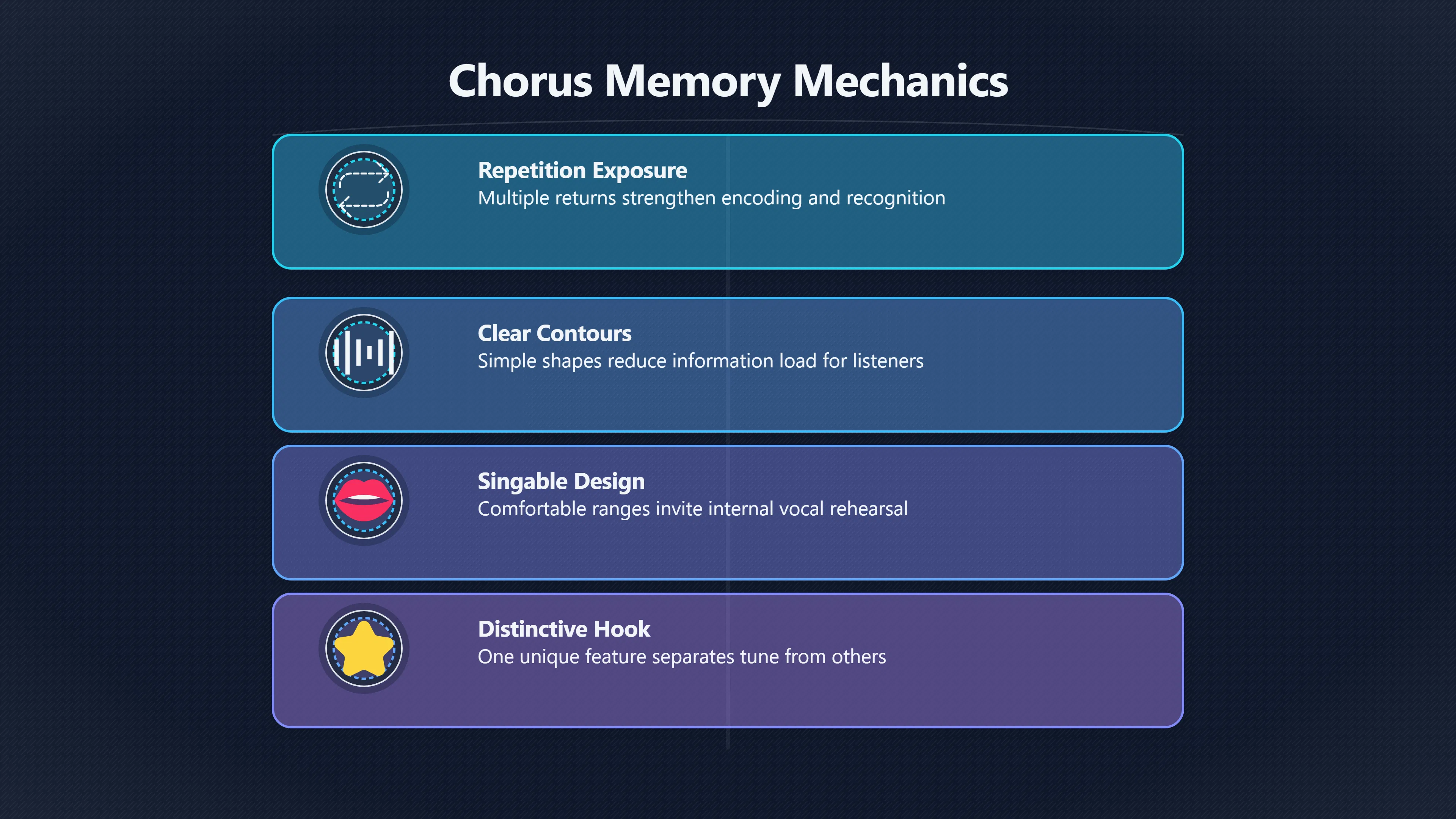
Choruses stick because repeated, singable melodic patterns give listeners more chances to encode and replay the tune.
On this page
- How repetition strengthens melodic memory
- Why chorus contours are built for recall
- When a chorus becomes inner singing
Page outline Jump by section
Introduction
Most people can recall the chorus of a song long after the verses have faded. That is not simply because the chorus contains the title or the most important lyrics. Choruses are usually built to maximise melodic recall. They repeat several times during a song, concentrate the clearest melodic ideas, and are often designed around pitch patterns that are easy to sing and mentally replay. The result is a section that receives more exposure, demands less effort to process, and leaves a stronger memory trace than the surrounding material.
 Research on musical memory, melodic perception and “earworms”—the involuntary replay of music in the mind—suggests that memorable choruses succeed by combining repetition with simplicity and a small amount of distinctiveness. They feel familiar enough to learn quickly but different enough to stand out.[American Psychological Association]apa.orgAmerican Psychological AssociationMelodic Features and Song Popularity Predict Involuntary…by K Jakubowski · Cited by 137 — Involuntar…[Durham Repository]durham-repository.worktribe.comDurham RepositoryDissecting an earworm: Melodic features and song popularity…by K Jakubowski · 2016 · Cited by 137 — The present study…
How Repetition Strengthens Melodic Memory
The most obvious advantage of a chorus is that listeners hear it repeatedly. In a typical popular song, a verse may appear once or twice, while the chorus returns multiple times. Each repetition gives the brain another opportunity to encode the same melodic information.
Memory research consistently shows that repeated exposure improves retention. Studies of melodic learning have found that repeated and distributed encounters with a melody strengthen later recall, much as spaced repetition improves memory for words and facts.[Sage Journals]journals.sagepub.comSage JournalsSpaced learning and melodic memory30 Dec 2025 — We examined the effect of distributing learning on long-term memory for a me…
A chorus benefits from several forms of repetition at once:
- The entire section returns throughout the song.
- Key melodic phrases are often repeated within the chorus itself.
- Important words are frequently paired with the same melodic pattern.
- The final chorus may be extended, giving listeners additional exposure.
Because the listener repeatedly encounters the same tune, recognition becomes increasingly automatic. By the end of the song, the chorus may have been rehearsed internally several times without any conscious effort.
This effect is amplified by what psychologists often call the mere-exposure effect: familiar material tends to become easier to process and remember. Repeated listening is also one reason songs that receive heavy radio play are more likely to become earworms.[The Washington Post]washingtonpost.comThe Washington Post Why catchy songs get stuck in your head (and how to stop itThese musical snippets often persist due to their repetitive, simple, and singable nature. Upbeat and easily repeatable songs, especially…[Durham Repository]durham-repository.worktribe.comDurham RepositoryDissecting an earworm: Melodic features and song popularity…by K Jakubowski · 2016 · Cited by 137 — The present study…
Why Chorus Contours Are Built for Recall
Memorable choruses are rarely random collections of notes. They often rely on clear melodic contours—the overall shape created as pitches rise, fall and return.
Research into earworms has found that tunes most likely to become mentally persistent tend to use common, easily processed melodic contours. Rather than requiring listeners to track complex interval-by-interval movement, these melodies present a recognisable shape that can be remembered as a single pattern. Pure[American Psychological Association]apa.orgAmerican Psychological AssociationMelodic Features and Song Popularity Predict Involuntary…by K Jakubowski · Cited by 137 — Involuntar…
A typical chorus melody often exhibits several recall-friendly characteristics:
Clear directional movement. Listeners can easily follow whether the melody is climbing, descending or returning to a central pitch.
Limited pitch range. Many choruses avoid extreme high or low notes, making them easier for non-musicians to reproduce.
Balanced repetition. Short melodic cells appear multiple times, creating familiar landmarks.
Predictable structure. The listener quickly learns where phrases begin and end.
These features reduce the amount of information the brain must retain. Instead of memorising every individual note, listeners can remember the melody’s overall outline.
Studies of melodies that become earworms suggest that successful tunes often combine familiar contour patterns with one distinctive feature, such as an unusual leap or repeated note. This balance between familiarity and novelty appears to be particularly effective for long-term recall.[Time]time.comsong stuck in head earwormKnown scientifically as involuntary musical imagery, these tunes often persist for about 30 minutes, typically including lyrics rather th…[American Psychological Association]apa.orgAmerican Psychological AssociationMelodic Features and Song Popularity Predict Involuntary…by K Jakubowski · Cited by 137 — Involuntar…[Pure]pure.au.dkdissecting an earworm melodic features and song popularity predicMelodic features and song popularity predict involuntary…by K Jakubowski · 2017 · Cited by 137 — INMI tunes were found to have mor…

Why Singability Matters
A chorus is usually the part of a song that audiences are expected to sing. This design goal has important consequences for memory.
When a melody is easy to vocalise, listeners can rehearse it physically or mentally. Even people who never sing aloud often engage in subtle forms of internal vocal simulation while listening. The melody is not merely heard; it is mentally performed.
Research on earworms and involuntary musical imagery shows that vocal music frequently engages what researchers describe as “inner singing”. People often replay familiar choruses internally, using working-memory systems associated with speech and song.[PMC]pmc.ncbi.nlm.nih.govPMCOptimizing song retention through the spacing effectsong retention through the spacing effect - PMC - NIHby JJ Katz · 2021 · Cited by 11 — The spacing effect is the finding that memory rete…[Sage Journals]journals.sagepub.comSage JournalsSpaced learning and melodic memory30 Dec 2025 — We examined the effect of distributing learning on long-term memory for a me…
Choruses encourage this process because they are usually:
- Rhythmically straightforward.
- Built around memorable lyric phrases.
- Comfortable for average voices.
- Structured so that listeners can anticipate the next note.
The easier a melody is to imagine and reproduce, the more opportunities the brain has to reinforce it after the music has stopped.

Why the Chorus Usually Becomes the Earworm
When people experience an earworm, they rarely report an entire song looping in their minds. More often, a short fragment repeats. That fragment is frequently the chorus.
Large studies of involuntary musical imagery have identified several characteristics associated with tunes that become earworms: repetition, memorable contour, singability, moderate predictability and repeated exposure. These are precisely the qualities concentrated in many choruses.[Durham Repository]durham-repository.worktribe.comDurham RepositoryDissecting an earworm: Melodic features and song popularity…by K Jakubowski · 2016 · Cited by 137 — The present study…[Pure]pure.roehampton.ac.ukdissecting an earworm melodic features and song popularity predic2017). Dissecting an earworm: Melodic features and song popularity predict involuntary musical imagery. Psychology of Aesthetics, Creati…
Researchers analysing songs named as earworms by thousands of participants found that such tunes often contain common melodic shapes while also featuring distinctive moments that separate them from other songs. The chorus is usually where these memorable features are most strongly concentrated.[American Psychological Association]apa.orgAmerican Psychological AssociationMelodic Features and Song Popularity Predict Involuntary…by K Jakubowski · Cited by 137 — Involuntar…[Durham Repository]durham-repository.worktribe.comDurham RepositoryDissecting an earworm: Melodic features and song popularity…by K Jakubowski · 2016 · Cited by 137 — The present study…
This helps explain why listeners often remember a chorus before they can remember the verses. The chorus receives more exposure, presents a clearer melodic shape, invites participation and is more likely to continue replaying internally after listening ends.
When a Chorus Becomes Inner Singing
The final stage of memorability occurs when the chorus no longer requires the recording at all. A listener begins hearing it internally.
Neuroscience and music-cognition research indicate that imagining music activates many of the same systems involved in perceiving it. Once a chorus is firmly encoded, the brain can recreate portions of the experience without external sound.[The Washington Post]washingtonpost.comThe Washington Post Why catchy songs get stuck in your head (and how to stop itThese musical snippets often persist due to their repetitive, simple, and singable nature. Upbeat and easily repeatable songs, especially…[2brainfacts.org]brainfacts.orgThe Science Behind Earworms: How Music Sneaks Into…Dec 22, 2025 — It's actually the interplay of different parts of your brain…
This internal replay creates a powerful feedback loop:
- Repetition during listening strengthens the memory.
- The melody becomes easy to predict and sing.
- The chorus reappears as an earworm or mental replay.
- Each replay acts as another form of rehearsal.
A memorable chorus therefore does more than survive in memory. It becomes self-reinforcing. Long after the song ends, the listener may continue rehearsing the melody unconsciously, strengthening recall every time it returns.
For that reason, the chorus is often the most durable part of a song’s melodic identity. Its repeated exposure, clear contour, singable design and tendency to trigger inner singing combine to make it the section most likely to remain in memory days, months or even years later.[American Psychological Association]apa.orgAmerican Psychological AssociationMelodic Features and Song Popularity Predict Involuntary…by K Jakubowski · Cited by 137 — Involuntar…[PMC]pmc.ncbi.nlm.nih.govPMCOptimizing song retention through the spacing effectsong retention through the spacing effect - PMC - NIHby JJ Katz · 2021 · Cited by 11 — The spacing effect is the finding that memory rete…[Sage Journals]journals.sagepub.comSage JournalsSpaced learning and melodic memory30 Dec 2025 — We examined the effect of distributing learning on long-term memory for a me…
eBay marketplace picks
Marketplace Samples
Example marketplace items related to this page. Use the search link to explore similar finds on eBay.




Endnotes
1.
Source: pmc.ncbi.nlm.nih.gov
Title: PMCOptimizing song retention through the spacing effect
Link:https://pmc.ncbi.nlm.nih.gov/articles/PMC8665960/
Source snippet
song retention through the spacing effect - PMC - NIHby JJ Katz · 2021 · Cited by 11 — The spacing effect is the finding that memory rete...
2.
Source: time.com
Title: song stuck in head earworm
Link:https://time.com/5115013/song-stuck-in-head-earworm/
Source snippet
Known scientifically as involuntary musical imagery, these tunes often persist for about 30 minutes, typically including lyrics rather th...
3.
Source: pmc.ncbi.nlm.nih.gov
Link:https://pmc.ncbi.nlm.nih.gov/articles/PMC10585939/
Source snippet
The song that never ends: The effect of repeated exposure on...by C Killingly · 2023 · Cited by 9 — Previous research demonstrates th...
4.
Source: brainfacts.org
Link:https://www.brainfacts.org/neuroscience-in-society/the-arts-and-the-brain/2025/the-science-behind-earworms-how-music-sneaks-into-your-brain-12225
Source snippet
The Science Behind Earworms: How Music Sneaks Into...Dec 22, 2025 — It's actually the interplay of different parts of your brain...
5.
Source: apa.org
Link:https://www.apa.org/pubs/journals/releases/aca-aca0000090.pdf
Source snippet
American Psychological AssociationMelodic Features and Song Popularity Predict Involuntary...by K Jakubowski · Cited by 137 — Involuntar...
6.
Source: durham-repository.worktribe.com
Link:https://durham-repository.worktribe.com/output/1371466/dissecting-an-earworm-melodic-features-and-song-popularity-predict-involuntary-musical-imagery
Source snippet
Durham RepositoryDissecting an earworm: Melodic features and song popularity...by K Jakubowski · 2016 · Cited by 137 — The present study...
7.
Source: apa.org
Link:https://www.apa.org/news/press/releases/2016/11/earworms
Source snippet
American Psychological AssociationPsychologists identify key characteristics of earwormsNov 3, 2016 — The study found that the tunes most...
8.
Source: journals.sagepub.com
Link:https://journals.sagepub.com/doi/10.1177/03057356251401906
Source snippet
Sage JournalsSpaced learning and melodic memory30 Dec 2025 — We examined the effect of distributing learning on long-term memory for a me...
9.
Source: washingtonpost.com
Title: The Washington Post Why catchy songs get stuck in your head (and how to stop it)
Link:https://www.washingtonpost.com/wellness/interactive/2025/why-songs-get-stuck-in-your-head/
Source snippet
These musical snippets often persist due to their repetitive, simple, and singable nature. Upbeat and easily repeatable songs, especially...
10.
Source: journals.sagepub.com
Link:https://journals.sagepub.com/doi/10.1177/20592043231165661
Source snippet
Sage JournalsInvoluntary, Limited, and Contiguously Repeating Musical...by E Schubert · 2023 · Cited by 5 — “Earworms” have been propose...
11.
Source: musicscience.net
Link:https://musicscience.net/research/music-memory/earworms/
Source snippet
Music & ScienceAn earworm is the spontaneous mental recall and repetition of a piece of music, often referred to in everyday terms as hav...
Additional References
12.
Source: musicianscience.org
Link:https://www.musicianscience.org/index.php/what-makes-an-earworm-sticky/
Source snippet
ADRIAN BRADBURY cellistWhat makes an earworm sticky?Three melodic features emerged from the statistical analysis as significant predictor...
13.
Source: inspiredbybeatz.com
Link:https://www.inspiredbybeatz.com/en/earworms-why-your-brain-plays-songs-on-repeat/
Source snippet
Earworms: Understand Why Songs Get Stuck In Your HeadResearch from Goldsmiths University of London has revealed that earworms share disti...
14.
Source: sciencefocus.com
Link:https://www.sciencefocus.com/the-human-body/why-earworms-get-stuck-in-your-head
Source snippet
Why earworms get stuck in your headThe large-scale study, involving 3,000 participants, showed that earworms are usually faster, with a f...
15.
Source: kennedy-center.org
Link:https://www.kennedy-center.org/education/resources-for-educators/classroom-resources/media-and-interactives/media/music/your-brain-on-music/your-brain-on-music/your-brain-on-music-earworms/
Source snippet
Your Brain on Music: EarwormsThey're sections of songs that we remember in our minds. Once they start, these music memories can repeat un...
16.
Source: pure.au.dk
Title: dissecting an earworm melodic features and song popularity predic
Link:https://pure.au.dk/portal/en/publications/dissecting-an-earworm-melodic-features-and-song-popularity-predic/
Source snippet
Melodic features and song popularity predict involuntary...by K Jakubowski · 2017 · Cited by 137 — INMI tunes were found to have mor...
17.
Source: pure.roehampton.ac.uk
Title: dissecting an earworm melodic features and song popularity predic
Link:https://pure.roehampton.ac.uk/portal/en/publications/dissecting-an-earworm-melodic-features-and-song-popularity-predic/
Source snippet
(2017). Dissecting an earworm: Melodic features and song popularity predict involuntary musical imagery. Psychology of Aesthetics, Creati...
18.
Source: unsw.edu.au
Title: ear resistible why there are some songs we simply can t get out
Link:https://www.unsw.edu.au/newsroom/news/2023/04/ear-resistible–why-there-are-some-songs-we-simply-can-t-get-out
Source snippet
Ear-resistible: why there are some songs we simply can't...Apr 5, 2023 — It appears there's an essential characteristic necessary for a...
19.
Source: news.harvard.edu
Title: scientist on why that song is stuck in your head
Link:https://news.harvard.edu/gazette/story/2021/12/harvard-scientist-on-why-that-song-is-stuck-in-your-head/
Source snippet
Dec 14, 2021 — Certain traits make songs more likely to become earworms, says the Medical...
20.
Source: unsw.edu.au
Title: Why do some songs get stuck in our heads so easily?
Link:https://www.unsw.edu.au/newsroom/news/2025/10/why-do-some-songs-get-stuck-in-our-heads-so-easily-the-science-of-earworms
Source snippet
8, 2025 — Earworms are more likely to start their musical wriggles when a particular set of brain [regions]({{ 'regions/' | relative_url }}) is activated, called...
21.
Source: uc.edu
Title: the scientific reason songs get stuck in your head
Link:https://www.uc.edu/news/articles/2024/06/the-scientific-reason-songs-get-stuck-in-your-head.html
Source snippet
Jun 21, 2024 — An earworm happens when you have the “inability to dislodge a song and prevent it from repeating itself” in your head, sai...
Topic Tree