Within Music
How Streaming Changed Listening Habits
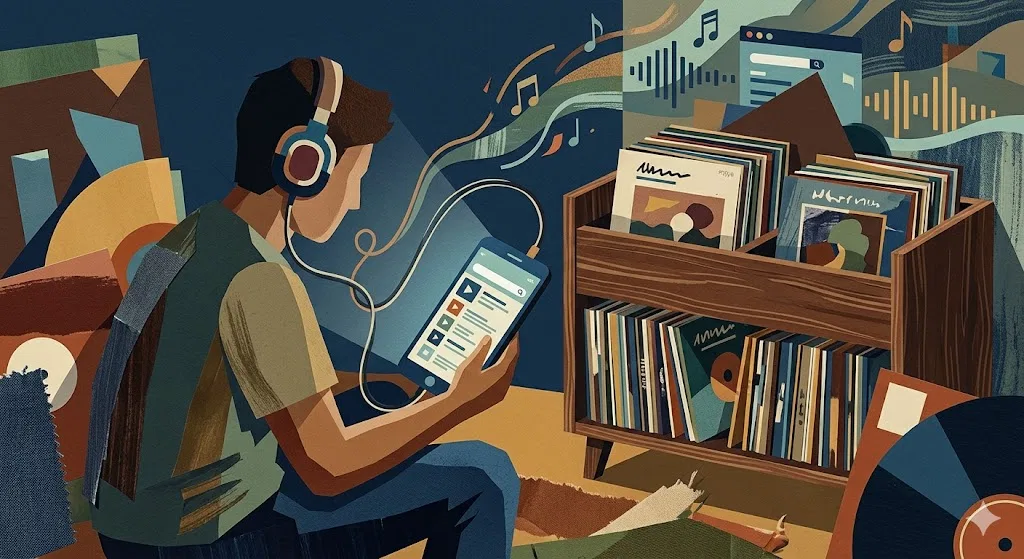
Streaming moved listening from owned albums and downloads toward instant access, playlists and algorithmic discovery.
On this page
- Access instead of ownership
- Playlists, moods and moments
- Convenience and platform dependence
Page outline Jump by section
Introduction
Streaming changed everyday listening by making music feel less like a collection of things people own and more like an always-available service. Instead of buying an album, importing files, or carrying a small library on a device, listeners can search a catalogue, tap a playlist, follow an algorithmic recommendation, or let music run in the background while commuting, cooking, working, exercising or relaxing. The shift matters because it has changed not only how music is paid for, but how it is chosen, remembered and fitted into ordinary routines.
The clearest evidence is economic as well as behavioural. IFPI reported that global recorded music revenue reached US$31.7 billion in 2025, with streaming accounting for 69.6% of recorded music income and paid subscriptions alone accounting for 52.4%.[IFPI]ifpi.orgGLOBAL MUSIC REPORT 2026: GLOBAL RECORDED…March 18, 2026 — 18 Mar 2026 — Global recorded music revenues grew 6.4% and reached US$3… In the United States, the RIAA reported that streaming represented 82% of total recorded music revenue for the fifth year running in 2025.[RIAA]riaa.comReports: US Recorded Music Annual Revenue2025 Year-End Recorded Music Revenue Report. 2025 Highlights: US recorded music hit record high at $11.5B; Streaming revenues grew to $9… Those figures do not prove that every listener has abandoned albums, radio or physical formats, but they do show that streaming has become the central infrastructure through which recorded music is encountered.
Access Replaced the Personal Library
The old model of recorded music was built around possession. A listener bought a CD, vinyl record, cassette or download, and the resulting library was limited by money, storage space, taste and effort. Streaming changed that default. For a monthly fee, or through advertising-supported access, the listener no longer needs to decide whether one album is worth buying before hearing it repeatedly. A song can be sampled once, saved, skipped, replayed, shared or forgotten with almost no friction.
Research on streaming adoption repeatedly points to this access model as one of the central reasons people changed habits. A 2025 qualitative study of college students found that participants moved from CDs and downloads to music streaming mainly because of convenience and “massive song choices for a reasonable price”.[American Journal of Qualitative Research]ajqr.orgMusic streaming services have become the primary source for listeners to access music daily. Qualitative interviews were conducted to und… Earlier research on the psychology of streaming framed the same shift as a move from ownership responsibilities towards access, discovery, nostalgia and emotional use.[ResearchGate]researchgate.netExploring music listeners' motivations to favour access over…October 1, 2016 — This paper explores streaming from a psycho… In everyday terms, streaming reduces the practical burden of having a music collection: there is less need to rip CDs, manage files, sync devices, back up libraries or decide in advance what music will be needed later.
That convenience also changes the meaning of commitment. Buying an album once required a small bet: the listener had to care enough to spend money on that particular object or file. Streaming weakens that threshold. People can try a new artist because a song appears in a playlist, because a friend sends a link, because an app recommends it, or because a fragment has circulated elsewhere online. The cost of curiosity falls, but so does the sense that every piece of music in a library has been deliberately chosen.
The result is not the death of ownership. Physical formats remain meaningful for many fans precisely because they offer tangibility, artwork, ritual and a stronger feeling of support for artists. IFPI reported that physical-format revenue grew 8.0% in 2025, helped by vinyl’s nineteenth consecutive year of growth.[IFPI]ifpi.orgGMR2025 SOTIGMR2025 SOTI But for everyday listening, ownership is now often the exception rather than the default. A vinyl record may be a treasured object; the playlist or search bar is what many people use on an ordinary Tuesday.
Playlists Changed the Unit of Listening
Streaming did not simply put the old record shop onto a phone. It changed the unit around which listening is organised. Albums still matter, especially for major releases, devoted fandoms and critical discussion, but everyday listening increasingly happens through playlists, queues, recommendations and mood-based sessions.
This is a major historical change. In the album era, listeners often entered music through an artist, a record, a genre shelf, a radio station, a chart show or a friend’s collection. In the streaming era, they may enter through a situation: “focus”, “sleep”, “gym”, “sad songs”, “dinner”, “commute”, “new music Friday”, or an automatically generated daily mix. Ofcom’s 2026 UK audio report found that relaxation, background listening and mood boosting are important drivers of music listening, while online music services remain among the most-used forms of audio.[www.ofcom.org.uk]ofcom.org.ukaudio report 2026audio report 2026
The practical effect is that music is increasingly selected for what it does in a moment. A listener may not ask, “Which album do I want to hear?” but “What fits this walk?”, “What keeps me working?”, “What will calm the room?”, or “What sounds like the thing I already like?” Streaming platforms are well suited to that behaviour because they can organise tracks by tempo, style, past listening, editorial category and user behaviour.
Spotify’s own product language shows how normal this has become. Its 2025 Wrapped material described listening through “moments, moods, and memories”, while newer features such as weekly listening statistics, Discover Weekly, Release Radar and daylist treat everyday listening as a pattern of habits that can be summarised, refreshed and shared.[Spotify]newsroom.spotify.comThe Simple Truth About How Your Wrapped Comes to LifeThe Simple Truth About How Your Wrapped Comes to Life The platform is not merely storing songs; it is turning listening into a stream of personalised occasions.
This shift has made listening more flexible, but also more fragmented. The album remains a powerful artistic format, but many listeners encounter songs first as standalone tracks inside a playlist. An artist’s work may be heard beside dozens of unrelated tracks selected by a platform, editor or algorithm. That can help a new song travel quickly, but it can also detach music from the album sequence, artwork, liner notes, local scene or cultural context that once framed it.
Algorithmic Discovery Became Part of Taste
Streaming’s most distinctive change is not just that listeners can access more music. It is that platforms increasingly help decide what appears next. Search still matters, and human curation has not disappeared, but algorithmic recommendation has become a routine part of music discovery.
For listeners, this can feel effortless. A platform learns from plays, skips, saves, follows, playlist additions, location, time of day, device use and similarities with other listeners. It can then recommend music that feels familiar enough to keep playing but new enough to feel like discovery. MIDiA’s 2025 analysis put the change plainly: music discovery is not dead, but it has moved from older channels such as radio towards streaming and social algorithms that give listeners personalised recommendations.[MIDiA Research]midiaresearch.comMIDi A Research Music discovery is not dead, just evolving – the industryMIDi A Research Music discovery is not dead, just evolving – the industry
Academic work helps explain why this is more than a technical feature. A 2022 First Monday study argued that music recommender systems act as active agents in shaping listening habits and taste, with users forming relationships of trust, intimacy and even betrayal with algorithmic systems.[First Monday]firstmonday.orgFirst Monday Don't mess with my algorithm: Exploring the relationshipFirst Monday Don't mess with my algorithm: Exploring the relationship A 2025 study of listening modes likewise linked streaming patterns to moods, events, daily routines, access to large catalogues and the integration of algorithmic recommendations into everyday life.[Sage Journals]journals.sagepub.comSource details in endnotes.
That is why recommendation can feel personal. When a playlist seems to know what a listener wants before they do, it can become part of their musical identity. But that same convenience creates a tension: if recommendations are built from past behaviour, they may reinforce what a listener already does. The UK government’s research into streaming algorithms warned that recommendation systems may prioritise some music, artists or playlists over others, and that algorithmic bias could affect visibility by genre, gender or other factors.[GOV.UK]GOV.UKThe impact of recommendation algorithms on the UK'sThe impact of recommendation algorithms on the UK's
The everyday consequence is subtle. A listener may feel more adventurous because they hear more unfamiliar tracks than before, yet still be guided within a platform-shaped corridor of similarity. Discovery becomes easier, but not necessarily freer. The listener has access to an enormous catalogue, while the visible slice of that catalogue is constantly sorted by systems they do not fully see.
Music Became More Continuous and Situational
Streaming has made music easier to weave through the day. A phone, smart speaker, laptop, television, car system or games console can become a listening device. That has encouraged a more continuous style of listening: music as atmosphere, companion, productivity aid, emotional regulation and social signal.
This does not mean people listen more attentively. In many cases, streaming makes listening more casual. Music can fill silence while the listener does something else. A playlist can run for hours without anyone choosing each track. Autoplay can turn one song into an extended session. In this sense, streaming has strengthened music’s role as an everyday utility.
The UK data is useful because it shows how broad audio habits have become. Ofcom reported in 2026 that 93% of UK adults listen to some kind of audio media each week, rising to 98% among 16- to 34-year-olds; it also identified YouTube, Spotify, BBC Sounds, Amazon Music and Apple Music as the most-used online audio services for any listening, with usage varying by audio type.[www.ofcom.org.uk]ofcom.org.uktop trends from our latest audio listening researchtop trends from our latest audio listening research The point is not that streaming has replaced every older format, but that it now sits inside a dense daily audio environment.
This situational use has affected the language of music culture. People talk about gym playlists, study music, sleep sounds, cleaning songs, dinner playlists, sad-girl walks, focus mixes and nostalgia queues. The category is often not artist or genre first, but activity or feeling. That makes music easier to apply to life, yet it can also make tracks feel interchangeable when they are consumed mainly as mood material.
For artists and labels, this changes the challenge of being heard. A song might succeed not because a listener seeks out the artist, but because it fits a platform context: background pop, chilled electronic music, upbeat workout tracks, acoustic covers, lo-fi study beats, ambient sleep music or a genre-specific discovery list. The everyday listener experiences this as convenience; the music industry experiences it as a contest for placement, retention and repeat listening.

The Listener Gained Control, Then Gave Some Back
Streaming appears to give listeners unprecedented control. They can play almost any available track instantly, skip what they dislike, create playlists, follow artists, download for offline use, and move between decades, countries and genres in seconds. Compared with radio scheduling or the limited stock of a local shop, this is a dramatic expansion of choice.
Yet streaming also shifts control towards platforms. Music availability depends on licensing deals, catalogue delivery, regional rights, app design, recommendation systems, subscription rules and account access. A listener may feel that a song is “theirs” because it is saved in a library, but that saved track is not the same as a bought file or physical record. It can disappear, be replaced by a different version, become unavailable in a region, or be harder to find after an interface change.
Legal and policy work describes this as platformisation: streaming services are not neutral shelves but intermediaries that host music, license rights, organise access and distribute revenue through complex systems. A 2026 paper on the platformisation of music explains that streaming platforms contract with copyright holders to offer music to listeners and generally compensate rights holders through revenue-sharing systems, while the practical arrangements are irregular and platform-specific.[Columbia Library Journals]journals.library.columbia.eduSource details in endnotes. The listener may experience a simple play button, but behind it is a layered structure of rights, data and commercial ranking.
This dependence also affects memory and identity. In an owned collection, the listener’s library is a record of past choices: shelves, folders, scuffed discs, downloads, playlists and mixtapes. In streaming, memory is partly outsourced to the platform. Wrapped-style summaries, algorithmic recaps and listening statistics turn personal history into shareable data. Spotify’s 2026 Taste Profile announcement went further, describing a tool that lets listeners see how Spotify understands their taste and shape what appears on the homepage.[Spotify]newsroom.spotify.comnew feature listening statsnew feature listening stats
That may be useful, but it also changes the relationship between taste and measurement. Listening becomes something to optimise, visualise and compare. A private habit can become a public identity card: top artists, minutes listened, most-played genres, obscure discoveries, guilty pleasures. Streaming did not invent musical self-expression, but it made the data trail of listening much more visible.
What Streaming Did Not Fully Replace
Streaming is now central, but it has not erased older listening habits. Radio remains important for many listeners, especially for news, companionship, presenters, local identity and passive discovery. Physical formats retain value for collectors and fans who want ownership, artwork, better control over access, or a more deliberate listening ritual. Downloads still matter for some DJs, archivists, audiophiles and listeners who dislike subscription dependence.
The strongest change is therefore not a simple replacement story. It is a rebalancing of everyday defaults. Before streaming, many listeners built a music life from owned recordings, broadcast media, borrowed music, live experiences, downloads and social recommendation. After streaming, the centre of gravity moved towards access, platforms, playlists and personalised discovery.
That change has benefits. Music is easier to find, cheaper to sample, more portable, more global and more adaptable to daily life. It can help a listener move from a childhood favourite to a new artist in another country within seconds. It can also make obscure catalogues more reachable than they were in many local retail environments.
The trade-offs are equally real. The listener owns less, depends more on platforms, may hear music in more fragmented forms, and may mistake algorithmic convenience for independent discovery. The album, the record shop, the radio presenter and the personal collection have not vanished, but they now coexist with an environment where the next song is often chosen by a system designed to keep listening going.
The Everyday Habit Streaming Left Behind
The defining habit of streaming is frictionless continuation. Music no longer has to begin with a purchase, a disc, a download or a scheduled broadcast. It can begin with a search, a mood, a saved playlist, a recommendation, a smart speaker command or the app simply carrying on.
That has made listening more abundant and more casual at the same time. People can hear more music than before, but they may spend less time with any single object or release. They can discover artists across borders, but through systems that rank, filter and monetise attention. They can build highly personal soundtracks, yet those soundtracks live inside platforms whose rules shape what appears, what is remembered and what disappears.
Streaming changed everyday listening because it moved music from the shelf to the flow. The old question was often “What music do I own?” The streaming-era question is more likely to be “What should play now?”
Amazon book picks
Further Reading
Books and field guides related to How Streaming Changed Listening Habits. Use these as the next step if you want deeper reading beyond the article.
All You Need to Know About the Music Business
Provides context for how streaming reshaped the industry.

How to make it in the new music business
Shows how streaming platforms influence audience behavior.
eBay marketplace picks
Marketplace Samples
Example marketplace items related to this page. Use the search link to explore similar finds on eBay.




Endnotes
1.
Source: ifpi.org
Link:https://www.ifpi.org/global-music-report-2026-global-recorded-music-revenues-grow-6-4-as-record-companies-drive-innovation/
Source snippet
GLOBAL MUSIC REPORT 2026: GLOBAL RECORDED...March 18, 2026 — 18 Mar 2026 — Global recorded music revenues grew 6.4% and reached US$3...
Published: March 18, 2026
2.
Source: riaa.com
Title: Reports: US Recorded Music Annual Revenue
Link:https://www.riaa.com/riaa-reports-us-recorded-music-annual-revenue-achieves-new-high-of-11-5-billion-in-2025/
Source snippet
2025 Year-End Recorded Music Revenue Report. 2025 Highlights: US recorded music hit record high at $11.5B; Streaming revenues grew to $9...
3.
Source: researchgate.net
Link:https://www.researchgate.net/publication/377066831_The_psychology_of_streaming_Exploring_music_listeners%27_motivations_to_favour_access_over_ownership
Source snippet
Exploring music listeners' motivations to favour access over...October 1, 2016 — This paper explores streaming from a psycho...
Published: October 1, 2016
4.
Source: ofcom.org.uk
Title: audio report 2026
Link:https://www.ofcom.org.uk/siteassets/resources/documents/research-and-data/data/statistics/2026/audio-listening-in-uk/audio-report-2026.pdf?v=418128
5.
Source: newsroom.spotify.com
Title: The Simple Truth About How Your Wrapped Comes to Life
Link:https://newsroom.spotify.com/2025-12-03/how-your-wrapped-is-made/
6.
Source: newsroom.spotify.com
Title: new feature listening stats
Link:https://newsroom.spotify.com/2025-11-06/spotify-new-feature-listening-stats/
7.
Source: GOV.UK
Title: The impact of recommendation algorithms on the UK’s
Link:https://www.gov.uk/government/publications/research-into-the-impact-of-streaming-services-algorithms-on-music-consumption/the-impact-of-recommendation-algorithms-on-the-uks-music-industry-creators-survey-results
8.
Source: journals.library.columbia.edu
Link:https://journals.library.columbia.edu/index.php/lawandarts/article/download/14725/8048
9.
Source: newsroom.spotify.com
Link:https://newsroom.spotify.com/2026-03-13/taste-profile-beta-announcement/
10.
Source: ifpi.org
Title: GMR2025 SOTI
Link:https://www.ifpi.org/wp-content/uploads/2024/03/GMR2025_SOTI.pdf
11.
Source: ifpi.org
Title: GMR2026 SOTI
Link:https://www.ifpi.org/wp-content/uploads/2026/03/GMR2026_SOTI.pdf
12.
Source: riaa.com
Link:https://www.riaa.com/wp-content/uploads/2025/09/RIAA-Mid-Year-Revenue-2025.pdf
13.
Source: riaa.com
Title: 2025 mid year music industry revenue report riaa
Link:https://www.riaa.com/reports/2025-mid-year-music-industry-revenue-report-riaa/
14.
Source: riaa.com
Link:https://www.riaa.com/growth-in-paid-subscription-streaming-drives-mid-year-2025-us-recorded-music-revenues-to-new-high-reports-riaa/
15.
Source: riaa.com
Link:https://www.riaa.com/riaa-reports-us-latin-recorded-music-revenue-hits-nearly-500-million-at-2025-mid-year/
16.
Source: riaa.com
Title: RIAA US Latin Mid Year Revenue 2025
Link:https://www.riaa.com/wp-content/uploads/2025/10/RIAA-US-Latin-Mid-Year-Revenue-2025.pdf
17.
Source: newsroom.spotify.com
Title: 2025 wrapped user experience
Link:https://newsroom.spotify.com/2025-12-03/2025-wrapped-user-experience/
18.
Source: newsroom.spotify.com
Title: the art and science behind spotify wrapped
Link:https://newsroom.spotify.com/2024-12-04/the-art-and-science-behind-spotify-wrapped/
19.
Source: newsroom.spotify.com
Title: loud and clear music economics highlights
Link:https://newsroom.spotify.com/2026-03-11/loud-and-clear-music-economics-highlights/
20.
Source: artists.spotify.com
Title: what were building for artists in 2026
Link:https://artists.spotify.com/blog/what-were-building-for-artists-in-2026
21.
Source: artists.spotify.com
Link:https://artists.spotify.com/en/home
22.
Source: newsroom.spotify.com
Title: wrapped methodology explained
Link:https://newsroom.spotify.com/2025-12-05/wrapped-methodology-explained/
23.
Source: ofcom.org.uk
Title: top trends from our latest audio listening research
Link:https://www.ofcom.org.uk/tv-radio-and-on-demand/digital-radio/top-trends-from-our-latest-audio-listening-research
24.
Source: ofcom.org.uk
Title: audio report 2025
Link:https://www.ofcom.org.uk/siteassets/resources/documents/research-and-data/data/statistics/2025/audio-report-2025/audio-report-2025.pdf
25.
Source: ofcom.org.uk
Title: Audio listening in the UK
Link:https://www.ofcom.org.uk/siteassets/resources/documents/research-and-data/data/statistics/2024/audio-report-2024/ofcom-audio-report.pdf?v=320716
26.
Source: researchgate.net
Title: 388827947 Effects of algorithmic curation in users’ music taste on Spotify
Link:https://www.researchgate.net/publication/388827947_Effects_of_algorithmic_curation_in_users%27_music_taste_on_Spotify
27.
Source: researchgate.net
Title: 403343293 The Platformization of Music
Link:https://www.researchgate.net/publication/403343293_The_Platformization_of_Music
28.
Source: researchgate.net
Link:https://www.researchgate.net/publication/391342303_A_song_for_each_moment_Identifying_listening_modes_as_reflexive_practices_in_music_streaming
29.
Source: youtube.com
Link:https://www.youtube.com/watch?v=gvLs-uU9QN8
30.
Source: youtube.com
Link:https://www.youtube.com/watch?v=b-zr4041sBM
31.
Source: GOV.UK
Title: the impact of recommendation algorithms on the uks music industry
Link:https://www.gov.uk/government/publications/research-into-the-impact-of-streaming-services-algorithms-on-music-consumption/the-impact-of-recommendation-algorithms-on-the-uks-music-industry
32.
Source: youtube.com
Title: How Streaming Platforms Changed the Music Industry
Link:https://www.youtube.com/watch?v=N4tP83R_h4Q
Source snippet
How the Algorithm Shapes What We Listen To...
33.
Source: youtube.com
Link:https://www.youtube.com/watch?v=FjC5Jc6N5Fw
Source snippet
Why Music Ownership is Dying...
34.
Source: youtube.com
Title: Why Music Ownership is Dying
Link:https://www.youtube.com/watch?v=J9cTq3_g70Q
Source snippet
How Streaming Changed How We Discover Music...
35.
Source: youtube.com
Title: How Streaming Changed How We Discover Music
Link:https://www.youtube.com/watch?v=c5wS-t14_80
Source snippet
The Psychology of Streaming and Algorithmic Curation...
36.
Source: youtube.com
Title: The Psychology of Streaming and Algorithmic Curation
Link:https://www.youtube.com/watch?v=P_w4vY-o8P0
37.
Source: ajqr.org
Link:https://www.ajqr.org/article/switching-to-music-streaming-services-understanding-college-students-music-listening-habits-on-music-16556
Source snippet
Music streaming services have become the primary source for listeners to access music daily. Qualitative interviews were conducted to und...
38.
Source: midiaresearch.com
Title: MIDi A Research Music discovery is not dead, just evolving – the industry
Link:https://www.midiaresearch.com/blog/music-discovery-is-not-dead-just-evolving-the-industry-needs-to-evolve-with-it
39.
Source: firstmonday.org
Title: First Monday Don’t mess with my algorithm: Exploring the relationship
Link:https://firstmonday.org/ojs/index.php/fm/article/download/11783/11150
40.
Source: journals.sagepub.com
Link:https://journals.sagepub.com/doi/10.1177/20539517251338742
41.
Source: facebook.com
Link:https://www.facebook.com/awesomeitv/posts/spotifys-latest-loud-clear-2026-report-is-a-game-changer-for-the-music-world-in-/1398741722293452/
42.
Source: facebook.com
Link:https://www.facebook.com/gizmodo/posts/spotify-rolls-out-a-wrapped-for-users-entire-streaming-history/1414289857230811/
43.
Source: techcrunch.com
Link:https://techcrunch.com/2021/06/02/spotify-rolls-out-new-personalized-experiences-and-playlists-including-a-mid-year-review-and-a-blended-mix-with-a-friend/
Additional References
44.
Source: instagram.com
Link:https://www.instagram.com/p/DWQ5mfDlDER/
45.
Source: medium.com
Link:https://medium.com/music-for-thought/how-can-you-gain-back-control-of-your-music-listening-habits-against-the-algorithm-dceebdea5600
46.
Source: vi.be
Link:https://vi.be/files/research/matthias-de-rouck-music-streaming-services-and-their-path-to-financial-viability-non-confidential-version-.pdf
47.
Source: facebook.com
Link:https://www.facebook.com/lev.manovich/posts/many-people-assume-that-the-use-of-algorithmic-media-streaming-and-distribution-/10165944381712316/
48.
Source: diarydirectory.com
Link:https://www.diarydirectory.com/newsarticle/ofcom-releases-report-on-uks-media-habits/66553
49.
Source: academia.edu
Link:https://www.academia.edu/36325338/Streaming_the_Everyday_Life
50.
Source: reddit.com
Link:https://www.reddit.com/r/LetsTalkMusic/comments/17vt6c2/why_and_who_buys_digital_downloadsalbums_when/
51.
Source: eprints.whiterose.ac.uk
Link:https://eprints.whiterose.ac.uk/id/eprint/224357/3/avila-torres-beer-2025-music-streaming-cultural-consumption-and-the-everyday-routines-of-algorithm-management-exploring.pdf
52.
Source: revistas.ucm.es
Link:https://revistas.ucm.es/index.php/TEKN/article/download/68748/4564456555481
53.
Source: omdia.tech.informa.com
Link:https://omdia.tech.informa.com/om138016/report-from-uk-media-regulator-ofcom-details-the-battle-for-music-and-audio-listeners-in-the-uk
Topic Tree