Within Playlists
When Music Becomes a Mood Button
Mood and activity playlists make music easier to use, but they can also detach songs from artists, albums and scenes.
On this page
- Why focus, gym and sleep playlists fit daily routines
- How functional listening changes attention to songs
- What gets lost when tracks leave albums and scenes
Page outline Jump by section
Introduction
Mood playlists have become one of the defining features of the streaming era. Instead of choosing an album, artist or radio station, many listeners now begin with a question such as: “What do I need music to do right now?” Focus, sleep, exercise, relaxation, studying, commuting and stress relief have become organising categories for listening. In this model, music functions less as a destination and more as a tool.
 This shift helps explain why playlists became the new radio. They fit seamlessly into everyday routines, reduce the effort of choosing from enormous catalogues and provide ready-made soundtracks for specific situations. Yet the same convenience has prompted criticism. As music becomes increasingly tied to moods and activities, songs can be detached from the artists, albums and cultural scenes that produced them. The result is a growing tension between music as a functional service and music as an object of attention, discovery and artistic engagement. IFPI[PMC]pmc.ncbi.nlm.nih.govPMCMusic that is used while studying and music that isby RJ Scarratt · 2023 · Cited by 21 — The mood-arousal hypothesis suggests that music used for studying should be uplifting to boost a…
When Music Becomes a Mood Button
Mood-based listening is not new. People have long used music to regulate emotions, boost energy, relax, study or create atmosphere. What streaming platforms changed was scale. They transformed these behaviours into searchable categories, recommendation systems and playlist brands.
Research on music listening shows that people regularly select music according to desired levels of mood and arousal. Music used for studying, for example, tends to be associated with concentration and alertness, while music used for sleep is generally calmer and less stimulating.[PMC]pmc.ncbi.nlm.nih.govPMCMusic that is used while studying and music that isby RJ Scarratt · 2023 · Cited by 21 — The mood-arousal hypothesis suggests that music used for studying should be uplifting to boost a…
Streaming services increasingly organise music around these practical goals. Rather than browsing genres or record labels, listeners encounter categories such as:
- Deep focus[youtube.com]youtube.comDeep FocusMusic For Studying, Concentration and WorkWant to have an insomnia free good night sleep? Listen to our relaxing sleeping music with amaz…
- Sleep
- Meditation
- Workout
- Chill
- Study
- Relaxation
- Stress relief
The logic is straightforward: activities are often easier to identify than musical preferences. Someone may not know which jazz pianist or ambient composer to choose, but they know they want help concentrating during work.
This approach aligns with broader listening habits. IFPI’s global music research found that people listen while engaging in a wide range of everyday activities, reflecting music’s integration into routines rather than its confinement to dedicated listening sessions. Music is increasingly woven into work, exercise, travel and relaxation throughout the day.[IFPI]ifpi.orgIFPI Engaging With Music 2023 full reportIFPI's Engaging with Music 202311 Dec 2023 — to music (rising to 12 among 16-24 year olds). TOP INDIVIDUAL ACTIVITIES. People listen…
Why Focus, Gym and Sleep Playlists Fit Daily Routines
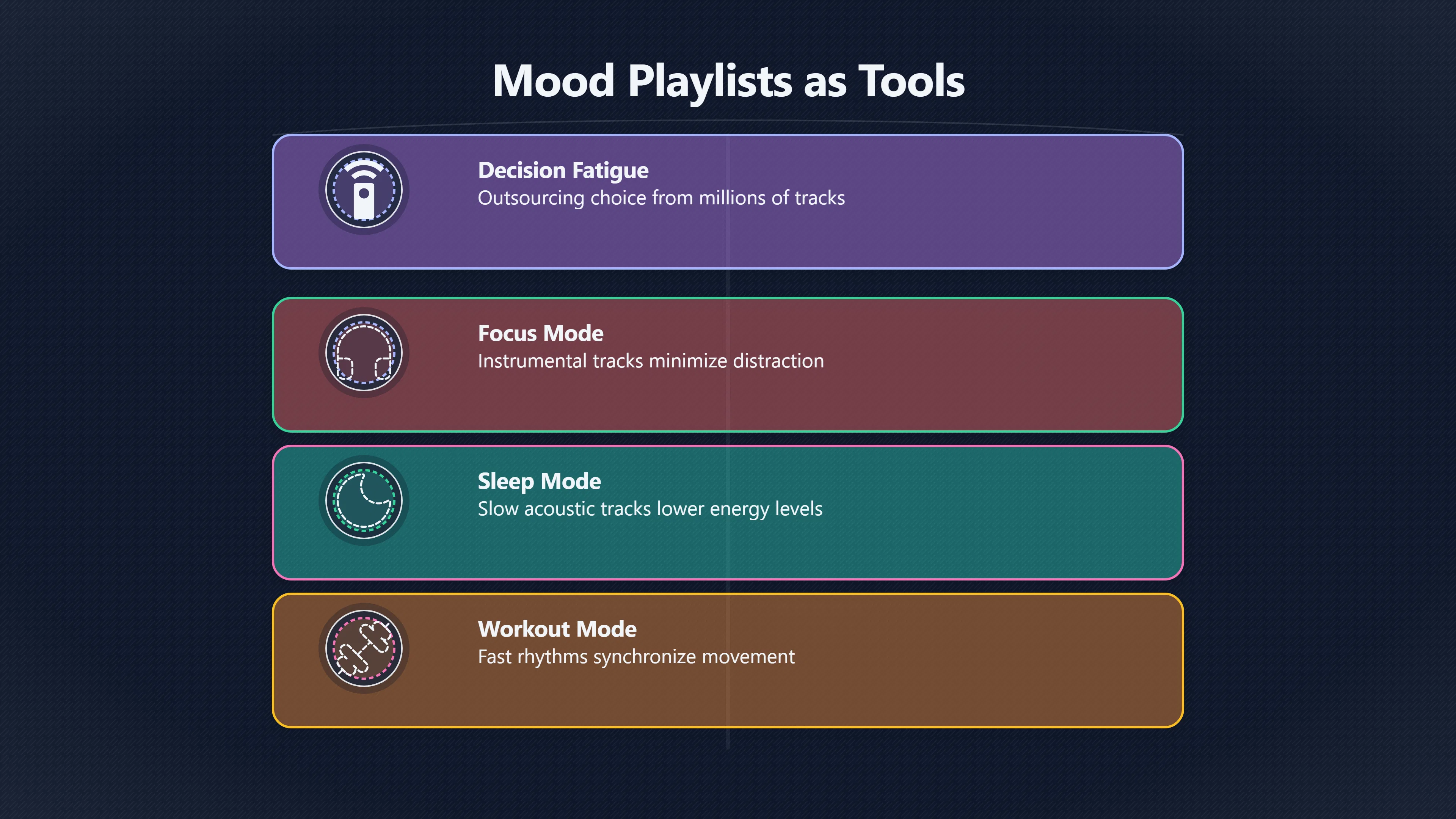
The success of functional playlists comes from solving a practical problem: decision fatigue.
Streaming catalogues contain tens of millions of tracks. Choosing music repeatedly throughout the day can become a burden. Mood playlists outsource that decision-making process.
Focus and productivity
Focus playlists promise concentration without distraction. Instrumental music, ambient textures, soft electronic sounds and repetitive rhythms are common because they minimise attention-grabbing elements such as dramatic vocals or sudden dynamic shifts.
Entire businesses now market music specifically for cognitive performance. Services such as Brain.fm present music as a productivity tool designed to support concentration, sleep and relaxation, illustrating how functional listening has become a distinct commercial category rather than simply a by-product of music consumption.[BrainFM]brain.fmFMBrain.fm: Music to Focus BetterUse Brain.fm's functional music to help you focus relax and sleep better, using cutting edge neuros…
Exercise and motivation
Workout playlists operate differently. Here the goal is not calm but energy regulation. Fast tempos, strong rhythms and predictable emotional peaks help synchronise movement and sustain motivation. Music becomes part of a performance routine rather than an artistic experience in its own right.[ifpi.se]ifpi.seengaging with music 2022 reportMusic is integral to people's mental and physical wellbeing – Music continues to play a vital role supporting both mental health and phys…
Sleep and relaxation
Sleep playlists represent perhaps the clearest example of functional listening. Research examining music in sleep playlists found recurring characteristics: tracks were often slower, quieter, more acoustic and lower in energy than music associated with other contexts. The music is selected primarily for what it does rather than who made it.[Sage Journals]journals.sagepub.comSage JournalsStreaming's Effects on Music Culture: Old Anxieties and…16 Jun 2021 — This article identifies five key themes, or sets of…
In all three cases, success is measured less by musical memorability than by whether the playlist helps accomplish a task.
How Functional Listening Changes Attention to Songs
Functional listening encourages a different relationship with music.[ifpi.org]ifpi.orgEngaging with Music reportEngaging-with-Music-report.pdf11 Oct 2021 — Engaging with Music reflects music's powerful contribution to emotional wellbeing. Young…
In traditional album listening, attention often centres on the artist’s intentions, sequencing choices, lyrics and stylistic development. The listener follows a work from beginning to end.
Mood playlists reverse that hierarchy. The playlist’s purpose becomes more important than the individual track. Songs are selected because they fit a desired atmosphere, not because they belong to a particular artistic statement.
This can alter how listeners remember music. People may recognise a playlist title, mood category or streaming recommendation but struggle to identify the artist responsible for a track they have heard repeatedly.
The playlist becomes the primary cultural object, while individual songs become interchangeable components within it.
Researchers and critics have argued that streaming interfaces actively frame musical experience in this way. Rather than presenting music as a collection of albums and artist catalogues, platforms often foreground activities, emotions and personalised recommendations.[ResearchGate]researchgate.netResearch Gate(PDF) Critically Analyzing Platform Interfaces: How MusicResearchGate(PDF) Critically Analyzing Platform Interfaces: How Music-…July 15, 2024 — This article identifies and contributes to a sm…
The result is a form of listening that is often described as “lean-back” consumption. Music remains present, but it may occupy less of the listener’s conscious attention than in earlier eras dominated by physical media or appointment-based radio listening.[Financial Times]ft.comFinancial Times Spotify and Netflix perfected the business of distractionBoth platforms prioritize user data and personalization to maximize consumption time, often at the expense of content quality and cultura…
What Gets Lost When Tracks Leave Albums and Scenes
The most common criticism of mood playlists is not that they exist, but that they can weaken context.
Albums historically connected songs through themes, sequencing and artistic narrative. Local scenes connected music to places, communities and shared cultural histories. Radio programmes often reflected the tastes of specific presenters or specialist audiences.
Mood playlists frequently remove those connections.
A jazz track, an ambient piece and an electronic instrumental may appear together because they create a similar atmosphere, even if they emerged from entirely different traditions. The listener experiences the mood but may never encounter the surrounding culture.
Critics of streaming have identified this as one of the major cultural consequences of playlist-driven listening. David Hesmondhalgh’s analysis of streaming culture notes recurring concerns that streaming encourages functional experience, background listening and fragmented engagement with music. The criticism is not that listeners cannot engage deeply, but that platforms make convenience-driven listening especially easy.[Sage Journals]journals.sagepub.comSage JournalsStreaming's Effects on Music Culture: Old Anxieties and…16 Jun 2021 — This article identifies five key themes, or sets of…
The concern extends to artists as well. Success in mood categories can encourage music designed to fit playlists rather than stand apart from them. Ambient and instrumental musicians have benefited from playlist exposure, but some observers worry that the incentives can favour predictable sounds that blend smoothly into listening environments.[Pitchfork]pitchfork.comInside the Ambient Music Streaming BoomWilliam Basinski, one of the most celebrated ambient composers, found significant success through such playlists, which help artists reac…

The Trade-Off Between Convenience and Discovery
Functional listening offers genuine benefits.
Music can reduce stress, support emotional regulation and help people navigate daily routines. Studies continue to find associations between music listening and improved wellbeing, relaxation and stress reduction. For many listeners, mood playlists provide practical value that should not be dismissed.[ScienceDirect]sciencedirect.comListening to music is associated with reduced physiological…by M van Swieten · 2025 · Cited by 2 — The present study sugg…
At the same time, functional playlists can narrow the frame through which music is encountered. Discovery increasingly occurs within categories such as “focus” or “chill” rather than through exploration of artists, labels, genres or scenes. Songs may succeed because they fit an environment rather than because listeners actively seek them out.
This creates a cultural trade-off. Music becomes more useful and more accessible, but potentially less distinctive. The listener gains efficiency while risking a weaker connection to the creators and communities behind the music.
That tension helps explain why mood playlists have become such a significant part of the streaming era. They are not merely collections of songs. They represent a new idea about what music is for: not only listening, but helping people manage attention, emotion and everyday life.[Sage Journals]journals.sagepub.comSage JournalsStreaming's Effects on Music Culture: Old Anxieties and…16 Jun 2021 — This article identifies five key themes, or sets of…[IFPI]ifpi.orgTime spent listening to music increases to 20.7 hours per week.Read moreIFPI's global study finds we're listening to more music in…11 Dec 2023 — IFPI's Engaging with Music 2023 report: the largest music…
eBay marketplace picks
Marketplace Samples
Example marketplace items related to this page. Use the search link to explore similar finds on eBay.




Endnotes
1.
Source: ifpi.org
Title: IFPI Engaging With Music 2023 full report
Link:https://www.ifpi.org/wp-content/uploads/2023/12/IFPI-Engaging-With-Music-2023_full-report.pdf
Source snippet
IFPI's Engaging with Music 202311 Dec 2023 — to music (rising to 12 among 16-24 year olds). TOP INDIVIDUAL ACTIVITIES. People listen...
2.
Source: pmc.ncbi.nlm.nih.gov
Title: PMCMusic that is used while studying and music that is
Link:https://pmc.ncbi.nlm.nih.gov/articles/PMC10036617/
Source snippet
by RJ Scarratt · 2023 · Cited by 21 — The mood-arousal hypothesis suggests that music used for studying should be uplifting to boost a...
3.
Source: nature.com
Link:https://www.nature.com/articles/s41598-023-31692-8
Source snippet
Music that is used while studying and...by RJ Scarratt · 2023 · Cited by 21 — Music listening engages brain networks involved in h...
4.
Source: ifpi.org
Title: Time spent listening to music increases to 20.7 hours per week.Read more
Link:https://www.ifpi.org/ifpis-global-study-finds-were-listening-to-more-music-in-more-ways-than-ever/
Source snippet
IFPI's global study finds we're listening to more music in...11 Dec 2023 — IFPI's Engaging with Music 2023 report: the largest music...
5.
Source: brain.fm
Link:https://www.brain.fm/
Source snippet
FMBrain.fm: Music to Focus BetterUse Brain.fm's functional music to help you focus relax and sleep better, using cutting edge neuros...
6.
Source: ifpi.se
Title: engaging with music 2022 report
Link:https://www.ifpi.se/statistik/engaging-with-music-report/engaging-with-music-2022-report/
Source snippet
Music is integral to people's mental and physical wellbeing – Music continues to play a vital role supporting both mental health and phys...
7.
Source: researchgate.net
Title: Research Gate(PDF) Critically Analyzing Platform Interfaces: How Music
Link:https://www.researchgate.net/publication/382398170_Critically_Analyzing_Platform_Interfaces_How_Music-Streaming_Platforms_Frame_Musical_Experience
Source snippet
ResearchGate(PDF) Critically Analyzing Platform Interfaces: How Music-...July 15, 2024 — This article identifies and contributes to a sm...
Published: July 15, 2024
8.
Source: pitchfork.com
Title: Inside the Ambient Music Streaming Boom
Link:https://pitchfork.com/features/article/is-the-ambient-music-streaming-boom-helping-artists
Source snippet
William Basinski, one of the most celebrated ambient composers, found significant success through such playlists, which help artists reac...
9.
Source: sciencedirect.com
Link:https://www.sciencedirect.com/science/article/pii/S0891422225000605
Source snippet
Listening to music is associated with reduced physiological...by M van Swieten · 2025 · Cited by 2 — The present study sugg...
10.
Source: ifpi.org
Title: Engaging with Music report
Link:https://www.ifpi.org/wp-content/uploads/2021/10/IFPI-Engaging-with-Music-report.pdf
Source snippet
Engaging-with-Music-report.pdf11 Oct 2021 — Engaging with Music reflects music's powerful contribution to emotional wellbeing. Young...
11.
Source: ifpi.org
Title: ifpi releases engaging with music 2022 report
Link:https://www.ifpi.org/ifpi-releases-engaging-with-music-2022-report/
Source snippet
17 Nov 2022 — Music is central to people's engagement with short form video apps – 63% of people agreed that music plays a central role i...
12.
Source: ifpi.org
Link:https://www.ifpi.org/resources/
Source snippet
Report. Engaging With Music 2023. Engaging with Music explores music listeners' habits in 2023, across 26 markets – exploring how and whe...
13.
Source: ifpi.org
Title: Music Listening 2019 1
Link:https://www.ifpi.org/wp-content/uploads/2020/07/Music-Listening-2019-1.pdf
Source snippet
Music ListeningBased on research conducted by. IFPI in 2019 across 19 leading music markets this report provides an insight into music li...
14.
Source: ifpi.org
Title: GMR 2024 State of the Industry
Link:https://www.ifpi.org/wp-content/uploads/2024/04/GMR_2024_State_of_the_Industry.pdf
Source snippet
GMR_2024_State_of_the_Industry.pdfA more detailed analysis of IFPI Global [Charts]({{ 'charts/' | relative_url }}) is available in the. IFPI Global Music Report 2024 Premi...
15.
Source: ifpi.se
Link:https://www.ifpi.se/statistik/engaging-with-music-report/
Source snippet
Engaging with Music ReportBased on the responses of more than 43,000 people across 26 countries, the report is the largest music study of...
16.
Source: journals.sagepub.com
Link:https://journals.sagepub.com/doi/10.1177/17499755211019974
Source snippet
Sage JournalsStreaming's Effects on Music Culture: Old Anxieties and...16 Jun 2021 — This article identifies five key themes, or sets of...
17.
Source: journals.sagepub.com
Link:https://journals.sagepub.com/doi/10.1177/10298649241269011
Source snippet
Sage JournalsCharacterizing music for sleep: A comparison of Spotify...Aug 7, 2024 — Music from sleep playlists could generally be descr...
18.
Source: ft.com
Title: Financial Times Spotify and Netflix perfected the business of distraction
Link:https://www.ft.com/content/0a902be8-bb47-48c2-a24e-e5c361b1190a
Source snippet
Both platforms prioritize user data and personalization to maximize consumption time, often at the expense of content quality and cultura...
19.
Source: youtube.com
Title: Deep Focus
Link:https://www.youtube.com/watch?v=oPVte6aMprI
Source snippet
Music For Studying, Concentration and WorkWant to have an insomnia free good night sleep? Listen to our relaxing sleeping music with amaz...
Additional References
20.
Source: wired.com
Link:https://www.wired.com/story/plaintext-how-the-streaming-era-turned-music-into-sludge
Source snippet
The advent of platforms like The Pirate Bay and iTunes two decades ago marked a significant shift in music consumption, setting the stage...
21.
Source: scribd.com
Link:https://www.scribd.com/document/616787140/IFPI-Engaging-with-Music-report
22.
Source: feed.fm
Link:https://www.feed.fm/science-backed-music
Source snippet
Science-backed musicMusic triggers profound activations in the brain. Elevate sleep, athletic performance, and cognitive function with sc...
23.
Source: facebook.com
Title: ifpis landmark engaging with music 2023 report provides insight to the music ind
Link:https://www.facebook.com/Statista.Inc/posts/ifpis-landmark-engaging-with-music-2023-report-provides-insight-to-the-music-ind/821703900166981/
Source snippet
IFPI's landmark Engaging with Music 2023 report...IFPI also reveals that on average, people listen to eight or more different genres and...
24.
Source: ouci.dntb.gov.ua
Link:https://ouci.dntb.gov.ua/en/works/9ZeKjQwl/
Source snippet
Streaming makes musical experience passive and distracted, and music recedes into the background (here the...Read more...
25.
Source: bridgeratings.com
Title: what is functional music and why are we listening to more of it
Link:https://www.bridgeratings.com/blog/2025/3/27/what-is-functional-music-and-why-are-we-listening-to-more-of-it
Source snippet
What Is Functional Music and Why Are We Listening to...27 Mar 2025 — This term refers to music designed to serve a specific purpose—whet...
26.
Source: cityam.com
Title: research shows were listening to over 18 hours of music a week
Link:https://www.cityam.com/research-shows-were-listening-to-over-18-hours-of-music-a-week/
Source snippet
Research shows we're listening to over 18 hours of music a...22 Oct 2021 — While we know that music has a strong emotional connection, k...
27.
Source: canadianmusician.com
Title: Based on research conducted by IFPI across 21 of the world’s
Link:https://canadianmusician.com/post/new-ifpi-engaging-with-music-report-details-worldwide-music-listening-preferences
Source snippet
New IFPI 'Engaging with Music' Report Details Worldwide...It explores the ways that people listen to, discover, and engage with music ar...
28.
Source: aicerts.ai
Title: music ai mood sensing playlists reshape streaming industry
Link:https://www.aicerts.ai/news/music-ai-mood-sensing-playlists-reshape-streaming-industry/
Source snippet
Mood-Sensing Playlists Reshape Streaming IndustryNov 25, 2025 — Explore how Music AI mood engines deliver hyper-personalized playlists, b...
29.
Source: scispace.com
Link:https://scispace.com/pdf/background-by-design-listening-in-the-age-of-streaming-51mkyh2rip.pdf
Source snippet
Background by Design: Listening in the Age of Streaming11 Nov 2019 — playlist has become the central form of music curation on st...
Topic Tree