Within Music
Why Live Music Still Pays Differently
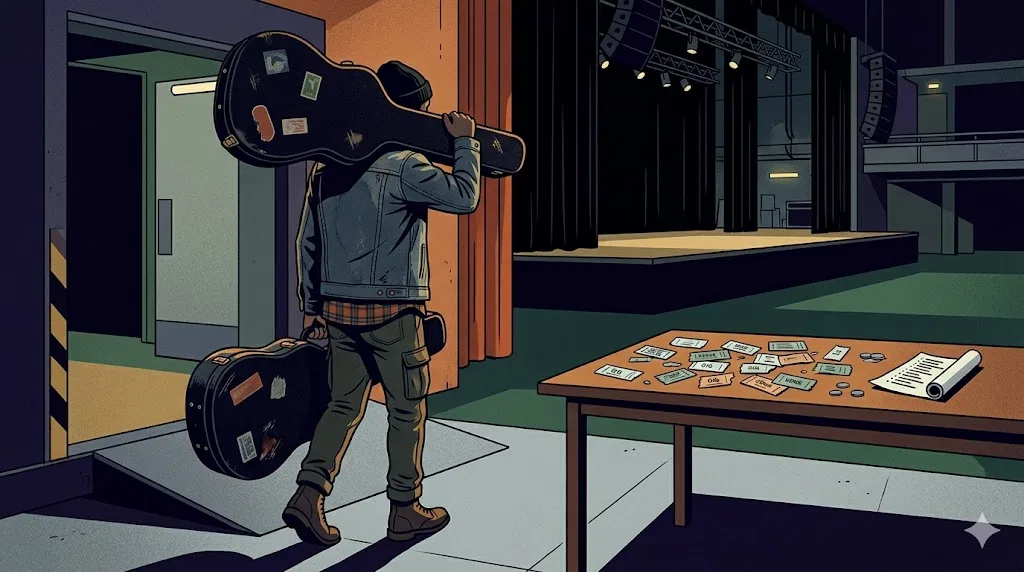
Concerts can provide artists with income, visibility and fan connection that recorded streaming alone may not deliver.
On this page
- Tickets, fees and touring economics
- Performance royalties and public use
- Why live work is not equally accessible
Page outline Jump by section
Introduction
Live music still matters financially because it pays differently from recordings. Streaming can spread a song globally, but the money is usually delayed, rights-dependent and thinly divided across labels, publishers, platforms, distributors and collaborators. A concert, by contrast, can create several kinds of value at once: ticket income, a performance fee, merchandise sales, public performance royalties for songs, fan data, local spending, press attention and a stronger bond with listeners. That does not make touring easy or equally profitable. It is expensive, risky and increasingly unequal. But it remains one of the few places where music turns attention into visible economic activity in a single night, and where artists can prove demand beyond play counts. Recorded music revenues reached US$31.7 billion globally in 2025, with streaming making up 69.6% of recorded income, but live performance remains a separate economic engine rather than a side activity.[IFPI]ifpi.orgGLOBAL MUSIC REPORT 2026: GLOBAL RECORDED MUSIC REVENUES GROW 6.4% AS RECORD COMPANIES DRIVE INNOVATION - IFPI…
Why a gig earns differently from a stream
The financial logic of live music begins with scarcity. A stream can be repeated endlessly and usually pays through a complex pool-based system; a live performance is limited by venue capacity, date, location and demand. That scarcity is why a committed fan may pay far more for one evening in a room with an artist than they would contribute through hundreds of passive streams.
For the artist, live work can also concentrate income. A fee for a small venue show, a share of ticket sales, a festival slot or a tour guarantee may be negotiated before the performance. This does not mean the artist keeps the full ticket price. Promoters, venues, ticketing companies, production suppliers, managers, agents, crew, transport, accommodation, insurance, tax and security all sit inside the live cost chain. But the artist can sometimes see a clearer connection between audience demand and earnings than they do in streaming, where income depends on scale, territory, platform rules and rights ownership.
This is why live music matters even in a streaming-dominated era. IFPI’s 2026 global report shows that paid subscriptions and streaming remain the main drivers of recorded music growth, but those figures describe the recorded market, not the full livelihood of working musicians.[IFPI]ifpi.orgGMR2025 SOTIGMR2025 SOTI The UK Musicians’ Census found that UK musicians’ average annual income from music work was £20,700, with 43% earning less than £14,000 from music; nearly half said a lack of sustainable income was a barrier to their career.[Musicians' Union]musiciansunion.org.ukFirst Ever UK Musicians’ Census Provides Unparalleled Insight into the Careers of the UK’s Musicians | The MU… Live work is therefore not a luxury add-on for many musicians. It is often part of the patchwork that makes a career possible.
Tickets, fees and touring economics
Ticket money is the most visible part of live music, but it is not a simple transfer from fan to artist. A show is a small temporary business. Someone must hire the venue, staff the doors, provide sound and lighting, promote the date, pay support acts, arrange travel, cover risk and sell enough tickets to make the numbers work. At small scale, the musician may be the person doing much of that work. At large scale, it becomes a network of agents, promoters, production teams, venue operators and ticketing platforms.
The biggest live companies show how large this economy has become. Live Nation says it connected 159 million fans across 55,000 events in 55 countries in 2025, and its fourth-quarter 2025 results showed concert revenue of US$5.15 billion, up 12% year on year.[Live Nation Entertainment]investors.livenationentertainment.comLive Nation Entertainment Investor Relations:: Live Nation Entertainment (LYVLive Nation Entertainment Investor Relations:: Live Nation Entertainment (LYV[Live Nation Newsroom]newsroom.livenation.comlive nation entertainment full year and fourth quarter 2025 resultslive nation entertainment full year and fourth quarter 2025 results That does not describe the experience of a new band in a 150-capacity room, but it demonstrates the scale of demand for live music as a paid experience.
In the UK, live music spending has also become a major consumer market. LIVE reported that UK consumer spending on live music reached £6.68 billion in 2024, up 9.5% on the previous year and more than £2 billion higher than in 2019; concerts accounted for 75.3% of that spending, and more than 23.5 million music tourists attended UK live music events.[The Guardian]theguardian.comSource details in endnotes. UK Music’s wider economic report put the UK music industry’s 2024 contribution at a record £8 billion in gross value added, with 220,000 full-time equivalent jobs.[UK Music]ukmusic.orgthis is music 2025this is music 2025
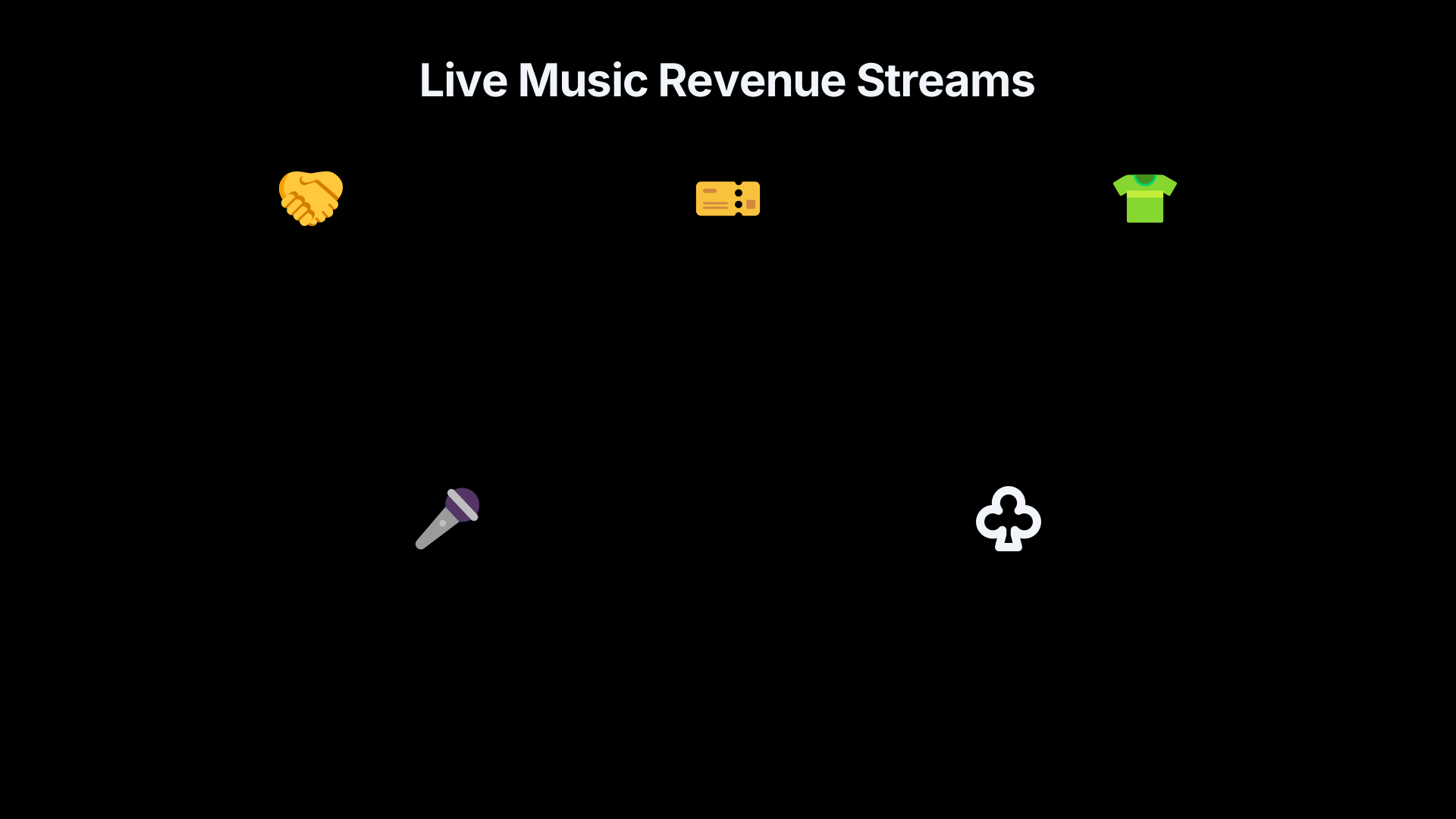
For an artist, the live income mix can include:
- A guaranteed fee: common for support slots, functions, session work, festivals and some venue bookings.
- A percentage of ticket sales: more common when an artist has enough demand to share upside with the promoter.
- Merchandise: often crucial because fans buy directly at the moment of highest emotional connection, though venues may take a commission.
- Tour support or subsidy: sometimes supplied by labels, managers, grants or brands when touring is treated as career development rather than immediate profit.
- Long-term conversion: a show can move a casual listener into buying records, joining a mailing list, subscribing to a fan club or attending future dates.
The problem is that gross ticket revenue can look impressive while net income is modest. Fuel, van hire, hotels, crew wages, visas, carnets, rehearsal rooms, instrument insurance and production costs can eat through a run before the artist is paid properly. The Musicians’ Union’s live engagement guidance reflects this reality: it notes that many gig fees are negotiated case by case and stresses written confirmation of terms so musicians can prove what has been agreed and recover fees if problems arise.[Musicians' Union]musiciansunion.org.ukRecommended Minimum Rates for Live Musicians | The MU…
Performance royalties and public use
Live music also pays through rights, not just through the fee at the door. When a songwriter’s work is performed publicly, that use can generate performance royalties. In the UK, PRS for Music licenses the public performance of compositions and distributes money to songwriters, composers and publishers. This matters because the person performing on stage is not always the person who wrote the songs, and because the song itself has a separate economic life from the ticketed event.
For concerts and many other live music events, PRS’s live tariff increased from 3% to 4% of relevant gross box office receipts, while qualifying festivals have a lower rate of 2.5% or 2.7% depending on reporting criteria.[PRS for Music]prsformusic.comPRS for Music Copyright Tribunal approves Tariff LPPRS for Music Copyright Tribunal approves Tariff LP In practice, that means a live show can generate publishing income alongside performance fees and ticket revenue. A songwriter whose work is played at a large show may benefit even if they are not the headline performer.
This mechanism is financially important but imperfect. It depends on setlists being reported and matched correctly. The Guardian reported in 2025 that PRS had collected money from more than 100,000 UK gigs and performances but could not allocate it because it lacked setlist information; the article described an “unclaimed pot” and cited a 2019 figure of £2.7 million in unallocated income.[The Guardian]theguardian.comSource details in endnotes. That dispute shows both why live performance royalties matter and why administration can determine who actually receives them.
For working musicians, the lesson is practical as well as structural. A gig can create income after the night itself, but only if the relevant songs are reported, the rightsholder information is accurate and the collecting society can connect the performance to the correct writers. Live royalties are not a bonus floating above the business; they are part of the machinery that turns public musical use into payment.
Why visibility can become money later
A live show is also a marketing event with financial consequences. Streaming platforms can show that someone listened, but they do not always reveal whether the listener would buy a ticket, recommend the artist or support a release. A room full of paying fans sends a clearer signal. Promoters, agents, labels, publishers, festivals and brands all treat live demand as evidence that an audience is real.
This is why early-stage live work has value even when the immediate fee is small. A support slot can put an artist in front of listeners who would not have found them through playlists. A festival appearance can generate press, social clips and industry attention. A run of sold-out small shows can justify moving to larger venues. The financial payoff may come later through better guarantees, a stronger booking position, higher merchandise sales or a more valuable mailing list.
Grassroots venues are especially important here because they function as the testing ground for future careers. The UK Parliament’s Culture, Media and Sport Committee described grassroots music venues as central to the live music circuit, noting that they hosted about 21.9 million audience visits across 176,000 events in 2022 and more than 1.6 million individual artist performances. It also quoted English Teacher’s Lily Fontaine saying grassroots venues gave her space to develop and start performing for money, making music feel like a possible career.[UK Parliament]publications.parliament.ukUK Parliament Grassroots music venuesUK Parliament Grassroots music venues
That development role is financially different from streaming discovery. A playlist placement may lift a track; a live circuit can train an artist, build local demand, employ crew and create repeatable ticket-buying behaviour. The money is not only in the first gig. It is in the career infrastructure that a run of gigs can build.

Why live work is not equally accessible
The strongest argument against romanticising live music is that touring is not equally available to all artists. It rewards those who can absorb upfront costs, travel repeatedly, survive uncertainty and take time away from other paid work or caring responsibilities. The result is a financial filter: some artists can use live work to grow, while others are priced out before demand has a chance to develop.
The grassroots end of the sector is particularly fragile. The 2024 parliamentary report found that the average grassroots music venue had a profit margin of just 0.5%, less than £3,000 a year, with venues in smaller communities making an average loss.[UK Parliament]publications.parliament.ukUK Parliament Grassroots music venuesUK Parliament Grassroots music venues A later Music Venue Trust annual report, covered by MusicRadar in 2026, said 53% of UK grassroots music venues made no profit in 2025, 30 small venues closed, and 175 towns and cities no longer received touring shows from professional artists.[MusicRadar]musicradar.comSource details in endnotes.
That matters for artists because a weakened venue network means fewer first steps. If small rooms close, new musicians lose places to learn, test songs, meet fans, sell merchandise and make mistakes at survivable scale. The live market can then become more top-heavy: stadium and arena tours generate record spending, while the pipeline that produces future headliners becomes less secure.
Access barriers also fall unevenly. The UK Musicians’ Census found that 23% of musicians said they did not earn enough to support themselves or their families, and 44% saw lack of sustainable income as a career barrier.[Musicians' Union]musiciansunion.org.ukFirst Ever UK Musicians’ Census Provides Unparalleled Insight into the Careers of the UK’s Musicians | The MU… Disabled musicians face further structural challenges: a Musicians’ Union report based on Musicians’ Census data found an average disability pay gap of £4,400 among musicians earning all their income from music, with higher debt levels among disabled musicians than non-disabled musicians.[Musicians' Union]musiciansunion.org.ukRecommended Minimum Rates for Live Musicians | The MU…
So live music still pays differently, but not automatically fairly. The artist who can fund rehearsals, travel and losses may reach better rooms; the artist who cannot may be stuck playing unpaid or underpaid shows, or may leave the field altogether.
The financial value is real, but uneven
Live music remains financially important because it converts music into direct, place-based economic activity. It can pay performers through fees and ticket shares, pay songwriters through public performance royalties, support venues and local economies, and turn fan attention into long-term career momentum. It also gives the industry a demand signal that streaming alone cannot fully provide: people leaving home, paying for entry and choosing to be present.
The tension is that the live economy is both powerful and fragile. At the top, global tours and major concert companies show extraordinary demand. In the middle and at the grassroots, rising costs, thin margins, weak bargaining power and venue closures make the same system hard to enter and hard to sustain. Live music matters financially not because it solves the problems of streaming, but because it creates a different route by which music becomes livelihood, community spending and career proof. Its future value depends on whether that route remains open beyond the already successful few.

Amazon book picks
Further Reading
Books and field guides related to Why Live Music Still Pays Differently. Use these as the next step if you want deeper reading beyond the article.
All You Need to Know About the Music Business
Explains touring, royalties, ticketing and revenue structures.

How to make it in the new music business
Addresses modern artist income including live work.


eBay marketplace picks
Marketplace Samples
Example marketplace items related to this page. Use the search link to explore similar finds on eBay.




Endnotes
1.
Source: ifpi.org
Link:https://www.ifpi.org/global-music-report-2026-global-recorded-music-revenues-grow-6-4-as-record-companies-drive-innovation/
Source snippet
GLOBAL MUSIC REPORT 2026: GLOBAL RECORDED MUSIC REVENUES GROW 6.4% AS RECORD COMPANIES DRIVE INNOVATION - IFPI...
2.
Source: musiciansunion.org.uk
Title: Musicians’ Union
Link:https://musiciansunion.org.uk/news/first-ever-uk-musicians-census-provides-unparalleled-insight-into-the-careers-of-the-uk-s-musicians
Source snippet
First Ever UK Musicians’ Census Provides Unparalleled Insight into the Careers of the UK’s Musicians | The MU...
3.
Source: musiciansunion.org.uk
Title: Musicians’ Union
Link:https://musiciansunion.org.uk/working-performing/gigs-and-live-performances/live-engagement-rates-of-pay
Source snippet
Recommended Minimum Rates for Live Musicians | The MU...
4.
Source: publications.parliament.uk
Title: UK Parliament Grassroots music venues
Link:https://publications.parliament.uk/pa/cm5804/cmselect/cmcumeds/527/report.html
5.
Source: musicradar.com
Link:https://www.musicradar.com/music-industry/this-sector-has-done-all-it-can-to-keep-music-live-in-our-communities-it-now-needs-permanent-protection-annual-music-venue-trust-report-reveals-sector-is-fragile-and-one-shock-away-from-a-crisis
6.
Source: ifpi.org
Title: GMR2025 SOTI
Link:https://www.ifpi.org/wp-content/uploads/2024/03/GMR2025_SOTI.pdf
7.
Source: ifpi.org
Title: MITE 2025
Link:https://www.ifpi.org/wp-content/uploads/2025/09/MITE_2025.pdf
8.
Source: ifpi.org
Link:https://www.ifpi.org/resources/
9.
Source: committees.parliament.uk
Title: uk Written evidence
Link:https://committees.parliament.uk/writtenevidence/161871/html/
10.
Source: investors.livenationentertainment.com
Title: Live Nation Entertainment Investor Relations:: Live Nation Entertainment (LYV)
Link:https://investors.livenationentertainment.com/
11.
Source: newsroom.livenation.com
Title: live nation entertainment full year and fourth quarter 2025 results
Link:https://newsroom.livenation.com/news/live-nation-entertainment-full-year-and-fourth-quarter-2025-results/
12.
Source: theguardian.com
Link:https://www.theguardian.com/music/2025/sep/03/taylor-swifts-eras-tour-helps-fuel-uk-consumer-spending-on-live-music-to-record-67bn-high
13.
Source: ukmusic.org
Title: this is music 2025
Link:https://www.ukmusic.org/research-reports/this-is-music-2025/
14.
Source: prsformusic.com
Title: PRS for Music Copyright Tribunal approves Tariff LP
Link:https://www.prsformusic.com/press/archive/industry-reaches-agreement-on-new-live-music-[licensing
15.
Source: theguardian.com
Link:https://www.theguardian.com/business/2025/jul/04/songwriters-royalties-uk-gigs-prs-for-music
16.
Source: musiciansunion.org.uk
Title: Musicians’ Union Musicians’ Census Reveals Disabled
Link:https://musiciansunion.org.uk/news/musicians-census-reveals-disabled-musicians-experience-discrimination-poor-wellbeing-and-financial-challenges
17.
Source: investors.livenationentertainment.com
Title: annual reports
Link:https://investors.livenationentertainment.com/sec-filings/annual-reports
18.
Source: musiciansunion.org.uk
Title: how to report live performances to prs for music
Link:https://musiciansunion.org.uk/working-performing/gigs-and-live-performances/how-to-report-live-performances-to-prs-for-music
19.
Source: musiciansunion.org.uk
Link:https://musiciansunion.org.uk/news/this-is-music-2025-report-reveals-uk-music-industry-contributed-record-%C2%A38-billion-to-economy
20.
Source: musiciansunion.org.uk
Title: take the musicians census 2023
Link:https://musiciansunion.org.uk/news/take-the-musicians-census-2023
21.
Source: musiciansunion.org.uk
Title: less than 24 hours left to take the musicians census 2023
Link:https://musiciansunion.org.uk/news/less-than-24-hours-left-to-take-the-musicians-census-2023
22.
Source: prsformusic.com
Title: performing right society limited
Link:https://www.prsformusic.com/-/media/files/prs-for-music/membership/membership-policies/prs-distribution-policy/public-performance-revenue–prs-distribution-policy
23.
Source: prsformusic.com
Link:https://www.prsformusic.com/-/media/files/prs-for-music/licensing/live-events/tariff-lp/live-consultation-summary-responses.pdf
24.
Source: ukmusic.org
Title: the four commercial assets inside the economics of the music industry
Link:https://www.ukmusic.org/news/the-four-commercial-assets-inside-the-economics-of-the-music-industry/
25.
Source: Wikipedia
Link:https://en.wikipedia.org/wiki/Musician
26.
Source: linkedin.com
Link:https://www.linkedin.com/posts/uk-music-ltd_uk-musics-this-is-music-report-into-the-activity-7414970779660070912-dhjd
27.
Source: instagram.com
Link:https://www.instagram.com/p/CxDPvGxNCW-/
28.
Source: store.mintel.com
Title: uk music concerts and festivals market report
Link:https://store.mintel.com/report/uk-music-concerts-and-festivals-market-report
29.
Source: prnewswire.com
Title: live nation entertainment third quarter 2025 results 302604664
Link:https://www.prnewswire.com/news-releases/live-nation-entertainment-third-quarter-2025-results-302604664.html
30.
Source: cultuurmonitor.nl
Link:https://www.cultuurmonitor.nl/en/domein/muziek/
Additional References
31.
Source: billboard.com
Link:https://www.billboard.com/[charts
32.
Source: pollstar.com
Link:https://pollstar.com/charts
33.
Source: linkedin.com
Link:https://www.linkedin.com/posts/new-industry-focus_ifpi-highlights-91-surge-in-eu-recorded-activity-7376685496841936896-Pz8I
34.
Source: facebook.com
Link:https://www.facebook.com/makingmusicuk/posts/if-your-music-group-performs-in-public-you-may-need-to-pay-royalties-to-the-comp/1309040740779881/
35.
Source: musicianscensus.co.uk
Link:https://www.musicianscensus.co.uk/insight-reports
36.
Source: instagram.com
Link:https://www.instagram.com/p/DU_usMTlwji/
37.
Source: musicvenuetrust.com
Link:https://musicvenuetrust.com/
38.
Source: musiciansfriend.com
Link:https://www.musiciansfriend.com/
39.
Source: facebook.com
Link:https://www.facebook.com/groups/495179813977387/
40.
Source: musicianscensus.co.uk
Link:https://www.musicianscensus.co.uk/
Topic Tree