Within Melody
The Shape Your Brain Hums Back
A melody's rising, falling and returning shape can make a song recognizable even when exact notes or rhythms are forgotten.
On this page
- What melodic contour means
- Why broad pitch shapes are easier to store
- How a few notes trigger song recognition
Page outline Jump by section
Introduction
A melody is often remembered as a shape before it is remembered as a sequence of exact notes. Even when listeners cannot reproduce the precise pitches of a familiar song, they frequently retain its overall pattern of rising, falling and returning. Music researchers call this pattern a melodic contour. Evidence from decades of music cognition research suggests that contour is one of the most important cues people use to recognise tunes, helping the brain store and retrieve melodies efficiently.[Research Labs]labs.utdallas.eduSecond, there is the overlearned musical scale to which.Read moreResearch LabsScale and Contour: Two Components of a Theory of Memory…by WJ Bowling · 1978 · Cited by 1073 — First, there is the melodi…
 This helps explain a common experience: hearing only a few notes of a familiar song and recognising it almost instantly. The recognition often begins not with exact pitch information, but with the melody’s broader outline.
What Melodic Contour Means
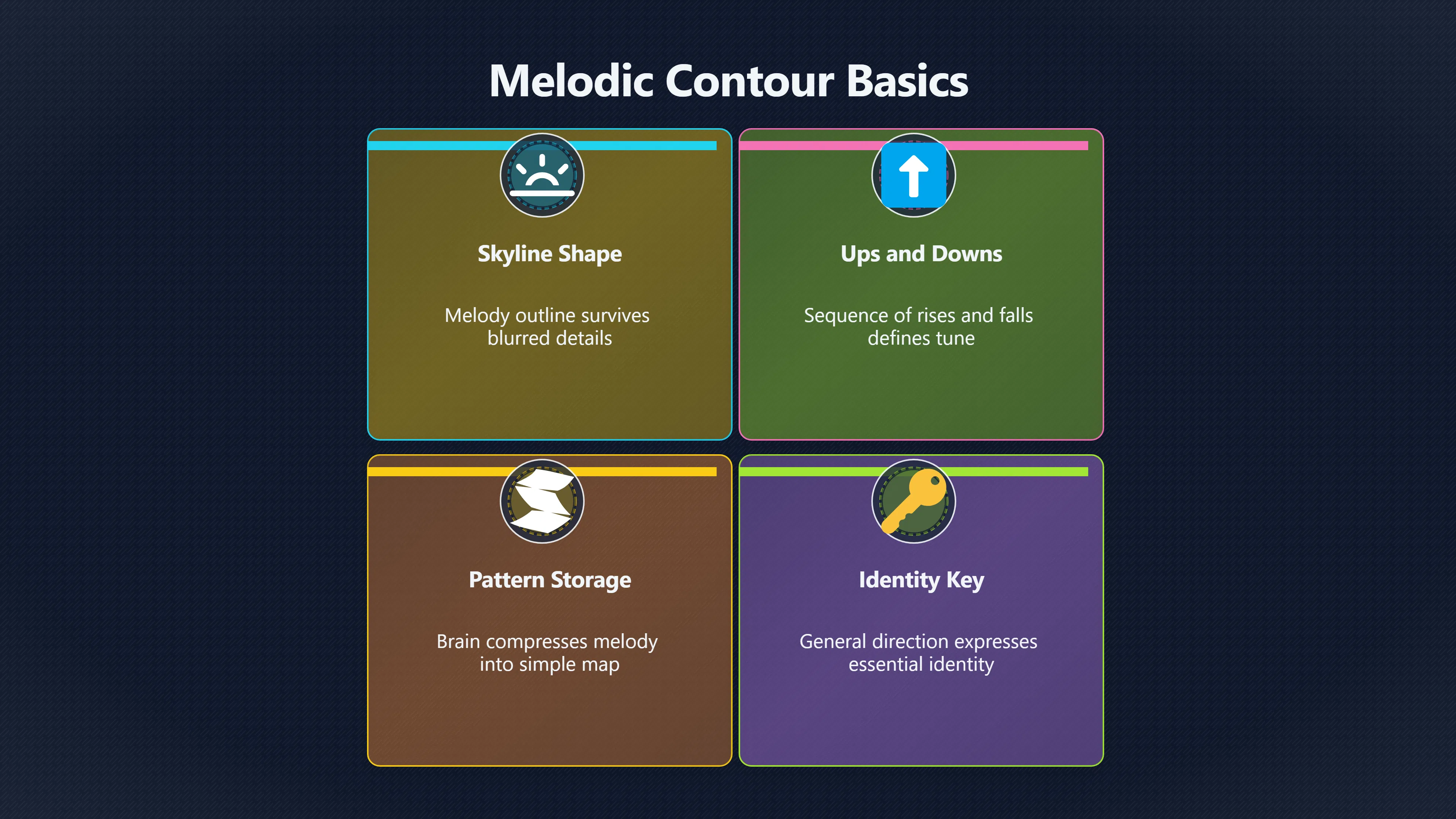
Melodic contour is the pattern of upward, downward and repeated pitch movements in a tune. Rather than focusing on exact interval sizes, contour captures the melody’s general direction.
For example, two versions of a melody may begin on different pitches and use slightly different intervals, yet still sound recognisably related if they preserve the same sequence of rises and falls. Researchers William Dowling and D. S. Fujitani described contour as the sequence of “ups and downs” that expresses some of the most essential aspects of melodic identity. AIP [Publishing](/publishing/)
A simple way to think about contour is as a musical skyline. Just as a city’s silhouette remains recognisable from a distance even when individual buildings are hard to distinguish, a melody’s contour can remain recognisable when finer musical details are blurred.
Why Broad Pitch Shapes Are Easier to Store
Research on memory for melodies has repeatedly found that listeners retain contour information remarkably well. Dowling’s influential theory of melodic memory proposed that contour functions as a high-level representation that listeners can encode before they process exact interval relationships.[Research Labs]labs.utdallas.eduSecond, there is the overlearned musical scale to which.Read moreResearch LabsScale and Contour: Two Components of a Theory of Memory…by WJ Bowling · 1978 · Cited by 1073 — First, there is the melodi…
This makes sense from a cognitive perspective. Remembering every precise pitch in a melody demands considerable detail. Remembering whether a tune generally rises, drops sharply and then returns requires far less information. The brain can compress the melody into a simpler pattern.
Several findings support this idea:
- People can often recognise melodies even when interval sizes are altered, provided the contour remains intact.[Brain Music]brainmusic.orgContour, Interval, and Pitch Recognition in Memory for MelodiesMelodic contour (the sequence of ups and downs in a melody, regardless of…
- Short-term memory experiments show that contour can be retained even when exact pitch information becomes less reliable.[UC Press Online]online.ucpress.eduExploring Melodic Contour A Clustering ApproachUC Press OnlineExploring Melodic Contour: A Clustering Approach19 Dec 2024 — An experiment by Dowling (1978) showed that the contours of…
- Studies of melodic recognition suggest that contour information is often processed before more detailed pitch relationships.[SciSpace]scispace.comMusical Features That Facilitate Melody IdentificationContour refers to the pattern of rising and falling pitches in a melody; ac…
In practical terms, contour acts as a cognitive shortcut. Instead of storing dozens of individual note values, listeners can store a compact representation of the melody’s overall trajectory.
How a Few Notes Trigger Song Recognition
One of the most striking aspects of musical memory is how little information is sometimes needed to identify a tune. Experiments on melody identification have shown that experienced listeners can often recognise familiar songs after hearing only a handful of notes.[ResearchGate]researchgate.netResearch Gate Musical Features That Facilitate Melody Identificationfew notes they would require in order to identify some well-known tune. Experienced listeners are often able to recognize a melody within…
Contour helps explain why.
The opening notes of many famous melodies establish a distinctive directional pattern almost immediately. Once listeners detect that pattern, they can begin matching it against stored musical memories. Recognition does not wait for the entire melody to unfold.
Researchers studying melody identification have found that distinctive contour changes, especially reversals in direction, are particularly informative. A melody that climbs and suddenly falls creates memorable landmarks that listeners can use as recognition cues.[American Psychological Association]apa.orgmelodic lines between contour turning points are more likely to become INMI. Turning points in a melody occur when the pitch direction re…
This means that recognition often depends less on hearing every note correctly and more on hearing enough of the melody’s outline to activate a stored template.
Evidence From Children and Infants
The importance of contour appears surprisingly early in human development.
Studies led by psychologist Sandra Trehub found that infants are sensitive to changes that alter melodic contour. Even before acquiring musical expertise, young listeners detect when the general shape of a melody changes. In many cases, contour violations are easier for them to notice than more subtle interval modifications.[JSTOR]jstor.orgInfants' Perception of Melodies: The Role of Melodic ContourInfants' Perception of Melodies: The Role of Melodic ContourJune 3, 1984 — by SE Trehub · 1984 · Cited by 514 — Performance on the c…
Research with children has produced similar findings. When melodies are transformed while preserving contour, children often judge them as more similar to the original than melodies whose contour has been altered.[ScienceDirect]sciencedirect.comW.J. Dowling. Scale and contour: Two components of a theory of memory for melodies. Psychological Review, 85 (1978), pp. 341-354. View in…
These results suggest that contour is not merely a skill used by trained musicians. It appears to be a fundamental feature of how humans perceive and remember melodic patterns.
Why Contour Matters More Than Perfect Accuracy
A common misconception is that recognising a melody requires remembering exact notes. In reality, listeners often succeed with much less precise information.
Evidence from melody-memory research indicates that contour and interval information contribute differently. Exact intervals add detail and specificity, but contour provides a robust framework that survives transposition, imperfect singing and memory decay.[Research Labs]labs.utdallas.eduSecond, there is the overlearned musical scale to which.Read moreResearch LabsScale and Contour: Two Components of a Theory of Memory…by WJ Bowling · 1978 · Cited by 1073 — First, there is the melodi…[Brain]brainmusic.orgContour, Interval, and Pitch Recognition in Memory for MelodiesMelodic contour (the sequence of ups and downs in a melody, regardless of…
This robustness has practical consequences. Systems designed to identify songs from humming frequently rely on contour-based representations because people tend to reproduce the shape of a melody more reliably than its exact pitches. Methods such as Parsons Code reduce melodies to simple symbols indicating whether each note moves up, down or stays the same, demonstrating how much recognition can be achieved from contour alone.[Wikipedia]WikipediaParsons codeParsons code
The success of these systems mirrors human perception: when people hum a remembered tune, they often preserve its contour even when many intervals are inaccurate.

The Shape Your Brain Hums Back
When a melody remains in memory, what survives is often not a detailed musical score but a simplified map of movement through pitch space. Research spanning memory experiments, developmental studies and melody-recognition tasks consistently points to melodic contour as a key mechanism behind tune recognition. Research Labs[JSTOR]jstor.orgInfants' Perception of Melodies: The Role of Melodic ContourInfants' Perception of Melodies: The Role of Melodic ContourJune 3, 1984 — by SE Trehub · 1984 · Cited by 514 — Performance on the c… That is why a familiar song can suddenly come back to mind after hearing only a few notes. The brain recognises the shape first. The exact notes may follow later, but the contour is often the spark that unlocks the memory of the tune.
Amazon book picks
Further Reading
Books and field guides related to The Shape Your Brain Hums Back. Use these as the next step if you want deeper reading beyond the article.
This Is Your Brain On Music
Explains how listeners recognize and remember musical patterns.
eBay marketplace picks
Marketplace Samples
Example marketplace items related to this page. Use the search link to explore similar finds on eBay.



Endnotes
1.
Source: pubs.aip.org
Title: Contour Interval and Pitch Recognition in Memory
Link:https://pubs.aip.org/asa/jasa/article/49/2B/524/747107/Contour-Interval-and-Pitch-Recognition-in-Memory
Source snippet
AIP PublishingContour, Interval, and Pitch Recognition in Memory for Melodies1 Feb 1971 — Melodic contour (the sequence of ups and downs...
2.
Source: scispace.com
Link:https://scispace.com/pdf/musical-features-that-facilitate-melody-identification-how-tu8nq13zwc.pdf
Source snippet
Musical Features That Facilitate Melody IdentificationContour refers to the pattern of rising and falling pitches in a melody; ac...
3.
Source: researchgate.net
Title: Research Gate Musical Features That Facilitate Melody Identification
Link:https://www.researchgate.net/publication/249979667_Musical_Features_That_Facilitate_Melody_Identification_How_Do_You_Know_It%27s_Your_Song_When_They_Finally_Play_It
Source snippet
few notes they would require in order to identify some well-known tune. Experienced listeners are often able to recognize a melody within...
4.
Source: jstor.org
Title: Infants’ Perception of Melodies: The Role of Melodic Contour
Link:https://www.jstor.org/stable/1130133
Source snippet
Infants' Perception of Melodies: The Role of Melodic ContourJune 3, 1984 — by SE Trehub · 1984 · Cited by 514 — Performance on the c...
Published: June 3, 1984
5.
Source: sciencedirect.com
Link:https://www.sciencedirect.com/science/article/pii/0022096588900495
Source snippet
W.J. Dowling. Scale and contour: Two components of a theory of memory for melodies. Psychological Review, 85 (1978), pp. 341-354. View in...
6.
Source: Wikipedia
Title: Parsons code
Link:https://en.wikipedia.org/wiki/Parsons_code
7.
Source: Wikipedia
Link:https://en.wikipedia.org/wiki/Musipedia
8.
Source: researchgate.net
Link:https://www.researchgate.net/publication/232603200_Scale_and_contour_Two_components_of_a_theory_of_memory_for_melodies
Source snippet
Scale and contour: Two components of a theory of memory...30 Sept 2025 — It has been suggested that contour may be processed independent...
9.
Source: researchgate.net
Link:https://www.researchgate.net/publication/2324840_Analysis_Of_A_Contour-Based_Representation_For_Melody
Source snippet
Analysis Of A Contour-Based Representation For MelodyThe goal of this research is to explore what variation of contour and rhythmic infor...
10.
Source: pubs.aip.org
Title: 524 1 online
Link:https://pubs.aip.org/asa/jasa/article-pdf/49/2B/524/18770420/524_1_online.pdf
Source snippet
"Musical Structure and Emotion in Several Cultures," paper presented to Western. Psychol.Read more...
11.
Source: labs.utdallas.edu
Title: Second, there is the overlearned musical scale to which.Read more
Link:https://labs.utdallas.edu/mpac/files/2021/03/1978-2.pdf
Source snippet
Research LabsScale and Contour: Two Components of a Theory of Memory...by WJ Bowling · 1978 · Cited by 1073 — First, there is the melodi...
12.
Source: brainmusic.org
Link:https://www.brainmusic.org/EducationalActivities/MBB91WebPage/MBB91%20Webpage/Melody_DowlingFujitani.pdf
Source snippet
Contour, Interval, and Pitch Recognition in Memory for MelodiesMelodic contour (the sequence of ups and downs in a melody, regardless of...
13.
Source: brainmusic.org
Link:https://www.brainmusic.org/EducationalActivities/DowlingFujitani_1971.pdf
Source snippet
"Musical Structure and Emotion in Several Cultures," paper presented to Western. Psychol.Read more...
14.
Source: online.ucpress.edu
Title: Exploring Melodic Contour A Clustering Approach
Link:https://online.ucpress.edu/mp/article/42/3/225/204037/Exploring-Melodic-ContourA-Clustering-Approach
Source snippet
UC Press OnlineExploring Melodic Contour: A Clustering Approach19 Dec 2024 — An experiment by Dowling (1978) showed that the contours of...
15.
Source: apa.org
Link:https://www.apa.org/pubs/journals/releases/aca-aca0000090.pdf
Source snippet
melodic lines between contour turning points are more likely to become INMI. Turning points in a melody occur when the pitch direction re...
16.
Source: brainmusic.org
Link:https://www.brainmusic.org/EducationalActivities/Fujioka_contour2004.pdf
Source snippet
Brain MusicMusical Training Enhances Automatic Encoding of Melodic...by T Fujioka · Cited by 508 — The role of contour and intervals in...
17.
Source: online.ucpress.edu
Link:https://online.ucpress.edu/mp/article/36/3/253/62714/The-Distinctiveness-Effect-in-the-Recognition-of
Source snippet
Distinctiveness Effect in the Recognition of Whole Melodies1 Feb 2019 — Using linear mixed-effects modeling, we found that greater pitch...
Additional References
18.
Source: jcaa.caa-aca.ca
Link:https://jcaa.caa-aca.ca/index.php/jcaa/article/download/2114/1861/2251
Source snippet
caa-aca.ca1.1 Contour in music cognitionby JB Prince · Cited by 25 — Contour also plays a crucial role in mu sic cognition, providing one...
19.
Source: ovid.com
Link:https://www.ovid.com/journals/pmmb/pdf/10.1037/h0094201~childrens-perception-of-familiar-melodies-the-role-of
Source snippet
CHILDREN'S PERCEPTION OF FAMILIAR MELODIESby SE Trehub · 1985 · Cited by 80 — In this case, exact transpositions may be confused with tra...
20.
Source: semanticscholar.org
Link:https://www.semanticscholar.org/paper/628e61b44ef28685756e1570796a337d56731e24
Source snippet
ktunes and fugues, is demonstrated by brief analyses of actual music...
21.
Source: decisionneurosciencelab.org
Link:https://www.decisionneurosciencelab.org/pdfs/Dowling%20et%20al.%2C%20%281999%29.pdf
Source snippet
melodic and rhythmic contour in perception and memoryby WJ Dowling · Cited by 17 — Dowling, Kwak, and Andrews (1995) introduced "real" no...
22.
Source: hal.science
Title: Talamini contour Music Perception
Link:https://hal.science/hal-05388434v1/file/Talamini_contour_MusicPerception.pdf
Source snippet
Can melodic contour help encoding luminance sequences...by F Talamini · 2025 — Studies have shown that contour is an essential feature t...
23.
Source: youtube.com
Title: Music Theory: Why We Remember Melodies
Link:https://www.youtube.com/watch?v=yW6C5f1S5-0
Source snippet
These videos explain how the broader, relative shape of a tune—its "melodic contour"—allows our brains to recognize and store musical pat...
24.
Source: pmc.ncbi.nlm.nih.gov
Link:https://pmc.ncbi.nlm.nih.gov/articles/PMC2943554/
Source snippet
by GC Lebedeva · 2010 · Cited by 80 — This study investigated whether 11-month-old infants perceive the pitch (melodic) or the phoneti...
25.
Source: pmc.ncbi.nlm.nih.gov
Link:https://pmc.ncbi.nlm.nih.gov/articles/PMC4605576/
Source snippet
for Melodic Contours Transcend Pitch - PMC - NIHby JE Graves · 2014 · Cited by 18 — The present study found that listener expectations fo...
26.
Source: digitalcommons.bucknell.edu
Link:https://digitalcommons.bucknell.edu/cgi/viewcontent.cgi?article=1822&context=fac_journ
Source snippet
Role of Features and Context in Recognition of Novel MelodiesWE INVESTIGATED HOW WELL STRUCTURAL FEATURES such as note density or the rel...
27.
Source: link.springer.com
Link:https://link.springer.com/content/pdf/10.3758/MC.38.5.641.pdf
Source snippet
melody recognition: Distinctiveness and the role of...by F Bailes · 2010 · Cited by 29 — They suggest that duration may facilitate melod...
Topic Tree