Within Publishing
Why the Same Song Pays Different People
Performance royalties are commonly divided between writer and publisher shares, making ownership structure crucial to payment.
On this page
- How writer and publisher shares work
- Collecting income without a publishing deal
- Why catalogue ownership gains value
Page outline Jump by section
Introduction
When a song earns performance income, the money often does not go to a single person. Instead, it is divided between two legally distinct interests: the writer’s share and the publisher’s share. This split is one of the most important mechanisms in music publishing because it determines who gets paid, who controls the catalogue, and whether royalties reach all entitled parties. In many performance-rights systems, the income is effectively divided 50/50 between writers and publishers, even though listeners experience the song as a single work. ASCAP[The Ivors Academy]ivorsacademy.comwhats the difference between writers share and publishers shareThe Ivors AcademyWhat's the difference between writer's share and…9 Jul 2025 — The music industry operates on a fundamental principle…
 Understanding this division explains why two people connected to the same song can receive different payments, why publishing ownership has long-term value, and why independent songwriters must pay attention not only to creating songs but also to collecting the publisher side of their income.
How Writer and Publisher Shares Work
The writer’s share belongs to the songwriter or songwriters who created the composition. The publisher’s share belongs to whoever owns or administers the publishing rights, whether that is a traditional music publisher, a co-publisher, or the songwriter acting as their own publisher.[The Ivors Academy]ivorsacademy.comwhats the difference between writers share and publishers shareThe Ivors AcademyWhat's the difference between writer's share and…9 Jul 2025 — The music industry operates on a fundamental principle…
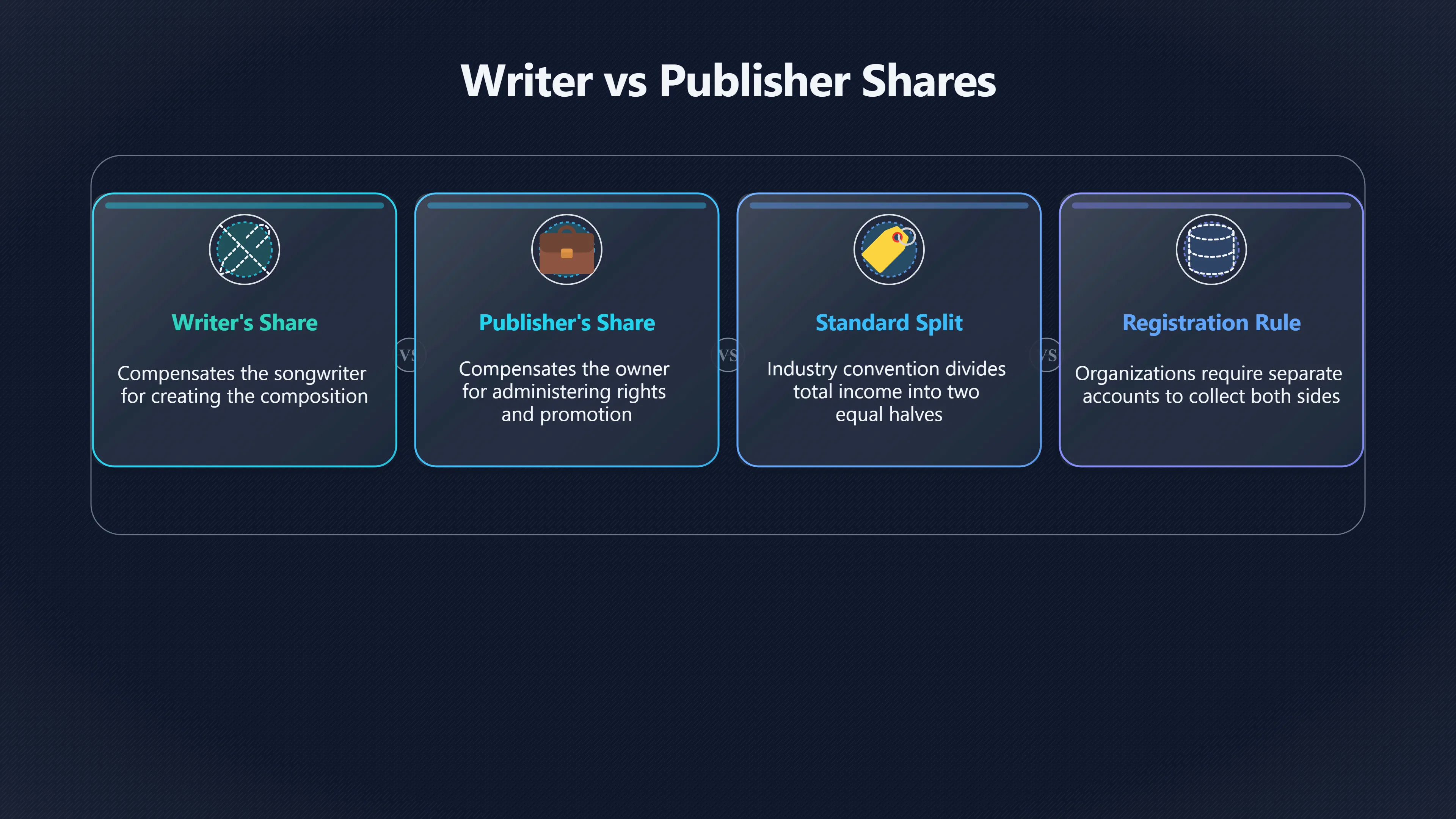
For performance royalties, the industry convention is that the revenue is split into two equal halves:
- 50% writer’s share[vi-control.net]vi-control.net50 writers share.8214350% Writers share15 May 2019 — The writer of a track gets 50% of the whole royalties, and the publisher gets the other 50% percent. In yo… * 50% publisher’s share[musicteam.com]musicteam.comthe writers share vs the publishers shareThe writer's share vs. the publisher's shareDec 13, 2022 — With BMI, the royalties are equal to 200% (100% Writer's share and 10…
ASCAP states that performance royalties are distributed with half going to writers and half to publishers. PRS for Music similarly recognises separate writer and publisher interests and limits publisher performance participation to a maximum 50% share.[ASCAP]ascap.comHelp CenterWhen ASCAP distributes royalties for a performance of your music, 50% goes to the writer(s), and 50% to the publisher(s)…
A simplified example illustrates the mechanism:
- A song generates £1,000 in performance royalties.
- £500 is allocated to the writer side.
- £500 is allocated to the publisher side.
If one songwriter wrote the entire composition and has a traditional publishing deal, the songwriter receives the writer share while the publisher receives the publisher share. If there are multiple writers, the writer half is divided according to their agreed songwriting percentages. The publisher half is divided according to the publishing ownership structure.[PRS for Music]prsformusic.comPublisher agreementsPRS for Music will not accept agreements that entitle the publisher to more than a 50% performance share. Publisher t…
The important point is that songwriting ownership percentages and publishing ownership percentages are related but not always identical. A writer may own part of the publisher side through a co-publishing arrangement, or may have assigned it entirely to a publisher.[ASCAP]ascap.comsongwriter and music publisher agreementsUnder the participation agreement, the writer shares in the publisher's income similar to t…
Why Performing Rights Organisations Separate the Shares
The split is not merely an accounting convention. It reflects the idea that song creation and song exploitation are separate contributions.
Traditionally, publishers invested in promoting songs, securing recordings, arranging licences, collecting royalties internationally and enforcing rights. In return, they received the publisher portion of income. Writers retained their writer share as compensation for creating the composition itself.[ASCAP]ascap.comJoin ASCAP | ASCAP.comASCAP royalties are split 50/50 between writers and publishers. Joining as both ensures that you can collect a…
Many performing rights organisations therefore pay the writer share and publisher share separately. The writer’s portion is often protected so that it cannot simply be redirected through publishing contracts in the same way as publisher income. PRS explicitly maintains policies governing writer-share assignments, while industry guidance from organisations such as ASCAP emphasises direct payment of writer income.[PRS for Music]prsformusic.comPublisher agreementsPRS for Music will not accept agreements that entitle the publisher to more than a 50% performance share. Publisher t…[ASCAP]ascap.comWhat Co-Writers Need to Know About Songwriting SplitsWhen you're registering music with ASCAP, make sure that all of the writer splits ad…
Collecting Income Without a Publishing Deal
One of the most common misunderstandings is that an independent songwriter automatically receives all the money generated by their songs.
Ownership and collection are not the same thing.
A songwriter without a publishing agreement may still own both the writer and publisher interests. However, they must ensure that both sides are registered and collectable. ASCAP notes that creators who want to collect the full royalty stream should be affiliated in both capacities because royalties are split between writer and publisher accounts.[ASCAP]ascap.comHelp CenterWhen ASCAP distributes royalties for a performance of your music, 50% goes to the writer(s), and 50% to the publisher(s)…
The practical consequences vary by organisation:
- Some societies require separate writer and publisher registrations to collect both shares.
- Some systems allow self-published writers to receive publisher income directly.
- Administrative publishing companies may collect the publisher share while leaving ownership with the songwriter. BMI.com MusicTeam This distinction explains why industry advisers often warn independent writers about[musicteam.com]musicteam.comthe writers share vs the publishers shareThe writer's share vs. the publisher's shareDec 13, 2022 — With BMI, the royalties are equal to 200% (100% Writer's share and 10…“leaving money on the table”. A creator can own 100% of a song yet fail to collect all available royalties if the publisher side is not properly administered.[ASCAP]ascap.comsongwriter and music publisher agreementsUnder the participation agreement, the writer shares in the publisher's income similar to t…[Royalty Exchange]royaltyexchange.comRoyalty ExchangePublishing Royalties: How They Work & How to Collect ThemApr 3, 2026 — Publishing royalties are split into two equal halv…

Multiple Writers, Multiple Payments
The situation becomes more complex when songs have several contributors.
Imagine a song written by two writers who agree to split authorship equally:
- Writer A: 50% of the composition
- Writer B: 50% of the composition
The writer share would be divided equally between them. If Writer A has a publisher and Writer B does not, the publisher share may be distributed differently from the writer share. The result is that several parties can receive payments from the same performance event.[PRS for Music]prsformusic.comPublisher agreementsPRS for Music will not accept agreements that entitle the publisher to more than a 50% performance share. Publisher t…
This is why accurate registration data matters. Performing rights organisations require works to be registered with writer names, publisher information and royalty percentages. Incorrect ownership information can delay or misdirect payments.[PRS for Music]prsformusic.comPublisher agreementsPRS for Music will not accept agreements that entitle the publisher to more than a 50% performance share. Publisher t…
Why Catalogue Ownership Gains Value
The publisher share is often the asset that attracts investors, music companies and catalogue buyers.
A song that continues to generate radio plays, streams, television broadcasts, live performances and other public performances may produce publishing income for decades. Whoever controls the publisher share receives a continuing claim on that revenue stream.[PRS for Music]prsformusic.comPublisher agreementsPRS for Music will not accept agreements that entitle the publisher to more than a 50% performance share. Publisher t…
This helps explain the value of catalogue acquisitions. Buyers are not purchasing memories or cultural prestige alone; they are purchasing rights to future royalty flows. The publisher share can therefore function like a long-lived income-producing asset.
Different publishing agreements change how much of that future value remains with the songwriter:
- Traditional publishing deals typically grant the publisher the publisher share while the writer keeps the writer share.
- Co-publishing deals often allow the writer to retain part of the publisher side as well.
- Administration deals generally focus on collection and licensing while leaving ownership largely with the writer.[ASCAP]ascap.comJoin ASCAP | ASCAP.comASCAP royalties are split 50/50 between writers and publishers. Joining as both ensures that you can collect a…
Because catalogue value depends on future royalty streams, even a small change in ownership percentages can have major financial consequences over time.
Why the Split Still Causes Disputes
The division between writer and publisher shares appears straightforward on paper, but real-world royalty systems can become contentious.
Disputes often arise over registration errors, unallocated royalties, distribution methods and the balance of power between writers and publishers. Recent legal challenges involving PRS for Music have focused on whether certain royalty pools and distribution practices disproportionately benefit publishers or larger rights holders. The underlying argument in such cases is often the same question: who should receive money that cannot immediately be matched to a specific song or owner?[The Times]thetimes.co.ukThe claim, filed at the competition appeal tribunal, argues that the PRS's distribution of "black box" income—royalties that cannot be al…
These controversies highlight why ownership records, publishing agreements and royalty registrations matter so much. The difference between the writer share and the publisher share is not merely technical paperwork. It determines who receives income when a song succeeds, who benefits from long-term catalogue value, and how money is distributed throughout the music business.
The Key Takeaway
The writer share rewards the creation of the song. The publisher share rewards ownership and administration of the composition rights. In many performance-royalty systems, those two interests divide the income equally, creating separate payment streams even though they arise from the same musical work. ASCAP[The Ivors Academy]ivorsacademy.comwhats the difference between writers share and publishers shareThe Ivors AcademyWhat's the difference between writer's share and…9 Jul 2025 — The music industry operates on a fundamental principle…
For songwriters, the critical question is not only “What percentage of the song do I own?” but also “Who owns and collects the publisher side?” The answer determines whether a song’s royalties flow to a publisher, a catalogue owner, an administrator, or back to the writer who created it.[BMI.com]bmi.comGeneral Royalty InformationBMI considers payments to songwriters or composers and to publishers as a single unit equal to 200%. Where the…[Royalty Exchange]royaltyexchange.comBMI Royalties: How They Work, What's Collected, and…2 days ago — BMI royalties, also known as BMI music royalties or BMI performance r…
Amazon book picks
Further Reading
Books and field guides related to Why the Same Song Pays Different People. Use these as the next step if you want deeper reading beyond the article.
All You Need to Know About the Music Business
Clearly explains writer and publisher income splits.

How to make it in the new music business
Shows how ownership affects long-term earnings.
The plain and simple guide to music publishing
Directly relevant to publisher participation and collection.
eBay marketplace picks
Marketplace Samples
Example marketplace items related to this page. Use the search link to explore similar finds on eBay.




Endnotes
1.
Source: ascap.com
Link:https://www.ascap.com/help
Source snippet
Help CenterWhen ASCAP distributes royalties for a performance of your music, 50% goes to the writer(s), and 50% to the publisher(s)...
2.
Source: bmi.com
Link:https://www.bmi.com/creators/royalty/general_information
Source snippet
General Royalty InformationBMI considers payments to songwriters or composers and to publishers as a single unit equal to 200%. Where the...
3.
Source: ascap.com
Link:https://www.ascap.com/help/music-business-101/200809
Source snippet
songwriter and music publisher agreementsUnder the participation agreement, the writer shares in the publisher's income similar to t...
4.
Source: ascap.com
Link:https://www.ascap.com/ome
Source snippet
Join ASCAP | ASCAP.comASCAP royalties are split 50/50 between writers and publishers. Joining as both ensures that you can collect a...
5.
Source: bmi.com
Link:https://www.bmi.com/faq/entry/how_does_bmi_split_royalties_between_songwriters_and_publishers
Source snippet
If you do not have a publisher, you will also receive the publisher's share as a writer. If you do not own a publishing...Read more...
6.
Source: musicteam.com
Title: the writers share vs the publishers share
Link:https://musicteam.com/the-writers-share-vs-the-publishers-share/
Source snippet
The writer's share vs. the publisher's shareDec 13, 2022 — With BMI, the royalties are equal to 200% (100% Writer's share and 10...
7.
Source: bmi.com
Link:https://www.bmi.com/faq/category/royalties
Source snippet
Royalties | FAQ | BMI.comAnswers to questions about becoming a BMI songwriter or publisher, royalty distribution, copyright protection, h...
8.
Source: bmi.com
Link:https://www.bmi.com/
Source snippet
BMI.comBMI, the world's leading performing rights organization, advocates for the value of music, representing over 25 million work...
9.
Source: bmi.com
Title: royalty policy manual
Link:https://www.bmi.com/creators/royalty-policy-manual
Source snippet
BMI Royalty Policy ManualAug 18, 2025 — How Royalties are Divided. BMI considers payments to songwriters or composers and to publishers a...
10.
Source: ascap.com
Link:https://www.ascap.com/help/registering-your-music/Splitsville
Source snippet
What Co-Writers Need to Know About Songwriting SplitsWhen you're registering music with ASCAP, make sure that all of the writer splits ad...
11.
Source: youtube.com
Title: The Writer’s Share vs. The Publisher’s Share
Link:https://www.youtube.com/watch?v=Fj-w16z9w-4
Source snippet
Understanding Songwriter Royalties: Writer's Share vs. Publisher's Share...
12.
Source: ivorsacademy.com
Title: whats the difference between writers share and publishers share
Link:https://ivorsacademy.com/faq/whats-the-difference-between-writers-share-and-publishers-share/
Source snippet
The Ivors AcademyWhat's the difference between writer's share and...9 Jul 2025 — The music industry operates on a fundamental principle...
13.
Source: prsformusic.com
Link:https://www.prsformusic.com/works/publisher-agreements
Source snippet
Publisher agreementsPRS for Music will not accept agreements that entitle the publisher to more than a 50% performance share. Publisher t...
14.
Source: prsformusic.com
Link:https://www.prsformusic.com/works/how-copyright-works/music-registration-policy
Source snippet
PRS for MusicMusic registration policyWorks should be registered by our members. A registered work will identify the: work's title; its w...
15.
Source: prsformusic.com
Link:https://www.prsformusic.com/join/prs-publisher-joining-criteria
Source snippet
PRS for MusicPRS Publisher joining criteriaYou have an interest in the performing right or have a share of the income that's generated by...
16.
Source: prsformusic.com
Link:https://www.prsformusic.com/works/writer-share-assignment-policy
Source snippet
PRS for MusicPRS Writer Share Assignment PolicyOur Policy sets out when PRS will give effect to a direction or assignment by a PRS writer...
17.
Source: royaltyexchange.com
Link:https://royaltyexchange.com/blog/music-royalties-101-publishing-royalties
Source snippet
Royalty ExchangePublishing Royalties: How They Work & How to Collect ThemApr 3, 2026 — Publishing royalties are split into two equal halv...
18.
Source: elizabethalexander.com
Title: ASCA P Composer + BMI Lyricist
Link:https://www.elizabethalexander.com/how-to-register-new-works-whose-entitled-parties-belong-to-different-performing-rights-organizations-pros/
Source snippet
Yikes, what's a self-...16 Oct 2016 — PUBLISHER SHARE: Seafarer Press (ASCAP) 50% · WRITER SHARES: Elizabeth Alexander (ASCAP) 25% and F...
19.
Source: prsformusic.com
Link:https://www.prsformusic.com/works/registering-works
Source snippet
PRS for MusicRegistering works | PRS for MusicWe can only distribute royalties for the use of works that have been registered. Who should...
20.
Source: thetimes.co.uk
Link:https://www.thetimes.co.uk/article/blur-drummer-dave-rowntree-royalties-kfb02qf3b
Source snippet
The claim, filed at the competition appeal tribunal, argues that the PRS's distribution of "black box" income—royalties that cannot be al...
21.
Source: prsformusic.com
Link:https://www.prsformusic.com/
Source snippet
PRS for Music: royalties, music copyright and licensingWe pay royalties to our members for the use of their work while protecting the fut...
22.
Source: prsformusic.com
Link:https://www.prsformusic.com/works/searching-works
Source snippet
Searching worksOnce you're logged-in, you can use our search tool to search for your own works, as well as the works by other writers and...
23.
Source: prsformusic.com
Link:https://www.prsformusic.com/m-magazine/how-to/how-to-understanding-publishing-rights
Source snippet
understanding publishing rights14 May 2021 — A PRO is an agency that ensures songwriters and publishers are paid for the use of their mus...
Published: May 2021
24.
Source: prsformusic.com
Link:https://www.prsformusic.com/join
Source snippet
JoinPRS represents performing rights and collects royalties for the performance of its members' work. MCPS represents mechanical rights a...
25.
Source: royaltyexchange.com
Link:https://royaltyexchange.com/blog/bmi-royalties
Source snippet
BMI Royalties: How They Work, What's Collected, and...2 days ago — BMI royalties, also known as BMI music royalties or BMI performance r...
26.
Source: vi-control.net
Title: 50 writers share.82143
Link:https://vi-control.net/community/threads/50-writers-share.82143/
Source snippet
50% Writers share15 May 2019 — The writer of a track gets 50% of the whole royalties, and the publisher gets the other 50% percent. In yo...
Published: May 2019
Additional References
27.
Source: prsguitars.com
Link:https://prsguitars.com/artists
Source snippet
ArtistsSignature Artists · Carlos Santana · David Grissom · Ed Sheeran · Herman Li · John Mayer · Mark Holcomb · Mark Lettieri · Mark Tre...
28.
Source: calculator.net
Link:https://www.calculator.net/bmi-calculator.html
Source snippet
BMI CalculatorBMI is a measurement of a person's leanness or corpulence based on their height and weight, and is intended to quantify tis...
29.
Source: reddit.com
Link:https://www.reddit.com/r/MusicDistribution/comments/1nzsnto/bmi_publishing_and_distribution/
Source snippet
BMI, Publishing, and Distribution: r/MusicDistributionBMI's 200% means 100% Writer's Share and 100% Publisher's Share. The split depends...
30.
Source: curveroyaltysystems.com
Link:https://www.curveroyaltysystems.com/royalties-101-publishing/lesson-7-a-publishers-collection-network
Source snippet
Lesson 7: A Publisher's Collection NetworkPRS will collect local royalties directly and will collect both the publisher's and writer's sh...
31.
Source: prsguitars.com
Link:https://prsguitars.com/
Source snippet
PRS Guitars | Electric and Acoustic Guitars, Basses, Amplifiers...Maryland-based Manufacturer of Electric Guitars, Acoustic Guitars, Bas...
32.
Source: reddit.com
Link:https://www.reddit.com/r/musicbusiness/comments/1g9b0id/songwriter_publisher_share/
Source snippet
Songwriter & publisher share: r/musicbusinessIf you sign to a publisher, a straight pub deal means writer keeps 100% of writers sh...
33.
Source: theguardian.com
Link:https://www.theguardian.com/music/article/2024/jun/25/jesus-and-mary-chain-robert-fripp-and-more-sue-prs-for-music-over-concert-royalties
Source snippet
Led by Pace Rights Management, the lawsuit alleges PRS charges smaller writers prohibitive fees and obstructs them from directly licensin...
34.
Source: support.tunecore.com
Link:https://support.tunecore.com/hc/en-gb/articles/115006689148-What-s-the-Difference-Between-the-Writer-s-Share-and-the-Publisher-s-Share
Source snippet
tunecore.comWhat's the Difference Between the Writer's Share and...The writer's share is the right attributed to the songwriter/composer...
35.
Source: youtube.com
Link:https://www.youtube.com/watch?v=8doQmyGkK_0
Source snippet
[SONGWRITING ROYALTIES]({{ 'publishing/' | relative_url }}) VS PUBLISHING ROYALTIES...In today's episode we are getting into songwriter royalties versus publisher royalties a...
36.
Source: texasheart.org
Link:https://www.texasheart.org/heart-health/heart-information-center/topics/body-mass-index-bmi-calculator/
Source snippet
Body Mass Index (BMI) CalculatorOne measure for obesity is determined by body mass index (BMI), which is a formula of kilograms divided b...
Topic Tree