Within Dance Music
How Club Architecture and Lighting Shape Dance Interaction
Spatial layout, lighting, and seating influence how dancers engage physically and socially.
On this page
- Dance Floor Prioritisation
- Lighting and Immersive Effects
- Seating and Social Flow Design
Page outline Jump by section
Introduction
Designing dance music venues isn’t just about aesthetics or technical systems; the physical and sensory architecture of a club profoundly shapes how people move, interact and feel together on the dance floor. The way a space is laid out — from the size and shape of the dance floor to seating arrangements, lighting gradients and circulation paths — creates conditions that either facilitate or inhibit embodied interaction among dancers. In dance-focused environments, designers deliberately craft spaces that support collective movement, social synchrony and dynamic engagement, not merely safe occupancy or functional circulation. Thoughtful venue design can amplify a sense of collective energy and shared presence by orienting attention, guiding bodies through space, and balancing zones of high-intensity dancing with opportunities for respite.[ntia]ntia.co.ukNTIA Night-Time IndustryNightlife Article #100: The Social Experiment of Club LayoutsDecember 8, 2025 — Dimly lit corners with clusters o…
Dance Floor Prioritisation
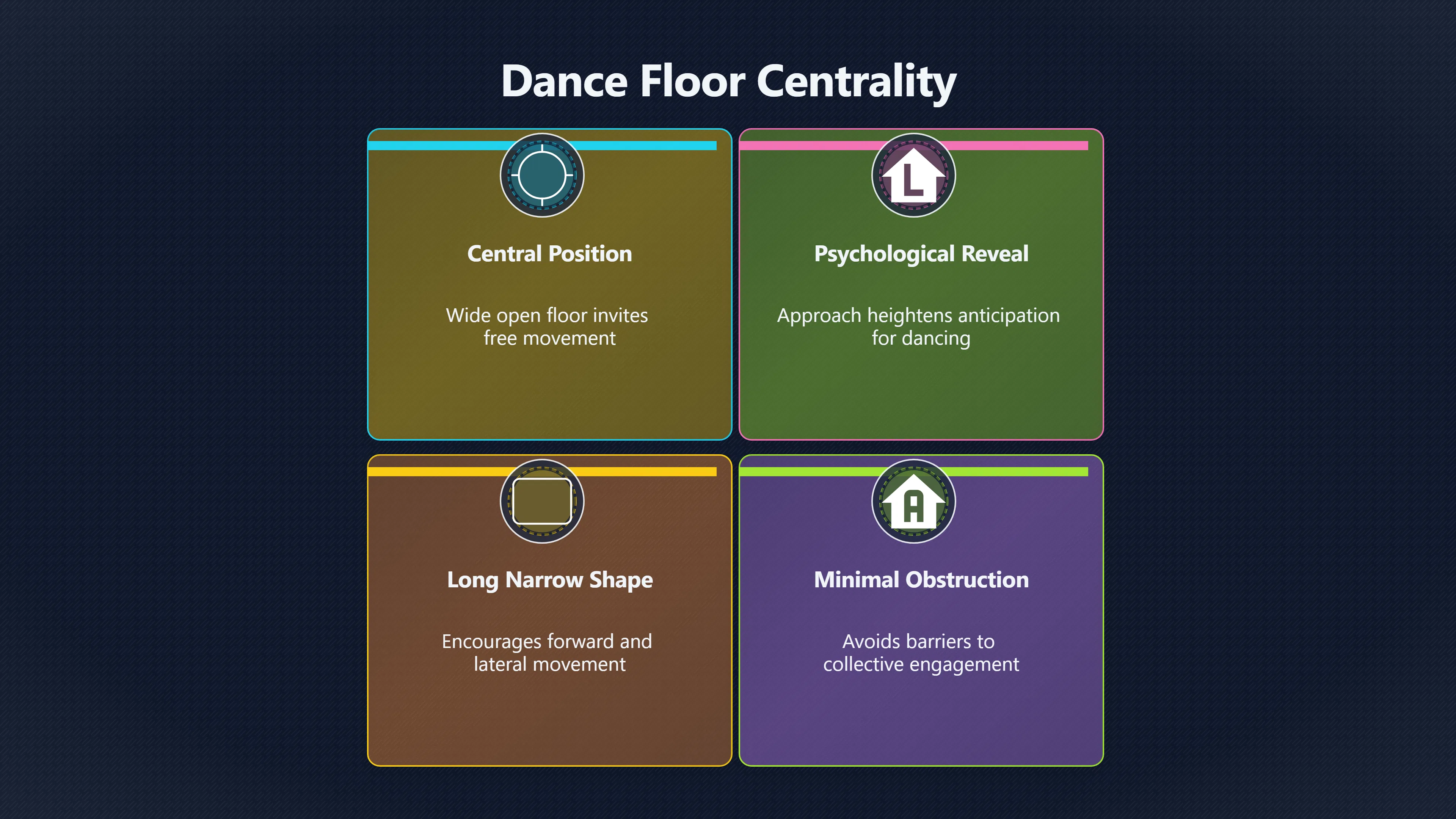
At the heart of an interactive club space is the dance floor itself. Instead of marginalising dancing as one activity among many, purpose‑built venues foreground this zone to promote shared rhythmic movement and reduce physical friction between dancers. A wide, open central dance floor invites free movement and collective energy, encouraging people to orient toward one another and the music rather than being fragmented into small, isolated clusters. Designers often position dance floors centrally within the venue’s circulation network, turning the approach into a kind of psychological reveal that heightens anticipation and draws patrons into a communal activity zone. This spatial centrality supports embodied synchronisation — the alignment of movement and rhythm across bodies — which is a key condition for shared social experience on dance floors.[ntia]ntia.co.ukNTIA Night-Time IndustryNightlife Article #100: The Social Experiment of Club LayoutsDecember 8, 2025 — Dimly lit corners with clusters o…
Beyond open space, the shape and boundaries of the dance floor matter. For example, long narrow layouts with minimal obstruction encourage forward and lateral movement, enhancing dancers’ ability to see and respond to others around them. Venues that prioritise floor space over dense seating avoid unnecessary barriers to movement and collective embodied engagement.[Lemon8]lemon8-app.comment and interaction, enhancing the club's energy. Bars also…Read more…
Lighting and Immersive Effects
Lighting design is a critical mechanism for fostering embodied interaction because it directly engages sensory perception and can unify attention across a room. Professional nightlife lighting strategies use layered systems to create a dynamic visual field that responds to the music and the crowd’s energy. Beam lights and wash layers animate the air above the dance floor, creating motion and depth that dancers can respond to physically, while accent and background layers provide visual rhythm and texture that complement the sonic pulse.[JC Lights]jc-lights.comJC Lights Club Lighting Design Guide for Nightclubs and Dance FloorsJC LightsClub Lighting Design Guide for Nightclubs and Dance FloorsApril 7, 2026 — 8 days ago — A successful club lighting design must sh…
Effective lighting does more than dazzle; it shapes the affective atmosphere of the space. Subtle colour gradients and sweeping movement layers can modulate mood and perception, making the floor feel expansive or intimate as the night progresses. Strategic lighting can also help delineate zones — using brighter, faster motion over the dance floor while leaving seating and lounge areas under softer illumination — which helps dancers instinctively understand where collective interaction is encouraged versus where quieter social interaction is expected.[ntia]ntia.co.ukNTIA Night-Time IndustryNightlife Article #100: The Social Experiment of Club LayoutsDecember 8, 2025 — Dimly lit corners with clusters o…
Innovative interactive lighting systems go further by responding to the dancers themselves, reinforcing the connection between movement and environment. While experimental systems that directly remix visuals and lights through gesture or dance remain largely research‑oriented, they point to the potential of interactive feedback loops in club design: when the environment reflects and amplifies dancers’ embodied activity, it deepens the sense of agency and shared experience.[the UWA Profiles and Research Repository]research-repository.uwa.edu.authe UWA Profiles and Research RepositoryGIRD (Gesture-based interactive Dance Floor): An audio and lighting system that allows audiences…

Seating and Social Flow Design
Seating and circulation patterns in a club are more than comfort features; they are instruments that shape how bodies move, pause, and reconnect. Traditional seating zones placed too close to the dance floor can create friction, interrupting flow and breaking dancers out of embodied synchrony. Instead, venues oriented toward social interaction tend to use buffered seating — such as stepped platforms, peripheral lounges, or elevated areas — that remain visually connected to the dance floor but do not obstruct movement. This allows patrons to rest and socialise without feeling detached from the collective rhythm.[Kelly Architects]kelly-architects.comKelly Architects Bar and Nightclub Design Ideas That Maximize CapacityKelly ArchitectsBar and Nightclub Design Ideas That Maximize Capacity…March 31, 2026 — 30 Mar 2026 — Multi-level seating platforms, el…
Transitions between zones are equally important. Narrower passages or changes in elevation between a high‑energy dance floor and quieter lounge spaces can signal shifts in activity and encourage momentary regrouping rather than abrupt disengagement. Thoughtful circulation planning encourages incidental encounters — for instance, strategically placed bottlenecks can slow movement just enough to foster chance interactions without causing congestion.[ntia]ntia.co.ukNTIA Night-Time IndustryNightlife Article #100: The Social Experiment of Club LayoutsDecember 8, 2025 — Dimly lit corners with clusters o…
Seating arrangements that prioritise visibility of the dance floor — such as raised booths or lounge platforms — help maintain a psychological and social link to the embodied activity at the centre of the space. Patrons can observe and engage with the collective energy of the room even when seated, which sustains a sense of shared presence across different engagement modes.[Kelly Architects]kelly-architects.comKelly Architects Bar and Nightclub Design Ideas That Maximize CapacityKelly ArchitectsBar and Nightclub Design Ideas That Maximize Capacity…March 31, 2026 — 30 Mar 2026 — Multi-level seating platforms, el…
Sensory Integration and Embodied Interaction
Design elements beyond layout and seating — including acoustics, scent and even perceived temperature — subtly condition how people interact in dance spaces. Acoustic design that directs powerful low‑frequency energy toward the dance floor enhances bodily sensation of the music, anchoring dancers’ movements to the shared sonic environment. Simultaneously, softer sound zones near seating allow for conversation without isolating those off the floor.[ntia]ntia.co.ukNTIA Night-Time IndustryNightlife Article #100: The Social Experiment of Club LayoutsDecember 8, 2025 — Dimly lit corners with clusters o…
Olfactory and microclimate factors may be less obvious, but subtle manipulation — such as scented entrances or controlled airflow over the dance floor — can influence mood and energy levels, reinforcing the embodied dimension of the experience. Together with lighting and spatial organisation, these sensory layers help transform architecture from a backdrop into an active participant in social interaction.[ntia]ntia.co.ukNTIA Night-Time IndustryNightlife Article #100: The Social Experiment of Club LayoutsDecember 8, 2025 — Dimly lit corners with clusters o…
In summary, the design of dance music venues that promotes embodied interaction is a multi‑dimensional practice. It weaves spatial prioritisation, lighting systems, circulation design and sensory dynamics into a coherent environment where bodies can move freely, synchronise rhythmically and engage socially. Rather than treating dance floors as incidental spaces in a broader nightlife programme, intentional design places collective movement and interaction at the core, shaping how people relate to each other through rhythm, sightlines and atmosphere.[ntia]ntia.co.ukNTIA Night-Time IndustryNightlife Article #100: The Social Experiment of Club LayoutsDecember 8, 2025 — Dimly lit corners with clusters o…
Amazon book picks
Further Reading
Books and field guides related to How Club Architecture and Lighting Shape Dance Interaction. Use these as the next step if you want deeper reading beyond the article.



The Experience Economy, With a New Preface by the Authors
First published 2019. Subjects: Production management, Marketing, Diversification in industry, Customer services.
eBay marketplace picks
Marketplace Samples
Example marketplace items related to this page. Use the search link to explore similar finds on eBay.
Endnotes
1.
Source: jc-lights.com
Title: JC Lights Club Lighting Design Guide for Nightclubs and Dance Floors
Link:https://jc-lights.com/club-lighting-design-guide-for-nightclubs-and-dance-floors/
Source snippet
JC LightsClub Lighting Design Guide for Nightclubs and Dance FloorsApril 7, 2026 — 8 days ago — A successful club lighting design must sh...
Published: April 7, 2026
2.
Source: kelly-architects.com
Title: Kelly Architects Bar and Nightclub Design Ideas That Maximize Capacity
Link:https://www.kelly-architects.com/insights/bar-and-nightclub-design-ideas-that-maximize-capacity-without-sacrificing-style
Source snippet
Kelly ArchitectsBar and Nightclub Design Ideas That Maximize Capacity...March 31, 2026 — 30 Mar 2026 — Multi-level seating platforms, el...
Published: March 31, 2026
3.
Source: ntia.co.uk
Link:https://ntia.co.uk/nightlife-article-100-the-social-experiment-of-club-layouts-how-design-manipulates-crowd-flow-and-interactions/
Source snippet
NTIA Night-Time IndustryNightlife Article #100: The Social Experiment of Club LayoutsDecember 8, 2025 — Dimly lit corners with clusters o...
Published: December 8, 2025
4.
Source: lemon8-app.com
Link:https://www.lemon8-app.com/zivyang/7434457716975878672?region=sg
Source snippet
ment and interaction, enhancing the club's energy. Bars also...Read more...
5.
Source: research-repository.uwa.edu.au
Link:https://research-repository.uwa.edu.au/en/publications/gird-gesture-based-interactive-dance-floor-an-audio-and-lighting-/
Additional References
6.
Source: tandfonline.com
Link:https://www.tandfonline.com/doi/abs/10.1080/03007766.2015.1094903
Source snippet
sic and Society: Vol 40, No 2October 20, 2015 — Popular Music and Society Volume 40, 2017 - Issue 2 Submit an article Journal homepage 1...
Published: October 20, 2015
7.
Source: popcenter.asu.edu
Link:https://popcenter.asu.edu/sites/g/files/litvpz3631/files/library/CrimePrevention/Volume_07/03_McIntyre.pdf
Source snippet
on the dance floor: a study of interior design...by S Macintyre · Cited by 162 — Abstract; This study is concerned with the role of phy...
8.
Source: journals.gold.ac.uk
Link:https://journals.gold.ac.uk/index.php/sysmus14/article/view/254
Source snippet
the club experience: Affective and bodily experiences of electronic dance music | International Conference of Students of Systematic Musi...
9.
Source: research.lancaster-university.uk
Link:https://research.lancaster-university.uk/en/publications/new-shapes-on-the-dance-floor-influencing-ambient-sound-and-visio/
Source snippet
shapes on the dance floor: influencing ambient sound and vision with computationally augmented poi - Lancaster University research direct...
10.
Source: research-repository.uwa.edu.au
Link:https://research-repository.uwa.edu.au/en/publications/turning-heads-on-the-dance-floor-synchrony-and-social-interaction/
Source snippet
Heads on the Dance Floor: Synchrony and Social Interaction Using a Silent Disco Paradigm - the UWA Profiles and Research RepositoryFebrua...
11.
Source: research.birmingham.ac.uk
Link:https://research.birmingham.ac.uk/en/publications/together-somehow-music-affect-and-intimacy-on-the-dancefloor
Source snippet
birmingham.ac.ukTogether, Somehow: Music, Affect, and Intimacy on the Dancefloor - University of BirminghamAugust 8, 2023 — TOGETHER, SOM...
Published: August 8, 2023
12.
Source: sciencedirect.com
Title: Digital Being – using the environment as an expressive medium for dance
Link:https://www.sciencedirect.com/science/article/pii/S0020025507004069
Source snippet
DigitalBeing – using the environment as an expressive medium for dance - ScienceDirectFebruary 1, 2008 — Volume 178, Issue 3, 1 February...
Published: February 1, 2008
13.
Source: research.ed.ac.uk
Title: ed.ac.uk Light bodies: Exploring interactions with responsive lights
Link:https://www.research.ed.ac.uk/en/publications/light-bodies-exploring-interactions-with-responsive-lights/
Source snippet
Seitinger, D.M. Taub, A.S. Taylor Research output: Chapter in Book/Report/Conference proceeding › Conference contribution ABSTRACT "...
14.
Source: doaj.org
Title: Bamford, * Birgitta Burger, * Petri Toiviainen Affiliations
Link:https://doaj.org/article/7a9510418b244dc894ebf26a66c2e021
Source snippet
Turning Heads on the Dance Floor: Synchrony and Social Interaction Using a Silent Disco Paradigm – DOAJMusic & Science (Feb 2023) TURNING...
15.
Source: researchgate.net
Link:https://www.researchgate.net/publication/29462013_Danger_on_the_dance_floor_A_study_of_interior_design_crowding_and_aggression_in_nightclubs
Source snippet
ting crowding in nightclubs, and with the relation- ship between crowding and...Read more...
Topic Tree