Within Music
How Recording Changed What Music Is
Recording let performances travel beyond the room where they happened, reshaping memory, ownership and fame.
On this page
- From event to repeatable object
- Records, radio and portable listening
- What is lost and gained in playback
Page outline Jump by section
Introduction
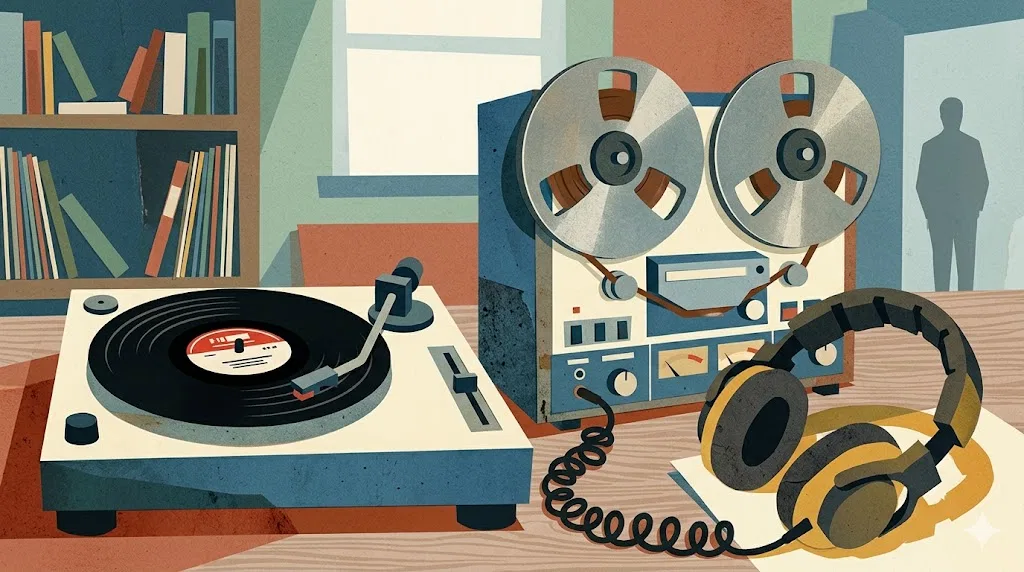
Recorded music changed music by loosening it from the single time and place of performance. Before recording, most listeners had to be present while music happened, or reproduce it themselves from memory, notation or domestic performance. After recording, a song, voice or instrumental take could become a repeatable object: replayed at home, sold in shops, broadcast by radio, carried in a pocket, archived for later generations and used as evidence of a style, a career or a moment in history. That shift did not simply make music more convenient. It changed what counted as a performance, how musical memory worked, how fame travelled, and how listeners judged the “real” version of a song. The key change was not that live music disappeared, but that music gained a second life as playback: separated from the room where it was made, yet powerful enough to reshape rooms everywhere else.
From Event to Repeatable Object
The earliest sound recording machines were startling because they made sound appear to survive its own disappearance. Edison’s 1877 phonograph was not the first attempt to trace sound, but it was the first generally reliable machine that could both record and play it back; even in 1878, Edison predicted that the phonograph would be “liberally devoted to music”.[Smithsonian Magazine]smithsonianmag.comSmithsonian Magazine How the Phonograph Changed Music ForeverSmithsonian Magazine How the Phonograph Changed Music Forever The practical result was a new kind of musical object. A performance no longer had to vanish when the singer stopped singing. It could be fixed, sold, replayed and compared.
This changed time in a basic way. Live performance is irreversible: a wrong note, a held breath, a tempo choice or an unusually moving phrase passes once. A recording made those moments returnable. That returnability created new habits: listening again for detail, memorising a particular rendition, learning from a distant performer, and treating a specific take as definitive. It also made music collectible. The record, cylinder, tape, disc or file could sit on a shelf, in an archive, in a radio library or on a device, waiting to be reactivated.
The change was not instant. The Library of Congress notes that early wax-cylinder phonographs were first aimed at uses such as dictation, but when that market disappointed, Edison’s company began selling pre-recorded popular music for use in offices, homes and coin-operated machines in public venues; by the early 1890s, a rudimentary recording industry had begun.[The Library of Congress]loc.govThe Gramophone | Articles and Essays | Emile Berliner and the Birth of the Recording Industry | Digital Collections | Library of Congress… In other words, recorded music emerged not only from invention, but from a discovery about listeners: people would pay to hear a performance without the performer being present.
The record also made comparison easier. A listener could hear the same aria, ballad or dance tune repeatedly, then judge other performances against it. Over time, this encouraged the idea that a recording could be the version of a song rather than merely a trace of one event. That distinction matters because it shifted attention from music as an activity to music as a reproducible artefact.
Records, Radio and Portable Listening
Recording first detached music from the original performance space; radio and portable devices then changed where playback could happen. The early phonograph and gramophone moved music into homes, shops, arcades and salons. Radio widened the effect by making distant performances and recordings part of shared domestic time. Later, the cassette player, the Walkman, the CD player, the MP3 player and the smartphone made listening mobile and increasingly private.
This created a new geography of music. A singer recorded in one city could be heard in another country; a dance style could travel before its performers toured; a folk song, opera excerpt, jazz solo or pop chorus could circulate among people who would never meet. The Cambridge account of early recorded sound describes the period between Edison’s phonograph and the First World War as a transformation from isolated “talking machines” into the “music machines” of the twentieth century, shaped by inventors, entrepreneurs, performers and listeners together.[cambridge]cambridge.orgCambridge University Press & AssessmentFrom Talking Machines to Music Machines: The Early Years of Recorded Sound and Playback in Picture… University Press & Assessment The phrase matters because it shows that playback was not merely a device feature. It became a social practice.
Portable listening intensified that transformation. The boombox made recorded music public in streets and parks; headphones then made it personal. The Sony Walkman, released in 1979, became an emblem of this shift because it put cassette playback into a small, mobile format; Business Insider’s retrospective notes that it launched at US$150 and that Sony ultimately sold more than 400 million Walkman units.[Business Insider]businessinsider.comBusiness InsiderWalkman Turns 40 Today: How Listening to Music Changed Over the Years - Business Insider… The musical consequence was subtle but profound: listeners could carry a chosen sound-world through a city, train journey, bedroom, workplace or exercise routine. Place no longer dictated the music available there.
Radio changed place in a different way. It synchronised listeners. A record lets many people hear the same performance at different times; a broadcast lets many people hear a performance, programme or hit record at the same time while remaining physically apart. Together, recording and broadcasting created modern musical mass culture: not one crowd in one hall, but dispersed audiences linked by the same sound.
How Playback Reshaped Memory
Recording did not simply preserve memory; it reorganised it. Before recording, musical memory depended heavily on bodies, communities, notation, oral transmission and repeated live use. After recording, memory could attach to a particular sonic object: the crackle of a disc, the exact vocal phrasing of a singer, the room sound of a studio, the sequencing of an album, or the private circumstances in which a listener replayed it.
This made recorded music unusually intimate. A recording can feel like a time machine because it brings a past performance into the present. The British Library’s Save Our Sounds programme was built around precisely this value: historic recordings can bring “events, sounds and voices from our past” into the present, but many formats risk being lost through decay or obsolete playback equipment.[The National Lottery Heritage Fund]heritagefund.org.ukSource details in endnotes. That archival urgency shows a paradox at the heart of recorded music. Recording promises preservation, yet each medium has its own fragility: wax cylinders wear down, shellac breaks, tape degrades, discs scratch, files corrupt and playback machines vanish.
Archives reveal how much recorded music has changed historical imagination. The Library of Congress says it holds about 3.5 million sound recordings, including music, spoken word and radio broadcasts, across more than 110 years of sound-recording history and many formats.[The Library of Congress]loc.govMajor Audio Collections at the Library of Congress | Tools & Resources | National Recording Preservation Plan | Programs | Library of Con… Such collections allow listeners to hear voices, styles, accents and performance practices that would otherwise be known only through written description. They also expose gaps: not everything was recorded, not everything was preserved, and not every community had equal control over how its music was captured, labelled or circulated.
Memory through recording is therefore powerful but selective. Playback can make the past vivid, but it can also over-represent what companies, collectors, broadcasters or scholars chose to record. A surviving disc can become the “sound” of an era partly because other sounds were never fixed, or were fixed and then lost.
Fame Could Travel Without the Performer
Recording changed fame because it allowed performers to become familiar to listeners who had never seen them. In a live-only culture, reputation travelled through touring, sheet music, reviews, personal testimony and local performance networks. With records, a voice or instrumental style could circulate directly. Listeners could know the grain of a singer’s voice, the timing of a comedian, the attack of a pianist or the tone of a trumpet player without sharing a room with them.
This altered what audiences valued. In the age of sheet music, a song could be popular because many people bought the notation and performed it themselves. As records became central, the identity of the performer and the specific recorded rendition grew more important. Daniela Furini’s study of recording and popular music argues that, during the 1920s and 1930s, recorded music gradually became a primary object of consumption, shifting emphasis away from the song as a general work and towards specific recordings marked by a performer’s voice or instrumental character.[sibetrans.com]sibetrans.comTRANS - Revista Transcultural de Música - Transcultural Music Review…
The result was a new kind of stardom. Recording made singers, bands and instrumentalists repeatably present. It also made small details marketable: a vocal catch, a guitar tone, a drum sound, a studio effect, a producer’s signature texture. Fame no longer depended only on being impressive in a particular venue. It depended on making a sound that could survive repetition and still feel compelling.
This did not remove the importance of live performance. Instead, it changed the relationship between live and recorded music. Audiences often went to concerts hoping to hear songs as they knew them from records, while performers faced the challenge of either recreating the recording or making the live version feel newly alive. Playback created expectations that live music then had to negotiate.
What Is Lost and Gained in Playback
The gain is obvious: recorded music multiplies access. It lets a listener hear a singer from another country, a musician from another century, a rare local tradition, a studio experiment or a private demo. It supports study, pleasure, fandom, preservation and global circulation. It also allows repetition, which deepens attention. A complex rhythm, lyric, harmony or production detail may only become clear after repeated listening.
But something is lost when music is removed from its original time and place. A recording cannot fully reproduce the social setting of a performance: the room, the bodies, the acoustics, the risk, the audience response, the ceremony, the dancing, the weather, the fatigue, the local knowledge. Early recording also compressed and distorted sound. Acoustic recording before microphones had limited frequency and dynamic range, so musicians often had to adapt their placement, balance and style to the machine rather than simply “capture” a natural performance. Furini notes that early recording often created the illusion of live performance through deliberate recording strategies rather than offering a transparent copy of an event.[sibetrans.com]sibetrans.comTRANS - Revista Transcultural de Música - Transcultural Music Review…
Playback can also standardise taste. When one recording becomes famous, it can crowd out other local versions, improvisations or traditions of variation. The repeated object becomes a benchmark. That can be artistically productive, giving musicians a shared reference point, but it can also narrow the imagination of what a song might be.
At the same time, recording opened creative possibilities that live performance alone could not offer. Tape and later digital tools made sound not only reproducible but alterable: sounds could be cut, layered, reversed, slowed, sped up, looped and transformed. One account of technology’s impact on musical experience notes that tape allowed composers to manipulate not only sound quality but also timespan, including compressing long works or stretching brief sounds into extended textures.[www.music.org]music.orgwww.music.org The Impact of Technology on the Musical Experiencewww.music.org The Impact of Technology on the Musical Experience In that sense, recording did not merely preserve music. It became a musical instrument.

The Recording Became a Place of Its Own
The deepest change is that recorded music created a new musical “place”: not the concert hall, church, club, street, theatre or home parlour, but the playback space. That space might be a living room, a car, a radio schedule, a nightclub sound system, a record shop listening booth, a teenager’s headphones or a streaming playlist. The same recording can enter all of them, gathering different meanings as it moves.
This is why recorded music changed both time and place rather than simply improving distribution. It allowed one performance-time to be replayed across many later times. It allowed one performance-place to be heard in many other places. It made memory more audible, fame more portable, ownership more complicated and listening more personal. It also created a lasting tension: recorded music can bring the absent performer close, but it can never fully restore the original event.
That tension is not a flaw. It is the modern condition of music. Live performance still matters because presence, risk and shared space matter. Recording matters because return, circulation and preservation matter. Most contemporary music culture lives between the two: we use recordings to remember performances we never attended, attend concerts shaped by recordings we already know, and build private histories around sounds that began somewhere else.
Amazon book picks
Further Reading
Books and field guides related to How Recording Changed What Music Is. Use these as the next step if you want deeper reading beyond the article.
How Music Works
Includes discussion of recording, technology and listening environments.
This Is Your Brain On Music
Explores how repeated listening changes musical experience.
eBay marketplace picks
Marketplace Samples
Example marketplace items related to this page. Use the search link to explore similar finds on eBay.
Endnotes
1.
Source: loc.gov
Title: The Library of Congress
Link:https://www.loc.gov/collections/emile-berliner/articles-and-essays/gramophone/
Source snippet
The Gramophone | Articles and Essays | Emile Berliner and the Birth of the Recording Industry | Digital Collections | Library of Congress...
2.
Source: cambridge.org
Link:https://www.cambridge.org/core/journals/journal-of-the-gilded-age-and-progressive-era/article/from-talking-machines-to-music-machines-the-early-years-of-recorded-sound-and-playback-in-pictures-and-audio/985C2153A42C386B7231CA53A05074D6
Source snippet
Cambridge University Press & AssessmentFrom Talking Machines to Music Machines: The Early Years of Recorded Sound and Playback in Picture...
3.
Source: loc.gov
Title: The Library of Congress
Link:https://www.loc.gov/programs/national-recording-preservation-plan/tools-and-resources/major-audio-collections-at-library-of-congress/
Source snippet
Major Audio Collections at the Library of Congress | Tools & Resources | National Recording Preservation Plan | Programs | Library of Con...
4.
Source: sibetrans.com
Link:https://www.sibetrans.com/trans/articulo/11/from-recording-performances-to-performing-recordings-recording-technology-and-shifting-ideologies-of-authorship-in-popular-music
Source snippet
TRANS - Revista Transcultural de Música - Transcultural Music Review...
5.
Source: music.org
Title: www.music.org The Impact of Technology on the Musical Experience
Link:https://www.music.org/cms-reports/celebrating-the-40th-anniversary-of-the-museum-of-modern-art-tape-music-concert/the-impact-of-technology-on-the-musical-experience.html
6.
Source: assets.cambridge.org
Title: 9780521863094 frontmatter
Link:https://assets.cambridge.org/97805218/63094/frontmatter/9780521863094_frontmatter.pdf
7.
Source: medium.com
Link:https://medium.com/%40driftingcanvas/how-the-phonograph-shaped-our-world-cd0c9c2b3723
8.
Source: smithsonianmag.com
Title: Smithsonian Magazine How the Phonograph Changed Music Forever
Link:https://www.smithsonianmag.com/arts-culture/phonograph-changed-music-forever-180957677/
9.
Source: businessinsider.com
Link:https://www.businessinsider.com/history-listening-to-music-recorded-walkman
Source snippet
Business InsiderWalkman Turns 40 Today: How Listening to Music Changed Over the Years - Business Insider...
10.
Source: heritagefund.org.uk
Link:https://www.heritagefund.org.uk/news/british-library-pledge-save-nations-sounds-secures-ps95m-hlf-boost
11.
Source: nationalarchives.gov.uk
Title: British Library
Link:https://www.nationalarchives.gov.uk/archives-sector/advice-and-guidance/resources-by-archive-type/arts-archives/case-studies/british-library/
12.
Source: youtube.com
Link:https://www.youtube.com/watch?v=w4fMVk_30Z0
13.
Source: youtube.com
Link:https://www.youtube.com/watch?v=o1bljsbKP-U
14.
Source: Wikipedia
Link:https://en.wikipedia.org/wiki/Walkman
15.
Source: electronicsound.co.uk
Title: save our sounds
Link:https://www.electronicsound.co.uk/features/long-reads/save-our-sounds/
Additional References
16.
Source: thereeltoreelrambler.com
Link:https://thereeltoreelrambler.com/reel-to-reel-tape-a-beginners-guide/a-brief-history-of-music-recording-where-tape-fits-in/
17.
Source: instagram.com
Link:https://www.instagram.com/reel/DTAvzc1k8az/?hl=en
18.
Source: facebook.com
Link:https://www.facebook.com/AFPnewsenglish/posts/british-sound-artist-stuart-fowkes-has-launched-an-online-project-to-save-disapp/5785468204824468/
19.
Source: ief.hr
Link:https://www.ief.hr/wp-content/uploads/2022/01/Ceribasic-Music-as-recording-music-in-culture-i-study-of-early-rec-industry-in-ethnomusicology-Take-on-EBP-IRASM-21.pdf
20.
Source: liverpoolmuseums.org.uk
Link:https://www.liverpoolmuseums.org.uk/early-recording-technologies
21.
Source: smithsonianeducation.org
Link:https://smithsonianeducation.org/educators/lesson_plans/radio/ATZ_HelloAmerica_Fall1986.pdf
22.
Source: instagram.com
Link:https://www.instagram.com/p/DUL3GdUgbrv/
23.
Source: volofun.com
Link:https://volofun.com/history-of-music-machines/
24.
Source: classicalbumsundays.com
Link:https://classicalbumsundays.com/how-has-the-recording-studio-affected-the-ways-in-which-music-is-created/
25.
Source: facebook.com
Link:https://www.facebook.com/sunsetblvdrecords/posts/it-happened-on-this-daythe-single-most-important-factor-in-the-history-of-music-/1086034300204383/
Topic Tree
Follow this branch
Parent topic
MusicRelated pages 39
- Edison Phonograph How Edison's Phonograph Changed Musical Memory
- Music Archives How Archived Recordings Keep Musical History Alive
- Playback Memory How Listening to Recordings Reshapes Musical Memory
- Portable Players How Portable Devices Made Music Personal Everywhere
- Recorded Fame How Recordings Carried Performer Fame Across Distances