Within AI Flooding
How AI Songs Turned Into Streaming Fraud
The Michael Smith case shows how AI tracks, fake accounts and bot listening can combine into royalty fraud at scale.
On this page
- The fraud model behind mass AI uploads
- Why small streams across many tracks are hard to spot
- What the case says about royalty pool leakage
Page outline Jump by section
Introduction
One of the clearest examples of how AI music can contribute to market flooding fears is not simply the creation of synthetic songs, but the combination of AI-generated tracks, fake listener accounts and automated streaming bots. In the case of North Carolina musician Michael Smith, US prosecutors alleged that hundreds of thousands of AI-created songs were uploaded to streaming services and then played by automated systems designed to imitate genuine listeners. The result was millions of dollars in royalty payments generated from activity that did not represent real audience demand. Prosecutors described the scheme as having produced billions of fraudulent streams and more than $10 million in royalty revenue.[Department of Justice]justice.govDepartment of Justice (DOJ). DOJ's mission is to enforce the law and defend the interests of the United States according to the…
 The case matters because streaming royalties are drawn from pools funded by subscriptions and advertising. When fraudulent listening activity receives payment, money that would otherwise flow to legitimate artists and rights holders can be redirected elsewhere. For critics of large-scale AI music generation, the Smith case became a concrete example of how cheap content production and automated consumption can be combined into a scalable form of royalty fraud.[Department of Justice]justice.govDepartment of Justice (DOJ). DOJ's mission is to enforce the law and defend the interests of the United States according to the…
The fraud model behind mass AI uploads
According to the US Department of Justice, the alleged scheme evolved over several years. Rather than attempting to make a small number of songs appear wildly popular, prosecutors said Smith and collaborators generated enormous quantities of music and distributed it across streaming platforms under fabricated artist identities. Automated software then repeatedly streamed those tracks through networks of fake accounts.[Department of Justice]justice.govDepartment of Justice (DOJ). DOJ's mission is to enforce the law and defend the interests of the United States according to the…
The economics were important. Traditional streaming fraud often relies on concentrating large numbers of plays on a limited catalogue, which can trigger detection systems. The alleged AI-assisted model instead depended on abundance. If generating songs becomes extremely cheap, an operator can spread listening activity across a vast catalogue rather than repeatedly hammering the same track.[WIRED]wired.comai bots streaming musicWIRED'A Billion Streams and No Fans': Inside a $10 Million AI…20 May 2025 — A chart-topping jazz album! Loads of Spotify and Apple Mus…
Prosecutors alleged that the operation eventually involved hundreds of thousands of songs and billions of streams between 2017 and 2024. Smith later pleaded guilty to conspiracy to commit wire fraud in 2026 and agreed to forfeit more than $8 million.[Department of Justice]justice.govDepartment of Justice (DOJ). DOJ's mission is to enforce the law and defend the interests of the United States according to the…[Music Business Worldwide]musicbusinessworldwide.comRead moreMusic Business WorldwideStreaming fraud man who pocketed $8m using hundreds of…19 Mar 2026 — Michael Smith, of Cornelius, North Caroli…
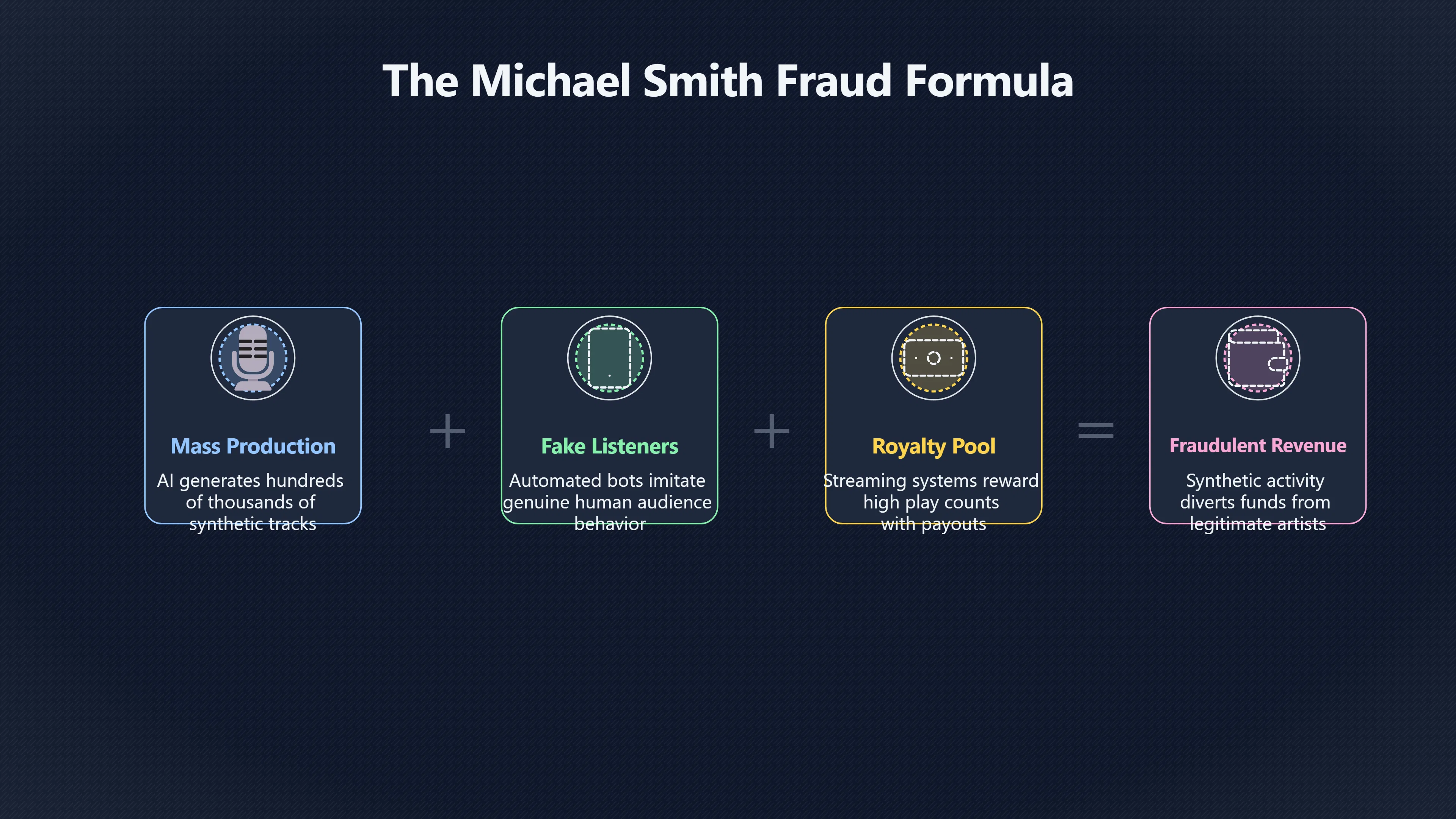
What made the case distinctive was not AI generation alone. The fraud depended on three elements working together:
- Mass production of tracks at a scale difficult for traditional recording methods to match.
- Automated listener accounts designed to resemble real users.
- Royalty systems that rewarded stream counts regardless of whether listening was genuine.
Individually, none of these elements was entirely new. The significance of the case lay in how AI lowered the cost of creating the raw material required for the scheme.[Lewis Silkin]lewissilkin.comai hits a sour note in us streaming fraud lawsuitLewis SilkinAI hits a sour note in US streaming fraud lawsuitDec 16, 2024 — A US musician and his co-conspirators stand accused of conspi…
Why small streams across many tracks are hard to spot
A common assumption is that streaming fraud always appears as a song suddenly receiving millions of suspicious plays. The Smith case suggested a more subtle approach.
Instead of creating a handful of blockbuster tracks, prosecutors alleged that streams were distributed across a huge catalogue. This strategy reduces the visibility of any single track while still generating substantial aggregate royalty income. If hundreds of thousands of songs each attract relatively modest listening numbers, the overall operation can become enormous without any individual title standing out.[Department of Justice]justice.govDepartment of Justice (DOJ). DOJ's mission is to enforce the law and defend the interests of the United States according to the…
This is one reason AI-generated music worries streaming platforms. Generative systems can create content faster than human creators can reasonably review, curate or audit it. Fraud detection systems must therefore distinguish between:
- legitimate independent artists with small audiences;
- genuine AI-assisted creators;
- large-scale synthetic catalogues designed primarily to harvest royalties.
That distinction is not always obvious from listening statistics alone. Researchers and industry groups have increasingly focused on AI-content detection and behavioural analysis because identifying artificial songs is only part of the challenge; detecting coordinated listening manipulation is equally important.[arXiv]arxiv.orgarXiv AI-Generated Music Detection and its ChallengesAI-Generated Music Detection and its ChallengesJanuary 17, 2025…
Industry evidence suggests the problem is not merely theoretical. Deezer reported that a large share of streams involving fully AI-generated music appeared fraudulent, with bots often being used to inflate play counts and collect royalty payments. The company responded by developing AI-detection systems and excluding identified fraudulent activity from royalty calculations.[The Guardian]theguardian.comDespite AI-generated tracks making up only 0.5% of overall streams, fraudsters manipulate the system by using bots to artificially inflat…
What the case says about royalty-pool leakage
The central issue raised by the Smith prosecution is royalty-pool leakage: the idea that fraudulent streams can divert money away from artists whose music was actually chosen by listeners.
Most major streaming services operate under systems where payouts are influenced by total listening activity across the platform. If artificial streams are counted, they increase the share of revenue directed toward fraudulent accounts while reducing the share available to legitimate rights holders. Prosecutors explicitly argued that the money obtained through the scheme should have gone to musicians, songwriters and other rights holders whose music received genuine listening.[Department of Justice]justice.govDepartment of Justice (DOJ). DOJ's mission is to enforce the law and defend the interests of the United States according to the…
The case therefore shifted discussion away from abstract fears about AI creativity and toward measurable financial effects. The concern was not simply that AI songs existed. The concern was that AI made it economically feasible to generate enough content to support industrial-scale manipulation of royalty systems.[WIRED]wired.comai bots streaming musicWIRED'A Billion Streams and No Fans': Inside a $10 Million AI…20 May 2025 — A chart-topping jazz album! Loads of Spotify and Apple Mus…
For streaming platforms, the challenge is compounded by scale. Millions of tracks are uploaded each month, and fraudulent operators need only capture a tiny fraction of total royalty distributions to make a scheme profitable. Deezer’s public reporting on AI-related fraud and its decision to demonetise identified fraudulent streams illustrate how platforms are increasingly treating AI-generated catalogues as a fraud-risk category rather than merely a content category.[The Guardian]theguardian.comDespite AI-generated tracks making up only 0.5% of overall streams, fraudsters manipulate the system by using bots to artificially inflat…
Why the Michael Smith case became a landmark example
The Smith prosecution is widely regarded as one of the first major criminal cases centred on AI-generated music and streaming fraud. Its importance lies less in the specific defendant than in what the alleged scheme demonstrated about the modern music economy.[Lewis Silkin]lewissilkin.comai hits a sour note in us streaming fraud lawsuitLewis SilkinAI hits a sour note in US streaming fraud lawsuitDec 16, 2024 — A US musician and his co-conspirators stand accused of conspi…
The case showed that AI can change the economics of fraud by making music supply effectively unlimited. When combined with automated listeners, that abundance can be used to exploit systems designed to reward genuine audience engagement. For critics concerned about AI-driven market flooding, the episode provided a concrete example of how synthetic music, mass uploads and bot activity can interact to extract value from royalty pools without creating corresponding cultural or artistic demand.[Department of Justice]justice.govDepartment of Justice (DOJ). DOJ's mission is to enforce the law and defend the interests of the United States according to the…[WIRED]wired.comai bots streaming musicWIRED'A Billion Streams and No Fans': Inside a $10 Million AI…20 May 2025 — A chart-topping jazz album! Loads of Spotify and Apple Mus…
eBay marketplace picks
Marketplace Samples
Example marketplace items related to this page. Use the search link to explore similar finds on eBay.



Endnotes
1.
Source: justice.gov
Link:https://www.justice.gov/usao-sdny/pr/north-carolina-musician-charged-music-streaming-fraud-aided-artificial-intelligence
Source snippet
Attorney Damian Williams said: “As alleged, Michael Smith fraudulently streamed songs created with artificial intelligence billions of...
2.
Source: justice.gov
Link:https://www.justice.gov/usao-sdny/pr/north-carolina-man-pleads-guilty-music-streaming-fraud-aided-artificial-intelligence-0
Source snippet
Department of JusticeNorth Carolina Man Pleads Guilty To Music Streaming...19 Mar 2026 — United States Attorney for the Southern Distric...
3.
Source: wired.com
Title: ai bots streaming music
Link:https://www.wired.com/story/ai-bots-streaming-music/
Source snippet
WIRED'A Billion Streams and No Fans': Inside a $10 Million AI...20 May 2025 — A chart-topping jazz album! Loads of Spotify and Apple Mus...
Published: May 2025
4.
Source: arxiv.org
Title: arXiv AI-Generated Music Detection and its Challenges
Link:https://arxiv.org/abs/2501.10111
Source snippet
AI-Generated Music Detection and its ChallengesJanuary 17, 2025...
Published: January 17, 2025
5.
Source: arxiv.org
Title: arXiv SONICS: Synthetic Or Not – Identifying Counterfeit Songs
Link:https://arxiv.org/abs/2408.14080
6.
Source: justice.gov
Link:https://www.justice.gov/
Source snippet
Department of Justice (DOJ). DOJ's mission is to enforce the law and defend the interests of the United States according to the...
7.
Source: musicbusinessworldwide.com
Title: Read more
Link:https://www.musicbusinessworldwide.com/streaming-fraud-man-who-pocketed-8m-using-hundreds-of-thousands-of-ai-songs-streamed-billions-of-times-by-bots-pleads-guilty/
Source snippet
Music Business WorldwideStreaming fraud man who pocketed $8m using hundreds of...19 Mar 2026 — Michael Smith, of Cornelius, North Caroli...
8.
Source: lewissilkin.com
Title: ai hits a sour note in us streaming fraud lawsuit
Link:https://www.lewissilkin.com/en/insights/2024/12/17/ai-hits-a-sour-note-in-us-streaming-fraud-lawsuit
Source snippet
Lewis SilkinAI hits a sour note in US streaming fraud lawsuitDec 16, 2024 — A US musician and his co-conspirators stand accused of conspi...
9.
Source: theguardian.com
Link:https://www.theguardian.com/technology/2025/jun/18/up-to-70-of-streams-of-ai-generated-music-on-deezer-are-fraudulent-says-report
Source snippet
Despite AI-generated tracks making up only 0.5% of overall streams, fraudsters manipulate the system by using bots to artificially inflat...
10.
Source: theguardian.com
Link:https://www.theguardian.com/us-news/2026/mar/21/man-pleads-guilty-music-streaming-fraud-ai
Source snippet
US man pleads guilty to defrauding music streamers out of...5 days ago — Michael Smith, 52, charged after flooding platforms with thousa...
11.
Source: dictionary.cambridge.org
Link:https://dictionary.cambridge.org/dictionary/english/department
Source snippet
English meaning - Cambridge Dictionarya part of an organization such as a school, business, or government that deals with a particular...
Additional References
12.
Source: apnews.com
Link:https://apnews.com/article/01bb3ef5a344045a64a0a7004e88df5b
Source snippet
In response to a surge in songs created with artificial intelligence—now comprising about 18% of daily uploads—Deezer will label [albums]({{ 'albums/' | relative_url }}) t...
13.
Source: rottentomatoes.com
Link:https://www.rottentomatoes.com/m/michael
Source snippet
MichaelMICHAEL is the cinematic portrayal of the life and legacy of one of the most influential artists the world has ever known. The fil...
14.
Source: musicradar.com
Link:https://www.musicradar.com/music-tech/although-the-songs-and-listeners-were-fake-the-millions-of-dollars-smith-stole-was-real-millions-of-dollars-in-royalties-that-smith-diverted-from-real-deserving-artists-and-rights-holders-us-man-pleads-guilty-to-industrial-scale-ai-fraud
Source snippet
Millions of dollars in royalties that Smith diverted from real, deserving artists and rights holders": US Man pleads guilty to industrial...
15.
Source: youtube.com
Link:https://www.youtube.com/watch?v=j7G3RUplSjU
Source snippet
Lawyer Reacts To MASSIVE $10 Million Streaming ScamIn this episode of the Top Music Attorney Podcast, Entertainment Attorney, Miss Krystl...
16.
Source: irrationalchange.com
Title: ai generated music listened to by ai bots leads to a fraud conviction
Link:https://www.irrationalchange.com/besci-ai-pulse/ai-generated-music-listened-to-by-ai-bots-leads-to-a-fraud-conviction
Source snippet
AI generated music listened to by AI bots leads to a fraud...30 Mar 2026 — A North Carolina man, Michael Smith, pleaded guilty to runnin...
17.
Source: researchgate.net
Title: 395200327 A man abused AI for several years An Academic Case Study
Link:https://www.researchgate.net/publication/395200327_A_man_abused_AI_for_several_years_An_Academic_Case_Study
Source snippet
A man abused AI for several years: An Academic Case StudySep 2, 2025 — PDF | This case examines the indictment of Michael Smith, a 52-yea...
18.
Source: rollingstone.com
Title: mike smith guilty ai generated music streaming fraud 1235534089
Link:https://www.rollingstone.com/music/music-news/mike-smith-guilty-ai-generated-music-streaming-fraud-1235534089/
Source snippet
Mike Smith Pleads Guilty to AI-Assisted Music-Streaming...19 Mar 2026 — Mike Smith pleaded guilty to defrauding music-streaming services...
19.
Source: incidentdatabase.ai
Link:https://incidentdatabase.ai/cite/779/
Source snippet
gs and fake streaming accounts to scam over $10 million in royalties from major...Read more...
20.
Source: musictech.com
Title: streaming fraudster pleads guilty eight million royalties
Link:https://musictech.com/news/industry/streaming-fraudster-pleads-guilty-eight-million-royalties/
Source snippet
fraudulent operation began all the way back in 2017. Smith has pleaded guilty to one count of conspiracy to commit wire fraud, which carr...
21.
Source: routenote.com
Link:https://routenote.com/blog/first-us-streaming-fraud-case-ai-music/
Source snippet
erves as a warning for the industry when it comes tackling streaming...Read more...
Topic Tree