Within Music
Do Algorithms Help Or Narrow Music Discovery?
Recommendation systems help listeners find music but can also reinforce patterns and make visibility harder for outsiders.

On this page
- Personalization and listener convenience
- Pattern rewards and filter effects
- What artists can and cannot control
Page outline Jump by section
Introduction
Recommendation systems now sit between listeners and a vast share of recorded music. They help people move through catalogues too large to browse by hand, turning listening history, skips, saves, playlists, context and similarity signals into personalised suggestions. At their best, these systems make discovery feel effortless: a listener opens an app and immediately finds a song that fits the moment. At their worst, they can make musical visibility less transparent, reward already legible patterns, and encourage artists to adapt their release strategies to systems they cannot fully inspect. The central question is not whether algorithms help or harm music discovery in a simple sense. They do both. They expand access by lowering search costs, while also shaping what “discoverable” music tends to look like, who gets repeated exposure, and how much control listeners and artists really have over the path from upload to audience.
Why algorithms became the new front door to music
Streaming changed music discovery because the problem shifted from scarcity to overload. A record shop, radio station or music magazine could only surface a limited number of releases. A streaming platform can host enormous catalogues, but that abundance creates a different bottleneck: attention. Recommendation systems are the platform’s answer to that bottleneck. They rank, sort and sequence songs so that a listener does not have to start each session with a blank search box.
Spotify’s own public explanation says its recommendations are selected and ordered by algorithms using signals such as what a user listens to, skips, likes, saves and adds to playlists, alongside broader information about audio content and user context. The company presents the goal as relevance: matching each listener with music, podcasts or audiobooks they are likely to enjoy at that moment.[Spotify]spotify.comunderstanding recommendationsUnderstanding recommendations on Spotify12 Mar 2026 — Spotify offers algorithmic recommendations that are relevant, unique, and sp…
The mechanism is not one single “algorithm”. Modern music discovery usually combines several approaches. Collaborative filtering looks for patterns among listeners with overlapping behaviour. Content-based systems compare tracks by audio features, metadata, genre tags or textual descriptions. Context-aware systems may weigh time of day, device, activity or recent listening session. Human curation may also be folded in, especially around editorial playlists, mood collections and genre hubs. Deezer’s published work on Flow Moods, for example, describes a system that combines collaborative filtering, audio analysis and mood annotations from professional curators to generate personalised mood-specific playlists at scale.[arXiv]arxiv.orgarXiv Flow Moods: Recommending Music by Moods on DeezerFlow Moods: Recommending Music by Moods on DeezerJuly 15, 2022…
That blend matters because discovery is no longer just “people finding songs”. It is an interaction among listeners, artists, labels, platform design, recommendation objectives and feedback loops. A listener’s casual choices train the system. The system then changes what the listener sees next. Artists notice which surfaces produce streams and adapt their campaigns accordingly. Over time, discovery becomes less like walking into a shop and more like moving through a personalised, constantly updated map.
Personalisation makes discovery easier, but not neutral
The strongest case for recommendation systems is convenience. Many listeners do not want to research every new release, follow every local scene, or manually assemble music for commuting, working, exercising or relaxing. A good recommendation system reduces effort. It can surface artists a listener would not know how to search for, maintain continuity between familiar and unfamiliar music, and turn passive listening into small moments of discovery.
Discover Weekly became the classic example of algorithmic music discovery because it made the promise feel simple: a weekly playlist that sounded personally chosen, but required no work. Spotify’s research on consumption diversity frames the platform’s challenge clearly: users can access millions of songs by millions of artists, so recommendation algorithms help them sort through abundance.[Spotify Research]research.atspotify.comalgorithmic effects on the diversity of consumption on spotifySpotify ResearchAlgorithmic Effects on the Diversity of Consumption on Spotify3 Dec 2020 — In this work, we analyze our users through the… The value is practical rather than abstract. The listener hears something new without needing to know the artist’s name, scene, label, genre term or release history.
Personalisation can also broaden discovery when it moves listeners just beyond their existing habits. If a fan of one underground jazz drummer is recommended a related contemporary ensemble, or a listener who enjoys British post-punk is introduced to a current band from another city, the algorithm acts as a bridge. Spotify’s work on exploratory search similarly shows that graph-based methods can connect queries, songs, artists, podcasts, topics and genres in ways that support more exploratory search paths; in its tests, the model increased clicks on exploratory query suggestions without hurting latency.[Spotify Research]research.atspotify.comalgorithmic effects on the diversity of consumption on spotifySpotify ResearchAlgorithmic Effects on the Diversity of Consumption on Spotify3 Dec 2020 — In this work, we analyze our users through the…
Yet personalisation is never neutral. A recommendation is not just a helpful nudge; it is a ranking decision. The same system that makes listening easier also decides which songs are not placed in front of a user. When music is encountered through personalised rows, autoplay, radio, generated playlists and “made for you” feeds, discovery can feel open while still being strongly shaped by platform choices. The listener experiences freedom, but within a designed set of options.
This is why music recommendation is best understood as a trade-off. It reduces friction, but it also gives platforms a powerful role in organising cultural attention. The user does not simply discover music; the user discovers music through a system optimised around particular signals and objectives.

The filter effect: when “more like this” becomes a narrower map
The main risk of algorithmic discovery is not that listeners are trapped forever in a sealed bubble. The evidence is more nuanced than that. The risk is that recommendation systems often work by detecting similarity, and similarity can become a conservative force. If a system learns that a user likes a narrow cluster of sounds, it has an incentive to keep serving tracks close to that cluster because those tracks are less likely to be skipped.
Spotify’s 2020 research found an important tension: diverse listening was associated with long-term user outcomes such as conversion and retention, but algorithmically driven listening through recommendations was associated with reduced consumption diversity. The study also found that when users became more diverse over time, they did so by shifting away from algorithmic consumption and increasing more organic listening.[Spotify Research]research.atspotify.comalgorithmic effects on the diversity of consumption on spotifySpotify ResearchAlgorithmic Effects on the Diversity of Consumption on Spotify3 Dec 2020 — In this work, we analyze our users through the…
That finding does not mean every recommendation makes taste smaller. It means that recommendation systems designed to maximise immediate relevance may favour safe adjacency over surprise. A track that sounds very close to a user’s recent favourites is a lower-risk suggestion than a track that opens a new scene, era or aesthetic. In music, where mood and habit matter heavily, the safest recommendation is often not the most culturally adventurous one.
Spotify’s later research on diversity in recommendation systems makes the trade-off even clearer. It formalised diversity around taste similarity and popularity, noting that recommendations can help users explore new content, spread consumption across artists and include less popular tracks. At the same time, it found that reducing user-track similarity can risk lowering immediate relevance, although lowering average popularity may be possible without harming user satisfaction as much.[Spotify Research]research.atspotify.comalgorithmic effects on the diversity of consumption on spotifySpotify ResearchAlgorithmic Effects on the Diversity of Consumption on Spotify3 Dec 2020 — In this work, we analyze our users through the…
For listeners, the filter effect is often subtle. It may not feel like being blocked from music. It feels like repetition with slight variation: the same tempo range, the same vocal texture, the same mood labels, the same small group of adjacent genres. Discovery continues, but the path may bend back towards what the system already knows. The result can be a personalised comfort zone rather than a genuinely open musical journey.
Why popularity and pattern recognition can reinforce visibility gaps
Recommendation systems do not only learn from music. They learn from behaviour around music. Saves, completions, playlist additions, skips, repeat plays and co-listening patterns all become signals. That creates a problem for newer, niche or less institutionally supported artists: before a system can confidently recommend them, it needs evidence of listener response. But to gather that evidence, the artist first needs exposure.
This is often described as a cold-start problem. New tracks and lesser-known artists may not yet have enough behavioural data for the system to place them confidently. Platforms can design exploration mechanisms to solve this, and Spotify Research has written about centralising content exploration so new content can reach its potential faster across recommender systems. Spotify describes this work as creator-centric and says online experiments showed it could reduce the time needed for new content to find its audience.[Spotify Research]research.atspotify.comalgorithmic effects on the diversity of consumption on spotifySpotify ResearchAlgorithmic Effects on the Diversity of Consumption on Spotify3 Dec 2020 — In this work, we analyze our users through the…
The existence of those interventions is revealing. It shows that algorithmic discovery does not automatically create a level playing field. Without deliberate exploration, recommendation systems can over-rely on existing signals. Popularity, early playlist traction, recognisable genre metadata, existing fan engagement and external marketing can all make a track easier for systems to interpret. Music that arrives with a clear audience signal may receive more algorithmic confidence than music that is new, hybrid, local, experimental or poorly categorised.
The UK Competition and Markets Authority’s music streaming market study examined discovery playlists and found that although the majority of tracks listed on discovery playlists were licensed by major labels, their share was lower than the majors’ combined share of total streams. That finding complicates the common claim that discovery algorithms simply hand all visibility to major-label catalogues. It suggests that discovery surfaces can provide space for non-major music, but they still operate inside a market where large rightsholders, marketing resources and catalogue scale matter.[GOV.UK]GOV.UKOpen source on gov.uk.
The practical effect is uneven opportunity rather than simple exclusion. Recommendation systems can help an unknown artist reach listeners far beyond their city or scene. But they can also reward music that is already legible to the machine: tracks with clean metadata, familiar sonic neighbours, early engagement, platform-friendly release pacing and a clear behavioural profile. Outsiders are not locked out, but they may have to become easier for the system to read.
Discovery tools give artists leverage, but also shift pressure onto them
Artists are not passive in algorithmic discovery. They can pitch songs, study listener data, time releases, encourage pre-saves, drive traffic from social platforms, build playlists, target likely audiences and use platform marketing tools. The problem is that this control is partial. Artists can influence the conditions around recommendation, but they cannot command the system to recommend a song to the right audience at the right scale.
Spotify’s Discovery Mode is the clearest example of this tension. Spotify describes it as a tool that lets artists and labels identify priority songs; the system then adds that signal to the algorithms behind personalised playlists. The company says this increases the likelihood of recommendation but does not guarantee it, and that listener engagement still affects future recommendations. Spotify also says artist teams have seen an average monthly listener increase of 106% for songs included in Discovery Mode.[Spotify for Artists]artists.spotify.comSource details in endnotes.
For artists, that sounds useful: a way to tell the platform which track matters. For critics, it raises a fairness question because Discovery Mode is not a neutral discovery switch. Reporting and industry criticism have focused on the fact that participating artists accept a lower royalty rate on eligible streams in exchange for algorithmic prioritisation, prompting comparisons with older forms of paid influence even though the mechanism is legally and technically different from radio payola.[The Guardian]theguardian.comSource details in endnotes.
The important point is not only whether Discovery Mode is “good” or “bad”. It shows how algorithmic visibility can become a market in itself. Once recommendation space is valuable, artists, labels and platforms develop tools to compete for it. Larger teams may be better able to test campaigns, interpret analytics, absorb lower margins, coordinate paid promotion and optimise release schedules. Smaller artists may still benefit, but they face a more complex environment where musical discovery is intertwined with data strategy.
What artists can control is therefore limited but real:
- They can improve clarity. Accurate metadata, consistent artist profiles, strong release information and clear genre positioning help platforms and listeners understand a track.
- They can build early signals. Saves, follows, repeat listening and genuine playlist additions can help demonstrate that a song is connecting.
- They can bring outside attention. Social media, live shows, press, mailing lists and community support can create the initial momentum that recommendation systems may later amplify.
- They cannot guarantee discovery. No tactic can force sustained algorithmic exposure if listeners skip, ignore or fail to return to the music.
- They cannot fully audit the system. Artists can see some performance data, but they usually cannot know exactly why one song was recommended more than another.
This creates a psychological burden as well as a commercial one. Musicians may feel they are not only writing songs, but also producing signals for opaque systems.

Human taste still matters, but it is increasingly mediated
A common misunderstanding is that algorithmic discovery has replaced human discovery. In reality, human taste still feeds the system constantly. A listener’s playlists, skips, saves and repeat plays are human signals. Editorial playlists often combine human judgement with data. Social platforms, radio, clubs, record shops, critics, friends and fandom communities still create momentum that streaming systems may later detect.
Research on listener experience suggests that people do not relate to algorithmic curation as a purely mechanical process. Sophie Freeman’s work on Spotify users argues that listeners build complex relationships with algorithmic features through daily interaction, sometimes treating the algorithm as useful, annoying, intimate or negotiable depending on how well it reflects their self-image and listening habits.[First Monday]firstmonday.orgSource details in endnotes.
That matters because music taste is personal. A recommendation can feel flattering when it captures a private mood, but intrusive or flattening when it misreads a listener. A platform may infer “relaxing acoustic pop” from repeated evening listening, while the listener may understand those songs as memories of a particular friend, place or breakup. Algorithms are strong at recognising patterns, but weaker at understanding why those patterns matter.
The same applies to scenes and genres. A recommender may group songs by shared listeners, sonic features or playlist co-occurrence, but scenes are also built from venues, politics, language, fashion, local histories, fan practices and artist relationships. Some of that texture can be represented in data; much of it is compressed. When recommendation systems become the main discovery layer, music can be detached from the social worlds that gave it meaning.
This does not make algorithmic discovery fake. It makes it partial. It is excellent at identifying “you may also like this”, but less reliable at explaining why a song matters, what community shaped it, or how it sits inside a living musical culture.
The design choices that decide whether discovery opens or narrows
Recommendation systems are not fixed natural forces. Their effects depend on design choices: what the platform optimises, how much novelty it permits, whether it gives users meaningful controls, how it handles new music, and whether it measures success only by immediate engagement or also by long-term diversity and creator opportunity.
Several design tensions matter most in music:
Relevance versus surprise. A system that always maximises short-term satisfaction may recommend highly familiar music. A system that allows controlled surprise may help listeners grow, but it risks more skips.
Personal taste versus catalogue diversity. A listener may want music that fits their mood, while a platform may also want to distribute attention across a broader set of artists. Spotify’s research into multi-objective recommendation explicitly frames recommendation as a balancing problem among user, artist and platform objectives.[Spotify Research]research.atspotify.comalgorithmic effects on the diversity of consumption on spotifySpotify ResearchAlgorithmic Effects on the Diversity of Consumption on Spotify3 Dec 2020 — In this work, we analyze our users through the…
Popularity versus discovery. Popular tracks provide reliable signals, but too much reliance on popularity can make discovery feel circular. Less popular tracks may need deliberate exploration space so the system can learn who might love them.
Automation versus explanation. Recommendations often work better when they are seamless, but users and artists may trust them more when they understand why something appears. A playlist labelled by mood, genre or listening habit gives more context than an unexplained autoplay queue.
User agency versus passive flow. Autoplay and radio-style recommendations are convenient, but they can reduce active searching. More controls, filters and visible alternatives can help listeners steer discovery rather than simply receive it.
Recent platform changes point towards this tension. Spotify has expanded personalised and AI-assisted playlisting tools, including prompt-based playlist generation research that retrieves track IDs directly from text prompts, with the aim of making recommendation more personalised and intuitive.[Spotify Research]research.atspotify.comalgorithmic effects on the diversity of consumption on spotifySpotify ResearchAlgorithmic Effects on the Diversity of Consumption on Spotify3 Dec 2020 — In this work, we analyze our users through the… That may give listeners more expressive control, but it also deepens the role of algorithmic systems as the interface through which music is found.
The healthier version of algorithmic discovery is not one without algorithms. It is one where systems are designed to balance fit with breadth, give new and niche music enough room to be tested, and let listeners understand and adjust the path they are being taken down.
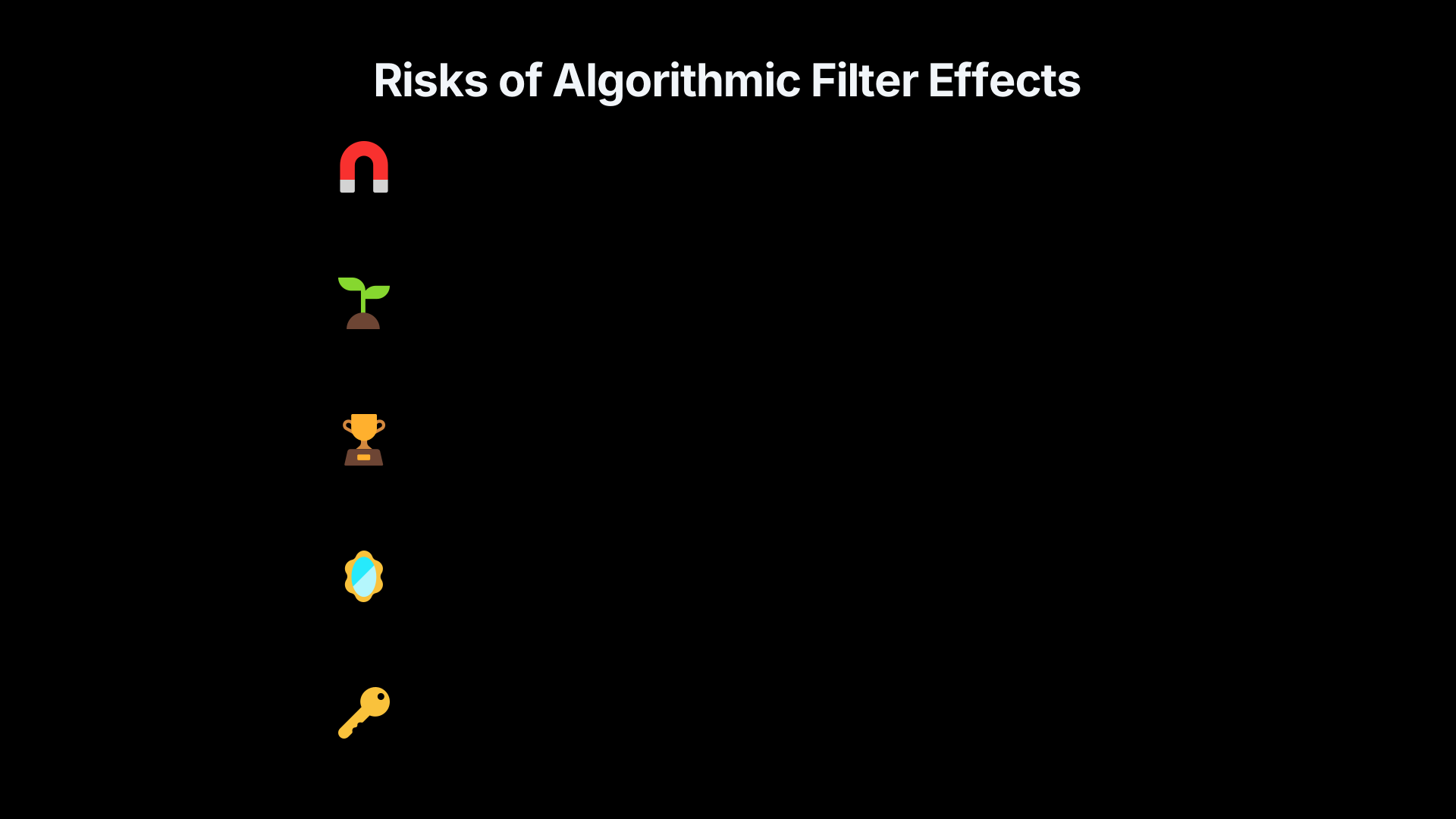
What listeners can do to keep discovery wider
Listeners are not powerless. Because recommendation systems learn from behaviour, small habits can change the discovery environment around an account. The effect is not perfect or instant, but it matters.
The simplest way to widen discovery is to mix passive and active listening. Algorithmic playlists are useful, but they should not be the only route into new music. Searching by label, producer, session musician, local scene, support act, radio show, festival line-up, record shop recommendation or independent publication introduces signals that do not come only from the platform’s existing profile of the listener.
It also helps to treat recommendations as starting points rather than final answers. When a generated playlist surfaces one strong track, the wider discovery move is to open the artist page, look at collaborators, follow the label, check related artists, explore earlier releases and save songs intentionally. Those actions give the system richer signals than letting autoplay run in the background.
Listeners can also resist mood monotony. Mood playlists are convenient, but they often organise music around functional categories such as focus, chill, sleep, gym or commute. That can be useful, yet it may reduce artists to atmosphere. Alternating mood-based listening with album listening, scene exploration and human-curated programmes helps preserve music as more than background utility.
The broader point is simple: recommendation systems are better servants than guides. They are excellent for reducing friction, but weaker at cultivating curiosity unless the listener actively gives them room to do so.
What recommendation systems really change about music discovery
Recommendation systems have not ended music discovery. They have changed its centre of gravity. Discovery used to depend more visibly on radio programmers, shops, critics, clubs, friends, television, magazines and local scenes. Those forces still matter, but streaming platforms now convert many of them into data, rankings and personalised surfaces.
That shift has three lasting consequences.
First, discovery is more individualised. Two listeners can open the same app and inhabit different musical worlds. This can make discovery feel intimate and efficient, but it can also reduce the shared cultural moments that came from many people hearing the same new song at once.
Second, discovery is more measurable. Artists and teams can track streams, saves, listener locations and playlist performance in ways previous generations could not. But measurability can become pressure: if everything is a signal, every release becomes an experiment in platform legibility.
Third, discovery is more governed by systems whose priorities are only partly visible. The platform wants satisfied users, retained subscribers, advertiser value, catalogue engagement, creator growth and commercial relationships to coexist. Those goals can align, but they can also pull against one another.
The fairest assessment is therefore mixed. Recommendation systems genuinely help listeners find music and can give artists routes to audiences that would once have been unreachable. But they also concentrate discovery power inside platforms, reward certain patterns of visibility, and make musical opportunity depend on systems that artists and listeners can influence more easily than they can understand. The question for the future of music discovery is not whether algorithms should exist. It is whether they can be designed, governed and used in ways that make curiosity easier rather than making taste quietly smaller.
Amazon book picks
Further Reading
Books and field guides related to Do Algorithms Help Or Narrow Music Discovery?. Use these as the next step if you want deeper reading beyond the article.
Weapons of Math Destruction
Provides broader context for algorithmic influence and opacity.
eBay marketplace picks
Marketplace Samples
Example marketplace items related to this page. Use the search link to explore similar finds on eBay.




Endnotes
1.
Source: spotify.com
Title: understanding recommendations
Link:https://www.spotify.com/safetyandprivacy/understanding-recommendations
Source snippet
Understanding recommendations on Spotify12 Mar 2026 — Spotify offers algorithmic recommendations that are relevant, unique, and sp...
2.
Source: arxiv.org
Title: arXiv Flow Moods: Recommending Music by Moods on Deezer
Link:https://arxiv.org/abs/2207.11229
Source snippet
Flow Moods: Recommending Music by Moods on DeezerJuly 15, 2022...
Published: July 15, 2022
3.
Source: assets.[publishing]({{ ‘publishing/’ | relative_url }}). service.gov.uk
Title: UK Music and streaming
Link:https://assets.publishing.service.gov.uk/media/6384f43ee90e077898ccb48e/Music_and_streaming_final_report.pdf
4.
Source: artists.spotify.com
Link:https://artists.spotify.com/en/discovery-mode
5.
Source: spotify.design
Link:https://spotify.design/
6.
Source: GOV.UK
Link:https://www.gov.uk/government/publications/research-into-the-impact-of-streaming-services-algorithms-on-music-consumption/the-impact-of-algorithmically-driven-recommendation-systems-on-music-consumption-and-production-a-literature-review
7.
Source: GOV.UK
Title: the impact of recommendation algorithms on the uks music industry
Link:https://www.gov.uk/government/publications/research-into-the-impact-of-streaming-services-algorithms-on-music-consumption/the-impact-of-recommendation-algorithms-on-the-uks-music-industry
8.
Source: GOV.UK
Link:https://www.gov.uk/cma-cases/music-and-streaming-market-study
9.
Source: artists.spotify.com
Title: masterclass campaign kit
Link:https://artists.spotify.com/en/video/masterclass-campaign-kit
10.
Source: support.spotify.com
Title: using discovery mode in spotify for artists
Link:https://support.spotify.com/us/artists/article/using-discovery-mode-in-spotify-for-artists/
11.
Source: artists.spotify.com
Title: display campaigns
Link:https://artists.spotify.com/display-campaigns
12.
Source: artists.spotify.com
Title: thuy how to grow audience spotify discovery mode marquee case study
Link:https://artists.spotify.com/nl/video/thuy-how-to-grow-audience-spotify-discovery-mode-marquee-case-study
13.
Source: artists.spotify.com
Title: for artists tools 101
Link:https://artists.spotify.com/en/blog/spotify-for-artists-tools-101
14.
Source: artists.spotify.com
Title: thuy on her success with campaign kit and more
Link:https://artists.spotify.com/en/video/thuy-on-her-success-with-campaign-kit-and-more
15.
Source: artists.spotify.com
Title: marquee make noise when it matters most
Link:https://artists.spotify.com/en/blog/marquee-make-noise-when-it-matters-most
16.
Source: artists.spotify.com
Title: thuy how to grow audience spotify discovery mode marquee case study
Link:https://artists.spotify.com/video/thuy-how-to-grow-audience-spotify-discovery-mode-marquee-case-study
17.
Source: research.atspotify.com
Title: algorithmic effects on the diversity of consumption on spotify
Link:https://research.atspotify.com/algorithmic-effects-on-the-diversity-of-consumption-on-spotify
Source snippet
Spotify ResearchAlgorithmic Effects on the Diversity of Consumption on Spotify3 Dec 2020 — In this work, we analyze our users through the...
18.
Source: research.atspotify.com
Title: graph learning for exploratory query suggestions in an instant search system
Link:https://research.atspotify.com/2023/10/graph-learning-for-exploratory-query-suggestions-in-an-instant-search-system
Source snippet
Spotify ResearchGraph Learning for Exploratory Query Suggestions in an...25 Oct 2023 — We developed a query suggestion model based on gr...
19.
Source: research.atspotify.com
Title: algorithmic effects on the diversity of consumption on spotify
Link:https://research.atspotify.com/publications/algorithmic-effects-on-the-diversity-of-consumption-on-spotify
20.
Source: research.atspotify.com
Title: shifting consumption towards diverse content via reinforcement learning
Link:https://research.atspotify.com/2021/03/shifting-consumption-towards-diverse-content-via-reinforcement-learning
21.
Source: research.atspotify.com
Title: accelerating creator audience building through centralized exploration
Link:https://research.atspotify.com/2024/02/accelerating-creator-audience-building-through-centralized-exploration
22.
Source: theguardian.com
Link:https://www.theguardian.com/music/2025/feb/19/spotify-discovery-mode-payola-playlist
23.
Source: firstmonday.org
Link:https://firstmonday.org/ojs/index.php/fm/article/view/11783/10589
24.
Source: research.atspotify.com
Title: mostra balancing multiple objectives for music recommendation
Link:https://research.atspotify.com/2022/04/mostra-balancing-multiple-objectives-for-music-recommendation
25.
Source: research.atspotify.com
Link:https://research.atspotify.com/2025/4/text2tracks-improving-prompt-based-music-recommendations-with-generative-retrieval
26.
Source: passivepromotion.com
Title: spotify discovery mode strategy
Link:https://passivepromotion.com/spotify-discovery-mode-strategy/
27.
Source: research.atspotify.com
Title: spotify at recsys 2019
Link:https://research.atspotify.com/2019/10/spotify-at-recsys-2019
28.
Source: horusmusic.global
Title: spotifys discovery mode explained
Link:https://www.horusmusic.global/spotifys-discovery-mode-explained/
29.
Source: youtube.com
Title: Spotify Discovery Mode
Link:https://www.youtube.com/watch?v=zstBWDUKY4g&vl=en
30.
Source: identitymusic.com
Title: spotify discovery mode the guide
Link:https://identitymusic.com/blog/spotify-discovery-mode-the-guide
Additional References
31.
Source: youtube.com
Title: How Recommendation Algorithms Shape Your Music Taste
Link:https://www.youtube.com/watch?v=1FhXG0gHw2U
Source snippet
The Science of Personalised Music Recommendations...
32.
Source: facebook.com
Link:https://www.facebook.com/ReutersUK/posts/britains-competition-regulator-has-launched-an-investigation-into-the-music-stre/5254781674531946/
33.
Source: ravensbourne.ac.uk
Link:https://www.ravensbourne.ac.uk/asset-bucket/prod/2020-10/Disrupting_the_Disrupters_MusicIndustry.pdf
34.
Source: renownedforsound.com
Link:https://renownedforsound.com/how-streaming-algorithms-shape-music-taste-discovery-playlists/
35.
Source: ism.org
Link:https://www.ism.org/wp-content/uploads/2023/08/ISM-submission-Economics-of-music-streaming.pdf
36.
Source: competitionpolicyinternational.com
Link:https://www.competitionpolicyinternational.com/wp-content/uploads/2021/03/AC-February-II.pdf
37.
Source: create.ac.uk
Link:https://www.create.ac.uk/wp-content/uploads/2022/03/CREATe-CMA-streaming-study-opinion-piece.pdf
38.
Source: music-tomorrow.com
Link:https://www.music-tomorrow.com/blog
39.
Source: andrebola.github.io
Link:https://andrebola.github.io/thesis_v_26_10_21.pdf
40.
Source: pec.ac.uk
Link:https://pec.ac.uk/wp-content/uploads/2024/01/PEC_CREATe_CMA_streaming_submission.pdf
Topic Tree