Within Music
How K Pop Built A Global Fan Machine
K-pop shows how songs, videos, performance, merchandise, fandom and online platforms can operate as one coordinated system.
On this page
- Songs, performance and visual identity
- Fandom, collecting and online coordination
- Global reach and industry pressure
Page outline Jump by section
Introduction
K-pop turns music into a fan system by treating a song as only one part of a larger, coordinated design: choreography, video, styling, collectable albums, livestreams, fan clubs, private-message apps, merchandise, voting campaigns and social media activity all reinforce one another. The result is not just a pop act with listeners, but a participatory ecosystem in which fans buy, translate, stream, organise, collect, promote and argue over the work. That is why K-pop often behaves differently from ordinary pop in the music economy. A release can be a recording, a visual concept, a performance challenge, a collectable object and a community event at the same time. The model has helped Korean acts dominate physical album sales, build unusually organised global fandoms and make direct-to-fan platforms central to the business. It has also created pressures: overwork for artists, high spending expectations for fans, environmental criticism around albums and dependence on a highly mobilised core audience. MDPI[WIPO]wipo.intbeyond music rights how kpop fandoms rally around intellectual property 73531beyond music rights how kpop fandoms rally around intellectual property 73531
Why the song is only the starting point
In much of pop, the song is the main product and everything else is promotion. K-pop reverses that hierarchy more often than it admits. The song still matters, but it is designed to travel through a network of visible, repeatable and ownable forms. A chorus becomes a dance point. A music video becomes a concept reveal. A stage outfit becomes an era-defining image. An album becomes a box of collectables. A livestream becomes a feeling of access. A fan platform becomes a place where attention can be measured, monetised and retained.
Research on K-pop’s production system stresses that entertainment companies do not simply release finished recordings into the market; they build integrated production, training and promotion systems around performers, content and fan interaction. That helps explain why K-pop is often described less as a genre in the narrow musical sense and more as an industrial format: pop songs arranged around performance, visual identity, media circulation and organised fandom.[MDPI]mdpi.comOpen source on mdpi.com.
The most important implementation choice is coordination. A comeback is usually not a single release date but a sequence: logo motion, concept photos, track list, teaser clips, music video, showcase, dance practice, broadcast stages, fan calls, album versions, behind-the-scenes content and platform posts. Each piece gives fans something to decode, share or purchase. The music becomes the centre of gravity, but the fan system is built from all the objects and rituals orbiting it.
This makes K-pop unusually legible online. A viewer who does not speak Korean can still understand a synchronised dance break, a colour-coded concept, a striking video set or a short performance clip. That visual and choreographic portability is one reason K-pop could spread through global video platforms before it had the same level of radio or mainstream media access in many countries. Early research on European audiences found that online music videos were a primary mode of consumption for fans with little access to live events, showing how internet distribution helped performance-heavy Korean pop travel beyond its domestic infrastructure.[Livrepository]livrepository.liverpool.ac.ukUm et al. 2014 K pop on the Global Platform(ENGUm et al. 2014 K pop on the Global Platform(ENG

Songs, performance and visual identity work as one product
K-pop’s fan system begins with the way acts are packaged for recognition. A group is rarely presented as only a set of voices. It has a name, logo, colour palette, member roles, choreography, styling language, fandom name, light stick, album design and recurring visual universe. These elements help fans identify the act instantly and give them objects and symbols through which to display belonging.
Choreography is especially important because it turns listening into participation. Many K-pop songs are built around memorable dance points that can be clipped, covered and repeated. Academic work on K-pop choreography notes the importance of highly synchronised group dance and memorable gestures in shifting attention from the band-as-musicians model towards the idol group as a performance unit. That shift matters because it gives fans more than a track to replay: it gives them a routine to learn, a stage to compare, and a visual signature to circulate.[Sage Journals]journals.sagepub.comSource details in endnotes.
Music videos intensify this effect. They are not just advertisements for songs; they are often the most complete statement of a group’s concept. A video may introduce a fictional world, a fashion direction, a colour scheme or a symbolic object that then reappears in stage performances and album packaging. The same release can therefore be consumed at different levels: casually as a song, visually as a video, socially as a set of clips, and deeply as a collection of references for fans to interpret.
This is why K-pop is so compatible with the language of “eras”. A new release does not merely add tracks to a catalogue; it can reset the group’s look, storyline, choreography and fan rituals. Fans compare eras, rank styling choices, debate line distribution, trade collectables from specific album versions and revisit performance stages as distinct artefacts. The music anchors the cycle, but the system turns each cycle into a wider cultural package.
Fandom becomes organised labour, not just enthusiasm
K-pop fandom is often intense because it gives fans tasks. They stream songs, buy albums, vote in award polls, translate posts, subtitle clips, organise birthday projects, manage fan accounts, coordinate chart goals, trade photocards and explain group lore to newcomers. These activities are not accidental side effects. They are encouraged by an industry structure that recognises fans as central participants in visibility and revenue.
Scholars have described K-pop fandom as part of a “fan-centred” idol production system, in which popularity depends on the continuing work of fans as much as on conventional promotion. Weverse research describes fan platforms as part of a move to domesticate and manage fandom inside company-controlled spaces, while work on fan participation highlights the shift from passive consumption towards organised digital practices.[Sage Journals]journals.sagepub.comSource details in endnotes.
The system is powerful because it converts emotional attachment into repeatable action. A casual listener may play a song. A committed fan may learn the release schedule, buy multiple album versions, stream during chart windows, join a fan platform, vote in competitions and help other fans navigate the group’s content. At scale, this turns fandom into an informal promotional network that can outperform traditional marketing in speed, persistence and global reach.
It also changes what “supporting an artist” means. In many fandom spaces, support is not only appreciation but proof: buying, voting, posting and defending. That can create belonging, friendship and shared achievement. It can also create pressure, especially when fans feel that insufficient spending or streaming might harm an artist’s career.
Collecting turns albums into fan objects
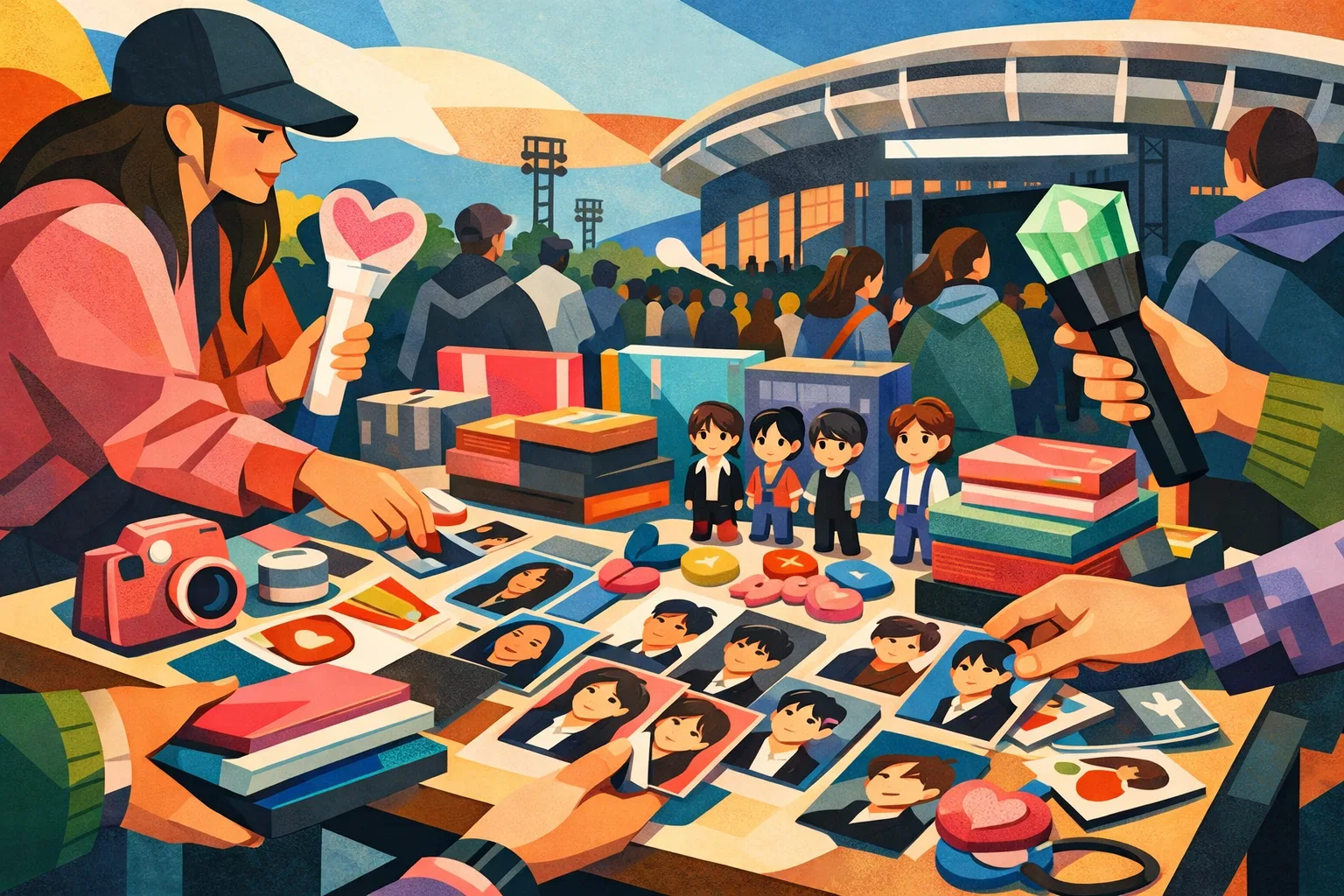
K-pop’s physical album culture shows the fan system at its clearest. In the streaming era, most listeners do not need a CD to hear music, yet K-pop albums remain commercially important because they are designed as collectable packages. They often include photobooks, posters, stickers, postcards, random photocards and multiple versions. The CD is only one component; the album is also a fan object, a lottery, a display item and sometimes an entry route to fan events.
This is why K-pop can appear disproportionately strong in physical sales compared with streaming. IFPI reported that Seventeen’s FML was the world’s top album in 2023, with five of the top ten albums by South Korean acts, while later reporting that Taylor Swift led the 2024 global album charts and that K-pop acts such as ENHYPEN and Seventeen remained among the biggest-selling global artists.[Reuters]reuters.comSeventeen's album "FML" tops IFPI global chart as K-pop dominatesSeventeen's album "FML" tops IFPI global chart as K-pop dominates
The collectable logic also explains repeated purchases. A fan may buy more than one copy to obtain different covers, member-specific photocards or more chances in a fan call or signing lottery. Recent research on K-pop CD purchases in the United States found that fans often buy albums to acquire, collect and trade photocards, support favourite artists and decorate personal spaces, with not all buyers primarily using the CD for listening.[ResearchGate]researchgate.netResearch Gate The Appeal, Popularity, and Uses of K-pop Compact DiscResearch Gate The Appeal, Popularity, and Uses of K-pop Compact Disc
This is not unique to K-pop; Western pop has also embraced variants, deluxe editions and direct-to-fan sales. The difference is that K-pop normalised a more elaborate version of the practice earlier and tied it to a dense fan infrastructure. The album is not simply a format competing with streaming. It is a membership signal, a trading card system, a chart tool and a physical extension of the group’s visual world.

Platforms make fandom measurable and monetisable
The next layer of the system is platform control. K-pop companies and related technology firms have built dedicated fan platforms that combine communication, membership, commerce, livestreaming and translation. Instead of relying only on open social media, they increasingly direct fans into proprietary spaces where engagement can be counted and monetised.
Weverse is the clearest example. Launched by HYBE in 2019, it lets artists post, livestream and sell merchandise, and Reuters reported in 2024 that it had more than 10 million monthly active users on average in the third quarter of 2023, with around nine in ten users outside South Korea.[Reuters]reuters.comOpen source on reuters.com. By 2025, Weverse’s own fandom trend report framed the service as a global superfan hub with expanded e-commerce and regional growth, while industry reporting said the platform reached 12 million monthly active users in 2025.[Weverse]en.weverse.coISSUES GLOBAL FANDOM TREND REPORTISSUES GLOBAL FANDOM TREND REPORT
DearU’s Bubble shows a more intimate version of the same model. The company describes Bubble as a private messaging service for artists and fans, while academic research on the platform notes that by 2024 it had about 2 million fan subscribers and around 600 idols or artists.[Dearu]dearu.comOpen source on dearu.com. The appeal is obvious: fans feel closer to the artist, and companies gain recurring subscription revenue and behavioural data.
These platforms reshape fandom because they place music, communication and shopping in the same funnel. A fan can watch a livestream, read translated posts, buy an album, join a membership and receive artist messages without leaving the ecosystem. For companies, this reduces dependence on third-party platforms and makes the most committed fans easier to reach. For fans, it can feel convenient and intimate. For critics, it raises questions about data, paid access, emotional labour and the commercialisation of closeness.[Sage Journals]journals.sagepub.comSource details in endnotes.
Global reach depends on localised access, not just catchy songs
K-pop’s global growth is often explained as a matter of polished songs and attractive performers, but the fan system is just as important. International fans need translation, shipping, time-zone-aware content, online events, global tour routes, multilingual subtitles and platform interfaces that make Korean entertainment legible abroad. Companies have learned to build for that audience directly.
Weverse’s machine translation, international user base and global artist expansion are part of this infrastructure. Reuters described the app as offering translation in 15 languages and reported that Ariana Grande’s move onto the platform reflected HYBE’s ambition to make Weverse a broader global superfan app rather than only a K-pop service.[Reuters]reuters.comWhat is Weverse, 'super app' joined by Ariana Grande?What is Weverse, 'super app' joined by Ariana Grande?
The model also lets fans outside South Korea participate without being physically present. They can buy imported albums, join online fan calls, attend livestreamed concerts, vote in global polls, organise local cup-sleeve events, trade photocards by post and coordinate streaming campaigns across countries. This turns distance into another design problem for the system to solve.
That said, globalisation introduces tension. Some critics argue that as K-pop companies chase international audiences, they risk flattening the qualities that made the music culturally specific, while recent industry coverage has raised questions about slowing growth, artist disputes and whether fan-driven support can remain sustainable at the same intensity.[The Guardian]theguardian.comThe Guardian'It's ended up being nothing to no one': can K-pop overcome crisis?The Guardian'It's ended up being nothing to no one': can K-pop overcome crisis? The fan system can take K-pop far beyond Korea, but it also puts pressure on companies to satisfy many markets at once.

The system creates real power, but also real strain
K-pop’s fan machine works because it gives many parties what they want. Companies get diversified revenue from albums, concerts, merchandise, memberships, licensing and platforms. Artists get unusually committed audiences who can propel them onto global charts. Fans get community, identity, collectables, routines, inside jokes and the feeling of helping an artist succeed.
HYBE’s business illustrates the revenue logic. Industry analysis of the company’s 2025 results reported record annual revenue, with artist direct-involvement businesses such as albums and concerts alongside large indirect lines such as merchandise, licensing, content and fan clubs. Another analysis of HYBE’s 2024 performance noted that recorded music was only part of the company’s revenue mix, with expanded rights and non-recorded revenue helping offset weaker recorded-music results in some quarters.[Music Business Worldwide]musicbusinessworldwide.comSource details in endnotes.
But the same system can become extractive. Fans may feel pushed towards repeated purchases; artists may be expected to maintain constant communication; and companies may rely on scarcity, randomisation and emotional access to drive revenue. Research on Bubble frames artist-fan messaging as a form of relational labour, where performers are not only singing and dancing but also sustaining an ongoing sense of personal connection for subscribers.[Taylor & Francis Online]tandfonline.comSource details in endnotes.
The physical album system has drawn particular criticism. Reuters reported in 2024 that K-pop’s heavy CD output had become a target for environmental campaigners because many fans buy albums for collectable inclusions rather than the discs themselves; the same report noted that album sales had nearly tripled even though only a small share of South Koreans used physical albums to listen to music.[Reuters]reuters.comK-pop's profligate CD output draws fire as South Korea hosts plastic waste talksK-pop's profligate CD output draws fire as South Korea hosts plastic waste talks Environmental groups and fan activists have argued that random photocards, fan-event lotteries and multiple versions encourage wasteful bulk buying, even when companies introduce “digital” or “smart” album alternatives.[SSRN]papers.ssrn.comSource details in endnotes.
The most honest reading is not that K-pop fandom is simply manipulated, nor that all fan labour is freely chosen joy. It is both. Fans are active, creative and socially powerful; they also operate inside commercial structures designed to capture that devotion. The tension is the system.
What K-pop teaches the wider music industry
K-pop’s biggest lesson for music is that the future of pop may not be organised around recordings alone. The industry increasingly talks about “superfans”, direct-to-fan platforms, premium memberships, collectables and community commerce. K-pop offers one of the most developed versions of that model: not merely selling more things to fans, but designing a whole release architecture in which every song can produce performances, objects, rituals and data.
That is why K-pop matters beyond its own scene. It shows how recorded music can become the core of a broader fan operating system. A track drives a video; the video drives clips; clips drive fandom recruitment; fandom drives album sales and chart campaigns; platforms retain fans between releases; merchandise turns identity into objects; concerts turn the online community into a physical crowd.
The risk for the wider industry is copying the surface without understanding the structure. Multiple album variants alone do not make a fan system. A private app alone does not create loyalty. Choreography alone does not build community. K-pop’s model works when songs, performers, visual design, fan rituals, platform tools and release timing are coordinated over time.
Its deeper lesson is that music now competes not only as sound, but as an environment. K-pop built one of the clearest examples of that environment: emotionally intense, visually rich, commercially sophisticated, globally networked and sometimes exhausting. It turns songs into systems by making fandom part of the product, part of the promotion and part of the meaning of the music itself.
eBay marketplace picks
Marketplace Samples
Example marketplace items related to this page. Use the search link to explore similar finds on eBay.


Endnotes
1.
Source: mdpi.com
Link:https://www.mdpi.com/2071-1050/14/17/11101
2.
Source: wipo.int
Title: beyond music rights how kpop fandoms rally around intellectual property 73531
Link:https://www.wipo.int/en/web/wipo-magazine/articles/beyond-music-rights-how-kpop-fandoms-rally-around-intellectual-property-73531
3.
Source: reuters.com
Title: Seventeen’s album “FML” tops IFPI global chart as K-pop dominates
Link:https://www.reuters.com/lifestyle/seventeens-album-fml-tops-ifpi-global-chart-k-pop-dominates-2024-02-27/
4.
Source: reuters.com
Link:https://www.reuters.com/lifestyle/taylor-swift-wins-recording-artist-year-crown-fifth-time-2025-02-18/
5.
Source: researchgate.net
Title: Research Gate The Appeal, Popularity, and Uses of K-pop Compact Disc
Link:https://www.researchgate.net/publication/399936886_Photocards_and_Collections_The_Appeal_Popularity_and_Uses_of_K-pop_Compact_Disc_Purchases_in_the_United_States
6.
Source: reuters.com
Title: What is Weverse, ‘super app’ joined by Ariana Grande?
Link:https://www.reuters.com/technology/what-is-weverse-super-app-joined-by-ariana-grande-2024-06-14/
7.
Source: en.weverse.co
Title: ISSUES GLOBAL FANDOM TREND REPORT
Link:https://en.weverse.co/news/?bmode=view&idx=165565023
8.
Source: dearu.com
Link:https://www.dearu.com/en/pages/business_bubble.php
9.
Source: reuters.com
Title: K-pop’s profligate CD output draws fire as South Korea hosts plastic waste talks
Link:https://www.reuters.com/sustainability/k-pops-profligate-cd-output-draws-fire-south-korea-hosts-plastic-waste-talks-2024-11-21/
10.
Source: papers.ssrn.com
Link:https://papers.ssrn.com/sol3/papers.cfm?abstract_id=5291937
11.
Source: researchgate.net
Link:https://www.researchgate.net/publication/371263272_The_Research_on_the_Influence_of_KPOP_Korean_Popular_Music_Culture_on_Fans
12.
Source: researchgate.net
Link:https://www.researchgate.net/publication/390505325_Platform_Fandom_Weverse_and_the_Technological_Domestication_of_Fan_Community
13.
Source: researchgate.net
Link:https://www.researchgate.net/publication/376992450_Utilization_Of_New_Media_As_Digital_Fandom_Among_Korean_Pop_K-POP_Fan_Groups_On_The_Social_Media_Platform_Twitter
14.
Source: researchgate.net
Link:https://www.researchgate.net/publication/390830166_The_Labor_Process_of_Relational_Labor_The_Case_of_the_K-Pop_Fan_Platform_Bubble
15.
Source: researchgate.net
Link:https://www.researchgate.net/publication/356869424_phenomenon_of_fandom_consumption_in_k-pop_commodity_through_the_army_community_Bangtan_Sonyeondan_fandom
16.
Source: researchgate.net
Title: 363388133 K Pop’s Global Success and Its Innovative Production System
Link:https://www.researchgate.net/publication/363388133_K-Pop%27s_Global_Success_and_Its_Innovative_Production_System
17.
Source: researchgate.net
Link:https://www.researchgate.net/publication/378928643_Creativity_and_Innovation_in_the_K-pop_System_and_a_Possible_Link_with_Pansori
18.
Source: ifpi.org
Title: GMR2025 SOTI
Link:https://www.ifpi.org/wp-content/uploads/2024/03/GMR2025_SOTI.pdf
19.
Source: ifpi.org
Title: Global Music Report 2023 State of the Industry
Link:https://www.ifpi.org/wp-content/uploads/2020/03/Global_Music_Report_2023_State_of_the_Industry.pdf
20.
Source: ifpi.org
Link:https://www.ifpi.org/taylor-swift-makes-music-history-as-ifpis-biggest-selling-global-recording-artist-of-the-year-for-the-fifth-time/
21.
Source: ifpi.org
Title: taylor swift seventeen and morgan wallen top ifpi global album charts
Link:https://www.ifpi.org/taylor-swift-seventeen-and-morgan-wallen-top-ifpi-global-album-charts/
22.
Source: honoraryreporters.korea.net
Link:https://honoraryreporters.korea.net/board/detail.do?articlecate=1&board_no=23100&pageidx=1&searchtp=all&searchtxt=Mathilde&tpln=1
23.
Source: mdpi.com
Title: 2076 328X
Link:https://www.mdpi.com/2076-328X/14/12/1136
24.
Source: dearu.com
Link:https://www.dearu.com/en/pages/about_overview.php
25.
Source: ifpi.gr
Title: charts el
Link:https://www.ifpi.gr/charts_el.html
26.
Source: journals.sagepub.com
Link:https://journals.sagepub.com/doi/10.1177/20563051251326689
27.
Source: livrepository.liverpool.ac.uk
Title: Um et al. 2014 K pop on the Global Platform(ENG)
Link:https://livrepository.liverpool.ac.uk/3034928/1/Um%20et%20al.%202014_K-pop%20on%20the%20Global%20Platform%28ENG%29.pdf
28.
Source: journals.sagepub.com
Link:https://journals.sagepub.com/doi/10.1177/2059436420974935
29.
Source: musicbusinessworldwide.com
Link:https://www.musicbusinessworldwide.com/hybe-says-weverse-hit-12m-monthly-users-last-year-and-that-its-turning-casual-fans-into-superfans/
30.
Source: tandfonline.com
Link:https://www.tandfonline.com/doi/full/10.1080/03007766.2025.2492505
31.
Source: theguardian.com
Title: The Guardian’It’s ended up being nothing to no one’: can K-pop overcome crisis?
Link:https://www.theguardian.com/music/2025/mar/27/can-k-pop-overcome-crisis
32.
Source: musicbusinessworldwide.com
Link:https://www.musicbusinessworldwide.com/hybe-posts-record-annual-revenues-of-1-86bn-for-2025-as-k-pop-firms-concert-revenues-hit-all-time-high-but-operating-profit-plunged-73/
33.
Source: musicbusinessworldwide.com
Link:https://www.musicbusinessworldwide.com/sm-entertainment-buys-additional-11-4-stake-in-bubble-superfan-app-operator-dearu-in-92m-deal/
34.
Source: musicbusinessworldwide.com
Title: hybes revenue slides 2 in q3 amid olympics impact internal challenges
Link:https://www.musicbusinessworldwide.com/hybes-revenue-slides-2-in-q3-amid-olympics-impact-internal-challenges/
35.
Source: musicbusinessworldwide.com
Link:https://www.musicbusinessworldwide.com/k-pop-in-crisis-around-93m-albums-were-sold-in-south-korea-in-2024-23m-fewer-than-in-2023/
36.
Source: facebook.com
Title: weverse hybes global superfan platform released the 2024 weverse fandom trend re
Link:https://www.facebook.com/ManilaBulletinEntertainment/posts/weverse-hybes-global-superfan-platform-released-the-2024-weverse-fandom-trend-re/1103722398217895/
37.
Source: Wikipedia
Title: Dear U
Link:https://en.wikipedia.org/wiki/Dear_U
38.
Source: dear-u.co
Title: 20240819153322 25a35e7d36a96863f1f1196b73856171
Link:https://www.dear-u.co/data/file/ir_etc/20240819153322_25a35e7d36a96863f1f1196b73856171.pdf
39.
Source: thatfangirllife.com
Title: weverse reaches 12 million monthly users according to new fandom report
Link:https://thatfangirllife.com/2026/02/weverse-reaches-12-million-monthly-users-according-to-new-fandom-report/
Additional References
40.
Source: youtube.com
Title: Inside the K-Pop Fan Participation Economy
Link:https://www.youtube.com/watch?v=d_kS3q7M02A
Source snippet
These videos explore how the K-Pop industry transforms music into a participatory fan ecosystem through structured content, organized fan...
41.
Source: academia.edu
Link:https://www.academia.edu/10271948/Kpop_Fans_Internet_and_Influence
42.
Source: instagram.com
Link:https://www.instagram.com/reel/DM0xjZnhfWD/?hl=en-gb
43.
Source: facebook.com
Link:https://www.facebook.com/vmladvertising/posts/across-all-markets-we-grew-483-in-follower-growth-which-k-pop-has-a-large-part-t/1290354576472733/
44.
Source: medium.com
Link:https://medium.com/%40byoonmee/behind-the-numbers-how-k-pop-album-sales-are-fueling-environmental-harm-327ce26acd1a
45.
Source: facebook.com
Link:https://www.facebook.com/thekoreatimes/posts/for-years-k-pop-fans-have-shown-their-dedication-by-buying-physical-albums-in-bu/1269997705305992/
46.
Source: financialreports.eu
Link:https://financialreports.eu/companies/hybe-co-ltd/
47.
Source: medium.com
Link:https://medium.com/%40ezioauditorette/emotional-equity-how-k-pop-fan-communities-became-recurring-revenue-engines-e7ee9aba2258
48.
Source: instagram.com
Link:https://www.instagram.com/p/DYkYbTwn28e/
49.
Source: alphaspread.com
Link:https://www.alphaspread.com/security/krx/352820/investor-relations
Topic Tree