Within Recording
How Portable Devices Made Music Personal Everywhere
Devices like the Walkman and MP3 player allowed music to move with listeners, making listening personal and mobile.
On this page
- From Boombox to Walkman
- Shift to Private Listening
- Mobile Music and Cultural Change
Page outline Jump by section
Introduction
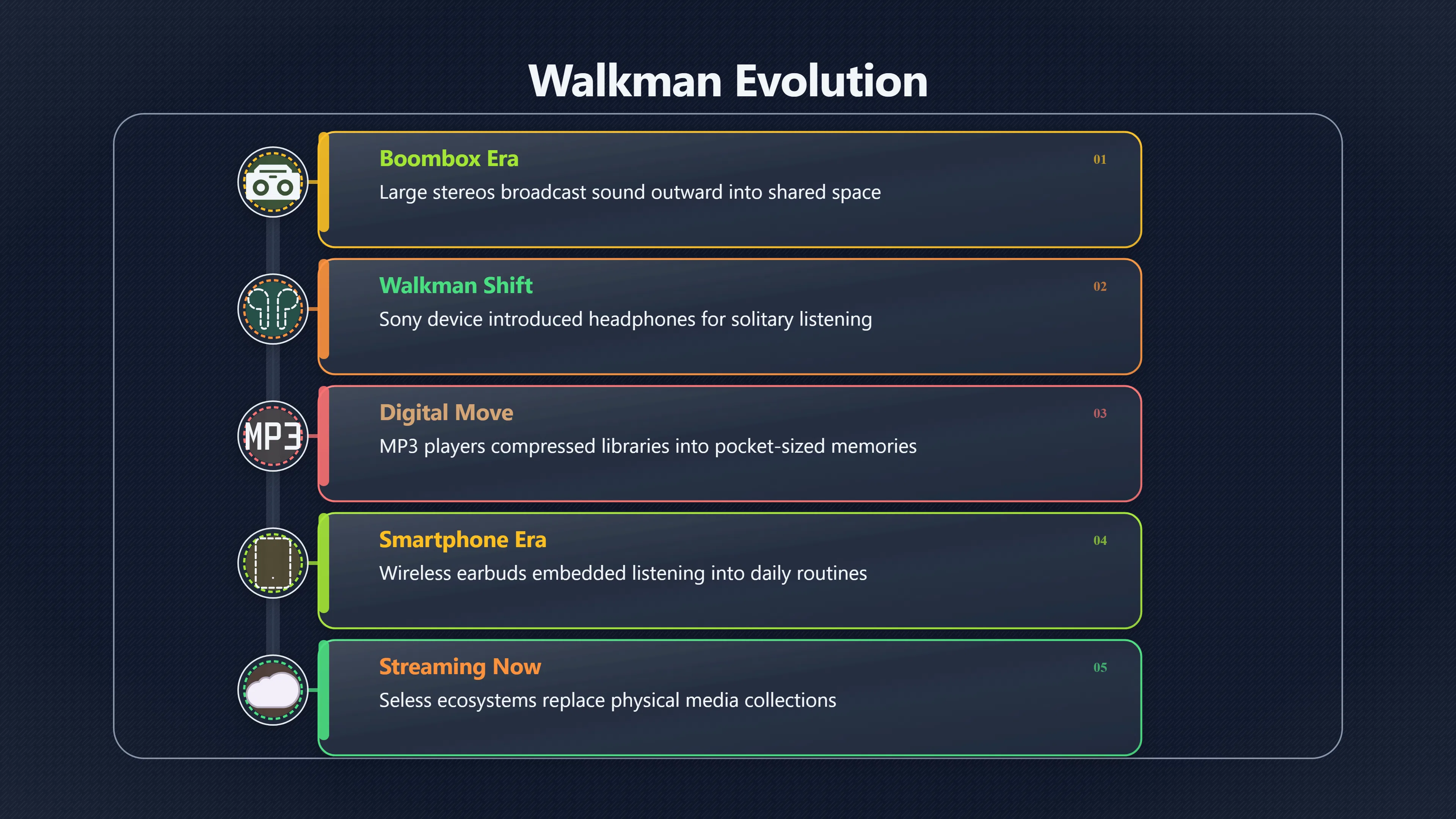
Portable listening devices fundamentally reshaped the experience of recorded music by detaching sound from fixed places and times and embedding it into everyday life. As compact, battery‑powered players evolved from bulky boomboxes to sleeker Walkmans, Discmen, MP3 players and, eventually, smartphones with wireless earbuds, they gave individuals unprecedented control over what, when and where they listened. This shift did more than enhance convenience: it altered social behaviour, redefined public and private space, and helped normalise personalised soundscapes that travel with us through work, travel and leisure.[Wikipedia]

From Boomboxes to Personal Soundtracks
Before truly personal portable players existed, portable music was already on the move in the form of boomboxes — large, battery‑powered stereos with loudspeakers carried via handles. While boomboxes made music mobile, they broadcast sound outward into shared space and became culturally associated with community scenes, especially in urban America where they were entwined with the rise of hip hop and street culture.[Wikipedia]
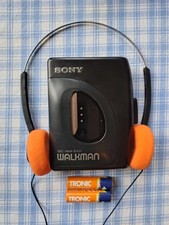
The Walkman, introduced by Sony in 1979, marked a clear break from this outward musical projection. Unlike boomboxes, it foregrounded headphones and solitary listening, enabling users to carry their own curated soundtracks through public and private spaces without imposing them on others. Its portability and emphasis on personal choice crystallised a new mode of engagement with music — one where the listener, not the location or community, set the terms of the experience.[Wikipedia]
Shift to Private Listening
The “Walkman Effect” and Personal Control
Music historian Shuhei Hosokawa coined the term the Walkman effect to describe how headphone listening with portable players gave listeners control of their sonic environment, allowing them to shape their mood and engagement with the world while simultaneously distorting or filtering their surroundings. This autonomy contrasts sharply with traditional, shared listening contexts — such as family radios or communal jukeboxes — where choice and timing were collective rather than individual.[Wikipedia]
Empirical research on mobile music listening underscores how this portability embeds music into routines such as commuting and travel. Studies show that a vast majority of users listen to music on the move, reporting that portable devices function both as companions and as tools for managing social situations and sensations during travel.[Sage Journals]journals.sagepub.comSage JournalsOn the Move: Principal Components of the Functions and Experiences of Mobile Music Listening - Mia Kuch, Clemens Wöllner, 20…

Social Reactions and Cultural Critiques
The personal, often solitary nature of portable listening devices provoked a range of cultural responses. In some contexts, users were criticised for perceived antisocial behaviour: early Walkman use drew commentary about isolation, consumerism and distraction from social interaction, with some critics decrying the headphones as symbols of individualistic retreat from shared life. For example, media coverage in the Netherlands during the 1980s framed portable players as signs of troubling individualism and social disengagement.[Sage Journals]journals.sagepub.comSage JournalsOn the Move: Principal Components of the Functions and Experiences of Mobile Music Listening - Mia Kuch, Clemens Wöllner, 20…
These concerns reflect broader cultural negotiations over public space and technology: while many embraced the ability to curate personal soundtracks in public, others saw it as eroding community norms and shared attention. Such debates foreshadowed later discussions about smartphone and wireless earbud use in public life.[The Guardian]theguardian.comInitially reliant on headphones for nearly every daily activity, the author came to realize how pervasive and escapist their usage had be…
Mobile Music and Cultural Change
Everyday Life and Identity
Portable listening devices did more than make music transportable; they were woven into users’ identities and daily rhythms. The ability to carry extensive libraries of songs — from customised mixtapes in the Walkman era to large digital collections on MP3 players — altered how people experienced time, mood and social transitions. Music became a personal backdrop to walking, working out, or commuting, reinforcing patterns of mood regulation and self‑expression on the go.[The Indian Express]indianexpress.comThe Indian ExpressRewind, Replay: How the Walkman changed the way we hear music | Technology News - The Indian Express…
As digital formats like MP3 compressed entire music collections into pocket‑sized memories, the locus of music shifted further from public institutions (radio, record stores, communal hi‑fi systems) to individuals’ bodies and routines. This accelerated a broader cultural move toward personalised media consumption, making music an intimate, ever‑present companion rather than a staged event.[CHM]

Broader Impacts and Legacy
The personal listening revolution also left visible marks on commerce and technology. Portable players helped entrench headphone culture in public spaces, influenced how artists and labels packaged and marketed music formats, and foreshadowed the seamless streaming ecosystems of the smartphone era. Though devices such as dedicated MP3 players are less central today, their legacy persists in how music fits fluidly into users’ lives and in ongoing discussions about the psychological and social effects of constant, embedded listening.[Wikipedia]
Conclusion
Portable listening devices transformed recorded music from a stationary, communal phenomenon into an intimate, mobile companion. Starting with devices like the boombox and crystallised through the Sony Walkman and its descendants, this shift empowered individuals to curate their own soundscapes amidst the routines of everyday life. The social impact of this transformation is visible in how we navigate public space, relate to personal and shared experiences of sound, and understand music as both a private refuge and a cultural artefact woven into the rhythms of daily life.[Wikipedia]
Amazon book picks
Further Reading
Books and field guides related to How Portable Devices Made Music Personal Everywhere. Use these as the next step if you want deeper reading beyond the article.
How Music Got Free
Covers the MP3 revolution that followed portable cassette and CD players.

Perfecting Sound Forever
Provides context for the evolution from home listening to portable playback.
Retromania
Touches on changing music consumption habits and technology-driven nostalgia.

eBay marketplace picks
Marketplace Samples
Example marketplace items related to this page. Use the search link to explore similar finds on eBay.



Endnotes
1.
Source: Wikipedia
Link:https://en.wikipedia.org/wiki/Walkman
2.
Source: Wikipedia
Link:https://en.wikipedia.org/wiki/Boombox
3.
Source: Wikipedia
Title: Walkman effect
Link:https://en.wikipedia.org/wiki/Walkman_effect
4.
Source: indianexpress.com
Link:https://indianexpress.com/article/technology/rewind-replay-how-the-walkman-changed-way-we-hear-music-10108139/lite/
Source snippet
The Indian ExpressRewind, Replay: How the Walkman changed the way we hear music | Technology News - The Indian Express...
5.
Source: journals.sagepub.com
Link:https://journals.sagepub.com/doi/10.1177/20592043211032852
Source snippet
Sage JournalsOn the Move: Principal Components of the Functions and Experiences of Mobile Music Listening - Mia Kuch, Clemens Wöllner, 20...
6.
Source: journals.sagepub.com
Link:https://journals.sagepub.com/doi/10.1177/13548565211060297
Source snippet
Sage JournalsThe epitome of reprehensible individualism: The Dutch response to the Walkman, 1980–1995 - Jesper Verhoef, 2022April 19, 2022...
Published: April 19, 2022
7.
Source: theguardian.com
Link:https://www.theguardian.com/technology/article/2024/jun/09/come-on-feel-the-noise-how-i-unplugged-my-headphones-and-reconnected-with-the-world
Source snippet
Initially reliant on headphones for nearly every daily activity, the author came to realize how pervasive and escapist their usage had be...
Additional References
8.
Source: smithsonianmag.com
Link:https://www.smithsonianmag.com/innovation/walkman-invention-40-years-ago-launched-cultural-revolution-180972552/
Source snippet
The Walkman's Invention 40 Years Ago Launched a Cultural RevolutionTHE WALKMAN’S INVENTION 40 YEARS AGO LAUNCHED A CULTURAL REVOLUTION IN...
9.
Source: cir.nii.ac.jp
Link:https://cir.nii.ac.jp/crid/1390853649843071232
Source snippet
Portable Music Player as the Landmark Commodity: In Case of Sony's Walkman | CiNii ResearchMarch 15, 2007 — THE PORTABLE MUSIC PLAYER AS...
Published: March 15, 2007
10.
Source: pmamagazine.org
Link:https://pmamagazine.org/boombox-bonanza-the-history-and-evolution-of-portable-music-players/
Source snippet
Boombox Bonanza: The History and Evolution of Portable Music PlayersJuly 23, 2024 — BOOMBOX BONANZA: THE HISTORY AND EVOLUTION OF PORTABL...
Published: July 23, 2024
11.
Source: allhist.com
Link:https://allhist.com/walkman
Source snippet
e that resonates with the hiss of magnetic tape and the vibrant pulse of 1980s pop culture, was far more than a mere gad...
12.
Source: neuroetpsycho.com
Title: They slip quietly into our daily lives, unnoticed at first, until we can n
Link:https://www.neuroetpsycho.com/en/walkman-personal-listening-revolution/
Source snippet
The Walkman: From shared [melody]({{ 'melody/' | relative_url }}) to solitary symphony - Neuro & PsychoJune 20, 2025 — THE WALKMAN: FROM SHARED MELODY TO SOLITARY SYMPHONY...
Published: June 20, 2025
13.
Source: cambridge.org
Title: The walkman effect* | Popular Music | Cambridge Core
Link:https://www.cambridge.org/core/journals/popular-music/article/walkman-effect/88BE235E3BF397CADFECEC5BEFF47035
Source snippet
November 11, 2008 — THE WALKMAN EFFECT* Published online by Cambridge University Press: 11 November 2008 Shuhei Hosokawa * * * Article co...
Published: November 11, 2008
14.
Source: throwbacks.com
Title: The Rise and Fall of the Walkman Era | Throwbacks
Link:https://www.throwbacks.com/posts/the-rise-and-fall-of-the-walkman-era
Source snippet
April 10, 2026 — THE RISE AND FALL OF THE WALKMAN ERA By Wren AnderssonApril 10, 2026 Music & AudioSony Walkman 90s Nostalgia Portable Au...
Published: April 10, 2026
15.
Source: blog.oup.com
Link:https://blog.oup.com/2012/07/introduction-walkman-transform-listening/
Source snippet
transformation of listening with the Walkman | OUPblogJuly 1, 2012 — THE TRANSFORMATION OF LISTENING WITH THE WALKMAN Image THE SOCIAL AN...
Published: July 1, 2012
16.
Source: generationxnow.com
Title: Why Was The Sony Walkman Important?
Link:https://www.generationxnow.com/why-was-the-sony-walkman-important/
Source snippet
Generation X NowMarch 28, 2025 — WHY WAS THE SONY WALKMAN IMPORTANT? generationxnow_5c2o4a March 28, 2025 Image: image March 27th 2025: T...
Published: March 28, 2025
17.
Source: newyorker.com
Title: The Walkman, Forty Years On | The New Yorker
Link:https://www.newyorker.com/culture/cultural-comment/the-walkman-forty-years-on
Source snippet
By Matt Alt June 29, 2020 Image: The Walkman TPSL2 model The Walkman débuted in Japan, in 1979, to near [silence]({{ 'silence/' | relative_url }})...
Published: June 29, 2020
Topic Tree