Within Music
Why Silence Can Be Music Too
Silence can create tension, space, intimacy and surprise, making absence as expressive as sound.
On this page
- Pauses, rests and anticipation
- Space in recordings and performance
- Silence as drama and meaning
Page outline Jump by section
Introduction
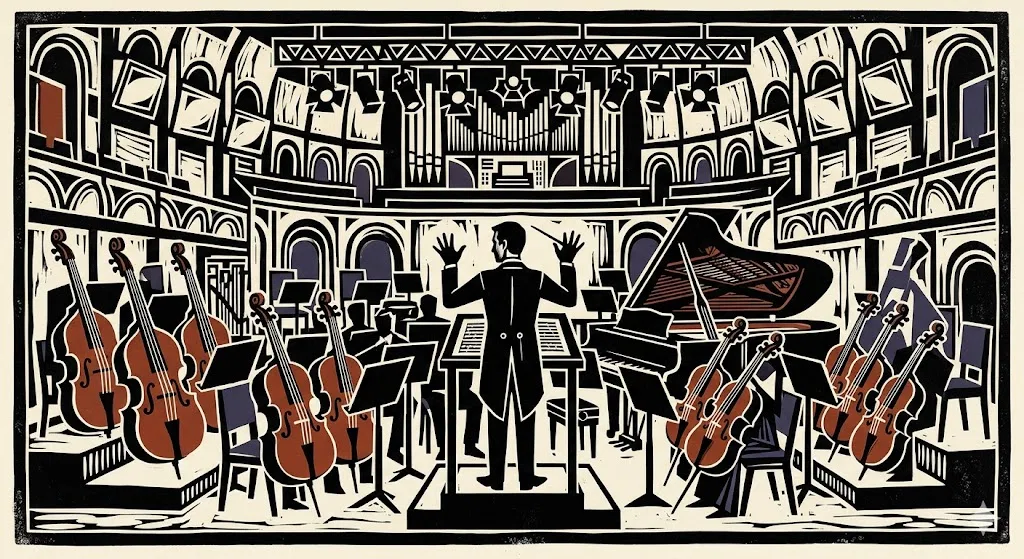
Silence matters inside music because it changes how sound is heard. A pause can make the next note feel inevitable, shocking, tender or funny; a rest can clarify a phrase; an empty bar can make a band breathe together; a sudden drop-out in a recording can make the return of sound feel enormous. Music is not only a chain of notes and beats. It is also a pattern of absences that tells listeners when to wait, lean in, remember, recover or expect surprise.
This is why silence is not just “nothing happening”. In musical context, it often carries the memory of what has just been played and the promise of what may come next. Elizabeth Hellmuth Margulis’s research on musical pauses argues that listeners do not hear silence as neutral empty time: the preceding music colours the gap, while expectations about continuation fill it with tension or closure.[JSTOR]jstor.orgSILENCES IN MUSIC ARE MUSICAL NOT SILENTJune 3, 2007 — by EH Margulis · 2007 · Cited by 86 — This study hypothesizes that listeners…
Pauses, rests and anticipation
A rest is one of music’s simplest symbols, but its effect is rarely simple. In notation, it tells a performer not to sound for a given duration. In listening, it can act more like punctuation, breath, suspense or interruption. The same length of silence can feel peaceful after a resolved cadence, uneasy after an unfinished phrase, or comic if it interrupts a pattern at just the right moment.
Margulis’s work is useful because it separates acoustic silence from musical silence. A gap in sound is not automatically meaningful on its own; it becomes musical because of where it occurs. Her study of silences after “open” and “closed” musical gestures found that context changes how silence is perceived: listeners carry the preceding phrase into the gap and anticipate what might follow.[JSTOR]jstor.orgSILENCES IN MUSIC ARE MUSICAL NOT SILENTJune 3, 2007 — by EH Margulis · 2007 · Cited by 86 — This study hypothesizes that listeners…
That mechanism is familiar outside music. A speaker who says, “You know what happened?” and then pauses has not stopped communicating. The pause creates expectation. Music can do the same without words: a drum fill that cuts out before the downbeat, a singer who delays the final word of a line, or an orchestra that stops just before a huge chord all use silence to organise attention.
The pause works because listeners are active predictors. Neuroscience research on music listening and imagery has found that people learn regularities in musical sequences and use them to anticipate and interpret what comes next. Even when sound is absent or imagined, the brain can continue tracking musical expectation rather than simply switching off.[PMC]pmc.ncbi.nlm.nih.govThe Music of Silence: Part II: Music Listening Induces Imagery…by GM Di Liberto · 2021 · Cited by 40 — During music listening, huma…
In performance, silence also has a bodily dimension. A singer takes a breath; a string player lifts the bow; a pianist holds still before the next entrance. Those visible gestures tell the audience that the silence belongs to the music rather than to a mistake. Recent performance research has treated silences as actions that performers mark, shape and time, not just as empty slots in a score.[Scholarly Publications]scholarlypublications.universiteitleiden.nlScholarly PublicationsPerforming musical silence: markers, gestures, and…10 Dec 2024 — My methods for studying silences include video…
Space in recordings and performance
Silence in music is not always literal quiet. In recordings especially, “space” can mean room around the vocal, a gap between drum hits, a sparse arrangement, a low noise floor, or frequency space that prevents instruments from masking one another. A crowded mix can feel powerful, but if everything is loud and continuous, nothing has room to arrive.
This is why producers and mixing engineers talk about space as a practical musical tool. A track can feel larger when fewer elements play at once, because the ear can locate the important sound more clearly. Sound on Sound describes “making space” as one of the central challenges of mixing, especially when many parts compete for attention.[Sound On Sound]soundonsound.comSource details in endnotes.
Dynamic range is part of the same story. If a recording has very little contrast between quiet and loud, a chorus, drop or orchestral climax may feel less dramatic because the music has not left enough room for impact. Splice’s discussion of dynamics and silence notes that recording and mixing often depend on the relationship between the softest and loudest parts, while some mainstream pop and dance production has favoured loudness and compression over wide dynamic contrast.[Splice]splice.comThe power of dynamics and silence in musicThe power of dynamics and silence in music
In performance, silence can be even more exposed. A live pause is shared time: the players must hold it together, and the audience must trust that the music has not broken. An EEG study of musicians timing pauses found that performers coordinate expressive silences through both behavioural timing and neural markers of action preparation. In other words, silence in ensemble playing is not passive waiting; it can be a demanding act of joint timing.[PMC]pmc.ncbi.nlm.nih.govOpen source on nih.gov.
This helps explain why a perfectly timed stop can electrify a room. In funk, jazz, rock, electronic music or classical performance, a band that drops out together makes the listener feel the groove more strongly, not less. The silence exposes the pulse. When the sound returns, the beat lands with renewed force because the listener has been made to carry it internally for a moment.
Space also creates intimacy. A close-miked vocal with only a few surrounding sounds can feel as though the singer is in the room. A sparse piano recording can make pedal noise, breath and room tone feel expressive. Silence in these cases does not remove emotion; it removes distraction, making small details feel human.
Silence as drama and meaning
The most famous modern test case is John Cage’s 4′33″. First performed by David Tudor in 1952, the piece instructs performers to produce no intentional sounds for four minutes and thirty-three seconds. MoMA describes it as three movements in which the performer does not deliberately play, so the listener’s attention turns to the surrounding sounds of the room.[The Museum of Modern Art]moma.orgSource details in endnotes.
Cage’s point was not that music should become blank. It was that “silence” is never purely silent in lived experience. MoMA’s account of the work notes that Cage treated silence as a way to connect the audience to ambient sound: rain, movement, breathing, coughs, footsteps and the room itself become part of the event.[The Museum of Modern Art]moma.orgSource details in endnotes. The Smithsonian Libraries likewise emphasise that the deliberate absence of instrumental sound in 4′33″ does not create pure silence; it reveals the noises usually pushed into the background.[Smithsonian Libraries and Archives]blog.library.si.edujohn cage and the sounds of silencejohn cage and the sounds of silence
That example is extreme, but it clarifies a principle that applies far beyond experimental music. Silence can frame sound. A museum frame does not create the painting, but it changes how the viewer attends to it. A musical silence can do something similar: it can make an ordinary noise, chord, lyric or entrance feel newly significant.
Silence can also carry cultural and emotional meaning. A pause before a final lyric may suggest hesitation. A cut to silence after a violent musical climax can feel like shock. A held rest before a cadence can make resolution feel earned. In memorial or ritual contexts, silence can mark collective attention, grief or respect, showing that absence can be socially expressive as well as musically structural.
This is why silence often produces stronger drama than more sound would. Adding another cymbal crash, chord or vocal ad-lib can intensify a moment, but removing sound can make the listener confront the moment more directly. The gap becomes a space where expectation, memory and bodily awareness rush in.
What silence changes for the listener
Silence changes music by changing the listener’s role. When sound stops, the listener has to complete the pattern internally. The beat continues in the body; the unresolved harmony keeps asking for release; the last word of the lyric hangs in memory. The music has not disappeared. It has moved into anticipation.
Several effects follow from that shift:
- Tension: silence after an unfinished gesture makes the listener wait for completion.
- Contrast: quiet makes the return of sound feel sharper, heavier or brighter.
- Clarity: space lets a melody, rhythm or lyric stand apart from surrounding material.
- Intimacy: sparse sound can make breath, touch and room tone feel close.
- Surprise: an unexpected stop can reset attention more quickly than another loud event.
- Meaning: a pause can imply doubt, grief, humour, awe or restraint depending on context.
The important point is that silence does not have one fixed emotional meaning. It depends on genre, tempo, performance, recording style, audience expectation and what happens immediately before and after. A break in a dance track can build collective anticipation; a rest in a string quartet can clarify form; a sudden stop in a metal riff can create physical impact; a long pause in a ballad can make vulnerability audible.

Why absence can be as expressive as sound
Silence matters inside music because music is temporal. It unfolds through expectation, delay, return and release. A note only has shape because it begins and ends. A rhythm only grips the body because attacks are separated by gaps. A phrase only breathes because it leaves room for another phrase to answer.
That makes silence one of music’s core mechanisms rather than an ornament. It organises structure, sharpens contrast, supports coordination, creates drama and gives listeners space to participate. Without silence, music can still be loud, dense or continuous, but it loses one of its strongest ways of making sound meaningful: the power to withhold.
Amazon book picks
Further Reading
Books and field guides related to Why Silence Can Be Music Too. Use these as the next step if you want deeper reading beyond the article.
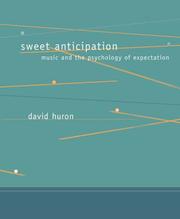
This Is Your Brain On Music
Explains expectation, anticipation and musical perception.
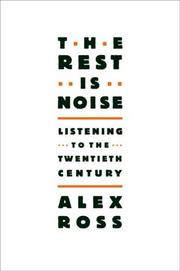
The Rest Is Noise
Discusses modern musical ideas including space, tension and listening.
eBay marketplace picks
Marketplace Samples
Example marketplace items related to this page. Use the search link to explore similar finds on eBay.

Endnotes
1.
Source: jstor.org
Link:https://www.jstor.org/stable/10.1525/mp.2007.24.5.485
Source snippet
SILENCES IN MUSIC ARE MUSICAL NOT SILENTJune 3, 2007 — by EH Margulis · 2007 · Cited by 86 — This study hypothesizes that listeners...
Published: June 3, 2007
2.
Source: pmc.ncbi.nlm.nih.gov
Link:https://pmc.ncbi.nlm.nih.gov/articles/PMC8412992/
Source snippet
The Music of Silence: Part II: Music Listening Induces Imagery...by GM Di Liberto · 2021 · Cited by 40 — During music listening, huma...
3.
Source: splice.com
Title: The power of dynamics and silence in music
Link:https://splice.com/blog/dynamics-and-silence-in-music/
4.
Source: pmc.ncbi.nlm.nih.gov
Link:https://pmc.ncbi.nlm.nih.gov/articles/PMC7812619/
5.
Source: moma.org
Link:https://www.moma.org/calendar/exhibitions/1386
6.
Source: moma.org
Link:https://www.moma.org/slideshows/24/389
7.
Source: splice.com
Title: what is funk music
Link:https://splice.com/blog/what-is-funk-music/
8.
Source: scholarlypublications.universiteitleiden.nl
Link:https://scholarlypublications.universiteitleiden.nl/[access
Source snippet
Scholarly PublicationsPerforming musical silence: markers, gestures, and...10 Dec 2024 — My methods for studying silences include video...
9.
Source: scholarlypublications.universiteitleiden.nl
Link:https://scholarlypublications.universiteitleiden.nl/access/item%3A4172030/view
10.
Source: soundonsound.com
Link:https://www.soundonsound.com/techniques/making-space-your-mix
11.
Source: blog.library.si.edu
Title: john cage and the sounds of silence
Link:https://blog.library.si.edu/blog/2018/06/22/john-cage-and-the-sounds-of-silence/
12.
Source: audioservices.studio
Link:https://audioservices.studio/category/mixing
13.
Source: talentedmusicapp.com
Title: silence in music
Link:https://talentedmusicapp.com/en/blog/silence-in-music
Additional References
14.
Source: news.uark.edu
Title: exploring the sounds of silence
Link:https://news.uark.edu/articles/9745/exploring-the-sounds-of-silence
Source snippet
Arkansas NewsExploring the Sounds of Silence | Arkansas News20 Jun 2007 — When a listener encounters silence in a musical work, Margulis...
15.
Source: jneurosci.org
Link:https://www.jneurosci.org/content/41/35/7435
Source snippet
Journal of NeuroscienceThe Music of Silence: Part I: Responses to Musical Imagery...by G Marion · 2021 · Cited by 66 — This study reveal...
16.
Source: researchgate.net
Link:https://www.researchgate.net/publication/337682903_The_Use_of_Silence_in_Selected_Compositions_by_Frederic_Devreese_A_Musical_Analysis_of_Notated_and_Acoustic_Silences
17.
Source: medium.com
Link:https://medium.com/%40ssourmoghe1/a-quote-that-stands-out-ff3be95c08a9
18.
Source: reddit.com
Link:https://www.reddit.com/r/classicalmusic/comments/1dega6p/a_question_to_people_who_agree_with_john_cages_433/
19.
Source: researchgate.net
Link:https://www.researchgate.net/publication/343366614_The_Sound_of_Silence_An_EEG_study_of_how_musicians_time_pauses_in_individual_and_joint_music_performance
20.
Source: academia.edu
Link:https://www.academia.edu/43890472/Analysis_of_Silences_in_Music_Theoretical_Perspectives_Analytical_Examples_from_Twentieth_Century_Music_and_In_Depth_Case_Study_of_Webern_s_Op_27iii_complete
21.
Source: reddit.com
Link:https://www.reddit.com/r/musictheory/comments/1e8g8t8/anyone_have_a_generalized_analysis_of_james_brown/
22.
Source: facebook.com
Link:https://www.facebook.com/JBerlinMusicGroup/posts/here-are-three-quotesdebussy-the-music-is-not-in-the-notes-but-in-the-silence-be/1194372208919326/
23.
Source: pbslearningmedia.org
Link:https://www.pbslearningmedia.org/resource/how-james-brown-invented-funk-video/sound-field/
Topic Tree
Follow this branch
Parent topic
MusicRelated pages 39
- Cage 4 33 How John Cage’s 4′33″ Redefines Musical Silence
- Emotional Silence How Silence Communicates Emotion and Meaning in Music
- Pauses & Tension How Pauses Build Anticipation in Music
- Performance Gestures How Performers Use Gesture to Shape Silence
- Recording Space Why Silence Shapes the Impact of Recorded Music