Within Lullabies
Why Repetition Helps Babies Settle
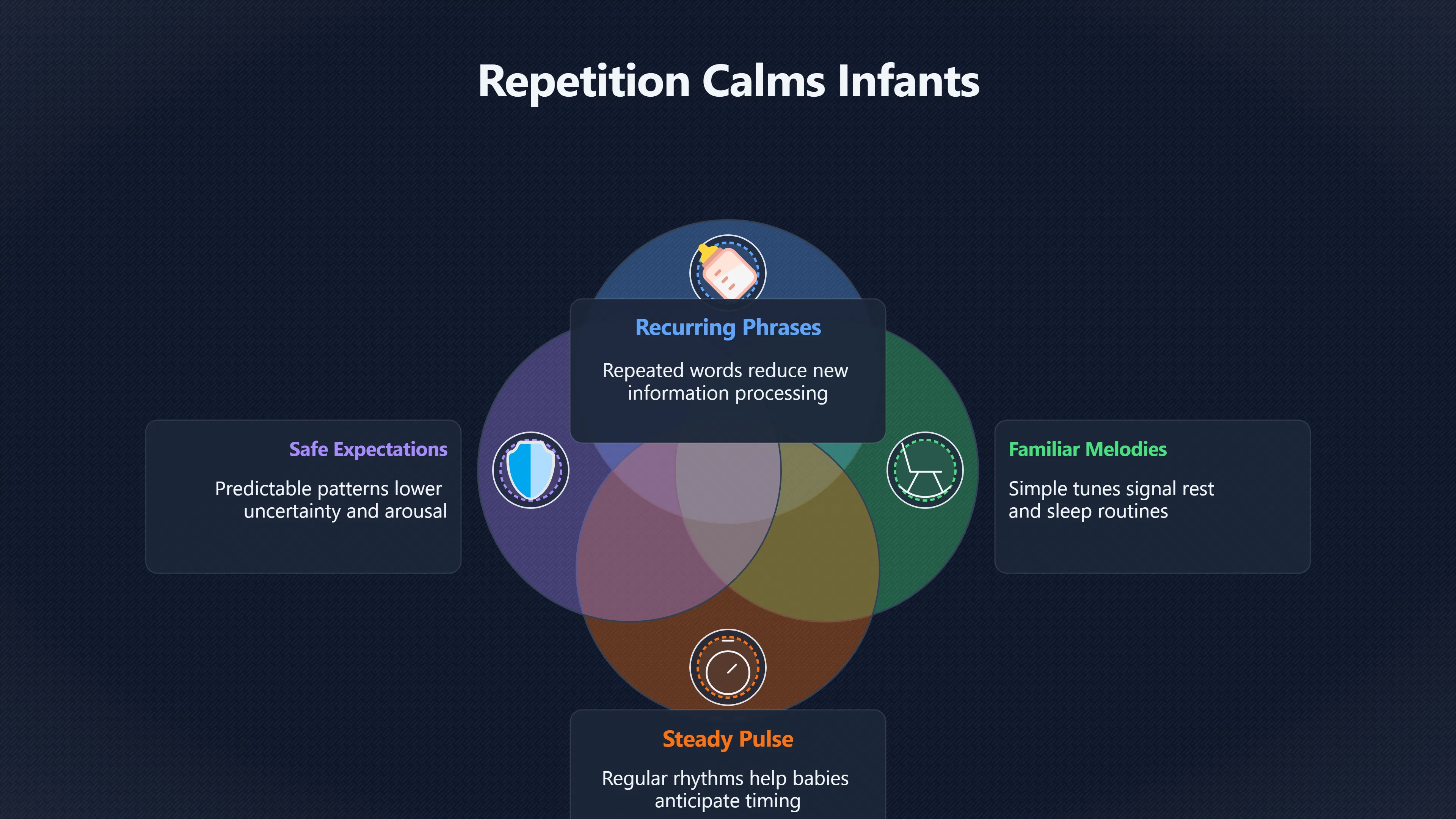
Repeated phrases and simple patterns make lullabies easier for babies to process and less likely to startle them.
On this page
- Predictable phrases and lower uncertainty
- Simple melody as a soothing cue
- When repetition becomes overstimulating
Page outline Jump by section
Introduction
Repetition is one of the most important ways lullabies help babies settle. While many forms of music attract attention by introducing new melodies, rhythms, and surprises, soothing baby songs often do the opposite. They rely on recurring phrases, repeated syllables, familiar melodic contours, and highly predictable timing. This reduces the amount of new information a baby must process and creates a stable auditory environment that is less likely to trigger alertness. Research on infant responses to lullabies suggests that babies relax not only to familiar songs but also to unfamiliar lullabies from other cultures, indicating that certain predictable musical features themselves contribute to calming effects.[Nature]nature.comInfants relax in response to unfamiliar foreign lullabiesby CM Bainbridge · 2021 · Cited by 113 — We show that US infants (N = 144)…
Why Predictable Phrases Feel Safe
Babies enter the world with developing sensory systems that are constantly processing new sights and sounds. In this context, predictability matters. A song built from repeated words, sounds, and melodic patterns creates fewer surprises than music that changes direction every few seconds.
Many traditional lullabies repeat short vocal units such as “la-la”, “hush”, or simple rhythmic phrases. The same melodic shape may return again and again with only minor variation. This repetition allows the infant’s brain to form expectations about what comes next. Rather than continually evaluating new auditory information, the listener encounters a pattern that becomes increasingly familiar with each repetition.[Wikipedia]WikipediaSource details in endnotes.
Studies of infant-directed singing show that lullabies across cultures share common structural characteristics, including reduced variability and predictable organisation. Infants respond to these features even when the songs are sung in unfamiliar languages, suggesting that the calming effect does not depend primarily on understanding words. Nature[PubMed]pubmed.ncbi.nlm.nih.govPub Med Infants relax in response to unfamiliar foreign lullabieshuman mind, or both. Here, we show that US infants (N = 144) relax in response to eight unfamiliar foreign lullabies, relative to matched…
Lower Uncertainty, Lower Arousal
Music researchers often describe listening as a process of forming expectations. When music becomes highly unpredictable, listeners must constantly update those expectations. Predictable music creates the opposite experience: fewer surprises and a more stable sense of what will happen next. Research on musical expectancy has shown that predictability strongly influences emotional responses to music.[arXiv]arxiv.orgarXiv Effects of pitch and timing expectancy on musical emotionEffects of pitch and timing expectancy on musical emotionAugust 11, 2017…
For infants, whose attention can be easily redirected by sudden changes, this reduction in uncertainty may be especially important. Repeated patterns help maintain a calm auditory environment in which nothing demands immediate attention. Instead of encouraging exploration or excitement, the music signals continuity and safety.
How Simple Melodies Become Soothing Cues
A lullaby’s melody is often simple enough that its shape can be anticipated after only a few repetitions. Rather than large leaps or dramatic contrasts, the tune usually moves gradually and returns to familiar notes.
This simplicity turns the melody itself into a cue for relaxation. Once a baby hears the same melodic contour repeatedly, the brain can predict upcoming notes with increasing accuracy. Predictable musical structures require less processing effort than constantly changing ones, making the listening experience gentler and more stable.[ScienceDirect]sciencedirect.comSing to me, baby: Infants show neural tracking and…by T Nguyen · 2023 · Cited by 45 — On the other hand, lullabies are ch…
Repeated melodies also gain power through familiarity. Even when a child is too young to consciously recognise a song, repeated exposure can create associations between that melody and comforting routines such as rocking, feeding, or bedtime. Over time, hearing the opening phrase alone may signal that sleep or rest is approaching.
This helps explain why caregivers often sing the same lullaby night after night. Consistency transforms a simple tune into a learned calming signal. Experts on infant sleep similarly note that familiar, repeated musical tracks can become effective bedtime cues when used consistently.[Parents]parents.comSay Music Helps Their Babies Sleep Better-Here's What to TryThe survey, conducted via Instagram stories, found that 77% of parents observed better sleep in their babies when incorporating music int…

Repetition Across Rhythm and Timing
Predictability in lullabies is not limited to melody. Rhythm also tends to be highly regular.
Many soothing songs maintain a steady pulse with few abrupt pauses or accents. Repeated rhythmic cycles allow infants to anticipate timing as well as pitch. Emerging research suggests that humans develop sensitivity to rhythmic regularities very early in life, with newborns showing evidence of tracking and anticipating rhythmic patterns.[The Guardian]theguardian.comLed by Dr. Roberta Bianco, the study used EEG to analyze the brain activity of 49 sleeping newborns exposed to original and randomized ve…
When rhythm repeats consistently, each cycle confirms the expectation established by the previous one. This creates a sense of continuity that can support relaxation. In contrast, sudden rhythmic disruptions, unexpected accents, or rapid tempo shifts are more likely to draw attention and increase alertness.
The effect is often strengthened when the singer naturally synchronises the lullaby with rocking, breathing, or gentle movement. Repeated auditory and physical patterns reinforce one another, making the experience even more predictable.
When Repetition Becomes Overstimulating
Although repetition is generally calming, more repetition is not always better. A soothing lullaby usually combines repetition with subtle variation.
If a song becomes excessively loud, rhythmically insistent, or mechanically repetitive, it can stop functioning as a calming cue and instead become a source of stimulation. Repetition works best when it occurs within a gentle framework that includes soft dynamics, gradual phrasing, and a moderate pace.
Caregivers often introduce tiny changes in timing, volume, or vocal expression while preserving the song’s overall structure. These small variations keep the performance natural without undermining predictability. The baby still recognises the pattern, but the music remains warm and human rather than rigid.
The Core Mechanism
The calming power of repetition in lullabies comes from its ability to reduce uncertainty. Repeated words, recurring melodic shapes, and stable rhythms create a sound world that is easy to predict. As expectations are repeatedly confirmed rather than challenged, the music becomes less demanding to process and less likely to provoke alertness. Research showing that infants relax to unfamiliar lullabies from distant cultures suggests that these predictable musical characteristics are not merely traditional conventions—they are central elements of how soothing baby songs work. Nature[PMC]pmc.ncbi.nlm.nih.govPMCInfants relax in response to unfamiliar foreign lullabiesby CM Bainbridge · 2020 · Cited by 115 — We show that American infants (N = 144) relax in response to 8 unfamiliar foreign lullabies…
Amazon book picks
Further Reading
Books and field guides related to Why Repetition Helps Babies Settle. Use these as the next step if you want deeper reading beyond the article.
This Is Your Brain On Music
Relevant to predictability, expectation, and musical processing.

Musicophilia
With an introduction by neuroscientist Daniel Glaser. With his trademark compassion and erudition, Dr Oliver Sacks examines the power of...
eBay marketplace picks
Marketplace Samples
Example marketplace items related to this page. Use the search link to explore similar finds on eBay.


Endnotes
1.
Source: nature.com
Link:https://www.nature.com/articles/s41562-020-00963-z
Source snippet
Infants relax in response to unfamiliar foreign lullabiesby CM Bainbridge · 2021 · Cited by 113 — We show that US infants (N = 144)...
2.
Source: pmc.ncbi.nlm.nih.gov
Title: PMCInfants relax in response to unfamiliar foreign lullabies
Link:https://pmc.ncbi.nlm.nih.gov/articles/PMC8220405/
Source snippet
by CM Bainbridge · 2020 · Cited by 115 — We show that American infants (N = 144) relax in response to 8 unfamiliar foreign lullabies...
3.
Source: Wikipedia
Link:https://en.wikipedia.org/wiki/Lullaby
4.
Source: arxiv.org
Title: arXiv Effects of pitch and timing expectancy on musical emotion
Link:https://arxiv.org/abs/1708.03687
Source snippet
Effects of pitch and timing expectancy on musical emotionAugust 11, 2017...
Published: August 11, 2017
5.
Source: arxiv.org
Link:https://arxiv.org/abs/1709.03629
6.
Source: sciencedirect.com
Link:https://www.sciencedirect.com/science/article/pii/S1878929323001184
Source snippet
Sing to me, baby: Infants show neural tracking and...by T Nguyen · 2023 · Cited by 45 — On the other hand, lullabies are ch...
7.
Source: arxiv.org
Link:https://arxiv.org/abs/2210.16587
8.
Source: parents.com
Title: Say Music Helps Their Babies Sleep Better-Here’s What to Try
Link:https://www.parents.com/parents-say-music-helps-their-babies-sleep-better-heres-what-to-try-11803447
Source snippet
The survey, conducted via Instagram stories, found that 77% of parents observed better sleep in their babies when incorporating music int...
9.
Source: nature.com
Link:https://www.nature.com/
Source snippet
First published in 1869, Nature is the world's leading multidisciplinary science journal. Nature publishes the finest peer-reviewed...
10.
Source: sciencedirect.com
Link:https://www.sciencedirect.com/science/article/pii/S0163638396900466
Source snippet
Infant preferences for infant-directed versus noninfant-...by LJ Trainor · 1996 · Cited by 457 — The infant-directed playsongs were rate...
11.
Source: pubmed.ncbi.nlm.nih.gov
Title: Pub Med Infants relax in response to unfamiliar foreign lullabies
Link:https://pubmed.ncbi.nlm.nih.gov/33077883/
Source snippet
human mind, or both. Here, we show that US infants (N = 144) relax in response to eight unfamiliar foreign lullabies, relative to matched...
12.
Source: theguardian.com
Link:https://www.theguardian.com/science/2026/feb/05/newborn-babies-can-anticipate-rhythm-in-music-researchers-find
Source snippet
Led by Dr. Roberta Bianco, the study used EEG to analyze the brain activity of 49 sleeping newborns exposed to original and randomized ve...
13.
Source: mehr.nz
Link:https://mehr.nz/pdf/2021_BainbridgeBertoloEtAl_NHB.pdf
Source snippet
Infants relax in response to unfamiliar foreign lullabiesby CM Bainbridge · Cited by 116 — Together, these findings suggest that infants...
14.
Source: pubmed.ncbi.nlm.nih.gov
Link:https://pubmed.ncbi.nlm.nih.gov/24441085/
Source snippet
of lullaby and classical music on physiologic stability...by E Amini · 2013 · Cited by 95 — Music can affect vital signs of preterm infa...
Additional References
15.
Source: researchgate.net
Link:https://www.researchgate.net/publication/404567031_Development_of_Auditory_and_Spontaneous_Movement_Responses_to_Music_over_the_First_Postnatal_Year
Source snippet
Development of Auditory and Spontaneous Movement...9 May 2026 — This study simultaneously investigates infants' neural (auditory) respon...
Published: May 2026
16.
Source: researchgate.net
Link:https://www.researchgate.net/publication/344783134_Infants_relax_in_response_to_unfamiliar_foreign_lullabies
Source snippet
Infants relax in response to unfamiliar foreign lullabiesInfants relax in response to unfamiliar foreign lullabies. Springer Nature. Natu...
17.
Source: polifonia-project.eu
Link:https://polifonia-project.eu/seminars/infants-relax-in-response-to-unfamiliar-foreign-lullabies/
18.
Source: upf.edu
Link:https://www.upf.edu/web/cbc/activities/-/asset_publisher/Lemqx7vH40kE/content/infants-relax-in-response-to-unfamiliar-foreign-lullabies/maximized
Source snippet
infant directed song, in that they relax to them even when the songs are drawn from unfamiliar cultures and sung in unfamiliar languages...
19.
Source: facebook.com
Title: infants relaxed more in response to the lullabies including unfamiliar foreign o
Link:https://www.facebook.com/NaturePortfolioJournals/posts/infants-relaxed-more-in-response-to-the-lullabies-including-unfamiliar-foreign-o/10158129951193167/
Source snippet
Infants relax in response to unfamiliar foreign lullabiesInfants relaxed more in response to the lullabies, including unfamiliar foreign...
20.
Source: github.com
Link:https://github.com/themusiclab/infant-relax
Source snippet
This repository contains data and code for Bainbridge & Bertolo et al. (2020, Nature Human Behaviour)...Read more...
21.
Source: cognitivesciencesociety.org
Link:https://cognitivesciencesociety.org/cogsci20/papers/0591/index.html
Source snippet
AbstractMusic is a human universal characterized by acoustical forms that are predictive of its...Read m...
22.
Source: themusicscientist.com
Title: the science of lullabies how slower bpms aid your childs sleep
Link:https://www.themusicscientist.com/the-science-of-lullabies-how-slower-bpms-aid-your-childs-sleep/
Source snippet
How Slower BPMs Aid Your Child's Sleep26 Oct 2025 — Research-Backed Benefits. Faster Sleep Onset. Children listening to 60-80 BPM music f...
23.
Source: maggiemoo-music.com
Link:https://maggiemoo-music.com/the-fascinating-science-of-bedtime-lullabies/
Source snippet
Research has shown that babies prefer songs with a slower tempo and simple melodies...Read more...
24.
Source: gosh.nhs.uk
Title: research proves lullabies really do help children feel better
Link:https://www.gosh.nhs.uk/press-releases/research-proves-lullabies-really-do-help-children-feel-better/
Source snippet
lullabies really do help to soothe poorly children and reduce their perception of pain... The music study involved 37 paediatric patient...
Topic Tree