Within Timbre
How Vocal Tract Formants Define Individual Timbre
Formants shaped by the human vocal tract create unique timbres that allow instant voice recognition.
On this page
- Formant formation and resonance patterns
- Impact on voice recognition
- Vocal timbre across speakers
Page outline Jump by section
Introduction
Human voices have a distinctive timbre — a perceptual quality that lets us recognise speakers and instruments as unique even when their pitch and loudness are the same. A central acoustic mechanism behind this timbre is the pattern of vocal tract formants: resonance peaks shaped by the geometry of the throat, mouth and nasal cavities. Formants filter the raw sound from the vocal folds, sculpting the spectral envelope in ways that encode both vowel identity and individual voice characteristics. In music and speech, this filtering gives each person’s voice its characteristic tone colour and makes familiar voices instantly recognisable.[Voice Science]voicescience.orgVoice Science Formant: Vocal Tract Resonance and Vowel IdentityVoice Science Formant: Vocal Tract Resonance and Vowel Identity
How Vocal Tract Formants Are Formed and What They Represent
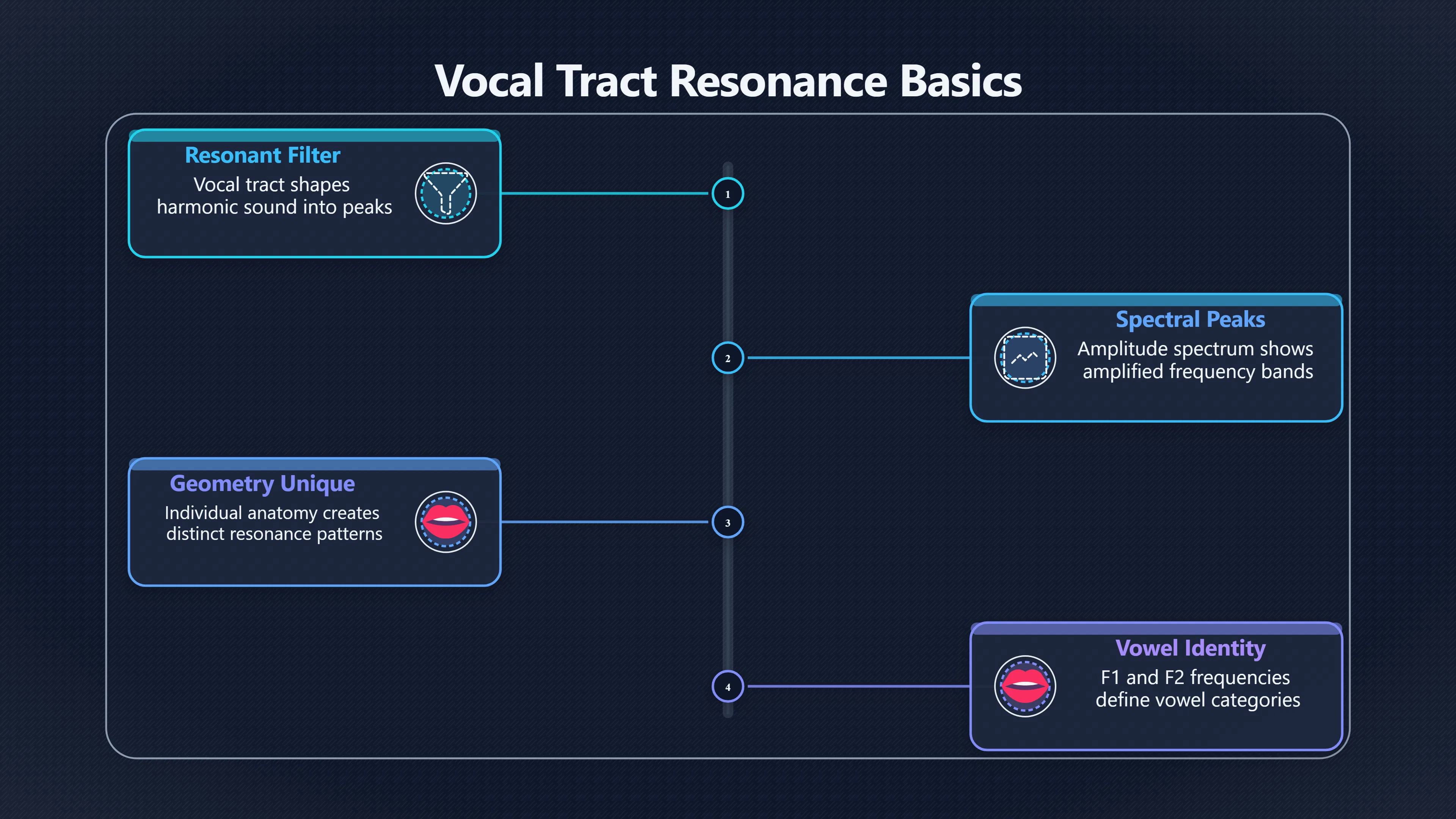
Formants are peaks in the amplitude spectrum that arise because the vocal tract acts as a resonant filter on the sound produced by vibrating vocal folds. In the source–filter model of voice production, the larynx generates a harmonic-rich sound series, and as that sound travels through the cavities of the pharynx, oral cavity and nasal passages, certain bands of frequencies are preferentially amplified because they coincide with the tract’s resonances. These amplified bands are the formants.[Voice Science]voicescience.orgVoice Science Formant: Vocal Tract Resonance and Vowel IdentityVoice Science Formant: Vocal Tract Resonance and Vowel Identity
In acoustic terms, formants correspond to peaks in the spectral envelope — a smooth curve that connects the strongest frequency components of the sound. The vocal tract’s shape determines where these peaks occur: longer or larger cavities produce lower-frequency formants, while smaller, tighter shaped cavities produce higher-frequency formants. Because the tract’s geometry varies among individuals (in overall length, shape of the tongue space, lip position, jaw opening), the detailed pattern of formants is unique to each voice.[SpringerLink]link.springer.comText-Independent Speaker Identification Using Vowel Formants | Journal of Signal Processing Systems | Springer Nature LinkMay 5…
Formants are usually numbered from lowest to highest (F1, F2, F3…). The first two formants (F1 and F2) are most critical for distinguishing vowels: F1 correlates with mouth opening and pharyngeal volume, and F2 with the front‑back position of the tongue. Higher formants (F3, F4…) contribute less to vowel identity but are essential to voice quality, colour and perceived individuality.[Voice Science]voicescience.orgVoice Science Formant: Vocal Tract Resonance and Vowel IdentityVoice Science Formant: Vocal Tract Resonance and Vowel Identity
Formants and Voice Recognition: Timbre Identity Across Speakers
What makes one person’s voice recognisable from another’s? While pitch (the fundamental frequency) relates to vocal fold vibration speed, formants shape the spectral envelope in ways tightly linked to vocal tract geometry. Research in speech science shows that vowels cluster in a two‑dimensional acoustic space defined by F1 and F2 values; listeners use these positions to identify vowel categories reliably. Variations in formant frequencies above these core two also contribute to individual timbral differences.[Frontiers]frontiersin.orgFrontiersFrontiers | Neural and behavioral investigations into timbre perceptionNovember 13, 2013…
Because anatomical differences (vocal tract length, cavity sizes, articulator habitus) vary from person to person, each speaker’s formant pattern forms a kind of acoustic fingerprint. Techniques in speaker identification explicitly extract vowel formants as features that remain robust across utterances and can distinguish one speaker from another.[Springer]link.springer.comText-Independent Speaker Identification Using Vowel Formants | Journal of Signal Processing Systems | Springer Nature LinkMay 5…
Even when fundamental frequency changes (for example, when singing higher or lower notes), the vocal tract resonances often remain relatively stable in frequency. This independence between pitch and formant structure is one reason why artificially shifting pitch without preserving formants (as sometimes occurs in digital pitch correction) can make a voice sound “unnatural” or uncanny — because the expected resonance patterns are altered in a way our auditory system does not recognise as human.[Reddit]reddit.comWhat is the difference between when i sing a G Note and sing an F then pitch it whole step up digitally?January 6, 2024…
How Formants Relate to Timbre in Music and Expression
In musical contexts, singers and voice coaches often talk about “placing” the sound or adjusting vocal tract shape. Acoustically, these adjustments are changes in formant positions and bandwidths. Trained singers can manipulate their vocal tract to bring a resonance closer to a harmonic of the sung pitch — a practice known as formant tuning — which increases the amplitude and perceived richness of the tone without changing pitch. This strategy contributes to stylistic timbre distinctions (e.g., classical versus contemporary singing) and affects how expressive and “present” a voice sounds in performance.[Royal Holloway Research Portal]pure.royalholloway.ac.ukRoyal Holloway Research PortalThe Perception of Formant Tuning in Soprano Voices - Royal Holloway Research PortalJanuary 1, 2018…
Beyond individual control, the interaction of formants with the auditory system’s pattern‑recognition processes shapes the emotional and identity cues carried by speech and song. Listeners are highly attuned to spectral envelope features like formant positions and bandwidths, using them to perceive qualities such as brightness, nasality, breathiness and even speaker gender or character.[Frontiers]frontiersin.orgFrontiersFrontiers | Neural and behavioral investigations into timbre perceptionNovember 13, 2013…
Vocal Timbre Across Speakers and Styles
Although the basic mechanism of formants is consistent across humans, their acoustic manifestation varies with both physiology and intentional articulation. Speakers and singers change tongue height, tongue advancement, lip rounding, jaw opening and soft palate position to modify formant positions, and this shapes both phonetic content (which vowel is heard) and timbre quality (how that vowel colour sounds).[Voice Science]voicescience.orgVoice Science Formant: Vocal Tract Resonance and Vowel IdentityVoice Science Formant: Vocal Tract Resonance and Vowel Identity
Moreover, higher formants beyond F2 are more sensitive to subtle geometry changes and contribute disproportionately to what we perceive as voice individuality and expressivity. In professional singing, these higher resonances can be exploited to enhance projection and presence in different acoustic environments, and psychoacoustic research shows that changes in formant distributions influence how listeners assess vocal richness or brightness.[PMC]pmc.ncbi.nlm.nih.govPMCVocal tract resonances in speech, singing, and playing musical instrumentsPMCVocal tract resonances in speech, singing, and playing musical instruments
In everyday speech, small articulatory differences across speakers — from habitual tongue position to the habitual openness of the mouth — create consistent formant patterns that our brains learn to associate with particular individuals. This learned sensitivity to spectral shape, rather than just pitch or loudness, is a cornerstone of human voice recognition.[Frontiers]frontiersin.orgFrontiersFrontiers | Neural and behavioral investigations into timbre perceptionNovember 13, 2013…
Summary
Formants are resonance peaks produced by the human vocal tract acting as a filter on the harmonic sound from the vocal folds. The specific pattern of formant frequencies — shaped by the unique anatomy and dynamic articulation of the throat, mouth and nasal cavities — defines both vowel identity and an individual’s voice timbre. Because listeners’ brains are tuned to these spectral patterns, formants underlie much of what makes a voice sound human and recognisable in both speech and singing.[Voice Science]voicescience.orgVoice Science Formant: Vocal Tract Resonance and Vowel IdentityVoice Science Formant: Vocal Tract Resonance and Vowel Identity
Amazon book picks
Further Reading
Books and field guides related to How Vocal Tract Formants Define Individual Timbre. Use these as the next step if you want deeper reading beyond the article.

The science of the singing voice
Directly explains formants, resonance and vocal timbre.


Principles of voice production
Detailed treatment of source-filter theory and formant behavior.
eBay marketplace picks
Marketplace Samples
Example marketplace items related to this page. Use the search link to explore similar finds on eBay.


Endnotes
1.
Source: pmc.ncbi.nlm.nih.gov
Title: PMCVocal tract resonances in speech, singing, and playing musical instruments
Link:https://pmc.ncbi.nlm.nih.gov/articles/PMC2689615/
2.
Source: link.springer.com
Link:https://link.springer.com/article/10.1007/s11265
Source snippet
Text-Independent Speaker Identification Using Vowel Formants | Journal of Signal Processing Systems | Springer Nature LinkMay 5...
3.
Source: reddit.com
Link:https://www.reddit.com/r/audioengineering/comments/18zz8zq
Source snippet
What is the difference between when i sing a G Note and sing an F then pitch it whole step up digitally?January 6, 2024...
Published: January 6, 2024
4.
Source: link.springer.com
Link:https://link.springer.com/article/10.3758/s13428-023-02288-x
Source snippet
practical guide to calculating vocal tract length and scale-invariant formant patterns | Behavior Research Methods | Springer Nature Link...
5.
Source: link.springer.com
Link:https://link.springer.com/article/10.1007/s10237
Source snippet
frequencies and bandwidths of the vocal tract transfer function are affected by the mechanical impedance of the vocal tract wall | Biomec...
6.
Source: voicescience.org
Title: Voice Science Formant: Vocal Tract Resonance and Vowel Identity
Link:https://www.voicescience.org/lexicon/formant/
7.
Source: bmcbiol.biomedcentral.com
Link:https://bmcbiol.biomedcentral.com/articles/10.1186/s12915-025-02188-w
Source snippet
SpringerLinkFormant analysis of vertebrate vocalizations: achievements, pitfalls, and promises | BMC Biology | Full TextApril 7, 2025...
Published: April 7, 2025
8.
Source: frontiersin.org
Link:https://www.frontiersin.org/article/10.3389/fnsys.2013.00088/abstract
Source snippet
FrontiersFrontiers | Neural and behavioral investigations into timbre perceptionNovember 13, 2013...
Published: November 13, 2013
9.
Source: pure.royalholloway.ac.uk
Link:https://pure.royalholloway.ac.uk/en/publications/the-perception-of-formant-tuning-in-soprano-voices/
Source snippet
Royal Holloway Research PortalThe Perception of Formant Tuning in Soprano Voices - Royal Holloway Research PortalJanuary 1, 2018...
Published: January 1, 2018
10.
Source: pure.york.ac.uk
Title: york.ac.uk The Perception of Formant Tuning in Soprano Voices
Link:https://pure.york.ac.uk/portal/en/publications/the-perception-of-formant-tuning-in-soprano-voices
Source snippet
Perception of Formant Tuning in Soprano Voices - York Research DatabaseMay 26, 2017 — THE PERCEPTION OF FORMANT TUNING IN SOPRANO VOICES...
Published: May 26, 2017
Additional References
11.
Source: pure.royalholloway.ac.uk
Link:https://pure.royalholloway.ac.uk/en/publications/using-an-exponential-sine-sweep-to-measure-the-vocal-tract-resona/
Source snippet
an exponential sine sweep to measure the vocal tract resonances - Royal Holloway Research PortalUSING AN EXPONENTIAL SINE SWEEP TO MEASUR...
12.
Source: researchportal.helsinki.fi
Title: fi How far are vowel formants from computed vocal tract resonances?
Link:https://researchportal.helsinki.fi/en/publications/how-far-are-vowel-formants-from-computed-vocal-tract-resonances/
Source snippet
University of HelsinkiAugust 29, 2012 — HOW FAR ARE VOWEL FORMANTS FROM COMPUTED VOCAL TRACT RESONANCES? Daniel Aalto, Antti Huhtala, Atl...
Published: August 29, 2012
13.
Source: vocevista.com
Link:https://www.vocevista.com/en/doc/theory-resonances/
Source snippet
The vocal tract has multiple resonances simultaneously, each of which amplifies sound near...
14.
Source: biologyinsights.com
Title: What Are Formants and How Do They Work?
Link:https://biologyinsights.com/what-are-formants-and-how-do-they-work/
Source snippet
Biology InsightsJuly 31, 2025 — WHAT ARE FORMANTS AND HOW DO THEY WORK? * July 31, 2025 Formants are key elements of human speech, repres...
Published: July 31, 2025
15.
Source: sciencedirect.com
Title: A Formant Range Profile for Singers
Link:https://www.sciencedirect.com/science/article/pii/S0892199716301096
Source snippet
"ScienceDirectJOURNAL OF VOICE Volume 31, Issue 3, May 2017, Pages 382.e9-382.e13 A FORMANT RANGE PROFILE FOR SINGERS [https://doi.org/10.1..."](https://doi.org/10.1...")...
Published: May 2017
16.
Source: ncvs.org
Title: How the Vocal Tract Filters Sound
Link:https://ncvs.org/how-the-vocal-tract-filters-sound/
Source snippet
As we phonate, our vocal folds produce a complex sound spectrum, made up of a wide range of frequencies and overtones. As this spectrum trav...
17.
Source: wiki.ubc.ca
Title: Formantand Timbreinthe Human Voice
Link:https://wiki.ubc.ca/Course%3APHYS341/Archive/2016wTerm2/FormantandTimbreintheHumanVoice
Source snippet
ubc.caCourse:PHYS341/Archive/2016wTerm2/FormantandTimbreintheHumanVoice - UBC WikiMay 5, 2017 — COURSE:PHYS341/ARCHIVE/2016WTERM2/FORMANT...
Published: May 5, 2017
18.
Source: sfu.ca
Title: Simon Fraser University Formant
Link:https://www.sfu.ca/sonic-studio-webdav/handbook/Formant.html
Source snippet
Formant> FORMANT > > * * * > > A characteristic RESONANCE region. A musical instrument may have several formant [regions]({{ 'regions/' | relative_url }}) dictated by the s...
19.
Source: pmc.ncbi.nlm.nih.gov
Link:https://pmc.ncbi.nlm.nih.gov/articles/PMC11525281/
Source snippet
practical guide to calculating vocal tract length and scale-invariant formant patterns - PMCDecember 29, 2023 — LINEAR FORMANTS AND VTL-B...
Published: December 29, 2023
20.
Source: pmc.ncbi.nlm.nih.gov
Link:https://pmc.ncbi.nlm.nih.gov/articles/PMC11974057/
Source snippet
Image: Fig. 1 Open in a new tab Basic source-filter theory. A A schematic larynx and vocal tract of a nonhuman primate, illustrating that...
Topic Tree