Within Melody
What Makes a Tune Become an Earworm?
Earworm melodies often combine repetition, simple contours and distinctive turns that make them unusually easy to replay mentally.
On this page
- Common melodic traits of earworms
- Why exposure and repetition matter
- How inner singing keeps the loop alive
Page outline Jump by section
Introduction
An earworm is not just a memorable melody. It is a melody that continues replaying in the mind without conscious effort, often as a short fragment such as a chorus, hook or riff. Research on involuntary musical imagery—the scientific term for songs getting stuck in the head—suggests that earworms emerge when a tune combines two qualities that rarely coexist: it is easy to process and sing internally, yet distinctive enough to stand out from countless other melodies. The most effective earworm melodies tend to rely on familiar shapes, strong repetition and a small number of unusual turns that keep the brain returning to them. Exposure also matters: the more often a listener encounters a tune, the more likely it is to become mentally available for replay.[American Psychological Association]apa.orgAmerican Psychological AssociationMelodic Features and Song Popularity Predict Involuntary…by K Jakubowski · Cited by 132 — Involuntar…[Durham Repository]durham-repository.worktribe.comDurham RepositoryDissecting an earworm: Melodic features and song popularity…by K Jakubowski · 2016 · Cited by 137 — The present study…

Common Melodic Traits of Earworms
One of the strongest findings in earworm research comes from a large study led by Kelly Jakubowski and colleagues, which analysed songs frequently reported as earworms by thousands of participants. The researchers found that earworm songs often share surprisingly ordinary melodic foundations. They tend to use familiar contours and straightforward pitch patterns that listeners can quickly learn and predict.[American Psychological Association]apa.orgAmerican Psychological AssociationMelodic Features and Song Popularity Predict Involuntary…by K Jakubowski · Cited by 132 — Involuntar…
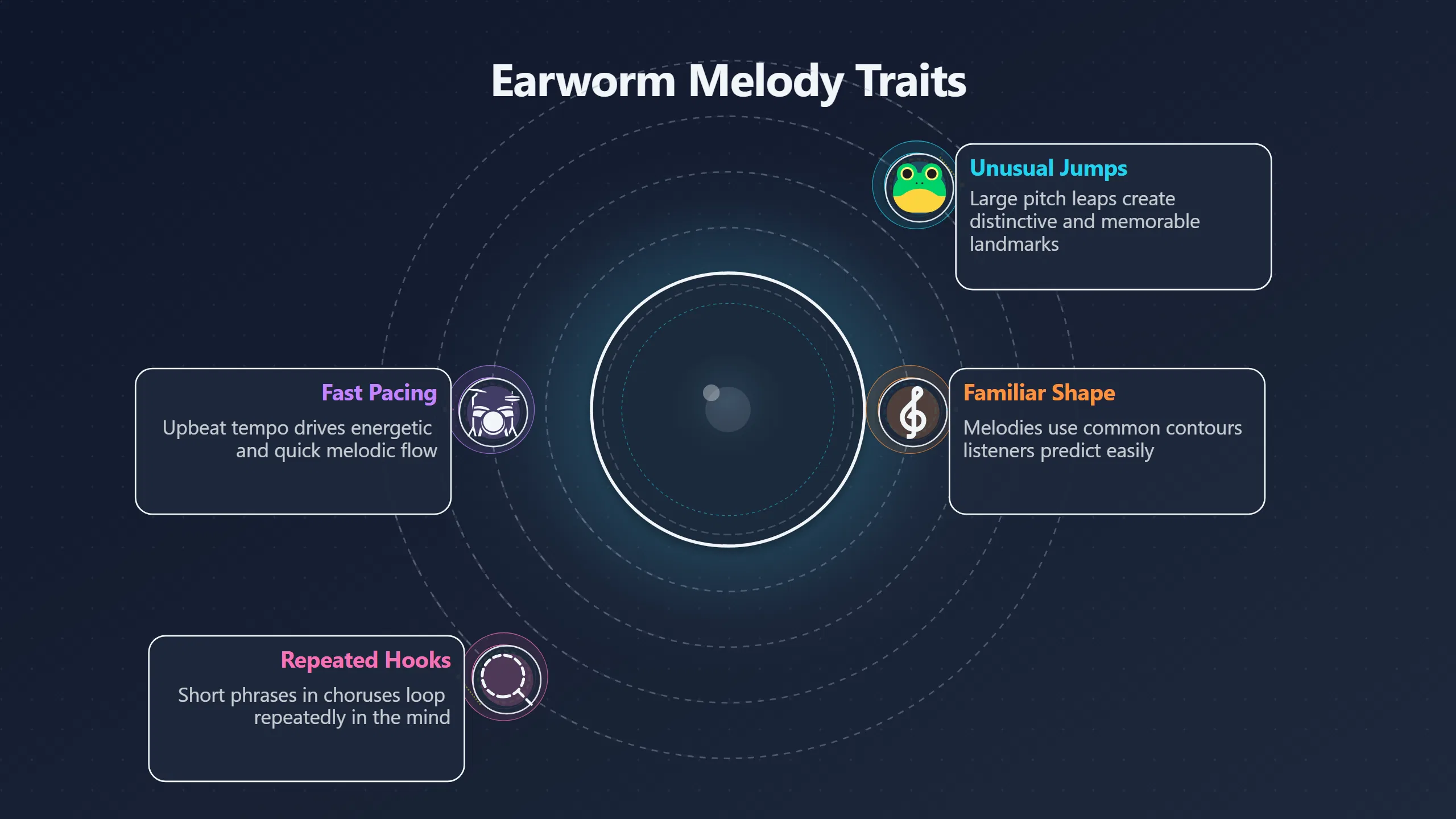
However, simplicity alone is not enough. Many songs are simple but forgettable. Earworms usually add a distinctive feature that separates them from the average tune. Research identified several recurring characteristics:
- A melody that follows a common, easily processed shape.
- Fast or energetic pacing.
- Unusual interval jumps or melodic leaps.
- Repeated notes or repeated short fragments.
- Strong hooks concentrated in choruses or riffs.[American Psychological Association]apa.orgAmerican Psychological AssociationMelodic Features and Song Popularity Predict Involuntary…by K Jakubowski · Cited by 132 — Involuntar…[Goldsmiths, University of London]gold.ac.ukscientists find key to writing catchy pop hitssmiths, University of LondonScientists find key to writing catchy pop hitsNov 3, 2016 — A 3,000-person study led by Dr Kelly Jakubows…
This combination helps explain why certain melodic fragments remain mentally active. A listener quickly understands the overall pattern, but the unusual detail creates a memorable landmark. In cognitive terms, the melody is both predictable and distinctive.
Examples often cited by researchers include the opening riff of “Smoke on the Water”, the chorus of “Bad Romance”, and the hook of “Can’t Get You Out of My Head”. These melodies are not complex. Instead, they pair familiar movement with a striking feature such as repeated notes or unexpectedly large pitch jumps.[EurekAlert!]eurekalert.orgnews releasesEurekAlert!Psychologists identify key characteristics of earworms3 Nov 2016 — "These musically sticky songs seem to have quite a fast tem…[Time]time.comearworm musicThis Is Why Songs Get Stuck In Your Head3 Nov 2016 — But earworms also tend to have some unique and unusual intervals… repeated notes…

Why Repetition and Exposure Matter
A melody rarely becomes an earworm on its musical structure alone. Repeated exposure greatly increases the chances that a tune will enter involuntary recall.
Studies of earworms consistently show that recent listening experiences are among the strongest predictors of what becomes stuck in the mind. Popular songs receive more radio play, streaming activity and social exposure, which increases the number of opportunities for the brain to encode and rehearse their melodic patterns. Jakubowski’s research found that song popularity itself helped predict earworm likelihood alongside melodic characteristics.[Durham Repository]durham-repository.worktribe.comDurham RepositoryDissecting an earworm: Melodic features and song popularity…by K Jakubowski · 2016 · Cited by 137 — The present study…
More recent experiments have examined what happens when listeners repeatedly hear previously unfamiliar songs. These studies suggest that repeated exposure can help transform a novel melody into an earworm by strengthening mental representations of its chorus and vocal line. Researchers also found evidence that repeated listening promotes internal replay through mechanisms related to working memory.[PMC]pmc.ncbi.nlm.nih.govAn “earworm”—the experience of a catchy melody that repeats persistently in the mind—is a ubiquitous yet mysterious cognitive phenomenon…
This aligns with a broader psychological principle known as the mere exposure effect: repeated encounters with a stimulus often increase familiarity and ease of processing. In music, that familiarity can make a melodic fragment easier to retrieve and mentally repeat.[The Washington Post]washingtonpost.comThe Washington Post Why catchy songs get stuck in your head (and how to stop itThese musical snippets often persist due to their repetitive, simple, and singable nature. Upbeat and easily repeatable songs, especially…
Importantly, earworms are usually not entire songs. People often report only a brief section looping repeatedly. A highly repetitive chorus or hook provides a compact unit that the mind can easily cycle through again and again.[Sage Journals]journals.sagepub.comSage JournalsInvoluntary, Limited, and Contiguously Repeating Musical…by E Schubert · 2023 · Cited by 5 — “Earworms” have been propose…
How Inner Singing Keeps the Loop Alive
An earworm persists because the brain does not merely remember the melody—it actively recreates it.
Researchers describe earworms as a form of involuntary musical imagery. When people experience them, they often engage in what has been called “inner singing”: a silent mental performance of the melody. Experiments indicate that vocal earworms recruit working-memory processes similar to those used when imagining speech or singing internally.[PMC]pmc.ncbi.nlm.nih.govAn “earworm”—the experience of a catchy melody that repeats persistently in the mind—is a ubiquitous yet mysterious cognitive phenomenon…
This helps explain why melodies with clear vocal shapes are especially sticky. A tune that can be easily hummed, sung or imagined places relatively low demands on memory. Once activated, the melodic fragment can cycle repeatedly through the mind’s rehearsal systems.
Some researchers propose that earworms operate through chains of connected musical segments. When one segment becomes activated, it primes the next, creating a self-sustaining loop. Because many earworms consist of short, highly repetitive phrases, the sequence can repeatedly reactivate itself rather than progressing toward closure.[Sage Journals]journals.sagepub.comSage JournalsInvoluntary, Limited, and Contiguously Repeating Musical…by E Schubert · 2023 · Cited by 5 — “Earworms” have been propose…
The result is the familiar experience of hearing a melody internally even when no external music is present.

Why Distinctive Simplicity Is the Winning Formula
A common misconception is that earworms succeed because they are musically sophisticated. The evidence points in the opposite direction. The melodies most likely to become earworms are often built from simple, familiar materials. Their power comes from a carefully balanced mixture of familiarity and novelty.
If a melody is too ordinary, it blends into the background. If it is too unusual, it becomes difficult to remember. Earworms occupy the middle ground: they are easy enough to learn after only a few listens but distinctive enough to attract attention and remain identifiable.[American Psychological Association]apa.orgAmerican Psychological AssociationMelodic Features and Song Popularity Predict Involuntary…by K Jakubowski · Cited by 132 — Involuntar…[American Psychological Association]apa.orgAmerican Psychological AssociationMelodic Features and Song Popularity Predict Involuntary…by K Jakubowski · Cited by 132 — Involuntar…
This balance helps explain why certain short melodic fragments persist for days while others disappear immediately after a song ends. The most effective earworm melodies give the brain a pattern it can effortlessly replay—and a twist it does not want to forget.[Durham Repository]durham-repository.worktribe.comDurham RepositoryDissecting an earworm: Melodic features and song popularity…by K Jakubowski · 2016 · Cited by 137 — The present study…[2pitchfork.com]pitchfork.comWhy Do Songs Get Stuck in Your Head?New Study Has the AnswerA study published in the American Psychological Association's journal investigated the nature of "involuntary mus…
Amazon book picks
Further Reading
Books and field guides related to What Makes a Tune Become an Earworm?. Use these as the next step if you want deeper reading beyond the article.
This Is Your Brain On Music
Directly relevant to earworms, memory, and musical repetition.
Sweet Anticipation
First published 2006. Subjects: Expectation (Psychology), Music, Psychological aspects of Music, Psychological aspects, Musikpsychologie.
eBay marketplace picks
Marketplace Samples
Example marketplace items related to this page. Use the search link to explore similar finds on eBay.




Endnotes
1.
Source: eurekalert.org
Title: news releases
Link:https://www.eurekalert.org/news-releases/555535
Source snippet
EurekAlert!Psychologists identify key characteristics of earworms3 Nov 2016 — "These musically sticky songs seem to have quite a fast tem...
2.
Source: time.com
Title: earworm music
Link:https://time.com/4557229/earworm-music/
Source snippet
This Is Why Songs Get Stuck In Your Head3 Nov 2016 — But earworms also tend to have some unique and unusual intervals... repeated notes...
3.
Source: pmc.ncbi.nlm.nih.gov
Link:https://pmc.ncbi.nlm.nih.gov/articles/PMC10585939/
Source snippet
An “earworm”—the experience of a catchy melody that repeats persistently in the mind—is a ubiquitous yet mysterious cognitive phenomenon...
4.
Source: pitchfork.com
Title: Why Do Songs Get Stuck in Your Head?
Link:https://pitchfork.com/news/69531-why-do-songs-get-stuck-in-your-head-new-study-has-the-answer
Source snippet
New Study Has the AnswerA study published in the American Psychological Association's journal investigated the nature of "involuntary mus...
5.
Source: time.com
Title: song stuck in head earworm
Link:https://time.com/5115013/song-stuck-in-head-earworm/
Source snippet
Known scientifically as involuntary musical imagery, these tunes often persist for about 30 minutes, typically including [lyrics]({{ 'lyrics/' | relative_url }}) rather th...
6.
Source: eurekalert.org
Title: news releases
Link:https://www.eurekalert.org/news-releases/521894
Source snippet
Why some songs get stuck in your head3 Nov 2016 — The opening riff of Moves Like Jagger by Maroon 5, one of the top-named earworm tunes i...
7.
Source: apa.org
Link:https://www.apa.org/pubs/journals/releases/aca-aca0000090.pdf
Source snippet
American Psychological AssociationMelodic Features and Song Popularity Predict Involuntary...by K Jakubowski · Cited by 132 — Involuntar...
8.
Source: durham-repository.worktribe.com
Link:https://durham-repository.worktribe.com/output/1371466/dissecting-an-earworm-melodic-features-and-song-popularity-predict-involuntary-musical-imagery
Source snippet
Durham RepositoryDissecting an earworm: Melodic features and song popularity...by K Jakubowski · 2016 · Cited by 137 — The present study...
9.
Source: apa.org
Link:https://www.apa.org/news/press/releases/2016/11/earworms
Source snippet
American Psychological AssociationPsychologists identify key characteristics of earworms3 Nov 2016 — “These musically sticky songs seem t...
10.
Source: gold.ac.uk
Title: scientists find key to writing catchy pop hits
Link:https://www.gold.ac.uk/news/scientists-find-key-to-writing-catchy-pop-hits/
Source snippet
smiths, University of LondonScientists find key to writing catchy pop hitsNov 3, 2016 — A 3,000-person study led by Dr Kelly Jakubows...
11.
Source: washingtonpost.com
Title: The Washington Post Why catchy songs get stuck in your head (and how to stop it)
Link:https://www.washingtonpost.com/wellness/interactive/2025/why-songs-get-stuck-in-your-head/
Source snippet
These musical snippets often persist due to their repetitive, simple, and singable nature. Upbeat and easily repeatable songs, especially...
12.
Source: journals.sagepub.com
Link:https://journals.sagepub.com/doi/10.1177/20592043231165661
Source snippet
Sage JournalsInvoluntary, Limited, and Contiguously Repeating Musical...by E Schubert · 2023 · Cited by 5 — “Earworms” have been propose...
13.
Source: musicscience.net
Title: Music & Science Earworms
Link:https://musicscience.net/research/music-memory/earworms/
Source snippet
Earworms - Music & ScienceAn earworm is the spontaneous mental recall and repetition of a piece of music, often referred to in everyday t...
14.
Source: Wikipedia
Link:https://en.wikipedia.org/wiki/Earworm
Source snippet
Earworma catchy or memorable piece of music or saying that continuously occupies a person's mind even after it is no longer being play...
Additional References
15.
Source: illustratemagazine.com
Link:https://illustratemagazine.com/the-science-behind-why-certain-songs-get-stuck-in-your-head-a-deep-dive-into-earworms/
Source snippet
The Science Behind Why Certain Songs Get Stuck in Your...20 Sept 2024 — This article will take a deep dive into the science of earworms...
16.
Source: reddit.com
Title: Study shows repetition in a song is key to involuntary musical imagery
Link:https://www.reddit.com/r/science/comments/12c2mco/study_shows_repetition_in_a_song_is_key_to/
Source snippet
April 5, 2023 — Study shows repetition in a song is key to involuntary musical imagery – the phenomenon of getting a song stuck in your head...
Published: April 5, 2023
17.
Source: pure.au.dk
Title: dissecting an earworm melodic features and song popularity predic
Link:https://pure.au.dk/portal/en/publications/dissecting-an-earworm-melodic-features-and-song-popularity-predic/
Source snippet
features and song popularity predict involuntary...by K Jakubowski · 2017 · Cited by 137 — Involuntary musical imagery (INMI or "earworm...
18.
Source: pure.roehampton.ac.uk
Title: dissecting an earworm melodic features and song popularity predic
Link:https://pure.roehampton.ac.uk/portal/en/publications/dissecting-an-earworm-melodic-features-and-song-popularity-predic/
Source snippet
(2017). Dissecting an earworm: Melodic features and song popularity predict involuntary musical imagery. Psychology of Aesthetics, Creati...
19.
Source: philpapers.org
Title: Melodic features and song popularity predict involuntary musical
Link:https://philpapers.org/rec/JAKDAE
Source snippet
(2017). Dissecting an earworm: Melodic features and song popularity predict involuntary musical imagery. Psychology of Aesthetics, Creati...
20.
Source: cbsnews.com
Title: psychologists identify why certain songs get stuck in your head
Link:https://www.cbsnews.com/news/psychologists-identify-why-certain-songs-get-stuck-in-your-head/
Source snippet
earworm tunes in the study — also follows this common [contour]({{ 'contour/' | relative_url }}) pattern. Additionally, earworms typically have an unusual interval structur...
21.
Source: centaur.reading.ac.uk
Title: reading.ac.uk The classification of involuntary musical imagery
Link:https://centaur.reading.ac.uk/40630/2/Classification%20of%20INMI%20revision%203%20-%20Centaur.pdf
Source snippet
classification of involuntary musical imagery - CentAURby TI Williams · 2015 · Cited by 80 — We consider the published literature on earw...
22.
Source: researchgate.net
Link:https://www.researchgate.net/publication/366984877_EXPRESS_The_Song_that_Never_Ends_The_Effect_of_Repeated_Exposure_on_the_Development_of_an_Earworm
Source snippet
lead to more persistent imagery (Byron & Fowles, 2015; Killingly & Lacherez...Read more...
23.
Source: newswise.com
Title: psychologists identify key characteristics of earworms
Link:https://www.newswise.com/articles/psychologists-identify-key-characteristics-of-earworms
Source snippet
1 Nov 2016 — The study found that the tunes most likely to get stuck in people's heads were those with more common global melodic contour...
24.
Source: prsformusic.com
Title: New study uncovers why some songs become ‘earworms’
Link:https://www.prsformusic.com/m-magazine/news/new-study-uncovers-songs-become-earworms
Source snippet
November 4, 2016 — According to a new academic study, earworms – the songs which get stuck in your head – have a common set of characteri...
Published: November 4, 2016
Topic Tree