Within Rhythm
Why Your Body Hears the Beat First
Beat perception activates motor systems even when listeners sit still, helping explain why rhythm can feel like a bodily invitation.
On this page
- Motor brain regions in beat perception
- Prediction before conscious counting
- Why pulse feels easier than meter theory
Page outline Jump by section
Introduction
A beat feels physical because the brain treats rhythm partly as a movement problem, even when the listener is sitting still. Hearing a regular pulse does not only involve the auditory system recognising sound patterns; it also recruits motor regions involved in timing, planning and sequencing action. That is why a foot tap can feel almost automatic: the brain is already preparing “when” a movement could happen before the listener consciously decides to move.
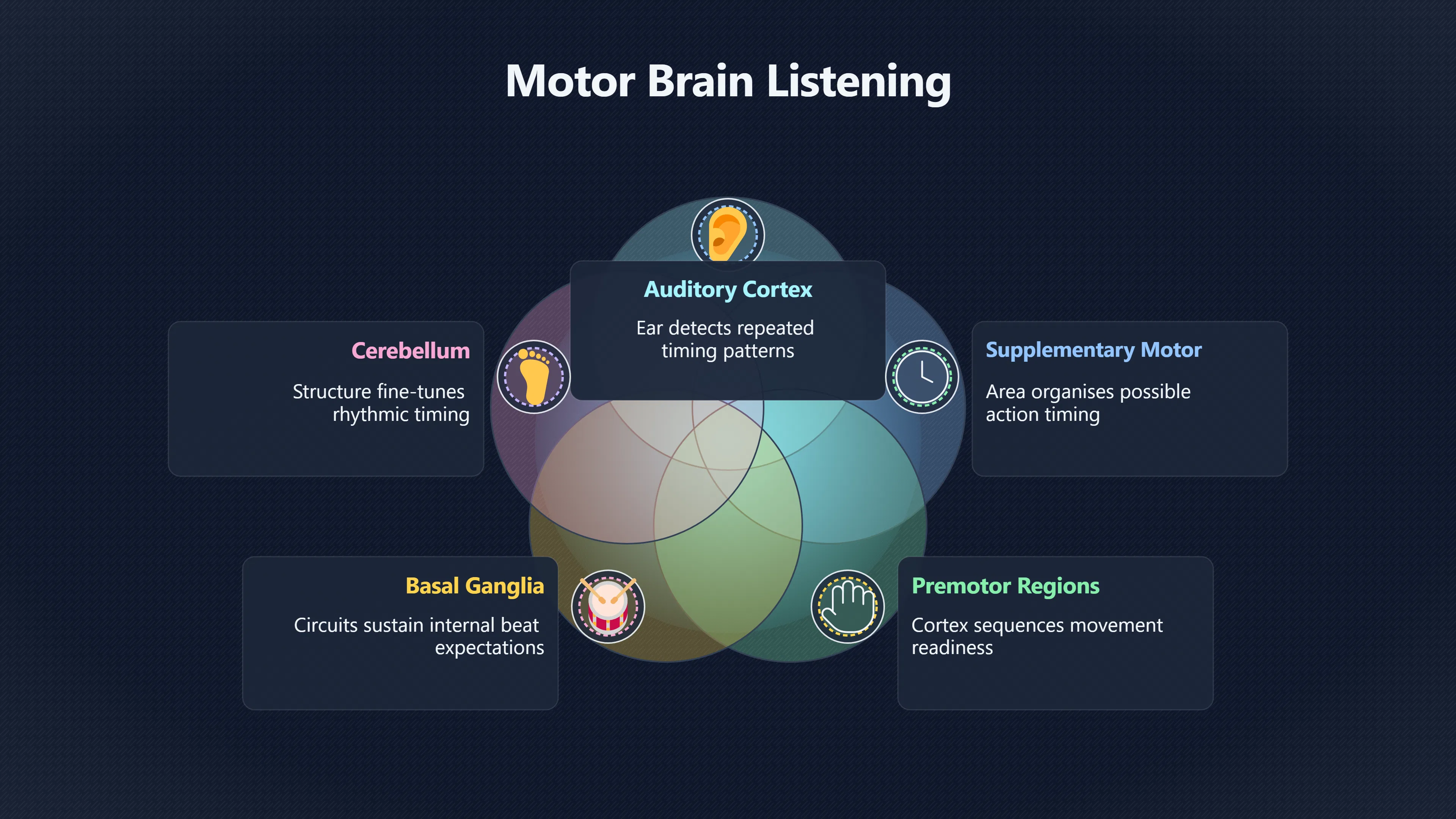
 The key idea is auditory-motor coupling. Beat perception links listening with movement-readiness through networks that include the supplementary motor area, premotor cortex, basal ganglia, cerebellum and auditory cortex. Studies using brain imaging, behavioural tasks, infant research and movement disorders all point in the same direction: the body does not simply react after the beat is understood. The brain helps understand the beat by simulating, predicting and organising possible movement.[PubMed]pubmed.ncbi.nlm.nih.govThis movement may result from processing of the beat by motor areasRhythm and beat perception in motor areas of the brainby JA Grahn · 2007 · Cited by 1592 — When we listen to rhythm, we often move…[PMC]pmc.ncbi.nlm.nih.govPMCHow beat perception coopts motor neurophysiologyNIHby JJ Cannon · 2020 · Cited by 250 — Components of the brain's motor system are activated by the perception of a musical beat, e…
Why the Motor Brain Listens Too
The most important finding is also the easiest to miss: motor areas can activate during rhythm listening even when no visible movement is made. In a landmark functional MRI study, Jessica Grahn and Matthew Brett found that listening to rhythms engaged a bilateral network including the supplementary motor area, premotor regions, basal ganglia, cerebellum and auditory areas, while the lack of primary motor cortex activation supported the idea that participants were not simply moving secretly in the scanner.[PubMed]pubmed.ncbi.nlm.nih.govThis movement may result from processing of the beat by motor areasRhythm and beat perception in motor areas of the brainby JA Grahn · 2007 · Cited by 1592 — When we listen to rhythm, we often move…
That matters because it changes what “hearing the beat” means. The brain is not only analysing a sound object from the outside. It is preparing a timed action model: where the pulse is, when the next important moment will arrive, and how a movement could align with it. The movement may never happen, but the preparation helps the rhythm become usable.
The supplementary motor area is especially important because it is involved in internally organised movement and timing. The basal ganglia, including the putamen and wider dorsal striatum, are also repeatedly linked to beat strength and internally generated pulse. A 2024 study using representational similarity analysis found that activity patterns in the putamen and supplementary motor area tracked beat strength rather than merely simpler features such as tempo or number of sound onsets.[OUP Academic]academic.oup.comSource details in endnotes.
This is why a drum loop feels different from a random set of clicks. Both may contain sounds in time, but the loop gives the motor system a structure it can predict. A strong beat offers a stable invitation: nod here, step here, clap here.
Prediction Comes Before Counting
Most listeners do not count “one, two, three, four” before they feel a pulse. The brain is faster and more practical than that. It forms expectations about when the next beat should arrive, then adjusts as the rhythm confirms or challenges those expectations.
Researchers often describe this through prediction and entrainment. Neural activity can align with external rhythmic patterns, helping the brain allocate attention at the moments when important sounds are likely to occur. Reviews of beat perception argue that motor-system involvement may support internal predictive models: the brain uses movement-related timing machinery to forecast the next beat, not merely to respond after it happens.[Frontiers]frontiersin.orgFrontiers Neural Networks for Beat Perception in Musical RhythmFrontiers Neural Networks for Beat Perception in Musical Rhythm
This explains why a beat can seem to “pull” movement out of the body. The listener is not waiting passively. The brain is already running a timing loop, comparing incoming sound with expected pulse points. When those predictions are stable enough, movement becomes easy to start because the body already has a temporal map.
It also explains why rhythm can survive missing information. In many songs, the beat is not struck on every pulse. A bassline, hi-hat, vocal phrase or handclap may imply the timing without spelling it out. The listener’s brain fills in the regular pulse, and the motor system helps maintain it across gaps, syncopations and pauses.
Why Pulse Feels Easier Than Meter Theory
Pulse is the felt regular beat. Meter is the organised pattern of strong and weak beats that musicians may describe as two, three, four or more beats in a bar. For many listeners, pulse is immediate while meter theory feels abstract because the brain can prepare movement from a simple repeating timing point without needing formal labels.
A person can walk, clap or nod to a song without knowing whether it is in four-four time, compound time or an unusual metre. The body mainly needs a reliable “when”. Music theory gives names to larger structures, but beat perception gives the nervous system a practical timing signal.
This is why metronomes, kick drums and clapping patterns can feel so direct. They reduce ambiguity and make prediction cheap. More complex grooves can still be highly danceable, but only if the listener can recover the pulse. When the pulse becomes too hard to infer, the motor invitation weakens: the rhythm may remain interesting, but it becomes harder to join.
The distinction also helps explain why people often feel rhythm before they can describe it. Conscious counting is slow, verbal and learned. Beat prediction is embodied, fast and partly automatic. The listener may only later explain what the body has already understood.
What Parkinson’s Reveals About Beat Timing
Movement disorders offer a powerful test of the link between beats and motor systems because they show what happens when key timing circuits are disrupted. Parkinson’s disease affects basal ganglia function, and studies have found that people with Parkinson’s can show specific difficulty with beat-based rhythm processing. Grahn and Brett reported that Parkinson’s patients did not gain the same usual advantage from beat-based rhythms that control participants did, supporting the idea that the basal ganglia help generate or detect an internal beat.[ScienceDirect]sciencedirect.comSource details in endnotes.
This does not mean people with Parkinson’s cannot respond to rhythm. In fact, rhythmic auditory stimulation is used in rehabilitation because external rhythmic cues can support walking timing. Reviews of rhythm- and music-based motor rehabilitation describe a substantial body of work testing rhythmic cueing for gait and motor function, while also noting that results depend on the condition, task, cue type and individual listener.[PMC]pmc.ncbi.nlm.nih.govOpen source on nih.gov.
The point for music is clear: rhythm is not merely decorative sound. A beat can act like an external timing scaffold. For a healthy listener, that scaffold may make dancing feel effortless. For someone with impaired movement timing, it may help organise steps that are otherwise harder to initiate or regulate.
The evidence also warns against oversimplifying. Not every rhythmic cue helps every person. One study found that people with weaker beat perception had more difficulty synchronising gait to some musical cues, and low-groove music could be less helpful than high-groove music or metronome cues.[Frontiers]frontiersin.orgFrontiers Neural Networks for Beat Perception in Musical RhythmFrontiers Neural Networks for Beat Perception in Musical Rhythm
Babies, Bodies and the Early Sense of Beat
The link between rhythm and movement appears early in life. Research on infants found that babies moved more rhythmically to music and rhythmically regular sounds than to speech, and that the quality of their movement related to their positive response to the sound.[PMC]pmc.ncbi.nlm.nih.govPMCRhythmic engagement with music in infancyPMCRhythmic engagement with music in infancy
Another influential infant study showed that movement can shape rhythm perception: when seven-month-old infants were bounced to an ambiguous rhythm, their later listening preferences matched the beat pattern implied by the bouncing. In plain terms, how the body moved influenced what the ears seemed to hear.[Brain Music]brainmusic.orgGrahn rhythm2007Brain MusicRhythm and Beat Perception in Motor Areas of the Brainby JA Grahn · Cited by 1586 — Moving on to the fMRI data collected in th…
This is one reason lullabies, rocking, clapping games and dance songs feel so fundamental rather than merely cultural decoration. Culture teaches people specific styles, steps and meanings, but the underlying link between sound, timing and bodily expectation is present very early.
Recent developmental work also suggests that newborns can detect beat or rhythmic regularity, though researchers continue to debate how innate rhythm perception is and how it develops through prenatal sound exposure, caregiving and learning. The cautious takeaway is not that babies are born as tiny dancers, but that the human brain is prepared to treat rhythm as a predictive, bodily signal from the start.[CORDIS]cordis.europa.euCORDISBaby's got rhythm: research shows that beat perception is innateCORDISBaby's got rhythm: research shows that beat perception is innate

Why This Makes Music Feel Like an Invitation
A beat invites movement because it gives the brain a future. Instead of hearing isolated sounds, the listener senses a pattern that points forward: the next pulse is coming, the body could meet it, and other people could meet it too.
That invitation depends on several linked mechanisms:
- Auditory patterning: the ear and auditory cortex detect repeated timing relationships.
- Motor preparation: premotor and supplementary motor areas organise possible action.
- Internal pulse generation: basal ganglia circuits help sustain beat expectations.[pubmed.ncbi.nlm.nih.gov]pubmed.ncbi.nlm.nih.govSource details in endnotes.
- Timing correction: the brain compares expected and actual sound events.
- Embodied attention: the listener becomes ready to nod, step, clap or dance at the right moment.
This is why rhythm can feel more bodily than melody alone. Melody may move emotion and memory, but beat gives the nervous system a timed place to act. A song does not need to command the listener to move; the brain has already built a movement-ready structure inside the listening experience.
What the Evidence Does Not Prove
The evidence strongly supports a close link between beat perception and motor systems, but it does not mean every rhythm automatically causes movement, or that motor activation is the whole story. Musical movement also depends on culture, attention, mood, training, context, loudness, social setting and personal preference.
There is also still debate over exactly how motor regions contribute. Some theories emphasise neural entrainment, where brain rhythms align with external timing. Others focus on active inference and prediction, where the motor system helps forecast sensory events. These accounts are not necessarily enemies; they may describe different levels of the same broader process.[PMC]pmc.ncbi.nlm.nih.govPMCNeural Networks for Beat Perception in Musical RhythmPMCNeural Networks for Beat Perception in Musical Rhythm
The strongest conclusion is therefore specific rather than exaggerated: the brain links beats to movement because beat perception uses systems normally associated with timing, sequencing and preparing action. The listener may remain still, but the beat is already being processed in a bodily way. That is why rhythm often feels less like something heard from a distance and more like something the body is being asked to join.
Amazon book picks
Further Reading
Books and field guides related to Why Your Body Hears the Beat First. Use these as the next step if you want deeper reading beyond the article.
This Is Your Brain On Music
Directly relevant to beat perception and motor engagement.
eBay marketplace picks
Marketplace Samples
Example marketplace items related to this page. Use the search link to explore similar finds on eBay.
Endnotes
1.
Source: pmc.ncbi.nlm.nih.gov
Title: PMCHow beat perception coopts motor neurophysiology
Link:https://pmc.ncbi.nlm.nih.gov/articles/PMC9440376/
Source snippet
NIHby JJ Cannon · 2020 · Cited by 250 — Components of the brain's motor system are activated by the perception of a musical beat, e...
2.
Source: academic.oup.com
Link:https://academic.oup.com/cercor/article/34/10/bhae406/7817849
3.
Source: sciencedirect.com
Link:https://www.sciencedirect.com/science/article/abs/pii/S0010945208002414
4.
Source: pmc.ncbi.nlm.nih.gov
Link:https://pmc.ncbi.nlm.nih.gov/articles/PMC8801707/
5.
Source: pmc.ncbi.nlm.nih.gov
Title: PMCRhythmic engagement with music in infancy
Link:https://pmc.ncbi.nlm.nih.gov/articles/PMC2851927/
6.
Source: cordis.europa.eu
Title: CORDISBaby’s got rhythm: research shows that beat perception is innate
Link:https://cordis.europa.eu/article/id/30401-babys-got-rhythm-research-shows-that-beat-perception-is-innate
7.
Source: pmc.ncbi.nlm.nih.gov
Title: PMCNeural Networks for Beat Perception in Musical Rhythm
Link:https://pmc.ncbi.nlm.nih.gov/articles/PMC4658578/
8.
Source: sciencedirect.com
Link:https://www.sciencedirect.com/science/article/abs/pii/S1364661320302746
9.
Source: sciencedirect.com
Link:https://www.sciencedirect.com/science/article/pii/S105381192030255X
10.
Source: sciencedirect.com
Link:https://www.sciencedirect.com/science/article/pii/S1053811925005968
11.
Source: sciencedirect.com
Link:https://www.sciencedirect.com/science/article/abs/pii/S1353802023001827
12.
Source: sciencedirect.com
Link:https://www.sciencedirect.com/science/article/abs/pii/S1388245719311599
13.
Source: sciencedirect.com
Link:https://www.sciencedirect.com/science/article/abs/pii/S016643281931160X
14.
Source: pubmed.ncbi.nlm.nih.gov
Title: This movement may result from processing of the beat by motor areas
Link:https://pubmed.ncbi.nlm.nih.gov/17488212/
Source snippet
Rhythm and beat perception in motor areas of the brainby JA Grahn · 2007 · Cited by 1592 — When we listen to rhythm, we often move...
15.
Source: pubmed.ncbi.nlm.nih.gov
Title: Pub Med Why Do We Move to the Beat?
Link:https://pubmed.ncbi.nlm.nih.gov/31846652/
Source snippet
A Multi-Scale Approach...by L Damm · 2020 · Cited by 137 — Humans' ability to synchronize movement with auditory rhythms relies on motor...
16.
Source: brainmusic.org
Title: Grahn rhythm2007
Link:https://www.brainmusic.org/EducationalActivities/Grahn_rhythm2007.pdf
Source snippet
Brain MusicRhythm and Beat Perception in Motor Areas of the Brainby JA Grahn · Cited by 1586 — Moving on to the fMRI data collected in th...
17.
Source: frontiersin.org
Title: Frontiers Neural Networks for Beat Perception in Musical Rhythm
Link:https://www.frontiersin.org/journals/systems-neuroscience/articles/10.3389/fnsys.2015.00159/full
18.
Source: frontiersin.org
Link:https://www.frontiersin.org/journals/human-neuroscience/articles/10.3389/fnhum.2020.578546/full
19.
Source: frontiersin.org
Link:https://www.frontiersin.org/journals/neurology/articles/10.3389/fneur.2022.940419/full
20.
Source: frontiersin.org
Title: Frontiers Individual Differences in Beat Perception Affect Gait
Link:https://www.frontiersin.org/journals/human-neuroscience/articles/10.3389/fnhum.2014.00811/full
21.
Source: brainmusic.org
Title: Brain Music Feeling the Beat: Movement Influences Infant Rhythm
Link:https://www.brainmusic.org/EducationalActivities/Phillips-Silver_rhythm2005.pdf
22.
Source: pubmed.ncbi.nlm.nih.gov
Link:https://pubmed.ncbi.nlm.nih.gov/19673753/
23.
Source: cordis.europa.eu
Link:https://cordis.europa.eu/project/id/801872
24.
Source: frontiersin.org
Link:https://www.frontiersin.org/journals/psychology/articles/10.3389/fpsyg.2014.01185/full
25.
Source: frontiersin.org
Link:https://www.frontiersin.org/journals/human-neuroscience/articles/10.3389/fnhum.2015.00444/full
26.
Source: frontiersin.org
Link:https://www.frontiersin.org/journals/human-neuroscience/articles/10.3389/fnhum.2015.00663/full
27.
Source: frontiersin.org
Link:https://www.frontiersin.org/journals/psychology/articles/10.3389/fpsyg.2024.1370007/full
28.
Source: youtube.com
Title: Brain Rhythms
Link:https://www.youtube.com/watch?v=fSbrYAwTGkA
Additional References
29.
Source: researchgate.net
Link:https://www.researchgate.net/publication/263738717_Newborn_infants_detect_the_beat_in_music
30.
Source: academia.edu
Link:https://www.academia.edu/3604841/The_role_of_the_basal_ganglia_in_beat_perception
31.
Source: researchgate.net
Link:https://www.researchgate.net/publication/273514062_Neurobiological_foundations_of_neurologic_music_therapy_rhythmic_entrainment_and_the_motor_system
32.
Source: researchgate.net
Link:https://www.researchgate.net/publication/366362744_The_Use_of_Rhythmic_Auditory_Stimulation_on_Gait_Parameters_in_Parkinson%27s_Disease_A_Systematic_Review
33.
Source: neuroscience.gsu.edu
Link:https://neuroscience.gsu.edu/files/2025/10/An-integrated-review-of-music-cognition-and-rhythmic-stimuli-in-sensorimotor-neurocognition-and-neurorehabilitation.pdf
34.
Source: physio-pedia.com
Link:https://www.physio-pedia.com/Auditory_Rhythmic_Stimulation_for_Gait_Training
35.
Source: dallabella-lab.ca
Link:https://dallabella-lab.ca/wp-content/uploads/2023/01/Damm-et-al_2020_Why-do-we-move-to-the-beat-A-multi-scale-approach-from-physical-principles-to-brain-dynamics.pdf
36.
Source: academia.edu
Link:https://www.academia.edu/35414707/Feeling_the_Beat_Movement_Influences_Infant_Rhythm_Perception
37.
Source: researchgate.net
Link:https://www.researchgate.net/publication/347962636_How_Beat_Perception_Co-opts_Motor_Neurophysiology
38.
Source: jessicagrahn.com
Link:https://www.jessicagrahn.com/research-summaries.html
Topic Tree