Within Rhythm
Why Chants Stay in the Body
Memorable rhythmic hooks work because listeners can feel entrances, pauses and repetitions quickly enough to join in.
On this page
- Rhythm, breath and repeatable participation
- Call and response and group memory
- How pop hooks become gestures and movement
Page outline Jump by section
Introduction
Chants and hooks stay in the body because they turn listening into participation. A memorable hook is rarely just a sequence of notes. It is a rhythm that people can predict, breathe with, repeat and physically enact. The strongest chants and choruses reduce the gap between hearing and doing: listeners know when to enter, when to pause and when to join others. As a result, the music becomes a shared action rather than a passive experience. Research on rhythm, synchronisation, chanting and musical memory suggests that repetition, bodily timing and group coordination all contribute to why certain musical phrases linger long after the song ends.[Annual Reviews]annualreviews.orgAnnual ReviewsThe Psychology of Music: Rhythm and MovementThe urge to move to music is universal among humans. Unlike visual art, which i…[Jessica Grahn]jessicagrahn.comannurev psych 122216 011740Jessica GrahnThe Psychology of Music: Rhythm and Movementby DJ Levitin · 2018 — To achieve entrainment, an internal representation of the…
 Within the broader question of how rhythm moves bodies, chants and hooks matter because they are often the point where musical timing becomes easiest to embody. They compress rhythm into a form that can be sung, clapped, shouted, marched to or remembered collectively.
Rhythm, Breath and Repeatable Participation
A chant succeeds when people can join it almost immediately. This sounds simple, but it depends on several linked mechanisms.
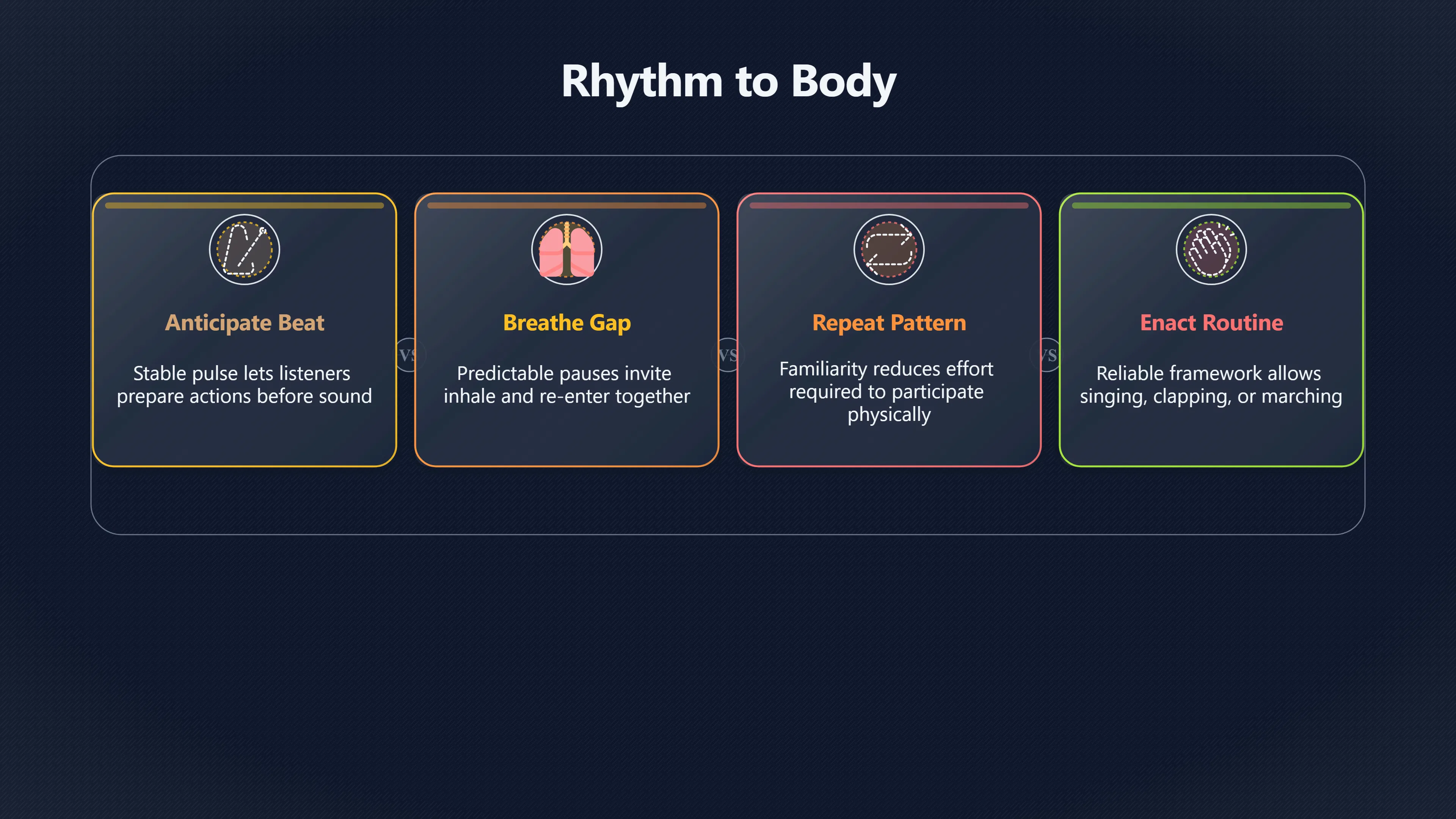
First, the rhythmic pattern must be easy to anticipate. Human movement synchronises best when a stable pulse allows people to prepare actions before the next beat arrives. Rather than reacting after a sound occurs, listeners build an internal sense of timing and move in expectation of the next event.[Jessica Grahn]jessicagrahn.comannurev psych 122216 011740Jessica GrahnThe Psychology of Music: Rhythm and Movementby DJ Levitin · 2018 — To achieve entrainment, an internal representation of the…
Second, successful hooks fit comfortably within natural cycles of breathing and vocal production. Many chants rely on short phrases separated by predictable gaps. Those gaps are not empty space; they are invitations. They provide time to inhale, prepare and re-enter together. In practice, this makes participation feel effortless rather than demanding.
Third, repetition turns a sound pattern into a bodily routine. Cognitive research on earworms and involuntary musical imagery consistently finds that repeated musical fragments are more likely to be recalled and mentally replayed. Repetition strengthens familiarity, while familiarity reduces the effort required to participate.[PMC]pmc.ncbi.nlm.nih.govby LA Liikkanen · 2020 · Cited by 65 — Repetition is a common element of the experience, resulting in the experience colloquially know…[PMC]pmc.ncbi.nlm.nih.govby LA Liikkanen · 2020 · Cited by 65 — Repetition is a common element of the experience, resulting in the experience colloquially know…
This helps explain why the most durable chants are often rhythmically economical. They do not overwhelm listeners with information. Instead, they provide a reliable framework that can be enacted repeatedly through singing, clapping, swaying or marching.
Why Simplicity Is Powerful but Not Enough
A common misconception is that hooks succeed because they are merely simple. Simplicity helps, but it is only part of the story.
Research on musical memory suggests that memorable musical fragments often combine predictability with a small amount of novelty. Songs that become earworms tend to be singable and repetitive, yet they usually contain a distinctive contour, rhythm or accent that separates them from countless other repeated phrases.[Durham Repository]durham-repository.worktribe.comDurham RepositoryDissecting an earworm: Melodic features and song popularity…by K Jakubowski · 2016 · Cited by 137 — Involuntary music…
This balance creates an important tension:
- The listener quickly understands the pattern.
- The pattern remains interesting enough to reward repetition.
- The body can anticipate future entrances.
- The mind continues to notice a distinctive feature.
A chant that is completely predictable may become background noise. A chant that is too complicated may never become collective. Hooks endure when they sit between those extremes.
Call-and-Response and Group Memory
Some of the most physically compelling musical forms use call-and-response structures. One voice, instrument or section presents a phrase; another answers.
This format distributes participation across a group. People do not need to remember an entire song. They only need to recognise when their turn arrives. That reduction in cognitive load makes large-scale coordination easier. At the same time, the alternation of call and response creates a rhythmic cycle that reinforces memory through repeated action.[Frontiers]frontiersin.orgFrontiers Music and Language in Social Interaction: SynchronyFrontiersMusic and Language in Social Interaction: Synchrony…July 2, 2019 — by N Oesch · 2019 · Cited by 50 — An important goal of eme…
Research on chanting practices also suggests that participatory forms can produce strong feelings of engagement and absorption. In studies examining chanting across traditions, call-and-response forms have been associated with particularly strong experiences of involvement and shared attention.[Macquarie University]researchers.mq.edu.auMacquarie UniversityHow chanting relates to cognitive function, altered states…by G Perry · 2022 · Cited by 40 — Participants whose ma…
The social dimension matters. When many people repeat the same rhythmic phrase together, memory becomes distributed across the group. Individuals do not carry the pattern alone. The crowd continually reinforces it through synchronised sound and movement.
This collective reinforcement helps explain why stadium chants, protest slogans, work songs and communal choruses can remain memorable even when their musical material is extremely limited.
How Pop Hooks Become Gestures and Movement
The most successful pop hooks often function as miniature movement scripts.
A chorus may be accompanied by a clap pattern, a hand wave, a jump, a head nod or a dance gesture. Once linked to movement, the hook becomes more than an auditory memory. It becomes a motor memory.
Research on rhythm and movement shows that listening to rhythmic music activates systems involved in planning and coordinating movement, even when people remain physically still. The body effectively rehearses action while listening.[Annual Reviews]annualreviews.orgAnnual ReviewsThe Psychology of Music: Rhythm and MovementThe urge to move to music is universal among humans. Unlike visual art, which i…
This is one reason why many modern hooks are built around highly repeatable rhythmic cells rather than elaborate melodies. A listener can quickly learn:
- where to clap,
- where to shout a word,
- where to raise a hand,
- where to bounce with the beat.
The hook therefore survives outside the song itself. It can be performed at concerts, in sports arenas, at parties or on social media. The musical phrase becomes a physical behaviour.
From this perspective, a hook is not simply a memorable sound. It is a compact package of timing instructions that people can enact together.
Why Some Hooks Feel Permanently Embedded
People often describe certain chants and choruses as being “in the body” rather than merely “in the head”. Scientific explanations remain incomplete, but several converging findings point in the same direction.
Repeated exposure increases the likelihood that musical fragments will be mentally replayed later. Earworms frequently involve short, repetitive sections such as choruses. These fragments recruit working-memory resources and often appear as forms of internal singing.[PMC]pmc.ncbi.nlm.nih.govby LA Liikkanen · 2020 · Cited by 65 — Repetition is a common element of the experience, resulting in the experience colloquially know…[PMC]pmc.ncbi.nlm.nih.govby LA Liikkanen · 2020 · Cited by 65 — Repetition is a common element of the experience, resulting in the experience colloquially know…
At the same time, rhythm appears closely linked to reward, learning and social coordination. Researchers have argued that rhythmic engagement can strengthen memory and social processes because synchronised participation is both cognitively efficient and emotionally rewarding.[ScienceDirect]sciencedirect.comCan rhythm-mediated reward boost learning, memory, and…by A Fiveash · 2023 · Cited by 55 — Rhythm-mediated reward may enh…
The result is a reinforcing cycle:
- A listener learns a short rhythmic pattern.
- The pattern becomes easy to predict.
- Participation becomes pleasurable and socially meaningful.
- Repetition strengthens memory.[scribbly.com.au]scribbly.com.auwhat makes a song catchy the science behind hooksWhat Makes a Song Catchy? The Science Behind Hooks23 Apr 2026 — Research into music cognition suggests repetition helps listeners encode…
- The hook becomes easier to reproduce again.
When this cycle succeeds, a chant no longer functions as a sequence of sounds alone. It becomes a learned bodily action, ready to be reactivated whenever the rhythm returns.
eBay marketplace picks
Marketplace Samples
Example marketplace items related to this page. Use the search link to explore similar finds on eBay.


Endnotes
1.
Source: sciencedirect.com
Link:https://www.sciencedirect.com/science/article/pii/S0149763423001227
Source snippet
Can rhythm-mediated reward boost learning, memory, and...by A Fiveash · 2023 · Cited by 55 — Rhythm-mediated reward may enh...
2.
Source: pmc.ncbi.nlm.nih.gov
Link:https://pmc.ncbi.nlm.nih.gov/articles/PMC10585939/
Source snippet
The song that never ends: The effect of repeated exposure on...by C Killingly · 2023 · Cited by 9 — Previous research demonstrates th...
3.
Source: pmc.ncbi.nlm.nih.gov
Link:https://pmc.ncbi.nlm.nih.gov/articles/PMC7704448/
Source snippet
by LA Liikkanen · 2020 · Cited by 65 — Repetition is a common element of the experience, resulting in the experience colloquially know...
4.
Source: pmc.ncbi.nlm.nih.gov
Link:https://pmc.ncbi.nlm.nih.gov/articles/PMC9688188/
Source snippet
Chanting Relates to Cognitive Function, Altered States...by G Perry · 2022 · Cited by 40 — This study examined how chanting relates to c...
5.
Source: pmc.ncbi.nlm.nih.gov
Link:https://pmc.ncbi.nlm.nih.gov/articles/PMC4193405/
Source snippet
nih.govChorusing, synchrony, and the evolutionary functions of rhythmby A Ravignani · 2014 · Cited by 195 — We consider how chorusing dyn...
6.
Source: annualreviews.org
Link:https://www.annualreviews.org/doi/10.1146/annurev-psych-122216-011740
Source snippet
Annual ReviewsThe Psychology of Music: Rhythm and MovementThe urge to move to music is universal among humans. Unlike visual art, which i...
7.
Source: jessicagrahn.com
Title: annurev psych 122216 011740
Link:https://www.jessicagrahn.com/uploads/6/0/8/5/6085172/annurev-psych-122216-011740.pdf
Source snippet
Jessica GrahnThe Psychology of Music: Rhythm and Movementby DJ Levitin · 2018 — To achieve entrainment, an internal representation of the...
8.
Source: durham-repository.worktribe.com
Link:https://durham-repository.worktribe.com/output/1371466/dissecting-an-earworm-melodic-features-and-song-popularity-predict-involuntary-musical-imagery
Source snippet
Durham RepositoryDissecting an earworm: Melodic features and song popularity...by K Jakubowski · 2016 · Cited by 137 — Involuntary music...
9.
Source: frontiersin.org
Title: Frontiers Music and Language in Social Interaction: Synchrony
Link:https://www.frontiersin.org/journals/psychology/articles/10.3389/fpsyg.2019.01514/full
Source snippet
FrontiersMusic and Language in Social Interaction: Synchrony...July 2, 2019 — by N Oesch · 2019 · Cited by 50 — An important goal of eme...
Published: July 2, 2019
10.
Source: researchers.mq.edu.au
Link:https://researchers.mq.edu.au/en/publications/how-chanting-relates-to-cognitive-function-altered-states-and-qua
Source snippet
Macquarie UniversityHow chanting relates to cognitive function, altered states...by G Perry · 2022 · Cited by 40 — Participants whose ma...
11.
Source: musicscience.net
Title: Music & Science Earworms
Link:https://musicscience.net/research/music-memory/earworms/
Source snippet
Earworms - Music & ScienceAn earworm is the spontaneous mental recall and repetition of a piece of music, often referred to in everyday t...
12.
Source: scribbly.com.au
Title: what makes a song catchy the science behind hooks
Link:https://scribbly.com.au/what-makes-a-song-catchy-the-science-behind-hooks/
Source snippet
What Makes a Song Catchy? The Science Behind Hooks23 Apr 2026 — Research into music cognition suggests repetition helps listeners encode...
13.
Source: Wikipedia
Link:https://en.wikipedia.org/wiki/Earworm
Source snippet
EarwormEarworms are considered to be a common type of involuntary cognition. Some of the phrases often used to describe earworms inclu...
Additional References
14.
Source: inspiredbybeatz.com
Link:https://www.inspiredbybeatz.com/en/earworms-why-your-brain-plays-songs-on-repeat/
Source snippet
Earworms: Understand Why Songs Get Stuck In Your HeadScientists call them INMI: Involuntary Musical Imagery; ▸ Songs with simple, repetit...
15.
Source: washingtonpost.com
Link:https://www.washingtonpost.com/wellness/interactive/2025/why-songs-get-stuck-in-your-head/
Source snippet
These musical snippets often persist due to their repetitive, simple, and singable nature. Upbeat and easily repeatable songs, especially...
16.
Source: kennedy-center.org
Link:https://www.kennedy-center.org/education/resources-for-educators/classroom-resources/media-and-interactives/media/music/your-brain-on-music/your-brain-on-music/your-brain-on-music-earworms/
Source snippet
Your Brain on Music: EarwormsEarworms have constant [access]({{ 'access/' | relative_url }}) to people's minds and memories. So far, no one knows why imagined songs someti...
17.
Source: researchgate.net
Link:https://www.researchgate.net/publication/220414811_Rhythmic_synchrony_and_mediated_interaction_Towards_a_framework_of_rhythm_in_embodied_interaction
18.
Source: youtube.com
Link:https://www.youtube.com/watch?v=7ckNyGDDX_U
19.
Source: psychology.stackexchange.com
Title: how are musical hooks defined studied in psychology
Link:https://psychology.stackexchange.com/questions/20000/how-are-musical-hooks-defined-studied-in-psychology
Source snippet
are musical hooks defined/studied in psychology?19 Jun 2018 — I know about the common concept of a 'musical hook': a "short riff, passage...
20.
Source: harmonymusictherapy.com
Title: Improvisation and call-and-response games support
Link:https://harmonymusictherapy.com/from-beat-to-brain-how-rhythm-supports-cognitive-development/
Source snippet
From Beat to Brain: How Rhythm Supports Cognitive...9 May 2025 — Songwriting and chant-based activities enhance memory, sequencing, and...
Published: May 2025
21.
Source: medium.com
Link:https://medium.com/illumination/what-does-chanting-do-to-the-brain-nervous-system-and-the-mind-2c0449e410f6
Source snippet
ens attention, and prepares the brain for memory and focus.Read more...
22.
Source: health.clevelandclinic.org
Title: Most earworms are just a portion of a song
Link:https://health.clevelandclinic.org/songs-get-stuck-head
Source snippet
clevelandclinic.orgEarworms: Why Certain Songs Get Stuck in Your HeadSep 16, 2025 — Less official names include stuck song syndrome, musi...
23.
Source: facebook.com
Link:https://www.facebook.com/thelingwist/posts/why-do-songs-make-words-easier-to-rememberrhythm-[melody
Source snippet
ues. That’s why chants, rhymes, and jingles stick like glue—your...
Topic Tree