Within Algorithms
Do personalised playlists make taste smaller?
Personalised playlists make discovery easier, but repeated safe matches can turn variety into a smaller comfort zone.
On this page
- How recommendation playlists learn from listening behavior
- Why safe similarity can beat musical surprise
- Ways platforms and listeners can widen discovery
Page outline Jump by section
Introduction
Personalised playlists are often presented as the ideal solution to music overload. Instead of searching through millions of tracks, listeners receive a stream of songs chosen specifically for them. This can make discovery feel effortless, but it also creates a subtle risk: the same systems that help people find new music can gradually reduce the range of music they hear.
 The problem is not that recommendation playlists never introduce anything new. Rather, they often optimise for the safest version of novelty—a song that is different enough to feel fresh but similar enough to minimise the chance of a skip. Over time, this can create a listening environment where familiar patterns are constantly reinforced and genuine surprise becomes less common. Research on music recommendation systems repeatedly identifies a tension between relevance and diversity, with platforms often favouring engagement and satisfaction over exploration.[Spotify Research]research.atspotify.comSpotify ResearchAlgorithmic Effects on the Diversity of Consumption on Spotify3 Dec 2020 — In this work, we analyze our users through the… 2arXiv
How recommendation playlists learn from listening behaviour
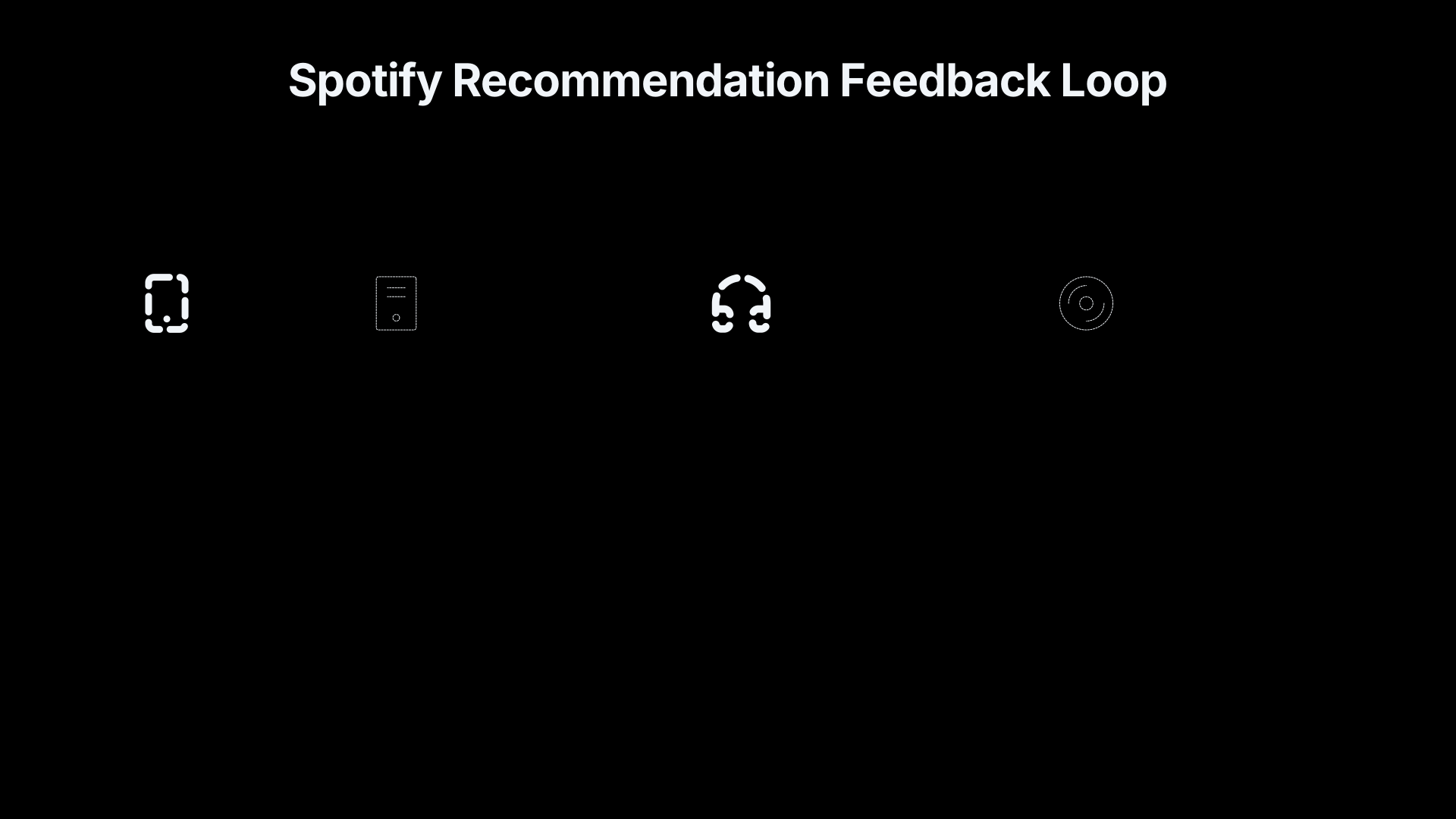
Personalised playlists are built from feedback. Every play, skip, save, repeat listen and playlist addition becomes a signal about what a listener might want next. The system then searches for tracks that resemble those signals, using combinations of collaborative filtering, audio analysis and behavioural similarity models.[ResearchGate]researchgate.netMusic Personalization at SpotifyWe'll dive deep into the workings of Discover Weekly, our marquee personalized playlist which…[Springer Link]link.springer.comSpringer LinkRevisiting recommender systems: an investigative surveyby OAS Ibrahim · 2025 · Cited by 31 — This paper provides a thorough…
This approach works extremely well at identifying preferences. The challenge is that the system only knows what a listener has already revealed about themselves. If someone spends months listening to indie folk, the recommendation engine receives thousands of data points suggesting that indie folk is a safe choice. Even when it introduces new artists, those artists are likely to share characteristics with the existing listening profile.
As a result, discovery often becomes incremental rather than expansive. A listener may encounter dozens of new songs while rarely moving beyond a familiar cluster of genres, moods or scenes. Researchers frequently describe this dynamic as an exploration-versus-exploitation problem: should a recommendation system show something known to work, or risk recommending something unfamiliar that might broaden taste? Most commercial systems must balance both objectives, but engagement metrics tend to reward the safer option.[arXiv]arxiv.orgSource details in endnotes.
Why safe similarity can beat musical surprise
The central mechanism behind narrowing habits is not repetition alone. It is repeated similarity.
A recommendation engine generally seeks to maximise the likelihood that a listener will continue listening. Songs that closely resemble previous favourites are statistically safer than radically different suggestions. When this process is repeated thousands of times, the listener receives a steady stream of music that sits near existing preferences.
Several effects can emerge:
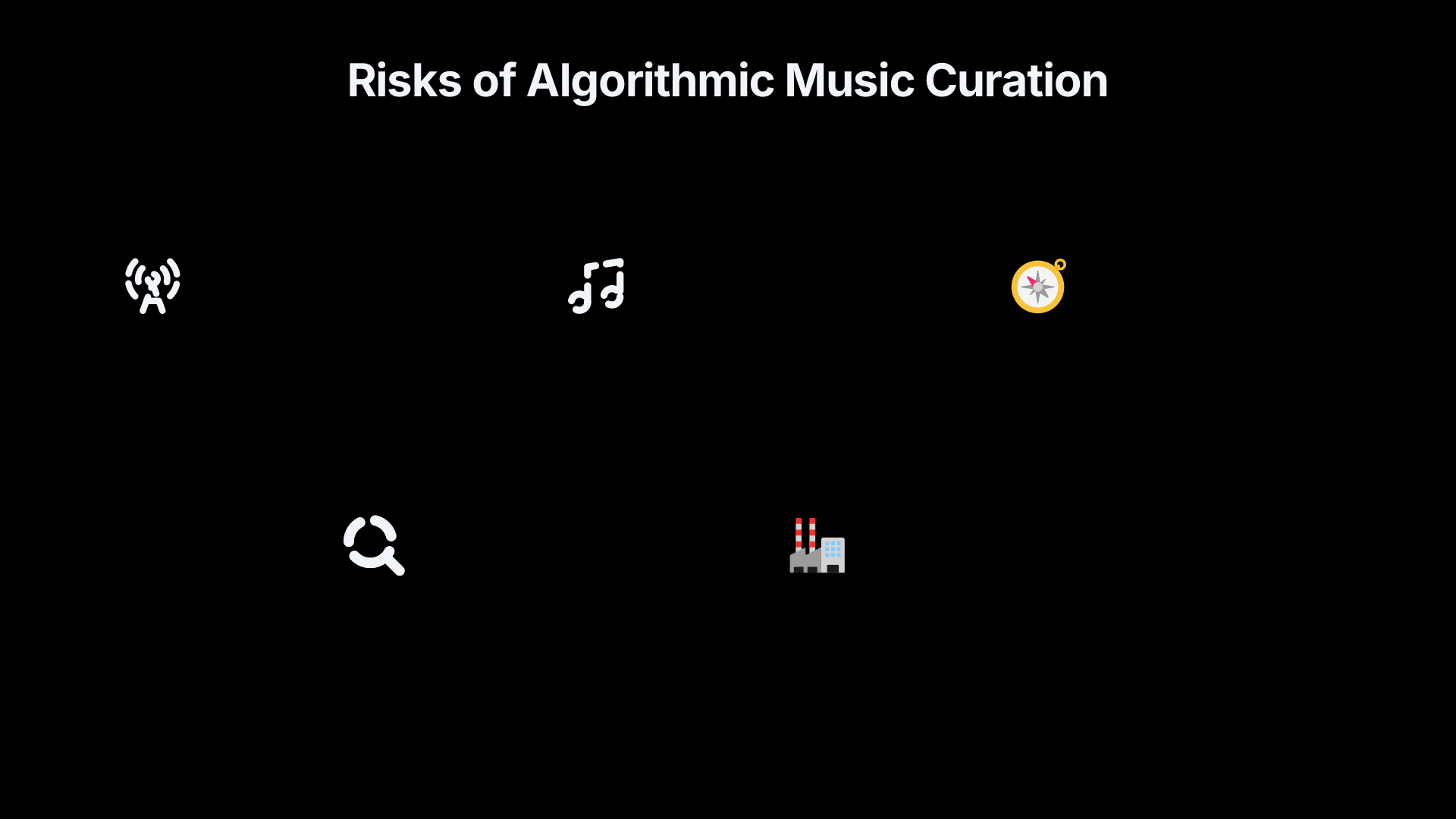
- Genre confinement: New recommendations arrive from the same handful of genres or adjacent genres.
- Mood reinforcement: Listeners repeatedly receive music matching established emotional or situational patterns.
- Artist-network clustering: Discoveries come from artists connected to the same audiences rather than from distant musical communities.
- Reduced serendipity: Unexpected encounters become rarer because they carry a higher risk of rejection.
Researchers studying recommender systems often refer to this tendency as a form of filter bubble or feedback loop, where prior behaviour increasingly shapes future exposure. While the strength of these effects remains debated, the underlying mechanism is widely recognised within recommendation research. Music Information Retrieval Transactions[JADS]jads.nlnetflix spotify and the evolution of recommender algorithmsNetflix, Spotify and the evolution of recommender algorithms25 Aug 2023 — This prevents users from slipping into a so-called “filter bubb…
The result is not necessarily boredom. Many listeners enjoy the experience because recommendations continue to feel relevant. The issue is that relevance and variety are not the same thing. A listener may discover hundreds of songs while still exploring only a narrow portion of the musical landscape.
What the evidence suggests about shrinking diversity
The question of whether recommendation systems actually reduce diversity has produced mixed findings, but several studies point to meaningful narrowing effects at the individual level.
Spotify researchers analysing listening behaviour found that recommendation systems influence the diversity of music consumption in complex ways. Their work showed that algorithmic recommendations can increase overall discovery while simultaneously concentrating individual listening patterns around particular preferences.[Spotify Research]research.atspotify.comSpotify ResearchAlgorithmic Effects on the Diversity of Consumption on Spotify3 Dec 2020 — In this work, we analyze our users through the…
A field experiment conducted on Spotify found an engagement-diversity trade-off. Personalised recommendations increased consumption, but they also reduced individual-level diversity of what users consumed. The researchers concluded that recommendation systems optimised primarily for engagement can make consumption more homogeneous within individual users even while increasing variety across the platform as a whole.[arXiv]arxiv.orgSource details in endnotes.
Other reviews of music recommendation research have similarly highlighted concerns about taste reinforcement and reduced exposure to unfamiliar music. Studies examining algorithmic curation frequently describe a tendency for recommendation systems to strengthen existing preferences, making it harder for listeners to encounter distant genres, scenes or cultural traditions.[ResearchGate]researchgate.netMusic Personalization at SpotifyWe'll dive deep into the workings of Discover Weekly, our marquee personalized playlist which…[ResearchGate At the same time]researchgate.netMusic Personalization at SpotifyWe'll dive deep into the workings of Discover Weekly, our marquee personalized playlist which…, the evidence is not one-sided. Some research finds that streaming platforms can broaden cultural consumption under certain conditions, and that the effects depend heavily on how diversity is measured. The important point is that narrowing habits are not inevitable, but they are a predictable outcome when recommendation systems prioritise behavioural similarity above exploration.[Sociological Science]sociologicalscience.comSociological ScienceStreaming Platforms, Filter Bubbles, and Cultural…by S Coavoux · 2025 — We find a statistically significant positi…
Why playlist loops become self-reinforcing
Once a listener begins relying heavily on personalised playlists, a feedback loop can develop.
The listener hears recommendations based on previous behaviour. Those recommendations influence what the listener plays next. The new listening activity becomes additional training data, which then shapes future recommendations.
This cycle can make personal taste appear more stable than it really is. Many listeners have interests they have never had the opportunity to discover because recommendation systems are better at identifying demonstrated preferences than latent ones.
The effect is especially visible in autoplay queues, personalised radio stations and continuously generated playlists. These features reduce the moments when a listener actively chooses what to hear. Instead of making deliberate jumps between styles, users are guided along paths the system predicts they will enjoy. Over time, those paths can become increasingly familiar.[The Decision Lab]thedecisionlab.comchained to the algorhythm how spotify standardizes our listeningThe Decision LabAlgoRhythm: How Spotify Standardizes Listening | TDL18 Apr 2024 — Spotify's feedback loop traps you inside of a filter bu…
Ways platforms and listeners can widen discovery
The same research that identifies narrowing effects also points towards solutions.
Designing for exploration
Recommendation researchers increasingly argue that diversity and serendipity should be treated as goals rather than side effects. Studies have shown that deliberately diversified recommendations can increase curiosity and openness to unfamiliar music over longer periods. Exposure to broader recommendations has even been associated with changing attitudes towards genres listeners initially disliked or ignored.[arXiv]arxiv.orgSource details in endnotes.
This is why many recommendation systems experiment with mechanisms that inject novelty into otherwise familiar playlists. The challenge is balancing surprise with satisfaction so that listeners remain engaged while still encountering genuinely new material.[arXiv]arxiv.orgSource details in endnotes.
Habits that break the loop
Listeners also have more influence than they may realise. A few behaviours can dramatically increase variety:
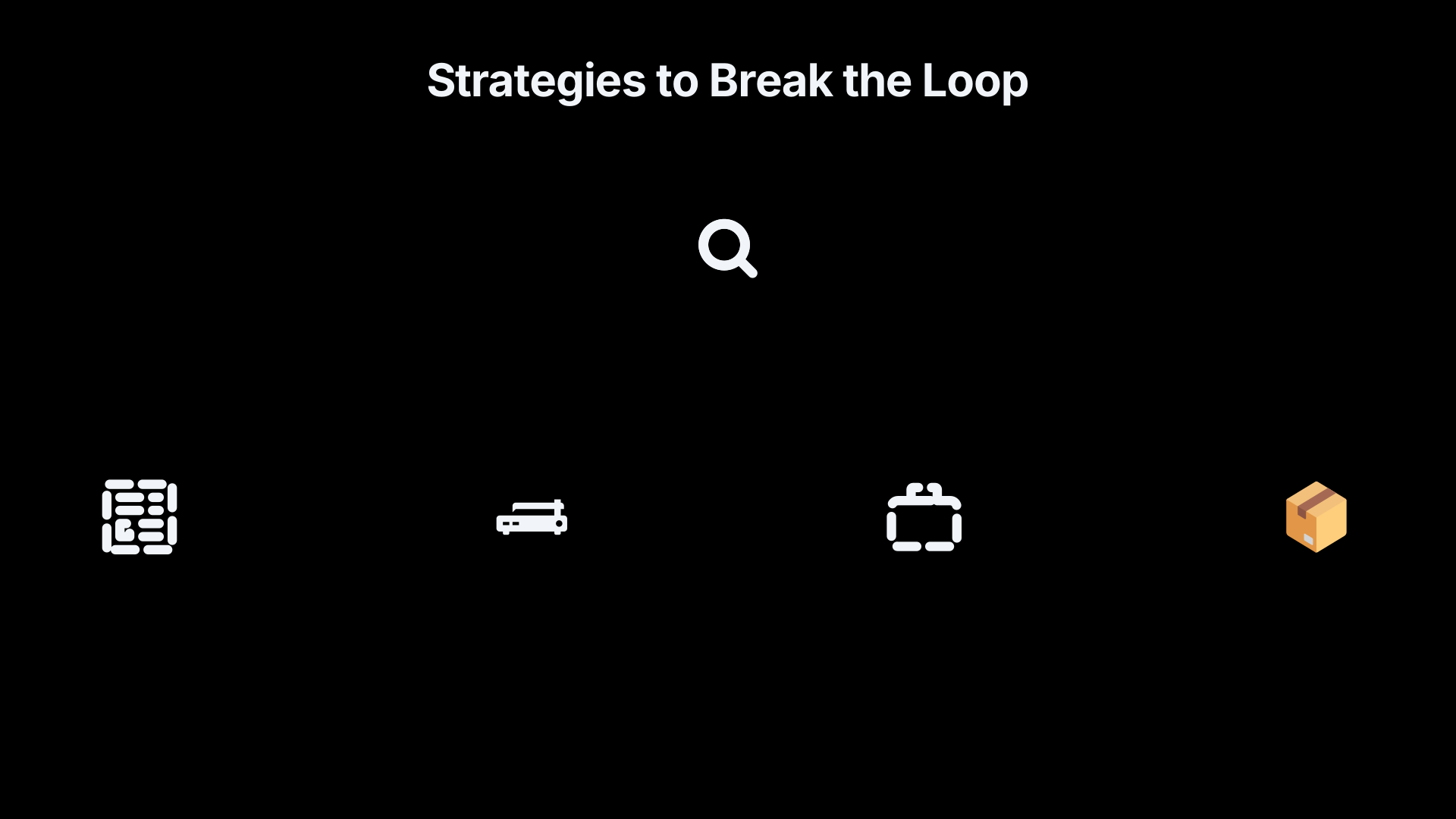
- Alternate between personalised playlists and manual exploration.
- Follow artists, labels or local scenes outside usual genres.
- Use editorial playlists alongside algorithmic ones.
- Occasionally listen through complete albums rather than endless recommendation feeds.
- Search deliberately for unfamiliar genres, countries or eras.
These actions create new behavioural signals that recommendation systems can learn from, making future suggestions more varied.
Do personalised playlists make taste smaller?
They can, but not because they stop discovery. The more subtle risk is that they redefine discovery as movement within a comfort zone. A listener may encounter countless new tracks while rarely straying far from established preferences.
Personalised playlists excel at reducing friction and maintaining relevance. Yet the qualities that make them useful—prediction, similarity and behavioural optimisation—also make them prone to reinforcing existing habits. Whether they expand or narrow musical horizons depends largely on how much room is left for surprise, both in the platform’s design and in the listener’s own choices.
eBay marketplace picks
Marketplace Samples
Example marketplace items related to this page. Use the search link to explore similar finds on eBay.




Endnotes
1.
Source: arxiv.org
Link:https://arxiv.org/abs/2003.08203
2.
Source: arxiv.org
Link:https://arxiv.org/abs/1812.03226
3.
Source: researchgate.net
Link:https://www.researchgate.net/publication/307573833_Music_Personalization_at_Spotify
Source snippet
Music Personalization at SpotifyWe'll dive deep into the workings of [Discover Weekly]({{ 'discover-weekly/' | relative_url }}), our marquee personalized playlist which...
4.
Source: link.springer.com
Link:https://link.springer.com/article/10.1007/s00521-024-10828-5
Source snippet
Springer LinkRevisiting recommender systems: an investigative surveyby OAS Ibrahim · 2025 · Cited by 31 — This paper provides a thorough...
5.
Source: arxiv.org
Link:https://arxiv.org/abs/1311.6355
Source snippet
[1311.6355] Exploration in Interactive Personalized Music...by X Wang · 2013 · Cited by 215 — This paper presents a new approach to musi...
6.
Source: jads.nl
Title: netflix spotify and the evolution of recommender algorithms
Link:https://www.jads.nl/news/netflix-spotify-and-the-evolution-of-recommender-algorithms/
Source snippet
Netflix, Spotify and the evolution of recommender algorithms25 Aug 2023 — This prevents users from slipping into a so-called “filter bubb...
7.
Source: researchgate.net
Title: 388827947 Effects of algorithmic curation in users’ music taste on Spotify
Link:https://www.researchgate.net/publication/388827947_Effects_of_algorithmic_curation_in_users%27_music_taste_on_Spotify
Source snippet
Effects of algorithmic curation in users' music taste on Spotify15 Mar 2026 — This study addresses the potential impact of re...
8.
Source: researchgate.net
Link:https://www.researchgate.net/publication/359434519_The_Diversity_of_Music_Recommender_Systems
Source snippet
[3] found that following Spotify's recommendations reduced the diversity of the users' listening lists (see also [8]) and that users...
9.
Source: researchgate.net
Link:https://www.researchgate.net/publication/388659001_Reframing_the_filter_bubble_through_diverse_scale_effects_in_online_music_consumption
Source snippet
(PDF) Reframing the filter bubble through diverse scale...The contribution of this work focuses on appraising the interpretability of an...
10.
Source: arxiv.org
Link:https://arxiv.org/abs/2212.00592
Source snippet
Assessing the Impact of Music Recommendation Diversity on Listeners: A Longitudinal StudyDecember 1, 2022...
Published: December 1, 2022
11.
Source: researchgate.net
Title: 387217872 Diversity and Serendipity Preference Aware Recommender System
Link:https://www.researchgate.net/publication/387217872_Diversity_and_Serendipity_Preference-Aware_Recommender_System
Source snippet
(PDF) Diversity and Serendipity Preference-Aware...Jul 8, 2024 — Diversity and novelty are essential objectives in recommender systems t...
12.
Source: researchgate.net
Title: 386149700 Music Recommendation System on Spotify Using Deep Learning
Link:https://www.researchgate.net/publication/386149700_Music_Recommendation_System_on_Spotify_Using_Deep_Learning
Source snippet
4. Contextual Bandits: Approaches that Spotify. may use to balance exploration (new music) with. exploitation (music...Read more...
13.
Source: researchgate.net
Link:https://www.researchgate.net/publication/345442009_Personalized_Recommendations_for_Music_Genre_Exploration
Source snippet
(2020) explored the effect of music recommendations on users' playlist creation behavior and found that users with high...
14.
Source: researchgate.net
Title: 341126150 Algorithmic Effects on the Diversity of Consumption on Spotify
Link:https://www.researchgate.net/publication/341126150_Algorithmic_Effects_on_the_Diversity_of_Consumption_on_Spotify
Source snippet
2020) provide cleaner evidence: Spotify's Discover Weekly increased consumption but reduced genre diversity by 12% over six...Read more...
15.
Source: arxiv.org
Link:https://arxiv.org/pdf/2003.08203
Source snippet
filter bubble: the effect of using recommender systems on content diversity. Proceedings of the 23rd international conference on. World w...
16.
Source: arxiv.org
Link:https://arxiv.org/html/2511.16478
Source snippet
In Proceedings of the Fifth ACM Conference on Recommender Systems.Read more...
17.
Source: spotify.com
Link:https://www.spotify.com/uk/signup
18.
Source: link.springer.com
Link:https://link.springer.com/article/10.1007/s11042-024-19505-0
Source snippet
ethical recommendation system based on friend's preferred...by M Furini · 2025 · Cited by 9 — Our proposed music recommendation mechanis...
19.
Source: link.springer.com
Link:https://link.springer.com/article/10.1007/s13735-017-0118-y
Source snippet
country-specific music preferences and music...by M Schedl · 2017 · Cited by 225 — We further illustrate how to exploit the dataset for...
20.
Source: research.atspotify.com
Link:https://research.atspotify.com/algorithmic-effects-on-the-diversity-of-consumption-on-spotify
Source snippet
Spotify ResearchAlgorithmic Effects on the Diversity of Consumption on Spotify3 Dec 2020 — In this work, we analyze our users through the...
21.
Source: sociologicalscience.com
Link:https://sociologicalscience.com/download/vol_12/september/SocSci_v12_572to600.pdf
Source snippet
Sociological ScienceStreaming Platforms, Filter Bubbles, and Cultural...by S Coavoux · 2025 — We find a statistically significant positi...
22.
Source: thedecisionlab.com
Title: chained to the algorhythm how spotify standardizes our listening
Link:https://thedecisionlab.com/insights/consumer-insights/chained-to-the-algorhythm-how-spotify-standardizes-our-listening
Source snippet
The Decision LabAlgoRhythm: How Spotify Standardizes Listening | TDL18 Apr 2024 — Spotify's feedback loop traps you inside of a filter bu...
23.
Source: research.atspotify.com
Title: calibrated recommendations with contextual bandits on spotify homepage
Link:https://research.atspotify.com/2025/9/calibrated-recommendations-with-contextual-bandits-on-spotify-homepage
Source snippet
exploration and exploitation. For about this work please refer our paper: Calibrated Recommendations with Contextual Bandits...
24.
Source: research.google
Link:https://research.google/pubs/values-of-exploration-in-recommender-systems/
Source snippet
ecommendation quality that more directly impact user experience.Read more...
Additional References
25.
Source: thesis.eur.nl
Link:https://thesis.eur.nl/pub/55231/Derwinis-Katarzyna.pdf
Source snippet
they Discover Weekly your taste?Therefore, this thesis aims to analyse whether the differences in Spotify usage have an impact on the per...
26.
Source: keentolearn.medium.com
Link:https://keentolearn.medium.com/7-ways-how-spotifys-algorithm-delivers-personalized-music-recommendations-ebfbc934d90f
Source snippet
medium.com7 ways How Spotify's Algorithm Delivers Personalized Music...One challenge is the “filter bubble” effect, where the algorithm...
27.
Source: fairmuse.eu
Link:https://fairmuse.eu/wp-content/uploads/2023/12/Tuning-In-A-Comprehensive-Analysis-of-Music-Recommender-Systems-Playlists-and-Algorithmic-Fairness.pdf
Source snippet
gorithms (recommender systems in particular) and playlists' design on consumption, by paying special...Read mor...
28.
Source: beckyxzhang.github.io
Link:https://beckyxzhang.github.io/paper
Source snippet
Assessing the diversity-accuracy dilemma of Spotify's...May 13, 2021 — In this paper, we explore how different algorithms impact accurac...
Published: May 13, 2021
29.
Source: illumin.usc.edu
Title: algorithmic symphonies how spotify strikes the right chord
Link:https://illumin.usc.edu/algorithmic-symphonies-how-spotify-strikes-the-right-chord/
Source snippet
Symphonies: How Spotify Strikes the Right Chord21 Jan 2024 — This article explores Spotify's recommendation algorithm, including how it h...
30.
Source: music-tomorrow.com
Title: fairness and diversity in music recommendation algorithms
Link:https://www.music-tomorrow.com/blog/fairness-and-diversity-in-music-recommendation-algorithms
Source snippet
Are music recommendation algorithms fair to emerging...21 Sept 2021 — In today's piece, we'll go through the main elements of this probl...
31.
Source: GOV.UK
Link:https://www.gov.uk/government/publications/research-into-the-impact-of-streaming-services-algorithms-on-music-consumption/the-impact-of-algorithmically-driven-recommendation-systems-on-music-consumption-and-production-a-literature-review
Source snippet
The impact of algorithmically driven recommendation...by D Hesmondhalgh · Cited by 55 — The impact of streaming platforms on musical pro...
32.
Source: ethos.itu.dk
Title: a foray into the world of music recommender systems
Link:https://ethos.itu.dk/a-foray-into-the-world-of-music-recommender-systems/
Source snippet
foray into the world of music recommender systems10 Jul 2023 — The impact of algorithmically driven recommendation systems on music consu...
33.
Source: transactions.ismir.net
Link:https://transactions.ismir.net/articles/10.5334/tismir.106
Source snippet
Music Information Retrieval TransactionsDiversity by Design in Music Recommender Systemsby L Porcaro · 2021 · Cited by 33 — Exploring the...
34.
Source: medium.com
Link:https://medium.com/%40myliemudaliyar/behind-the-playlist-analyzing-spotifys-recommendation-system-5044a13f5ccf
Source snippet
ith exploitation (recommending content similar to what the user...Read more...
Topic Tree