Within Playlists
How Playlists Make Songs Feel Familiar
Streaming still makes hits through repetition, but the repeats now come from playlists, autoplay and personal libraries.
On this page
- Why repeated exposure still drives hit making
- How playlists and autoplay spread the same track quietly
- How streaming repetition differs from radio rotation
Page outline Jump by section
Introduction
Songs still become hits through repetition. What has changed is where that repetition comes from. For most of the twentieth century, radio stations created familiarity by playing the same tracks repeatedly across days and weeks. In the streaming era, the same psychological process remains powerful, but it is delivered through playlists, autoplay, recommendation systems and personal libraries rather than through a broadcaster’s schedule.
 This shift helps explain why songs can now feel instantly familiar even when listeners cannot remember hearing them on radio. A track may appear in a workout playlist, then reappear in a personalised mix, then surface again through autoplay after an album ends. Each exposure is small, but together they create recognition. Streaming has not eliminated repetition as a hit-making tool; it has distributed repetition across many listening environments. Research on music recommendation systems and listening behaviour consistently finds that familiarity strongly influences preference and that repeated exposure remains central to how listeners adopt new music.[arXiv]arxiv.orgDiscovery Dynamics: Leveraging Repeated Exposure for User and Music CharacterizationOctober 28, 2022…
Why Repeated Exposure Still Drives Hit-Making
The basic mechanism behind musical familiarity is older than streaming. Psychologists call it the “mere exposure effect”: people often develop greater liking for something simply because they encounter it repeatedly. Music appears particularly susceptible to this effect because songs are designed to withstand multiple listens. Research using streaming data has found that interest in newly discovered songs often rises during the first several exposures before eventually levelling off, producing a pattern consistent with decades of psychological research.[arXiv]arxiv.orgDiscovery Dynamics: Leveraging Repeated Exposure for User and Music CharacterizationOctober 28, 2022…
This matters because familiarity is not merely a side effect of popularity. It is one of the engines that creates popularity. Studies of music choice have found that familiarity is a strong predictor of what listeners choose to play, sometimes outperforming factors that people claim matter more, such as novelty.[ResearchGate]researchgate.netWe show that although consumers say they would prefer to listen to unfamiliar music.Read more…
In the radio era, programmers deliberately relied on this principle. Heavy rotation ensured that listeners heard the same songs often enough for recognition to become preference. Streaming platforms may market themselves as discovery tools, but their recommendation systems face the same challenge: introducing enough novelty to keep users engaged while maintaining enough familiarity to keep them comfortable. Spotify researchers have explicitly described recommendation as a balancing act between familiarity and discovery.[Spotify Research]research.atspotify.comSpotify ResearchAlgorithmic Balancing of Familiarity, Similarity, & Discovery in…5 Nov 2021 — We propose a multi-level ordered-weighte…
How Playlists and Autoplay Spread the Same Track Quietly
The most important change is that repetition no longer arrives from a single source. Instead, it is scattered across many listening contexts.
A listener might encounter the same song through:
- A major editorial playlist.[orphiq.com]orphiq.comspotify editorial playlistUnderstanding Spotify Editorial Playlists15 Mar 2026 — If your song performs well on an editorial playlist, Spotify's algorithm may push…
- A personalised daily mix. * An artist radio station.[artists.spotify.com]artists.spotify.comfor Artists Spotify PlaylistsSpotify for ArtistsSpotify Playlists - Fan StudyIn fact, more than half of new artist discoveries on Spotify happen in programmed playlis… * Autoplay after another playlist finishes.[nickiedemakos.substack.com]nickiedemakos.substack.comso im making my own spotify wrappedI'm making my own Spotify Wrapped this year but betterMost of these songs came from Spotify's autoplay feature which continues to play mu…
- A user-created playlist shared through social media.
- Their own saved library.
Each appearance may seem independent, but together they create cumulative exposure. A song does not need a dominant radio campaign if streaming systems keep finding new opportunities to place it in front of the same listener.
Spotify’s own artist data shows how important these programmed environments have become. More than half of new artist discoveries on the platform come from programmed playlists, while a substantial share comes specifically from mixes, radio features and autoplay.[Spotify for Artists]artists.spotify.comfor Artists Spotify PlaylistsSpotify for ArtistsSpotify Playlists - Fan StudyIn fact, more than half of new artist discoveries on Spotify happen in programmed playlis…
Autoplay is particularly significant because it extends listening sessions beyond the listener’s original choice. When a playlist or album ends, the platform automatically serves similar tracks so the music continues uninterrupted. Spotify describes autoplay as a system that automatically plays related songs after a listener reaches the end of a selection.[Spotify]artists.spotify.comfor Artists Spotify PlaylistsSpotify for ArtistsSpotify Playlists - Fan StudyIn fact, more than half of new artist discoveries on Spotify happen in programmed playlis…
The result is a subtle form of repetition. Listeners may not consciously choose a track multiple times. Instead, recommendation systems repeatedly place it in their path. Some users have even complained that autoplay surfaces the same songs over and over again, illustrating how recommendation systems can reinforce familiarity through recurring selections.[Reddit]reddit.comSpotify's autoplay plays the same songs in every timeSpotify's autoplay plays the same songs in every timeApril 12, 2023 — For the past 2-3 weeks, every time an album/playlist ends, Au…
The New Familiarity Loop
Streaming creates a feedback cycle that differs from traditional promotion.
A radio listener might hear a song several times a day because a station programmer placed it in heavy rotation. A streaming listener may hear the same song across multiple products because recommendation systems detect that it performs well, generates engagement or fits common listening patterns.
The cycle often works like this:
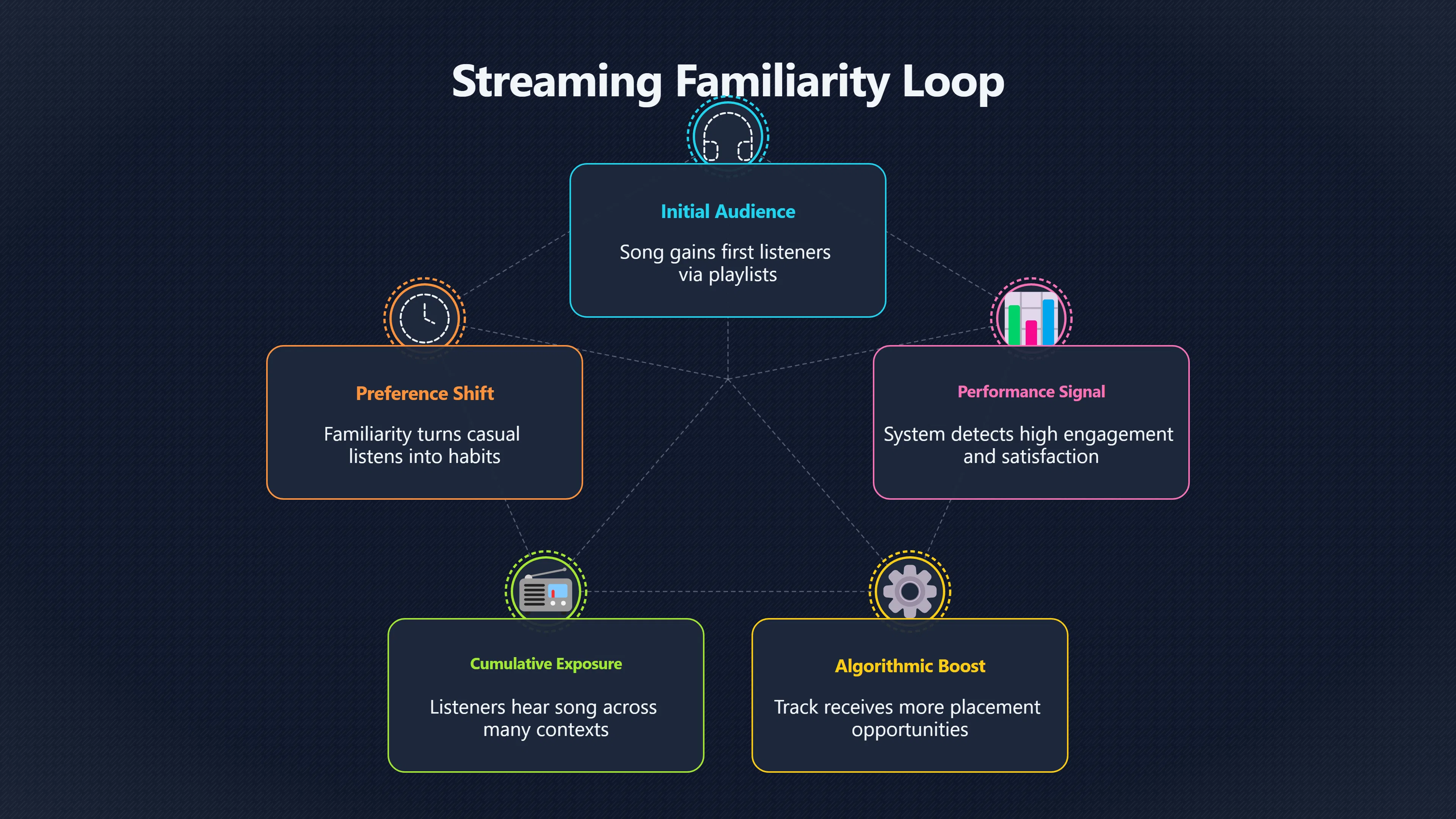
- A song gains an initial audience.
- It performs well in playlists or recommendations.
- Algorithms interpret those signals as evidence of listener satisfaction.
- The song receives more placement opportunities.
- More listeners become familiar with it.[arxiv.org]arxiv.orgFamiliarizing with Music: Discovery Patterns for Different…6 May 2025 — Research has shown that music listeners tend to like familiar…
- Familiarity increases the likelihood of additional plays.
Research into music recommender systems increasingly treats familiarity as a measurable variable because repeated listening is such a common behaviour. Studies using large streaming datasets show that recency, frequency of exposure and existing familiarity are all strong predictors of future listening choices.[arXiv]arxiv.orgDiscovery Dynamics: Leveraging Repeated Exposure for User and Music CharacterizationOctober 28, 2022…
This helps explain why many streaming hits seem to emerge gradually rather than exploding through a single promotional event. Familiarity accumulates through repeated encounters spread across weeks or months.
How Streaming Repetition Differs from Radio Rotation
Although both systems depend on repetition, the experience feels different.
Radio repeated songs publicly
Radio repetition was visible. Everyone listening to the same station heard largely the same rotation. Hit songs became cultural reference points because millions of people encountered them together.
Programmers also worked with relatively fixed schedules. If a song entered heavy rotation, listeners could often predict they would hear it again later in the day.
Streaming repeats songs privately
Streaming repetition is personalised. Two listeners may both hear a song repeatedly, but through entirely different pathways.
One person might receive it in a gym playlist. Another might encounter it through indie recommendations. A third might hear it via autoplay after related artists. The repetition exists, but it is distributed across personalised systems rather than concentrated in a public broadcast schedule. Spotify’s “algotorial” approach—combining human editorial choices with machine-driven personalisation—illustrates this hybrid model.[Spotify Engineering]engineering.atspotify.comhumans machines a look behind spotifys algotorial playlistsSpotify EngineeringHumans + Machines: A Look Behind the Playlists Powered by…27 Apr 2023 — Personalized Editorial Playlists has been e…
The consequence is that familiarity can develop without widespread awareness that repetition is occurring. Listeners may feel they “keep running into” a song without recognising that recommendation systems are creating those encounters.
Why Familiarity Matters More Than Discovery Alone
Streaming platforms often present themselves as engines of discovery, yet research consistently shows that listeners gravitate towards familiar music. Recommendation systems therefore face a tension: people say they want new music, but their behaviour frequently rewards familiar material.[ResearchGate]researchgate.netWe show that although consumers say they would prefer to listen to unfamiliar music.Read more…
This is why recommendation systems rarely maximise novelty. Instead, they tend to introduce new tracks alongside songs, artists and sounds that already feel known. Spotify researchers have described recommendation design as an effort to balance discovery, similarity and familiarity because users generally respond poorly to either extreme.[Spotify Research]research.atspotify.comSpotify ResearchAlgorithmic Balancing of Familiarity, Similarity, & Discovery in…5 Nov 2021 — We propose a multi-level ordered-weighte…
In practical terms, playlists often function less as discovery engines than as familiarity-building machines. A track may begin as something unfamiliar, but repeated appearances across playlists, radio features and autoplay gradually move it into the listener’s comfort zone. Once that transition happens, voluntary listening becomes more likely.
That process mirrors what radio once achieved through heavy rotation. The mechanism has survived the technological shift. What changed is that repetition is now personalised, distributed and largely invisible. Instead of hearing the same song because a station plays it every afternoon, listeners hear it because dozens of streaming systems quietly place it in front of them until it feels like part of their musical world.
Amazon book picks
Further Reading
Books and field guides related to How Playlists Make Songs Feel Familiar. Use these as the next step if you want deeper reading beyond the article.
You Have Not Yet Heard Your Favourite Song
Explores recommendation loops and discovery.
eBay marketplace picks
Marketplace Samples
Example marketplace items related to this page. Use the search link to explore similar finds on eBay.




Endnotes
1.
Source: arxiv.org
Link:https://arxiv.org/abs/2210.16226
Source snippet
Discovery Dynamics: Leveraging Repeated Exposure for User and Music CharacterizationOctober 28, 2022...
Published: October 28, 2022
2.
Source: arxiv.org
Link:https://arxiv.org/html/2505.03568v1
Source snippet
Familiarizing with Music: Discovery Patterns for Different...6 May 2025 — Research has shown that music listeners tend to like familiar...
Published: May 2025
3.
Source: researchgate.net
Link:https://www.researchgate.net/publication/255949989_The_same_old_song_The_power_of_familiarity_in_music_choice
Source snippet
We show that although consumers say they would prefer to listen to unfamiliar music.Read more...
4.
Source: artists.spotify.com
Title: for Artists Spotify Playlists
Link:https://artists.spotify.com/fan-study/spotify-playlists
Source snippet
Spotify for ArtistsSpotify Playlists - Fan StudyIn fact, more than half of new artist discoveries on Spotify happen in programmed playlis...
5.
Source: support.spotify.com
Link:https://support.spotify.com/uk/article/autoplay/
Source snippet
Autoplay tracksAutoplay tracks. When you reach the end of an album, playlist, or selection of songs, Spotify automatically plays s...
6.
Source: reddit.com
Title: Spotify’s autoplay plays the same songs in every time
Link:https://www.reddit.com/r/Music/comments/12j42b3/spotifys_autoplay_plays_the_same_songs_in_every/
Source snippet
Spotify's autoplay plays the same songs in every timeApril 12, 2023 — For the past 2-3 weeks, every time an album/playlist ends, Au...
Published: April 12, 2023
7.
Source: community.spotify.com
Link:https://community.spotify.com/t5/Other-Podcasts-Partners-etc/Autoplay-always-plays-the-same-songs-in-the-same-order-recently/td-p/5537846
Source snippet
Spotify CommunityAutoplay always plays the same songs in the same o...12 Apr 2023 — Whenever a song, playlist, or album ends, autoplay ge...
8.
Source: arxiv.org
Title: arXiv Predicting Music Relistening Behavior Using the ACT-R Framework
Link:https://arxiv.org/abs/2108.02138
Source snippet
Predicting Music Relistening Behavior Using the ACT-R FrameworkAugust 4, 2021...
Published: August 4, 2021
9.
Source: arxiv.org
Link:https://arxiv.org/pdf/2210.16226
Source snippet
It is notably more frequent when compared to the consumption of other.Read more...
10.
Source: newsroom.spotify.com
Title: prompted playlists algorithm gustav soderstrom
Link:https://newsroom.spotify.com/2025-12-10/spotify-prompted-playlists-algorithm-gustav-soderstrom/
Source snippet
spotify.comYou're in Control: Spotify Lets You Steer the Algorithm10 Dec 2025 — For the first time, your ideas, your logic, and your crea...
11.
Source: researchgate.net
Link:https://www.researchgate.net/publication/363645859_Discovery_Dynamics_Leveraging_Repeated_Exposure_for_User_and_Music_Characterization
Source snippet
To our knowledge, few studies have...Read more...
12.
Source: research.atspotify.com
Link:https://research.atspotify.com/publications/algorithmic-balancing-of-familiarity-similarity-discovery-in-music-recommendations
Source snippet
Spotify ResearchAlgorithmic Balancing of Familiarity, Similarity, & Discovery in...5 Nov 2021 — We propose a multi-level ordered-weighte...
13.
Source: engineering.atspotify.com
Title: humans machines a look behind spotifys algotorial playlists
Link:https://engineering.atspotify.com/2023/04/humans-machines-a-look-behind-spotifys-algotorial-playlists
Source snippet
Spotify EngineeringHumans + Machines: A Look Behind the Playlists Powered by...27 Apr 2023 — Personalized Editorial Playlists has been e...
14.
Source: chartlex.com
Link:https://www.chartlex.com/blog/streaming/how-to-get-on-spotifys-algorithmic-playlists-in-2025-the-ultimate-growth-playbook?srsltid=AfmBOoqtmct4v00qUHGXoDqhNs07wnhpA0lziK4_6Ch3289upprzqlfj
Source snippet
Spotify Algorithmic Playlists 2026: The 20% Save Rate...4 Nov 2025 — Spotify's recommendation algorithm in 2026 has shifted to prioritiz...
15.
Source: instagram.com
Link:https://www.instagram.com/reel/DWg7V_5AhLU/
Source snippet
, the music compilers will look at audience fit, and...
16.
Source: andrmusic.co
Link:https://andrmusic.co/behind-the-music/spotify-metrics-trigger-discovery/
Source snippet
Spotify Metrics That Trigger [Discover Weekly]({{ 'discover-weekly/' | relative_url }}) - AndRRepeat Listen Value: Develop songs that remain engaging across multiple exposures in r...
17.
Source: loopsolitaire.co.uk
Link:https://loopsolitaire.co.uk/blog/spotify-editorial-playlists/
Source snippet
ave on their featured artists, revealing and analyzing some in-depth data.Read more...
18.
Source: orphiq.com
Title: spotify editorial playlist
Link:https://orphiq.com/resources/spotify-editorial-playlist
Source snippet
Understanding Spotify Editorial Playlists15 Mar 2026 — If your song performs well on an editorial playlist, Spotify's algorithm may push...
Additional References
19.
Source: facebook.com
Link:https://www.facebook.com/ExposingTheTruth/posts/stop-letting-autoplay-dictate-your-daily-listening-real-music-discovery-feels-li/1367011875463039/
Source snippet
Stop letting autoplay dictate your daily listening. Real...Recent research into daily hit song [charts]({{ 'charts/' | relative_url }}) reveals a staggering gap: TikTok T...
20.
Source: linkedin.com
Link:https://www.linkedin.com/pulse/mere-effect-entire-music-market-explained-one-simple-concept-marsden-nmbee
Source snippet
tations in the streaming era. Again according to Luminate...Read more...
21.
Source: instagram.com
Link:https://www.instagram.com/reel/DLuwpQqvmnA/
Source snippet
her algorithmic playlists. The second your song goes live at midnight...
22.
Source: bridgeratings.com
Title: the habitual nature of music streaming
Link:https://www.bridgeratings.com/blog/2025/2/16/the-habitual-nature-of-music-streaming
Source snippet
16 Feb 2025 — Repetition & Comfort: Listeners form habits around specific songs due to emotional connection, nostalgia, or familiarity, l...
23.
Source: instagram.com
Link:https://www.instagram.com/reel/DW7DY_aDvTH/
Source snippet
om a playlist. Next is trust and emotion. DJ acted as taste...
24.
Source: medium.com
Link:https://medium.com/%40nimbalkaryashraj53/i-tracked-spotify-for-14-days-heres-why-you-can-t-discover-new-music-cde69cad9cf8
Source snippet
lysis represents my personal observations and hypotheses as...
25.
Source: theguardian.com
Title: The Guardian Pay to get playlisted?
Link:https://www.theguardian.com/music/2025/feb/19/spotify-discovery-mode-payola-playlist
Source snippet
The accusations against Spotify's Discovery ModeSpotify introduced Discovery Mode in 2020, a program where artists accept lower royalty r...
26.
Source: nickiedemakos.substack.com
Title: so im making my own spotify wrapped
Link:https://nickiedemakos.substack.com/p/so-im-making-my-own-spotify-wrapped
Source snippet
I'm making my own Spotify Wrapped this year but betterMost of these songs came from Spotify's autoplay feature which continues to play mu...
27.
Source: playlisthub.io
Title: Learn how these playlists work,
Link:https://playlisthub.io/academy/mastering-spotify-algorithmic-playlists-a-comprehensive-guide
Source snippet
Mastering Spotify Algorithmic Playlists: A Comprehensive...16 Feb 2026 — Explore the world of Spotify's algorithmic playlists in this pr...
28.
Source: linkedin.com
Link:https://www.linkedin.com/posts/davevandyke_the-rise-of-habit-songs-and-how-radio-activity-7442873066289860608-cwRx
Source snippet
Radio's New Metric: Identifying Habit Songs with Streaming...26 Mar 2026 — Streaming data shows that the average song in active rotation...
Topic Tree