Within Recording
How Edison's Phonograph Changed Musical Memory
Edison's phonograph created the first reliable way to record and replay performances, changing how music could be preserved.
On this page
- Invention and Technical Breakthroughs
- Early Music Applications
- Cultural Impact of Repeatable Sound
Page outline Jump by section
Introduction
In the history of music and sound, the invention of the phonograph by Thomas Edison in 1877 stands as a genuine turning point because it made the first reliable audio recording and playback possible. Before Edison’s machine, sound could be notated, remembered orally, or inscribed visually — but never replayed mechanically. The phonograph’s ability to fix a performance as an object that could be stored, carried, compared and later reproduced laid the groundwork for preserving musical performances far beyond the temporal and spatial limits of a live event.[Wikipedia]WikipediaOpen source on wikipedia.org.
Invention and Technical Breakthroughs
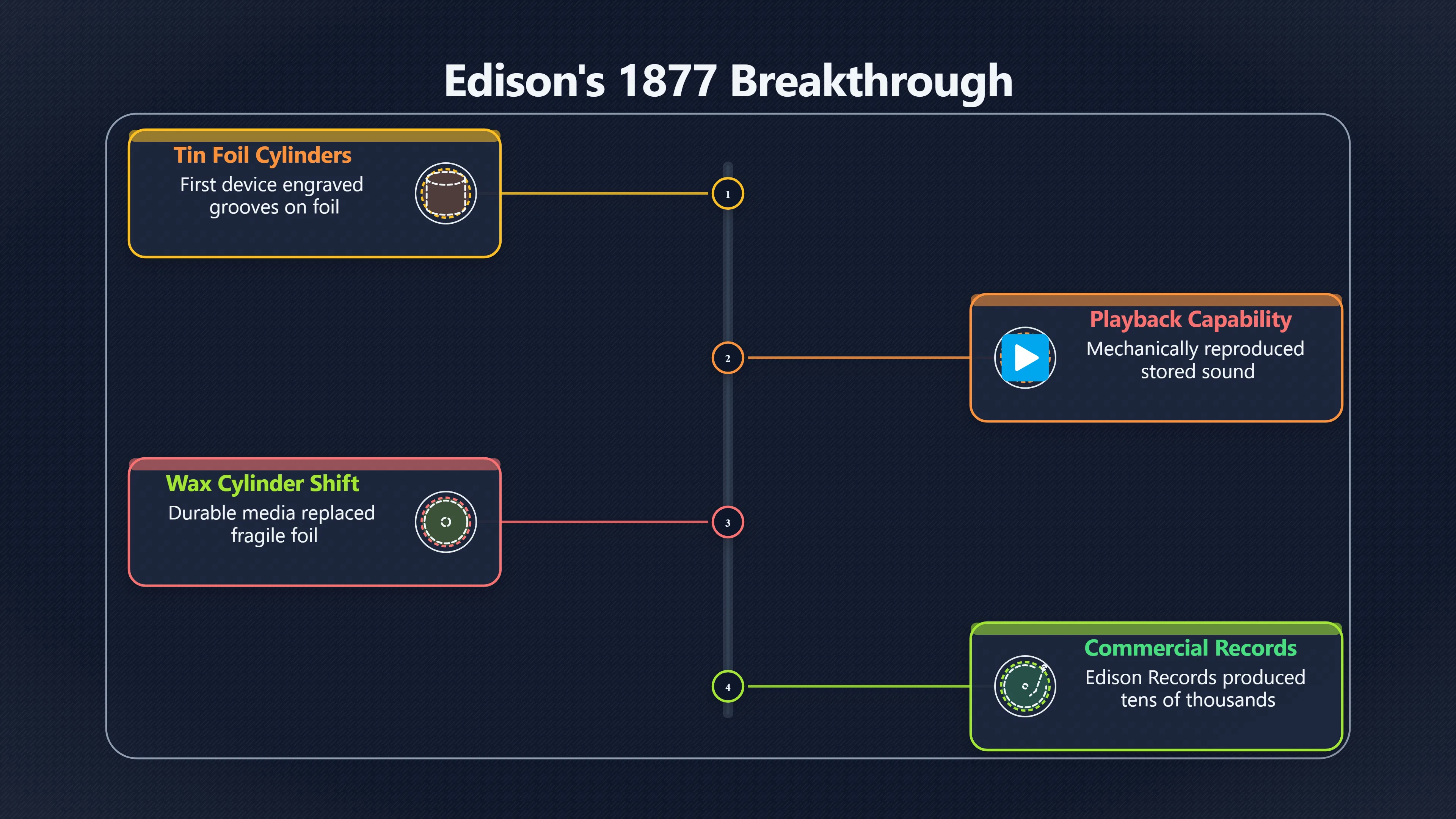
Edison’s phonograph translated acoustic vibrations into physical grooves engraved or indented on a medium, initially tin‑foil wrapped cylinders, that could later be traced by a stylus to mechanically reproduce the original sound. This was the first time a device performed both recording and playback, distinguishing it from earlier devices like the phonautograph that could only visualise sound waves.[Encyclopedia Britannica]britannica.comSource details in endnotes.
While Edison’s earliest device was rudimentary, subsequent improvements replaced tin foil with wax cylinders and later mass‑produced hard‑wax and celluloid formats. These refinements made recordings more durable and commercially viable. The cylinder itself — sometimes called an Edison cylinder — became one of the first commercial audio media capable of carrying actual musical sound.[Wikipedia]WikipediaPhonograph cylinderPhonograph cylinder
From a preservation perspective, these early formats were–for the first time–physical repositories of performances that did not vanish when an artist stopped singing or playing. Instead of dependent memory or notation, music could be stored and revisited.[Science Museum Group Blog]blog.sciencemuseumgroup.org.ukScience Museum Group BlogEavesdropping on history: listening to our collection21 Feb 2022 — This was a ground-breaking development; the p…
Early Music Applications
Although Edison initially viewed his phonograph as a novelty and a tool for dictation, inventors and entrepreneurs quickly explored its musical uses. By the late 1880s and into the 1890s, phonographs and cylinder recordings were being made of a wide range of music: popular songs, instrumental pieces, operatic excerpts and instrumental solos. Notables such as Josef Hofmann and Hans von Bülow made early recorded performances that survive in recorded history.[Encyclopedia Britannica]britannica.comSource details in endnotes.
The commercialisation of music recordings in the 1890s, including the establishment of companies such as Edison Records, marked the phonograph’s transition to a medium for preserving performances for listeners who might never hear live versions. Edison Records produced many tens of thousands of recordings before the company ceased operations in 1929, and some of these early discs remain preserved today in archives and libraries.[Wikipedia]WikipediaEdison RecordsEdison Records
Preserving Cultural and Musical Memory
Beyond commercial music, phonographs became tools for ethnographic and field research, capturing music and speech from cultures and traditions that had previously existed only in lived performance. Academics and explorers used cylinder recorders in the field from as early as the 1890s, preserving language, song and oral history in ways that surviving notation alone could not convey. These unique recordings now offer irreplaceable insight into musical traditions of remote communities.[The Library of Congress]loc.govThe Library of Congress Bill Klinger; Association for Recorded Sound CollectionsThe Library of CongressBill Klinger; Association for Recorded Sound CollectionsJune 7, 2007 — As early as 1890, academic researchers were…
Institutional collections, such as the Cylinder Audio Archive maintained by the University of California, Santa Barbara Library, have digitised thousands of phonograph cylinders — many originally produced by Edison’s companies — making them accessible to researchers and the public as enduring historical resources.[Wikipedia]WikipediaCylinder Audio ArchiveCylinder Audio Archive

Cultural Impact of Repeatable Sound
Edison’s phonograph changed music by making performances repeatable and collectible, not just ephemeral. For the first time, listeners could hear a specific rendition over and over, compare interpretations, memorise details from distant performers, and build personal or scholarly collections of recorded sound. This fostered new listening practices and altered concepts of musical memory and authenticity.[Science Museum Group Blog]blog.sciencemuseumgroup.org.ukScience Museum Group BlogEavesdropping on history: listening to our collection21 Feb 2022 — This was a ground-breaking development; the p…
The existence of recordings transformed how music could be preserved across generations. Rather than relying solely on written scores or oral transmission, recorded sound became a material trace of performance. This shift has enduring consequences: modern preservationists now work to digitise fragile analog media like cylinders to safeguard early recordings against physical deterioration, expanding access while respecting the phonograph’s role as the genesis of audio preservation practice.[Wikipedia]WikipediaOpen source on wikipedia.org.
These early mechanical recordings thus mark the origin of a long continuum of audio archiving and music preservation that stretches from wax cylinders to today’s digital libraries, enabling us to experience, analyse and appreciate performances across time and place.[clir.org]clir.orgPart OneThe recording and playback of sound began with Thomas Edison's invention of the phonograph in 1877. In the wake of that landmark…
Amazon book picks
Further Reading
Books and field guides related to How Edison's Phonograph Changed Musical Memory. Use these as the next step if you want deeper reading beyond the article.
How Music Got Free
Places the phonograph in the longer story of recorded music technologies.
Perfecting Sound Forever
Explains how recording transformed music from live experience into reproducible sound.
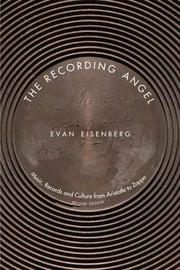
The recording angel
Examines how recordings changed the way people experience and remember music.
Denialism
Explains how recording transformed music from live experience into reproducible sound.
eBay marketplace picks
Marketplace Samples
Example marketplace items related to this page. Use the search link to explore similar finds on eBay.
![Listing image for [NO EXTRA CUSTOMS TAX] Recording Studio LED Neon Light Sign Mic Music Wall Decor](/assets/images/marketplace-covers/86c5f6bdf13f08f4a38f.jpg)
Endnotes
1.
Source: Wikipedia
Link:https://en.wikipedia.org/wiki/Phonograph
2.
Source: britannica.com
Link:https://www.britannica.com/technology/phonograph
3.
Source: Wikipedia
Title: Phonograph cylinder
Link:https://en.wikipedia.org/wiki/Phonograph_cylinder
4.
Source: britannica.com
Title: Encyclopedia Britannica Music recording
Link:https://www.britannica.com/topic/music-recording/The-development-of-musical-recording
Source snippet
Encyclopedia BritannicaMusic recording - Audio Technology, Preservation, History | Britannica...
5.
Source: Wikipedia
Title: Edison Records
Link:https://en.wikipedia.org/wiki/Edison_Records
6.
Source: Wikipedia
Title: Cylinder Audio Archive
Link:https://en.wikipedia.org/wiki/Cylinder_Audio_Archive
7.
Source: clir.org
Link:https://www.clir.org/pubs/reports/pub137/part1/
Source snippet
Part OneThe recording and playback of sound began with Thomas Edison's invention of the phonograph in 1877. In the wake of that landmark...
8.
Source: britannica.com
Link:https://www.britannica.com/technology/cylinder-recording
Source snippet
1904. CYLINDER RECORDING phonograph record Written and fact-checked by Britannica Editors History [Button: Ask Anything ] Table...
9.
Source: blog.sciencemuseumgroup.org.uk
Link:https://blog.sciencemuseumgroup.org.uk/eavesdropping-on-history/
Source snippet
Science Museum Group BlogEavesdropping on history: listening to our collection21 Feb 2022 — This was a ground-breaking development; the p...
10.
Source: loc.gov
Title: The Library of Congress Bill Klinger; Association for Recorded Sound Collections
Link:https://www.loc.gov/static/programs/national-recording-preservation-board/documents/klinger.pdf
Source snippet
The Library of CongressBill Klinger; Association for Recorded Sound CollectionsJune 7, 2007 — As early as 1890, academic researchers were...
Published: June 7, 2007
11.
Source: science.howstuffworks.com
Link:https://science.howstuffworks.com/innovation/inventions/phonograph.htm
Source snippet
the Phonograph Revolutionized Sound Recording | HowStuffWorksJuly 18, 2023 — HOW THE PHONOGRAPH REVOLUTIONIZED SOUND RECORDING By: Desire...
Published: July 18, 2023
12.
Source: scalar.oberlincollegelibrary.org
Title: the phonograph 1
Link:https://scalar.oberlincollegelibrary.org/decolonizing-ethnomusicology/the-phonograph-1
Source snippet
Phonograph - ScalarThe invention of the phonograph, which allowed sound to be recorded for the first time, changed the way people conduct...
13.
Source: americanhistory.si.edu
Title: replaying sound
Link:https://americanhistory.si.edu/explore/exhibitions/hear-my-voice/online/replaying-sound
Source snippet
Sound | National Museum of American HistoryREPLAYING SOUND THOMAS EDISON (1847–1931) * Hear My Voice * Explore Online * Picturing Sound *...
Additional References
14.
Source: loc.gov
Link:https://www.loc.gov/collections/edison-company-motion-pictures-and-sound-recordings/articles-and-essays/history-of-edison-sound-recordings/history-of-the-cylinder-phonograph/
Source snippet
History of the Cylinder PhonographThe phonograph was developed as a result of Thomas Edison's work on two other inventions, the telegraph...
15.
Source: nps.gov
Link:https://www.nps.gov/edis/learn/historyculture/origins-of-sound-recording-edisons-path-to-the-phonograph.htm
Source snippet
National Park Service)July 17, 2017 — ORIGINS OF SOUND RECORDING: EDISON'S PATH TO THE PHONOGRAPH Image: Scott phonautograph and Edison p...
Published: July 17, 2017
16.
Source: smithsonianmag.com
Link:https://www.smithsonianmag.com/arts-[culture
Source snippet
How the Phonograph Changed Music ForeverHOW THE PHONOGRAPH CHANGED MUSIC FOREVER MUCH LIKE STREAMING MUSIC SERVICES TODAY ARE RESHAPING O...
17.
Source: hibar-research.org
Link:https://hibar-research.org/restoring-and-preserving-historical-audio-recordings-story/
Source snippet
The HIBAR Research AllianceRestoring and Preserving Historical Audio RecordingsIRENE is currently in use by a number of archives and inst...
18.
Source: recordinghistory.org
Link:https://recordinghistory.org/technology/phonograph-record-technologies-from-the-beginning-almost-to-the-end/edisons-invention-of-the-phonograph/
19.
Source: facebook.com
Title: on this day in 1878 the phonograph patent changed music forever did you know how
Link:https://www.facebook.com/abbeyroad/posts/on-this-day-in-1878-the-phonograph-patent-changed-music-forever-did-you-know-how/1165707541779359/
Source snippet
On this day in 1878: The Phonograph Patent changed...On this day in 1878: The Phonograph Patent changed music forever 🔄🎶 Did you know ho...
20.
Source: home.nps.gov
Title: origins of sound recording edisons path to the phonograph
Link:https://home.nps.gov/edis/learn/historyculture/origins-of-sound-recording-edisons-path-to-the-phonograph.htm
Source snippet
National Park Service)July 17, 2017 — Edison’s Embossing Translating Telegraph made evident the many advantages of recording messages on...
Published: July 17, 2017
21.
Source: loc.gov
Title: Edison on hearing his voice play back to him from
Link:https://www.loc.gov/collections/edison-company-motion-pictures-and-sound-recordings/articles-and-essays/history-of-edison-sound-recordings/history-
Source snippet
History of Edison Sound Recordings | Articles and Essays | Inventing Entertainment: The Early Motion Pictures and Sound Recordings of the...
22.
Source: home.nps.gov
Title: origins of sound recording the inventors
Link:https://home.nps.gov/edis/learn/historyculture/origins-of-sound-recording-the-inventors.htm
Source snippet
National Park Service)July 17, 2017 — ORIGINS OF SOUND RECORDING: THE INVENTORS Edouard-Léon Scott de Martinville (1817-1879) WHO INVENTE...
Published: July 17, 2017
23.
Source: home.nps.gov
Title: origins of sound recording thomas edison
Link:https://home.nps.gov/edis/learn/historyculture/origins-of-sound-recording-thomas-edison.htm
Source snippet
National Park Service)July 17, 2017 — ORIGINS OF SOUND RECORDING: THE INVENTORS Image: Thomas Edison Thomas Edison (1847-1931) National P...
Published: July 17, 2017
Topic Tree