Within Harmony
How Major and Minor Chords Change Listener Emotions
Major and minor chords influence feeling, but their effect changes depending on musical context and progression.
On this page
- Isolated chord perception
- Progression and context effects
- Empirical studies on emotional ratings
Page outline Jump by section
Introduction
Major and minor chords are among the most powerful ways harmony shapes musical emotion. In many Western musical traditions, major chords are commonly perceived as brighter, more positive, or more stable, while minor chords are often heard as sadder, darker, or more introspective. Yet this contrast is not a fixed emotional code. Research increasingly shows that the emotional effect of a chord depends not only on whether it is major or minor, but also on what comes before it, what follows it, the listener’s cultural background, and the expectations created by the surrounding music. The same note or melody can feel comforting, triumphant, nostalgic, mournful, or ambiguous simply because the underlying harmony changes.[ScienceDirect]sciencedirect.comThe major-minor mode dichotomy in music perceptionby G Carraturo · 2025 · Cited by 28 — Traditionally, in Western music, maj…
 Understanding how major and minor chords alter emotional perception helps explain a central mechanism of musical expression: harmony changes the meaning listeners assign to the sounds they hear.
Is a Major Chord Really Happier Than a Minor Chord?
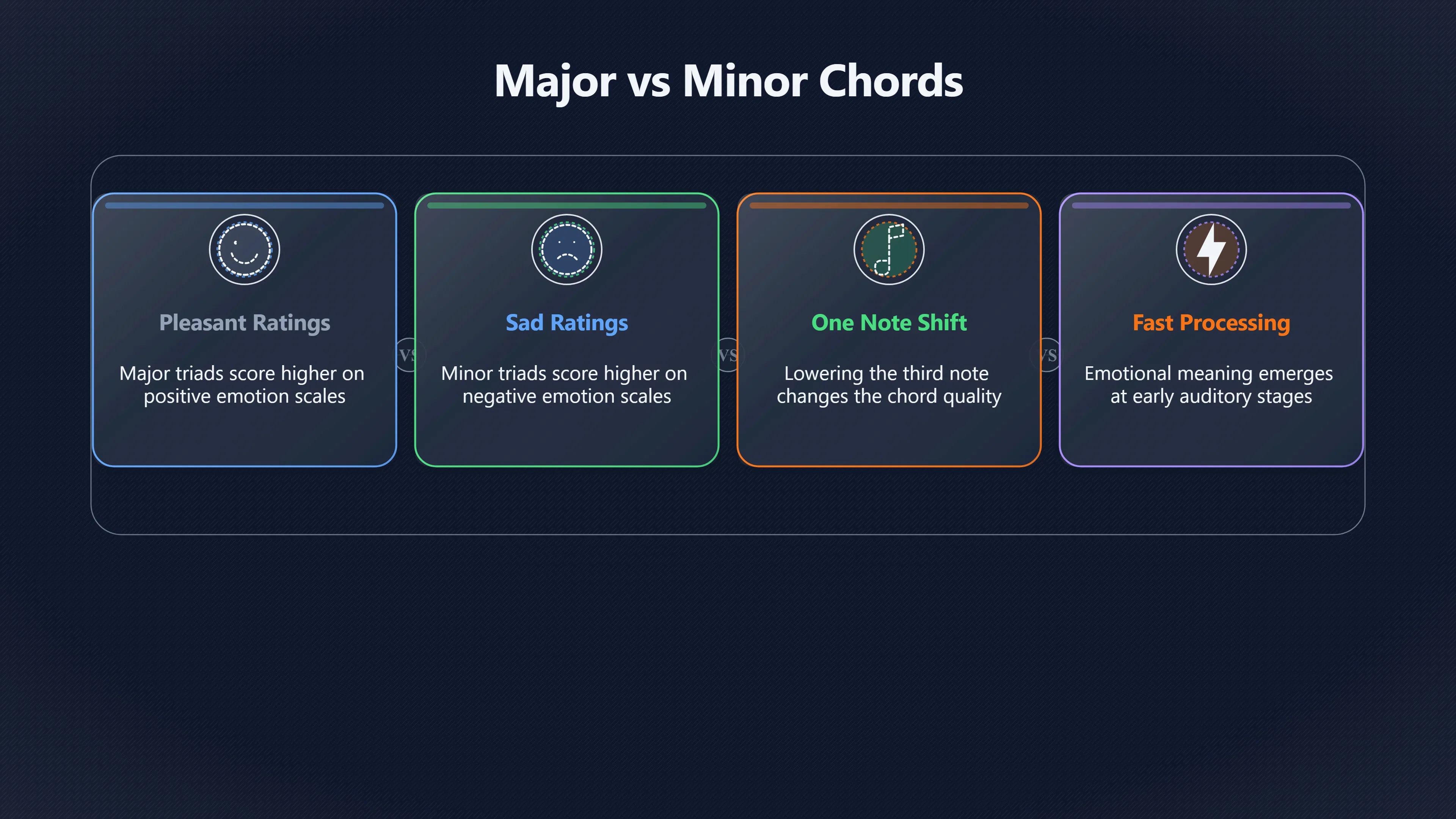
When listeners hear isolated chords, they tend to make remarkably consistent emotional judgements. Numerous psychological studies have found that major triads are typically rated as more pleasant, positive, and emotionally uplifting than minor triads, which are more often associated with sadness, seriousness, or negative affect.[PubMed]pubmed.ncbi.nlm.nih.govModerating effects of chord progressions on the emotional…by J Zhang · 2025 · Cited by 5 — This study investigates whether the e…[PMC]pmc.ncbi.nlm.nih.govHowever, previous studies have primarily focused on the emotionsPerception of Western Musical Modes: A Chinese Study - PMCby L Fang · 2017 · Cited by 37 — The major mode conveys positive emotion, wh…
The distinction comes from a very small musical change. A major and minor triad differ by only one note: the third of the chord is lowered by a semitone in the minor version. Despite this subtle alteration, listeners often experience a substantial emotional shift.
Researchers have also observed that the brain appears to process the emotional meaning of major and minor chords rapidly. Experiments measuring neural responses suggest that listeners do not simply learn to label major as “happy” and minor as “sad” after conscious reflection. Emotional associations emerge at early stages of auditory processing, indicating that chord quality becomes linked to emotional interpretation almost immediately.[PubMed]pubmed.ncbi.nlm.nih.govModerating effects of chord progressions on the emotional…by J Zhang · 2025 · Cited by 5 — This study investigates whether the e…
Importantly, listeners do not usually describe major chords as purely “happy” or minor chords as purely “sad”. Major chords are often associated with brightness, openness, confidence, or warmth. Minor chords may evoke melancholy, tenderness, longing, mystery, or emotional depth. These broader emotional qualities help explain why minor harmonies are frequently used in music that listeners find beautiful rather than simply depressing.[ScienceDirect]sciencedirect.comThe major-minor mode dichotomy in music perceptionby G Carraturo · 2025 · Cited by 28 — Traditionally, in Western music, maj…
Why a Single Note Can Feel Different Under Different Chords
Harmony changes emotion because it changes how listeners interpret individual notes.
Imagine a melody note such as E. Over a C major chord, that E functions as the major third, one of the defining tones that contributes to the chord’s bright character. If the harmony shifts to C minor, the same pitch may now feel unstable, foreign, or emotionally transformed because the expected third has changed to E-flat.
In other words, listeners do not hear notes in isolation. They hear relationships. A note acquires emotional meaning through its connection to the surrounding chord.
This relational hearing helps explain why identical melodies can convey radically different emotions when harmonised differently. The emotional change is not located in the melody alone; it emerges from the interaction between melody and harmony. The chord provides a context that tells the listener how to interpret the notes above it.[ScienceDirect]sciencedirect.comThe major-minor mode dichotomy in music perceptionby G Carraturo · 2025 · Cited by 28 — Traditionally, in Western music, maj…
Why Context Matters More Than Chord Type Alone
The traditional major-happy and minor-sad distinction becomes less reliable once chords are placed into real musical sequences.
A 2025 experimental study examined listeners’ reactions to major and minor chords both in isolation and as endings to chord progressions. Participants rated isolated major chords as more pleasant than isolated minor chords, consistent with decades of previous research. However, the emotional difference changed when the chords appeared within progressions. Stable harmonic endings strengthened the emotional contrast between major and minor chords, whereas unstable endings reduced it significantly.[PubMed]pubmed.ncbi.nlm.nih.govModerating effects of chord progressions on the emotional…by J Zhang · 2025 · Cited by 5 — This study investigates whether the e…
This finding illustrates a crucial principle: listeners react not just to a chord but to how that chord fulfils or frustrates expectations.
Several contextual factors can reshape emotional perception:
- Resolution: A minor chord that resolves a long period of tension can feel satisfying or comforting.
- Surprise: An unexpected switch from major to minor may create sadness, irony, or dramatic intensity.
- Tempo: Fast music in a minor key often feels energetic or aggressive rather than sorrowful.
- Instrumentation: A major chord played softly by a solo instrument can sound fragile or nostalgic.
- Genre conventions: Emotional interpretations are influenced by musical styles that listeners already know.[PubMed]pubmed.ncbi.nlm.nih.govModerating effects of chord progressions on the emotional…by J Zhang · 2025 · Cited by 5 — This study investigates whether the e…
Because harmony operates through expectation, emotional meaning emerges over time rather than residing permanently inside any single chord.
When Major Sounds Sad and Minor Sounds Hopeful
Many well-known musical moments challenge the simplistic major-versus-minor stereotype.
Major harmonies can sound wistful when combined with slow tempos, reflective lyrics, sparse textures, or melodies that descend gently. Listeners often describe such passages as nostalgic rather than joyful.
Likewise, minor harmonies can communicate strength, determination, excitement, or beauty. In film music, minor chords frequently accompany heroic struggle rather than despair. In popular music, they often create emotional richness while remaining energetic and engaging.
These examples do not disprove the major-minor distinction. Instead, they show that chord quality contributes one emotional cue among many. The final emotional impression results from the interaction of harmony with rhythm, melody, timbre, dynamics, and listener expectations. ScienceDirect[School of Composition]schoolofcomposition.comIn today's lesson we look at what this statement really means and perhaps more…Read more…
What Empirical Studies Reveal About Emotional Ratings
Laboratory studies consistently find measurable differences in how listeners rate major and minor harmonies.
Across experiments, major chords tend to receive higher ratings for pleasantness, positivity, and happiness, while minor chords receive higher ratings for sadness or negative valence. These patterns appear in both Western and non-Western participant samples that have substantial exposure to Western tonal music.[PubMed]pubmed.ncbi.nlm.nih.govModerating effects of chord progressions on the emotional…by J Zhang · 2025 · Cited by 5 — This study investigates whether the e…[PMC]pmc.ncbi.nlm.nih.govHowever, previous studies have primarily focused on the emotionsPerception of Western Musical Modes: A Chinese Study - PMCby L Fang · 2017 · Cited by 37 — The major mode conveys positive emotion, wh…
Researchers have also found evidence beyond direct emotional ratings:
- Brain-imaging studies show different neural activation patterns when listeners hear major versus minor harmonies.[Academia]academia.eduEmotion Processing of Major, Minor, and Dissonant ChordsOct 11, 2025 — The results indicate that (1) neural processing in emotion…
- Large-scale analyses linking song lyrics and chord usage have found that songs using major chords tend to be associated with more positively valenced language than songs dominated by minor chords.[Royal Society Publishing]royalsocietypublishing.orgThe Minor fall the Major lift inferring emotionalRoyal Society Publishinginferring emotional valence of musical chords through lyricsby A Kolchinsky · 2017 · Cited by 46 — We find that M…
- Studies of expectation suggest that switching unexpectedly between major and minor modes can generate reward-related prediction effects in the brain, indicating that emotional responses are tied to whether harmonic outcomes match or violate listener expectations.[arXiv]arxiv.orgSource details in endnotes.
Together, these findings support a nuanced conclusion. Major and minor chords genuinely influence emotional perception, but they do so within a broader cognitive system that constantly evaluates context, prediction, and musical meaning.
How Culture Shapes the Major–Minor Emotional Contrast
One of the most important developments in recent music-perception research is the recognition that the major-minor emotional distinction is not completely universal.
Studies comparing listeners from different cultural backgrounds have found that strong associations between major harmony and happiness are most pronounced among people familiar with Western tonal music. In populations with different musical traditions and less exposure to Western harmony, these emotional associations may be weaker or absent.[The Guardian]theguardian.comwhat makes a song sound happy it depends on your culture study findsWhat makes a song sound happy? It depends on your…Jun 29, 2022 — The perception of music in major keys as happy and minor keys as sad…[3Home | Western Sydney University]westernsydney.edu.auHome | Western Sydney UniversityPerceptions of happy and sad music may not be universal…Jun 30, 2022 — They then compared the emotiona…[Phys.org]phys.org2022 06 perceptions happy sad music universalPerceptions of happy and sad music may not be universal…Jun 30, 2022 — They then compared the emotional perceptions and preferences fo…
This does not mean the distinction is arbitrary. Rather, emotional responses appear to emerge from an interaction between acoustic properties and cultural learning. Listeners gradually absorb the emotional conventions of the musical systems they hear throughout their lives.
As a result, major and minor chords function partly as emotional signals and partly as learned cultural cues. The emotional power of harmony comes from both the sound itself and the expectations that listeners bring to it. Durham University[Psychology Today]psychologytoday.commusic to our earsNov 8, 2021 — The study strongly suggests that emotional reactions to major and minor chords are culturally dependent.Read more…
The Key Mechanism: Harmony Changes Meaning
The emotional effect of major and minor chords is best understood as a process of interpretation rather than a simple emotional label.
Major chords often create impressions of stability, openness, and positive affect. Minor chords often introduce shades of melancholy, tension, or introspection. Yet listeners rarely respond to these harmonies in isolation. They hear them as part of unfolding musical events.
A major chord may feel triumphant after uncertainty. A minor chord may feel comforting after tension. The same note can sound hopeful, tragic, or serene depending on the chord that surrounds it. Research increasingly suggests that this contextual flexibility is not a complication of the major-minor distinction but the very reason harmony is so emotionally expressive.[PubMed]pubmed.ncbi.nlm.nih.govModerating effects of chord progressions on the emotional…by J Zhang · 2025 · Cited by 5 — This study investigates whether the e…

Amazon book picks
Further Reading
Books and field guides related to How Major and Minor Chords Change Listener Emotions. Use these as the next step if you want deeper reading beyond the article.
This Is Your Brain On Music
Provides accessible explanations for emotional reactions to harmony.
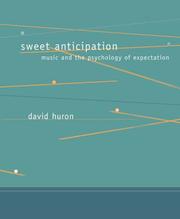
Sweet Anticipation
Explains why major and minor harmonies produce different emotional effects.

Emotion and meaning in music
Connects harmonic structure with emotional interpretation.
eBay marketplace picks
Marketplace Samples
Example marketplace items related to this page. Use the search link to explore similar finds on eBay.



Endnotes
1.
Source: sciencedirect.com
Link:https://www.sciencedirect.com/science/article/pii/S1571064524001672
Source snippet
The major-minor mode dichotomy in music perceptionby G Carraturo · 2025 · Cited by 28 — Traditionally, in Western music, maj...
2.
Source: pmc.ncbi.nlm.nih.gov
Title: However, previous studies have primarily focused on the emotions
Link:https://pmc.ncbi.nlm.nih.gov/articles/PMC5671660/
Source snippet
Perception of Western Musical Modes: A Chinese Study - PMCby L Fang · 2017 · Cited by 37 — The major mode conveys positive emotion, wh...
3.
Source: sciencedirect.com
Link:https://www.sciencedirect.com/science/article/pii/S0001691825000034
Source snippet
Moderating effects of chord progressions on the emotional...by J Zhang · 2025 · Cited by 2 — This study investigates whethe...
4.
Source: academia.edu
Link:https://www.academia.edu/16962796/Emotion_Processing_of_Major_Minor_and_Dissonant_Chords_A_Functional_Magnetic_Resonance_Imaging_Study
Source snippet
Emotion Processing of Major, Minor, and Dissonant ChordsOct 11, 2025 — The results indicate that (1) neural processing in emotion...
5.
Source: arxiv.org
Link:https://arxiv.org/abs/2212.12646
6.
Source: arxiv.org
Link:https://arxiv.org/abs/1706.08609
7.
Source: phys.org
Title: 2022 06 perceptions happy sad music universal
Link:https://phys.org/news/2022-06-perceptions-happy-sad-music-universal.html
Source snippet
Perceptions of happy and sad music may not be universal...Jun 30, 2022 — They then compared the emotional perceptions and preferences fo...
8.
Source: pubmed.ncbi.nlm.nih.gov
Link:https://pubmed.ncbi.nlm.nih.gov/39793277/
Source snippet
Moderating effects of chord progressions on the emotional...by J Zhang · 2025 · Cited by 5 — This study investigates whether the e...
9.
Source: pubmed.ncbi.nlm.nih.gov
Link:https://pubmed.ncbi.nlm.nih.gov/24957406/
Source snippet
Musical chords and emotion: major and minor triads are...by DR Bakker · 2015 · Cited by 99 — The early stages of processing that a...
10.
Source: schoolofcomposition.com
Link:https://www.schoolofcomposition.com/is-major-happy-and-minor-sad/
Source snippet
In today's lesson we look at what this statement really means and perhaps more...Read more...
11.
Source: royalsocietypublishing.org
Title: The Minor fall the Major lift inferring emotional
Link:https://royalsocietypublishing.org/rsos/article/4/11/170952/93447/The-Minor-fall-the-Major-lift-inferring-emotional
Source snippet
Royal Society Publishinginferring emotional valence of musical chords through lyricsby A Kolchinsky · 2017 · Cited by 46 — We find that M...
12.
Source: theguardian.com
Title: what makes a song sound happy it depends on your [culture]({{ ‘culture/’ | relative_url }}) study finds
Link:https://www.theguardian.com/australia-news/2022/jun/30/what-makes-a-song-sound-happy-it-depends-on-your-culture-study-finds
Source snippet
What makes a song sound happy? It depends on your...Jun 29, 2022 — The perception of music in major keys as happy and minor keys as sad...
13.
Source: psychologytoday.com
Title: music to our ears
Link:https://www.psychologytoday.com/us/blog/time-travelling-with-apollo/202111/music-to-our-ears
Source snippet
Nov 8, 2021 — The study strongly suggests that emotional reactions to major and minor chords are culturally dependent.Read more...
Additional References
14.
Source: researchgate.net
Link:https://www.researchgate.net/publication/387957319_Moderating_effects_of_chord_progressions_on_the_emotional_experience_of_major_and_minor_chords
Source snippet
Moderating effects of chord progressions on the emotional...1 Jan 2025 — Moderating effects of chord progressions on the emotional exper...
15.
Source: merriam-webster.com
Link:https://www.merriam-webster.com/dictionary/major
Source snippet
MAJOR Definition & Meaning6 days ago — The meaning of MAJOR is greater in dignity, rank, importance, or interest. How to use major in a s...
16.
Source: facebook.com
Link:https://www.facebook.com/groups/876194196241093/posts/2131858970674603/
Source snippet
Major keys can sound sad or wistfulIt bothers me when people say “major keys sound happy” without any caveats. A major key center can eas...
17.
Source: researchgate.net
Link:https://www.researchgate.net/publication/263355617_Musical_chords_and_emotion_Major_and_minor_triads_are_processed_for_emotion
Source snippet
Musical chords and emotion: Major and minor triads are...The early stages of processing that are involved suggest that major and minor c...
18.
Source: westernsydney.edu.au
Link:https://www.westernsydney.edu.au/news-centre/stories/2022/perceptions-of-happy-and-sad-music-may-not-be-universal-across-cultures-new-research-finds
Source snippet
Home | Western Sydney UniversityPerceptions of happy and sad music may not be universal...Jun 30, 2022 — They then compared the emotiona...
19.
Source: artemyk.github.io
Link:https://artemyk.github.io/assets/pdf/papers/Kolchinsky%20et%20al_2017_The%20Minor%20fall%2C%20the%20Major%20lift.pdf
Source snippet
higher valence lyrics than Minor chords, consistent with the previous music perception studies that showed that...Read mo...
20.
Source: interlude.hk
Title: the emotional architecture of chords major minor and the power of dynamics
Link:https://interlude.hk/the-emotional-architecture-of-chords-major-minor-and-the-power-of-dynamics/
Source snippet
How Chords & Dynamics Shape Emotion in Classical MusicJan 11, 2026 — Discover how major and minor chords create emotion in music. Learn w...
21.
Source: youtube.com
Link:https://www.youtube.com/watch?v=Rx52vrd5Dh8
Source snippet
Are Emotions in Chords Real? The Myth Behind Music TheoryDiscover the truth behind the conventional belief that chords inherently convey...
22.
Source: insounder.org
Title: music not rocket science 3 myth happy major and sad minor
Link:https://insounder.org/music-not-rocket-science-3-myth-happy-major-and-sad-minor
Source snippet
The Myth of Happy Major and Sad MinorMar 21, 2024 — Let's look at two examples of pieces that completely disprove the myth of happy major...
23.
Source: musicscience.net
Title: how automatic are emotional responses to musical chords
Link:https://musicscience.net/2023/11/21/how-automatic-are-emotional-responses-to-musical-chords/
Source snippet
?Nov 21, 2023 — In other words, a dissonant chord used in both major and minor keys is arguably a more familiar marker of negative valenc...
Topic Tree