Within Rhythm
Why Off Beat Rhythms Make People Move
Groove often feels best when a steady pulse is challenged just enough by off-beat accents, delays and rhythmic surprises.
On this page
- What syncopation does to expectation
- The pleasure of finding the pulse again
- Examples from funk, disco, hip hop and dance music
Page outline Jump by section
Introduction
Syncopation makes grooves feel danceable because it creates a controlled conflict between what listeners expect and what they actually hear. Instead of placing every important accent on the strongest beats, syncopated rhythms shift emphasis onto weaker beats, off-beats, or unexpected moments. The result is a musical push-and-pull: the pulse remains clear enough to follow, but the rhythm constantly teases that pulse by leaning against it. Research on groove consistently finds that people are most likely to experience pleasure and an urge to move when rhythms balance predictability with surprise rather than being either completely regular or highly chaotic.[PLOS]journals.plos.orgSyncopation, Body-Movement and Pleasure in Groove Musicby MAG Witek · 2014 · Cited by 598 — In this study, we investigated the relati…
 Within the broader question of how rhythm moves bodies, syncopation is one of the most effective mechanisms because it turns listening into an active process. The body is not merely following a beat; it is continually predicting where the beat is and enjoying the experience of finding it again after each rhythmic detour.[Frontiers]frontiersin.orgFrontiersThe sweet spot between predictability and surpriseby J Stupacher · 2022 · Cited by 69 — We argue that groove, when defined as th…
What Syncopation Does to Expectation
A straightforward rhythm confirms expectations. If strong sounds consistently occur on strong beats, listeners quickly understand the pattern and can easily predict what comes next. Syncopation interrupts this certainty by placing accents where the listener does not fully expect them.
For example, in a simple four-beat pattern, listeners often feel beats one, two, three and four as the rhythmic framework. A syncopated rhythm may emphasise the “and” between beats or delay an expected accent until slightly later. The underlying pulse remains present, but the surface rhythm seems to tug against it.
This matters because human rhythm perception relies heavily on prediction. Research in music cognition and neuroscience shows that listeners continuously generate internal models of timing and beat structure. Even during passive listening, motor-related brain systems become involved in anticipating future beats. Syncopation creates small prediction errors that force those timing systems to stay engaged.[Frontiers]frontiersin.orgFrontiersThe sweet spot between predictability and surpriseby J Stupacher · 2022 · Cited by 69 — We argue that groove, when defined as th…
The key point is that syncopation does not erase the beat. If it did, dancing would become difficult. Instead, it creates a temporary mismatch between the beat listeners feel and the accents they hear. That mismatch generates tension, attention and anticipation.[Frontiers]frontiersin.orgFrontiersThe sweet spot between predictability and surpriseby J Stupacher · 2022 · Cited by 69 — We argue that groove, when defined as th…
Why the Body Enjoys the Challenge
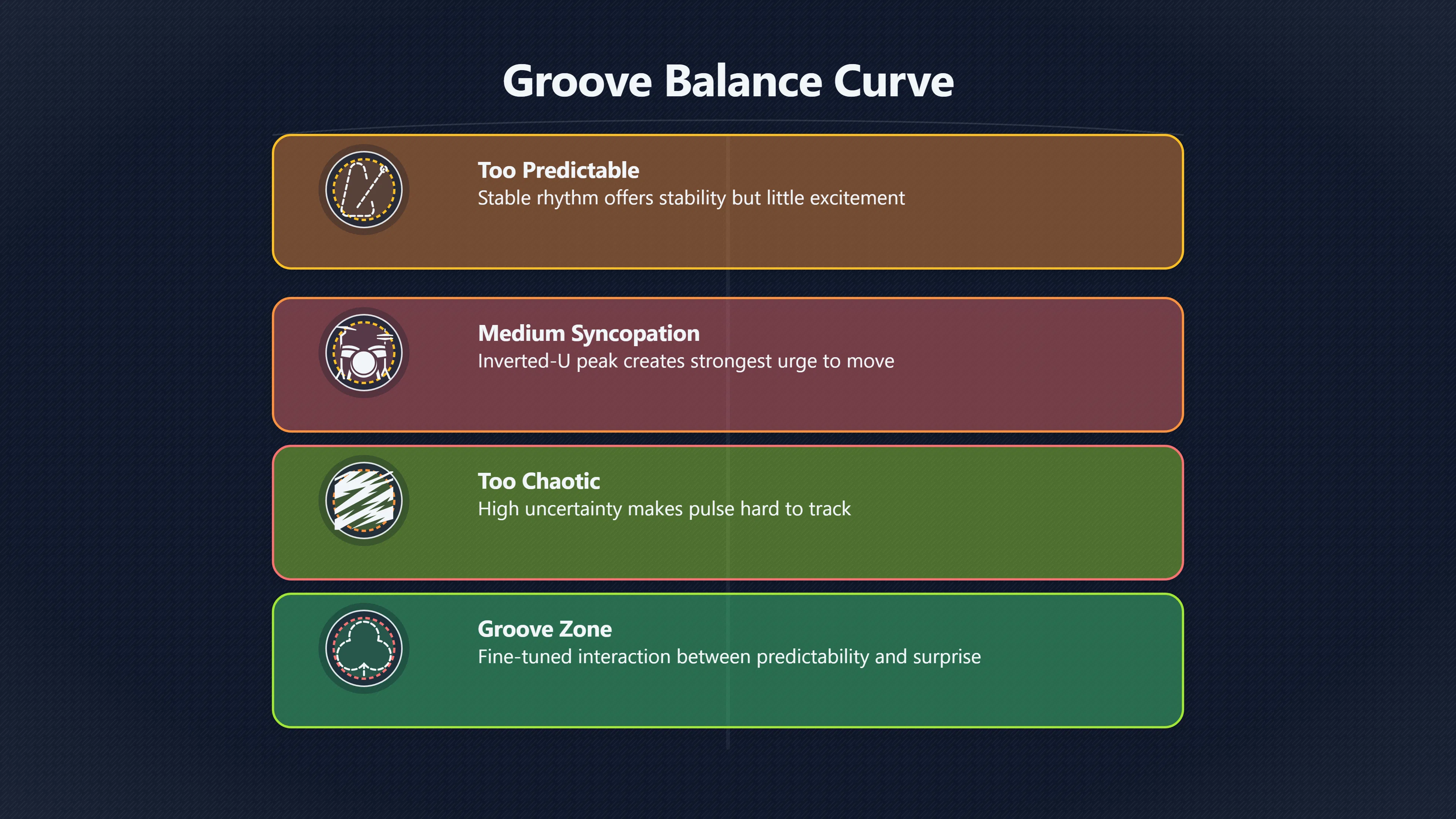
The danceability of syncopation comes from a balance rather than an extreme. A completely predictable rhythm offers stability but little excitement. A highly unpredictable rhythm can become difficult to follow. Groove emerges in the middle ground.
One influential study asked participants to listen to funk-inspired drum patterns with varying degrees of syncopation and rate both their pleasure and their desire to move. The results formed an inverted-U pattern: rhythms with a medium level of syncopation produced the strongest responses. Too little syncopation was less engaging, while too much reduced the desire to move because the pulse became harder to track.[PLOS]journals.plos.orgin drum patterns as a function of both rhythmic…by O Senn · 2018 · Cited by 122 — This exploratory study investigates the groove effec…[PMC]pmc.ncbi.nlm.nih.govActive Inference in Music Perception: Motor Engagement to…by K Ishida · 2025 · Cited by 3 — The urge to move (groove) induced by sy…
This finding has been replicated and expanded in later groove research. Reviews of the field describe groove as emerging from a fine-tuned interaction between predictability and surprise. Repetition provides the listener with a stable temporal framework, while syncopation introduces enough uncertainty to make participation rewarding. Frontiers[science]science.orgNeural dynamics of predictive timing and motor…Mar 6, 2024 — These results extend seminal studies on the quadratic relationship… Direct In practical terms, syncopation encourages movement because moving helps listeners maintain and reinforce their sense of the beat. Tapping a foot, nodding the head or dancing effectively becomes part of the process of resolving rhythmic tension. Rather than being a response that occurs after perception, movement helps support perception itself.[PMC]pmc.ncbi.nlm.nih.govnih.govSyncopation, Body-Movement and Pleasure in Groove Musicby MAG Witek · 2014 · Cited by 598 — Here we report results from a web-base…
The Pleasure of Finding the Pulse Again
A useful way to understand syncopation is to think of it as a game between certainty and uncertainty.
The listener establishes a pulse:
- The beat creates a stable expectation.
- Syncopated accents temporarily challenge that expectation.
- The listener mentally reconnects those accents to the underlying pulse.
- Successfully maintaining the pulse produces satisfaction and encourages movement.
Researchers studying groove increasingly interpret this process through predictive timing models. According to these accounts, the brain enjoys situations where expectations are challenged but not destroyed. Syncopation supplies exactly that condition. It introduces enough uncertainty to be interesting while preserving enough structure for the listener to remain oriented.[Science]science.orgNeural dynamics of predictive timing and motor…Mar 6, 2024 — These results extend seminal studies on the quadratic relationship…[Frontiers]frontiersin.orgFrontiersThe sweet spot between predictability and surpriseby J Stupacher · 2022 · Cited by 69 — We argue that groove, when defined as th…
This helps explain why dance music often feels energetic even when tempos are moderate. The sensation of forward motion does not come solely from speed. It comes from rhythmic events continually pulling attention away from the expected beat and then allowing the listener to reconnect with it.
Examples from Funk, Disco, Hip-Hop and Dance Music
Funk: Making the Off-Beat Feel Important
Funk is often cited as a classic example of syncopation-driven groove. Drum parts, bass lines and guitar figures frequently avoid simply reinforcing the strongest beats. Instead, they place accents around them, creating a sense that the rhythm is constantly bouncing, stretching and rebounding.
Many funk grooves place significant emphasis on sixteenth-note subdivisions between the main beats. The listener never loses track of the pulse, but the most interesting events often occur just beside it. This rhythmic strategy is so central to the style that discussions of funk routinely identify syncopation as one of its defining characteristics.[Universal Production Music]universalproductionmusic.comUniversal Production Music What makes music funkySyncopation is making the beats that are normally weak, dominant in a piece of music. That means you don…Read more…
Disco: Stability Below, Syncopation Above
Disco demonstrates a different balance. The bass drum often provides an unwavering four-on-the-floor pulse, creating exceptional stability for dancers. Above that foundation, bass lines, guitar parts, strings and vocal phrases frequently introduce syncopated accents.
The result is a groove that feels both secure and lively. Dancers can rely on the steady pulse while responding to the rhythmic surprises occurring around it.
Hip-Hop: The Art of Rhythmic Displacement
Hip-hop frequently uses syncopation through kick-drum placement, sampled breakbeats and vocal flow. Rappers often place syllables ahead of, behind or across expected beat locations, while producers build grooves from drum patterns rich in off-beat emphasis.
Ghost notes, swung subdivisions and syncopated kick drums create a feeling that the groove is constantly shifting weight without ever losing its centre. This is one reason hip-hop can feel physically compelling even at relatively slow tempos.[Beats To Rap On]beatstorapon.comBeats To Rap On Why Does Music Make You Dance?The Science of Beats…3 days ago — 4 days ago — The Hip-Hop / Funk Breakbeat. The hip-hop and funk drum pattern relies heavily on dyna…
Electronic Dance Music: Tension Around a Fixed Grid
House, techno and related dance genres often combine rigid timing with selective syncopation. A highly regular pulse keeps large groups of dancers synchronised, while off-beat hi-hats, syncopated percussion and delayed bass entries create motion and excitement.
The strongest dance grooves frequently rely not on abandoning the grid but on strategically resisting it.
Why Too Much Syncopation Can Reduce Groove
It might seem logical that more rhythmic surprise would create more excitement. Research suggests otherwise.
When syncopation becomes excessive, listeners can struggle to infer the underlying beat. Once the pulse becomes uncertain, movement becomes harder because dancers no longer have a reliable temporal reference. The same rhythmic complexity that creates excitement can eventually undermine groove. PLOS[science]science.orgNeural dynamics of predictive timing and motor…Mar 6, 2024 — These results extend seminal studies on the quadratic relationship… Daily This is why highly danceable music usually preserves some strong indicators of pulse even when surface rhythms are complex. A kick drum, bass pattern, handclap or recurring accent often functions as an anchor. Syncopation works best when it has something stable to push against.

Syncopation as a Movement Engine
The power of syncopation lies in its ability to transform a beat from a static framework into an active experience. Off-beat accents, delayed attacks and rhythmic surprises encourage listeners to predict, adjust and physically engage with the pulse. The body becomes involved because maintaining the beat is no longer automatic; it becomes a rewarding task.
Groove is therefore not created by regularity alone. It emerges when a steady pulse is challenged just enough to keep attention, anticipation and movement alive. Syncopation provides that challenge, making the beat feel less like a clock and more like an invitation to dance. PLOS[Frontiers]frontiersin.orgFrontiersThe sweet spot between predictability and surpriseby J Stupacher · 2022 · Cited by 69 — We argue that groove, when defined as th…
Amazon book picks
Further Reading
Books and field guides related to Why Off-Beat Rhythms Make People Move. Use these as the next step if you want deeper reading beyond the article.
This Is Your Brain On Music
Explains why rhythmic patterns affect movement and pleasure.
eBay marketplace picks
Marketplace Samples
Example marketplace items related to this page. Use the search link to explore similar finds on eBay.



Endnotes
1.
Source: journals.plos.org
Link:https://journals.plos.org/plosone/article?id=10.1371%2Fjournal.pone.0094446
Source snippet
Syncopation, Body-Movement and Pleasure in Groove Musicby MAG Witek · 2014 · Cited by 598 — In this study, we investigated the relati...
2.
Source: pmc.ncbi.nlm.nih.gov
Link:https://pmc.ncbi.nlm.nih.gov/articles/PMC12287993/
Source snippet
Active Inference in Music Perception: Motor Engagement to...by K Ishida · 2025 · Cited by 3 — The urge to move (groove) induced by sy...
3.
Source: pmc.ncbi.nlm.nih.gov
Link:https://pmc.ncbi.nlm.nih.gov/articles/PMC3989225/
Source snippet
nih.govSyncopation, Body-Movement and Pleasure in Groove Musicby MAG Witek · 2014 · Cited by 598 — Here we report results from a web-base...
4.
Source: sciencedirect.com
Link:https://www.sciencedirect.com/science/article/pii/S0149763423004918
Source snippet
A review of psychological and neuroscientific research on...by T Etani · 2024 · Cited by 63 — This article reviews research on groove as...
5.
Source: sciencedaily.com
Link:https://www.sciencedaily.com/releases/2014/04/140416172235.htm
Source snippet
In funk music, rhythmic complexity influences dancing desireApr 17, 2014 — The authors posit that the relationship between body movement...
6.
Source: journals.plos.org
Link:https://journals.plos.org/plosone/article?id=10.1371%2Fjournal.pone.0199604
Source snippet
in drum patterns as a function of both rhythmic...by O Senn · 2018 · Cited by 122 — This exploratory study investigates the groove effec...
7.
Source: journals.plos.org
Link:https://journals.plos.org/plosone/article?id=10.1371%2Fjournal.pone.0312030
Source snippet
pleasurable urge to move to music is unchanged in...by ID Romkey · 2025 · Cited by 14 — In cognitive science, the sensation of “groove”...
8.
Source: frontiersin.org
Link:https://www.frontiersin.org/journals/psychology/articles/10.3389/fpsyg.2022.906190/full
Source snippet
FrontiersThe sweet spot between predictability and surpriseby J Stupacher · 2022 · Cited by 69 — We argue that groove, when defined as th...
9.
Source: frontiersin.org
Link:https://www.frontiersin.org/journals/human-neuroscience/articles/10.3389/fnhum.2020.578546/full
Source snippet
FrontiersMotor and Predictive Processes in Auditory Beat and...by S Proksch · 2020 · Cited by 76 — In this article, we review recent adv...
10.
Source: science.org
Link:https://www.science.org/doi/10.1126/sciadv.adi2525
Source snippet
Neural dynamics of predictive timing and motor...Mar 6, 2024 — These results extend seminal studies on the quadratic relationship...
11.
Source: universalproductionmusic.com
Title: Universal Production Music What makes music funky
Link:https://www.universalproductionmusic.com/en-pl/news/what-makes-music-funky
Source snippet
Syncopation is making the beats that are normally weak, dominant in a piece of music. That means you don...Read more...
12.
Source: beatstorapon.com
Title: Beats To Rap On Why Does Music Make You Dance?
Link:https://beatstorapon.com/blog/why-does-music-make-you-dance/
Source snippet
The Science of Beats...3 days ago — 4 days ago — The Hip-Hop / Funk Breakbeat. The hip-hop and funk drum pattern relies heavily on dyna...
13.
Source: venicebeachdrumcircle.wordpress.com
Title: the science of groove
Link:https://venicebeachdrumcircle.wordpress.com/2025/10/04/the-science-of-groove/
Source snippet
Science of Groove - Venice Beach Drum CircleOct 4, 2025 — Neuroscience is uncovering how rhythm, prediction, and pleasure intertwine to c...
Additional References
14.
Source: neuroscience.gsu.edu
Link:https://neuroscience.gsu.edu/files/2025/10/An-integrated-review-of-music-cognition-and-rhythmic-stimuli-in-sensorimotor-neurocognition-and-neurorehabilitation.pdf
Source snippet
This work reviews the growing body of interdisciplinary research on music cognition, using biomechanical, kinesiological, clinical, psych...
15.
Source: researchgate.net
Link:https://www.researchgate.net/publication/275676327_Hip-Hop_Drumming_The_Rhyme_May_Define_but_the_Groove_Makes_You_Move
Source snippet
The Rhyme May Define, but the Groove Makes You Move... Syncopation characterises many genres associated with groove, e.g. funk [11], elec...
16.
Source: thetimes.co.uk
Link:https://www.thetimes.co.uk/article/scientists-discover-little-grey-cells-dance-boogie-france-john-travolta-555kfpqr7
Source snippet
This region integrates auditory and motor systems, prompting people to move to the beat. The research led by Benjamin Morillon highlights...
17.
Source: reddit.com
Link:https://www.reddit.com/r/edmproduction/comments/23933a/plos_one_syncopation_bodymovement_and_pleasure_in/
18.
Source: pmc.ncbi.nlm.nih.gov
Title: PMCmusical groove in brain, body, and social interactions
Link:https://pmc.ncbi.nlm.nih.gov/articles/PMC9396343/
Source snippet
by J Stupacher · 2022 · Cited by 74 — In dance, music making, and music listening, groove research can help us to better understand th...
19.
Source: mdlbeast.com
Title: the science of groove why some beats just make you move
Link:https://mdlbeast.com/xp-feed/music-industry/the-science-of-groove-why-some-beats-just-make-you-move
Source snippet
The Science of Groove: Why Some Beats Just Make You...17 Jul 2025 — Discover the science behind groove how rhythm, syncopation, and bass...
20.
Source: research.birmingham.ac.uk
Title: syncopation body movement and pleasure in groove music
Link:https://research.birmingham.ac.uk/en/publications/syncopation-body-movement-and-pleasure-in-groove-music
Source snippet
birmingham.ac.ukSyncopation, body-movement and pleasure in groove musicby M Witek · 2014 · Cited by 597 — Here we report results from a w...
22.
Source: direct.mit.edu
Title: Musical groove listening does not enhance primary
Link:https://direct.mit.edu/imag/article/doi/10.1162/IMAG.a.1185/135702/Musical-groove-listening-does-not-enhance-primary
Source snippet
groove listening does not enhance primary motor...by SR O’Connell · 2026 — This type of model proposes that groove results from a modera...
23.
Source: online.ucpress.edu
Title: A Critical Cross cultural Study of Sensorimotor
Link:https://online.ucpress.edu/mp/article/37/4/278/106226/A-Critical-Cross-cultural-Study-of-Sensorimotor
Source snippet
Critical Cross-cultural Study of Sensorimotor and Groove...Here we report on two studies in which sensorimotor and groove responses to s...
Topic Tree