Within Timbre
How the Brain Distinguishes Timbre Instantly
Auditory neurons process spectral and temporal sound features to identify voices and instruments regardless of pitch.
On this page
- Auditory cortex representation of spectral features
- Temporal evolution and sound identity
- Timbre adaptation and perception shifts
Page outline Jump by section
Introduction
When we hear the character of a violin, the breathiness of a singer’s voice or the warm richness of a cello, our brain rapidly interprets timbre — the quality that distinguishes sounds even when pitch and loudness are the same. At the heart of this ability is how neurons in the auditory cortex encode the spectral and temporal features of sound to construct rich, identifiable timbral representations. Unlike low‑level cochlear filtering, cortical mechanisms integrate complex patterns over time and frequency to support the perceptual constancy of timbre across contexts such as musical performance and speech. Extensive research in humans and animal models reveals that this neural encoding is distributed, spectrotemporal in nature, and tightly linked to timbre identity rather than isolated physical cues alone.[PMC]pmc.ncbi.nlm.nih.govPMCEncoding of Natural Timbre Dimensions in Human Auditory CortexFebruary 1, 2018…
Auditory Cortex Representation of Spectral Features
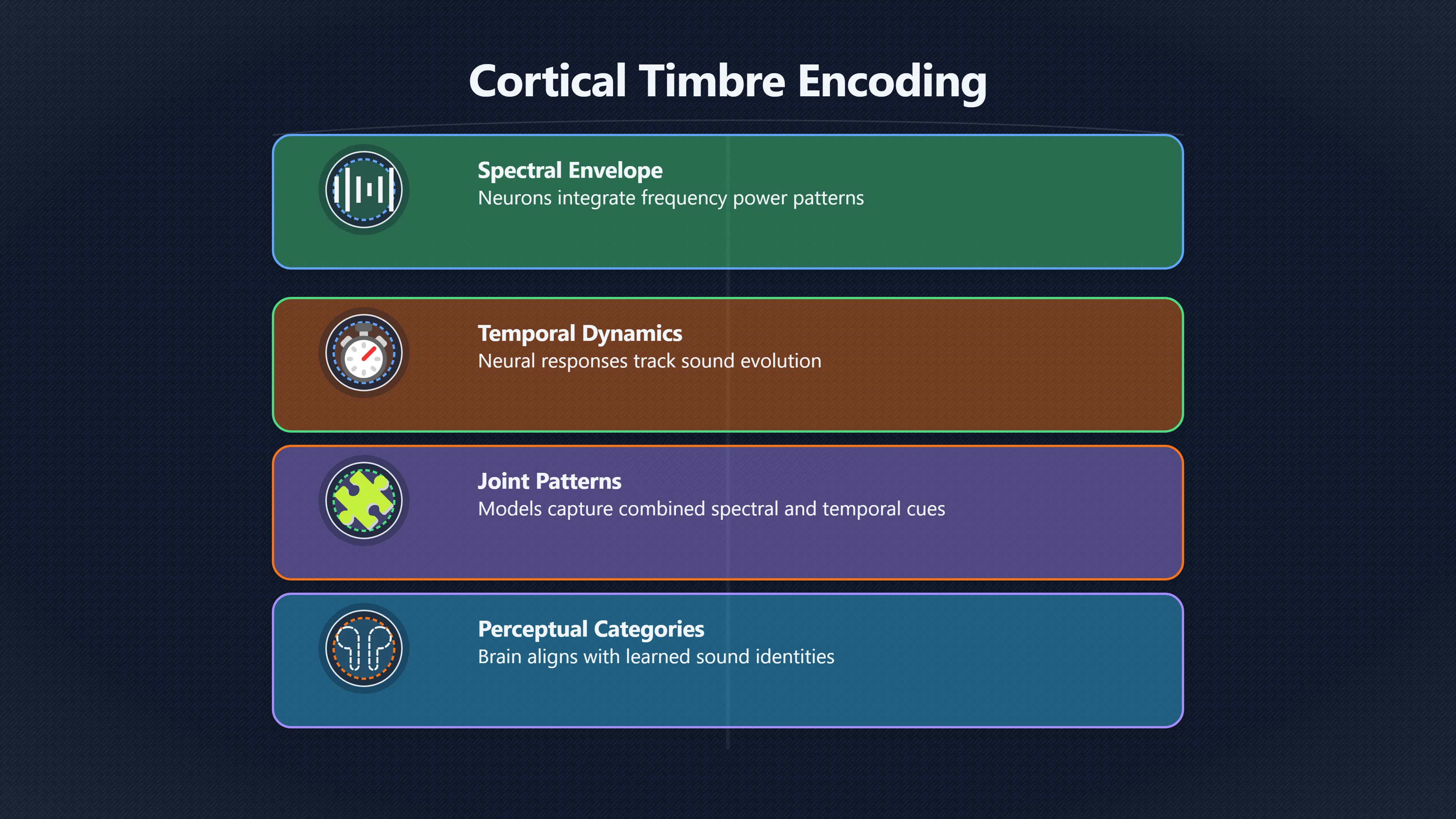
Neurons in the auditory cortex respond to combinations of frequencies and their relative power — the spectral envelope — which is a core element of timbre. In classic models, neurons are organised tonotopically so that different frequencies map onto different cortical locations; however, timbre perception depends on integrating across these frequencies rather than simply detecting one at a time. Animal studies show that single neurons in primary auditory cortex can be sensitive to complex spectral envelope cues that contribute to timbre, though in many cases the same neurons also respond to other features like pitch and sound location, indicating overlapping sensitivity rather than strict segregation of timbre coding.[PMC]pmc.ncbi.nlm.nih.govPMCNeural and behavioral investigations into timbre perceptionPMCNeural and behavioral investigations into timbre perception
Human neuroimaging with encoding models expands this picture by linking perceptual dimensions of timbre directly to cortical responses. Functional MRI studies have compared models grounded in subjective timbre ratings with models based on physical acoustics (spectral and temporal modulations). These analyses find that models capturing joint spectrotemporal features — combinations of spectral shape and temporal modulation — often outperform purely spectral descriptions, suggesting that cortical populations encode dynamic spectral patterns associated with distinctive timbral qualities. In early auditory cortex regions near Heschl’s gyrus, subjective timbre dimensions can predict neural responses as well as or better than physical spectral models, indicating a perceptually meaningful cortical representation of timbre.[PMC]pmc.ncbi.nlm.nih.govPMCMultiplexed and Robust Representations of Sound Features in Auditory CortexOctober 12, 2011…
Temporal Evolution and Sound Identity
Timbre is not static; how a sound’s spectral content evolves over time — the attack, sustain, decay, and modulation patterns — contributes substantially to its identity. Cortical neurons’ responses reflect this temporal structure. In electrophysiological recordings from mammalian auditory cortex, timbre‑related information often appears earlier in the neural response than pitch information, supporting behavioural observations that listeners can discriminate timbre rapidly. This early temporal encoding aligns with the idea that transient spectral changes (e.g. rapid onset differences between instruments) are crucial for timbre recognition.[PMC]pmc.ncbi.nlm.nih.govFebruary 18, 2009…
At the population level, cortical representations combine frequency and temporal modulation tuning. Research using models of spectrotemporal receptive fields (STRFs) shows that neurons are sensitive to joint spectrotemporal patterns, effectively performing a multi‑resolution analysis of sound. Such encoding enables the auditory cortex to track both fine spectral details (which shape timbral colour) and temporal fluctuations (which signal dynamic changes in sound identity). This spectrotemporal integration appears essential for distinguishing complex natural sounds, including musical instruments and voices, across variations in pitch or loudness.[PLOS]journals.plos.orgEncoding of Natural Sounds at Multiple Spectral and Temporal Resolutions in the Human Auditory Cortex | PLOS Computational BiologyJan…
Timbre Adaptation and Perceptual Shifts
Beyond early encoding, auditory cortical populations adapt their responses based on experience, expectation, and context. Encoding models trained on subjective perceptual timbre dimensions — such as those derived from listener ratings — outperform simpler physical models in predicting cortical activity, especially in right auditory areas near and beyond Heschl’s gyrus. This suggests that the brain’s timbre representation aligns not only with physical sound features but with perceptual categories that matter for recognising voices and instruments. Such alignment may reflect plasticity driven by extensive exposure to music and speech, where learned timbral distinctions become embedded in cortical tuning.[PMC]pmc.ncbi.nlm.nih.gov2017 Feb 1;37(5):1284–1293. doi: 10.1523/JNEUROSCI.2336-16.2016 REPRESENTATIONS OF PITCH AND TIMBRE VARIATION IN HUMAN AUDITORY CORTEX Em…
The distributed nature of timbre encoding also means that neurons rarely respond exclusively to timbre alone. Instead, timbre, pitch and spatial cues often interact within single neurons or across local populations, highlighting a multidimensional and context‑sensitive cortical code. This distributed coding supports perceptual constancy: the ability to recognise a timbre across changes in fundamental frequency or acoustic environment.[PMC]pmc.ncbi.nlm.nih.govPMCEncoding of Natural Timbre Dimensions in Human Auditory CortexFebruary 1, 2018…
Summary
Neural encoding of timbre in the auditory cortex is shaped by the integration of spectral envelopes and temporal dynamics across wide frequency ranges. Cortical populations represent joint spectrotemporal patterns that correspond to perceptual qualities of timbre, beyond simple frequency‑specific responses. This encoding supports rapid timbre discrimination, aligns with learned perceptual categories, and interacts with other auditory features like pitch and spatial location. The result is a robust, distributed cortical mechanism that underpins our ability to recognise the expressive qualities of human voices and musical instruments.[PMC]pmc.ncbi.nlm.nih.govPMCNeural and behavioral investigations into timbre perceptionPMCNeural and behavioral investigations into timbre perception
Amazon book picks
Further Reading
Books and field guides related to How the Brain Distinguishes Timbre Instantly. Use these as the next step if you want deeper reading beyond the article.
This Is Your Brain On Music
Strong introduction to how the brain processes musical sound.
Music, thought, and feeling
Explains perception of timbre, sound identity and auditory processing.
Oxford Handbook of Music and the Brain
First published 2019. Subjects: Music, psychological aspects, Music, physiological aspects, Cognitive neuroscience.
eBay marketplace picks
Marketplace Samples
Example marketplace items related to this page. Use the search link to explore similar finds on eBay.



Endnotes
1.
Source: pmc.ncbi.nlm.nih.gov
Title: PMCEncoding of Natural Timbre Dimensions in Human Auditory Cortex
Link:https://pmc.ncbi.nlm.nih.gov/articles/PMC5747995/
Source snippet
February 1, 2018...
Published: February 1, 2018
2.
Source: pmc.ncbi.nlm.nih.gov
Title: PMCNeural and behavioral investigations into timbre perception
Link:https://pmc.ncbi.nlm.nih.gov/articles/PMC3826062/
3.
Source: pmc.ncbi.nlm.nih.gov
Title: PMCMultiplexed and Robust Representations of Sound Features in Auditory Cortex
Link:https://pmc.ncbi.nlm.nih.gov/articles/PMC3272412/
Source snippet
October 12, 2011...
Published: October 12, 2011
4.
Source: journals.plos.org
Link:https://journals.plos.org/ploscompbiol/article?id=10.1371%2Fjournal.pcbi.1003412
Source snippet
Encoding of Natural Sounds at Multiple Spectral and Temporal Resolutions in the Human Auditory Cortex | PLOS Computational BiologyJan...
5.
Source: pmc.ncbi.nlm.nih.gov
Link:https://pmc.ncbi.nlm.nih.gov/articles/PMC2663390/
Source snippet
February 18, 2009...
Published: February 18, 2009
Additional References
6.
Source: pubmed.ncbi.nlm.nih.gov
Link:https://pubmed.ncbi.nlm.nih.gov/23133363/
Source snippet
in our ears: the biological bases of musical timbre perception - PubMedNovember 1, 2012 — ABSTRACT Timbre is the attribute of sound that...
Published: November 1, 2012
7.
Source: neuroscience.ox.ac.uk
Link:https://www.neuroscience.ox.ac.uk/publications/113872
Source snippet
Oxford NeuroscienceINTERDEPENDENT ENCODING OF PITCH, TIMBRE, AND SPATIAL LOCATION IN AUDITORY CORTEX. BIZLEY JK., WALKER KMM., SILVERMA...
8.
Source: sciencedirect.com
Title: ScienceDirect Encoding of natural timbre dimensions in human auditory cortex
Link:https://www.sciencedirect.com/science/article/pii/S1053811917308844
Source snippet
Encoding of natural timbre dimensions in human auditory cortex - ScienceDirectFebruary 1, 2018 — Volume 166, 1 February 2018, Pages 60-70...
Published: February 1, 2018
9.
Source: cris.maastrichtuniversity.nl
Title: nl Encoding of natural timbre dimensions in human auditory cortex
Link:https://cris.maastrichtuniversity.nl/en/publications/encoding-of-natural-timbre-dimensions-in-human-auditory-cortex/
Source snippet
of natural timbre dimensions in human auditory cortex - Maastricht UniversityFebruary 1, 2018 — ENCODING OF NATURAL TIMBRE DIMENSIONS IN...
Published: February 1, 2018
10.
Source: pubmed.ncbi.nlm.nih.gov
Title: Some animal studies of auditory cortical p
Link:https://pubmed.ncbi.nlm.nih.gov/28025255/
Source snippet
of Pitch and Timbre Variation in Human Auditory Cortex - PubMedFebruary 1, 2017 — ABSTRACT Pitch and timbre are two primary dimensions of...
Published: February 1, 2017
11.
Source: experts.umn.edu
Title: encoding of natural timbre dimensions in human auditory cortex
Link:https://experts.umn.edu/en/publications/encoding-of-natural-timbre-dimensions-in-human-auditory-cortex
Source snippet
Allen *, Michelle Moerel *, Agustín Lage-Castellanos *, Federico De Martino *, Elia Formisano *, Andrew J. Oxenham * P...
12.
Source: frontiersin.org
Title: Frontiers | Neural and behavioral investigations into timbre perception
Link:https://www.frontiersin.org/journals/systems-neuroscience/articles/10.3389/fnsys.2013.00088/full
Source snippet
Syst. Neurosci., 13 November 2013 Volume 7 - 2013 | [https://doi.org/10.3389/fnsys.2013.00088](https://doi.org/10.3389/fnsys.2013.00088) NEURAL AND BEHA...
Published: November 2013
13.
Source: pmc.ncbi.nlm.nih.gov
Link:https://pmc.ncbi.nlm.nih.gov/articles/PMC5296797/
Source snippet
2017 Feb 1;37(5):1284–1293. doi: 10.1523/JNEUROSCI.2336-16.2016 REPRESENTATIONS OF PITCH AND TIMBRE VARIATION IN HUMAN AUDITORY CORTEX Em...
14.
Source: tandfonline.com
Link:https://www.tandfonline.com/doi/abs/10.1080/09298219708570723
Source snippet
Representation of musical timbre in the auditory cortex*: Journal of New Music Research: Vol 26, No 2June 3, 2008 — Image: Publication C...
Published: June 3, 2008
15.
Source: journals.sagepub.com
Link:https://journals.sagepub.com/doi/10.1177/1073858410371009
Source snippet
Bizley, Kerry M. M. Walker, 2010June 7, 2010 — SENSITIVITY AND SELECTIVITY OF NEURONS IN AUDITORY CORTEX TO THE PITCH, TIMBRE, AND LOCATI...
Published: June 7, 2010
Topic Tree