Within Music
Why Music Merch Means More Than Branding
Merchandise gives fans a visible way to carry belonging beyond the song, album or concert venue.
On this page
- Identity, fandom and display
- Tour merch and memory
- Scarcity, value and authenticity
Page outline Jump by section
Introduction
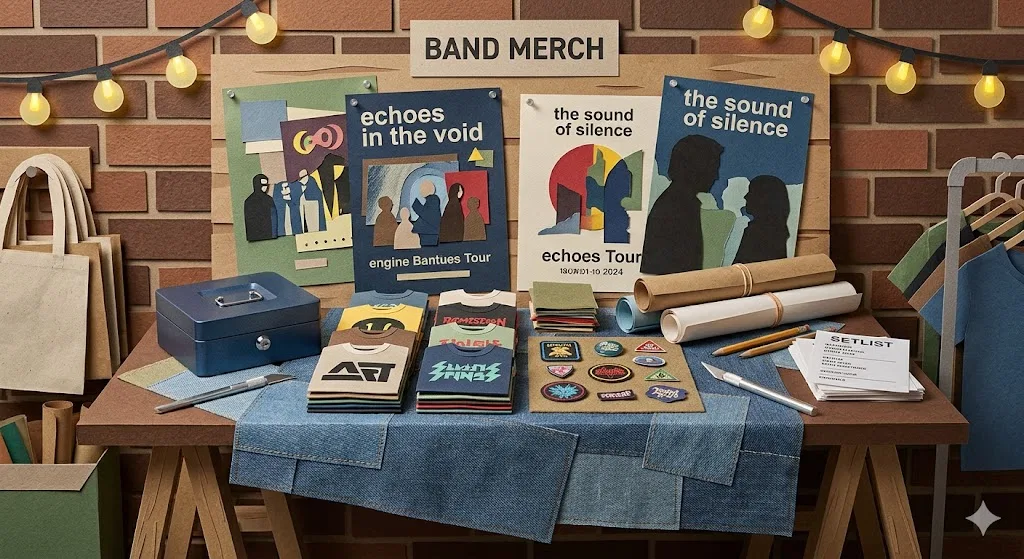
Merchandise extends an artist’s world by turning music into something fans can wear, keep, display and recognise in one another. A song may be private through headphones and temporary in a venue, but a hoodie, tour shirt, poster, tote bag or vinyl variant carries the artist’s visual language into daily life. That is why merch means more than branding: it becomes a portable sign of identity, a memory object from a specific night, and sometimes a scarce collectible whose value depends on trust, story and authenticity.
This matters because music fandom is increasingly lived across platforms, venues and social spaces rather than only through recordings. WIPO describes merchandise as a way for fans to continue their relationship with musicians and identify with them after live events, while MIDiA projects the global music merchandise market, including physical and digital merch and physical music formats, to reach US$16.3 billion by 2030.[WIPO]wipo.intmusic merchandise the new key to branding for musicians 74266Music merchandise: the new key to branding for musicians15 May 2025 — top musicians leverage merchandising to generate income more th…
Merch turns listening into visible identity
The simplest power of music merch is social recognition. Wearing a band T-shirt or artist hoodie says: this music is part of how I present myself. Philosopher Felix Bräuer argues that band merch has acquired a social meaning: people commonly infer that the wearer is a fan of the band or artist, which lets fans use clothing to communicate taste without saying anything.[Estetika Journal]estetikajournal.orgEstetika JournalBand Merch, Silencing, and Aesthetic Communityby F Bräuer · 2026 · Cited by 1 — Wearing band merch signals that one is a…
That visible signal does several things at once. It helps fans locate each other in public, especially around concerts, record shops, clubs, festivals and online fan meet-ups. It also compresses a lot of meaning into a design choice: an album cover, tour logo, lyric fragment, colour palette or era-specific graphic can point to a fan’s preferred phase of an artist’s catalogue. A black metal shirt, a pastel pop tour hoodie, a punk patch jacket and a K-pop lightstick are not interchangeable products. They carry different codes about sound, community, humour, politics, fashion and belonging.
Good merch therefore extends the artist’s world by translating sonic identity into visual and material identity. The most effective pieces do not simply place a name on cotton; they make the artist’s atmosphere legible. Olivia Rodrigo’s “Guts” era, for example, leaned into a specific teenage-pop-punk visual vocabulary, while Billie Eilish’s merch has often reflected her oversized silhouette, environmental messaging and distinctive colour worlds. Vogue’s reporting on the superfan economy quotes merch executives stressing that fans quickly notice when a product does not feel like something the artist would actually wear or endorse.[Vogue]vogue.comInside the Superfan EconomyFrom K-pop’s global expansion to Taylor Swift’s Eras tour, superfans now drive major brand and revenue opportunities. Unlike past fandom…
This is why “branding” is too thin a word for successful music merch. A corporate logo is designed to produce recognition. Artist merch has to do more: it must feel like a believable object from the same imaginative universe as the songs, videos, stage design and public persona. When it works, the fan is not just advertising the artist. They are carrying a piece of the artist’s world into ordinary life.
Tour merch turns a concert into a keepsake
Concert merchandise has a special emotional charge because it is tied to time and place. A tour shirt is not just a shirt; it can be proof of attendance, a memory aid, a social badge and a private souvenir. Dates printed on the back can turn the object into a personal archive: the city, the venue, the year, the person who came with you, the queue outside, the final song.
That memory function explains why fans still buy physical objects in a streaming-first music economy. AtVenu’s 2025 artist merchandise review reported that 21% of fans bought merch at concerts, broadly consistent with 2023 and 2024, and noted stronger merch-buying behaviour at stadium shows and smaller shows under 3,000 capacity.[atvenu.com]atvenu.comyear in reviewyear in review The purchase happens at the point of maximum emotional intensity: the fan has travelled, waited, sung with strangers and experienced the artist as a physical presence rather than a profile image.
Tour merch also extends the event beyond the venue. A fan may hear the set once, but wear the shirt for years. That makes merch unusually durable compared with many parts of the live experience. Ticket stubs have become less visible as mobile ticketing has grown, but shirts, wristbands, posters and tote bags still give the night a physical afterlife. IQ Magazine, citing Live Nation research, reported that Gen Z fans particularly value tangible music objects, with 81% valuing merchandise and 87% keeping items such as ticket stubs and wristbands.[IQ Magazine]iqmagazine.comIQ Magazine'Artists can make more from merch than performance feesIQ Magazine'Artists can make more from merch than performance fees
For artists, tour merch can also become a financial bridge. The Featured Artists Coalition argues that sales of T-shirts, vinyl and posters are often what allow artists to cover touring costs or break even, especially at smaller and mid-level stages where streaming income and fees may not be enough.[Featured Artists Coalition]thefac.orgSource details in endnotes. This gives the merch table a dual role: it is both a memory station for fans and a survival mechanism for working musicians.
Scarcity can create value, but it can also break trust
Limited merch works because music fandom is emotional and time-sensitive. A product available only at one show, during one album cycle or for one short online drop can feel more meaningful than a permanent item in a shop. Scarcity gives the object a story: it was available then, to those who noticed, waited or attended. Water & Music has described time-limited drops and livestream-linked exclusives as increasingly common in music merch, especially as artists borrow tactics from luxury fashion and streetwear.[waterandmusic.com]waterandmusic.commusic merchandise keeps artists afloat but how does it workmusic merchandise keeps artists afloat but how does it work
Scarcity can deepen an artist’s world when it is used to mark a real moment. A limited poster for a hometown show, a capsule tied to an album’s visual concept, or a piece designed around a tour’s stage imagery gives fans a reason to connect object and experience. It can also make the merch feel less generic. Fans are often not buying cloth, paper or plastic as raw materials; they are buying proximity to a particular chapter in an artist’s story.
But scarcity becomes fragile when fans feel manipulated. Multiple vinyl variants, countdown timers, surprise drops and fast sell-outs can create excitement, but they can also encourage overbuying, resale speculation and resentment. Entertainment Weekly reported Billie Eilish’s criticism of industry-wide multiple-vinyl practices as wasteful, while noting that she clarified she was not singling out one artist.[EW.com]ew.comSource details in endnotes.[News.com.au]news.com.auSwifties slam Life of a Showgirl vinyl variant dropSwifties slam Life of a Showgirl vinyl variant drop reported fan criticism of Taylor Swift vinyl variant drops around cost, environmental impact and the pressure placed on collectors.[News.com.au]news.com.auSwifties slam Life of a Showgirl vinyl variant dropSwifties slam Life of a Showgirl vinyl variant drop
The lesson is not that scarcity is always cynical. It is that scarcity has to feel earned. Fans tend to accept limited items when the limitation fits the story, production method or event. They are more likely to reject it when it appears to exist only to trigger urgency, inflate chart positions or squeeze repeat purchases from the most loyal audience.
Authentic merch feels designed from inside the artist’s world
Authenticity in merch is partly aesthetic and partly ethical. A product feels authentic when its design, materials, price, availability and message fit what fans already understand about the artist. If the artist’s public world is intimate and handmade, mass-produced glossy products may feel wrong. If an artist speaks often about climate responsibility, wasteful packaging or low-transparency manufacturing can weaken the message. If an artist’s image is rooted in streetwear, fashion quality matters more than it might for a novelty tour item.
Billie Eilish is a clear example of merch being used as an extension of values as well as image. Her official store says she prioritises organic and recycled fibres where possible, and her tour impact materials state that tour apparel used recycled, upcycled and organic materials, water-based inks, recycled paper posters and no plastic bags on tour.[Billie Eilish]store.billieeilish.comSource details in endnotes. Whether every large-scale merch operation can meet that standard is a separate question, but the example shows how materials can become part of the artist’s world rather than an invisible back-end decision.
Authenticity also affects collaborations. A fashion partnership can expand an artist’s universe if it makes sense with the artist’s style, audience and values. It can look hollow if fans perceive it as a logo swap. Vogue’s superfan economy reporting captures this tension: brands and merch teams increasingly want to turn fandom into products and experiences, but fans are quick to reject products that do not align with what the artist stands for.[Vogue]vogue.comInside the Superfan EconomyFrom K-pop’s global expansion to Taylor Swift’s Eras tour, superfans now drive major brand and revenue opportunities. Unlike past fandom…
In practical terms, artist-world merch usually has at least one of four anchors:
- Visual continuity: colours, typefaces, symbols and images match the album, tour, stage design or video world.
- Personal plausibility: the product feels like something the artist, band or scene would actually wear, use or approve.
- Fan legibility: insiders can recognise the reference without the object needing to explain itself.
- Material trust: quality, sustainability claims, sizing and delivery are credible enough not to damage the fan relationship.
When those anchors are missing, fans may still buy once, but the object does not strengthen the world around the music. It feels like an add-on.
Merch can build community beyond the biggest fans
Merch is often associated with superfans, but its cultural role is broader. A casual listener might buy a shirt because the design is good. A returning fan might buy a poster to remember one show. A dedicated fan might collect variants, queue early for venue exclusives or recognise a subtle lyric reference on a sleeve. These different levels of engagement let merch act as a bridge between everyday listening and deeper fandom.
MIDiA’s 2026 merch and ticket buyer research points to this widening fan economy. It notes that younger fans increasingly want bespoke products and that hip hop and R&B are especially important merch categories, with those genres counting more than half of merchandise, physical music and concert ticket buyers as fans while also generating above-average spend in those areas.[MIDiA Research]midiaresearch.comMIDi A Research How big can music merch get?MIDiA's latest report charts…24 Oct 2024 — The global merchandise market will rise to become a $16.3 billion industry by 2030. But as… That suggests merch is not only a legacy rock-band T-shirt business. It is part of how newer and younger fan cultures express identity.
The community effect is strongest when merch gives fans a shared code. At concerts, clothing can turn an audience into a temporary visual community: fans dress according to album eras, colour schemes, inside jokes or scene references. Vogue’s reporting on AEG’s live-event research noted that 41% of fans had dressed in a way that identified them as part of a fan community, and 12% had gone as far as getting a tattoo connected to a favourite artist or fan group.[Vogue]vogue.comInside the Superfan EconomyFrom K-pop’s global expansion to Taylor Swift’s Eras tour, superfans now drive major brand and revenue opportunities. Unlike past fandom…
This does not mean every fan wants to be visibly branded. In fact, subtle merch can be powerful because it lets fans signal belonging without looking like a walking poster. A small symbol, lyric fragment or design motif can create a quieter kind of recognition: not “everyone should know this artist”, but “the right people will know”. That is often where merch becomes most world-building, because it rewards attention and shared knowledge.
The business tension: support, access and over-commercialisation
For many fans, buying official merch is a direct way to support an artist. This is especially true at live shows, where the merch table feels closer to the artist than a streaming play. Yet the economics behind that purchase are not always simple. Venue commissions, production costs, licensing deals, fulfilment delays and platform fees can all affect how much of the fan’s money reaches the artist.
The Featured Artists Coalition’s 100% Venues campaign was launched in response to UK venues taking commission on merchandise sales, sometimes reported as 25% of gross revenue plus VAT. The campaign argues that artists should know rates up front, be able to negotiate, and that support acts should not be charged commission on merch.[Featured Artists Coalition]thefac.orgSource details in endnotes. This matters because the emotional logic of merch is often “I am supporting the artist”; if the commercial structure contradicts that belief, trust can erode.
There is also a fan-side tension. Merch can make music culture richer, more tactile and more communal, but it can also intensify pressure to consume. When every album cycle produces multiple drops, variants and countdowns, fans may feel that loyalty is being measured by purchasing power. The healthiest artist-world merch does not treat every fan as a collector with unlimited money. It offers meaningful objects at different price points, communicates clearly about scarcity, and avoids making fans feel excluded from the music itself if they cannot buy.
That balance is especially important for younger audiences. Music fandom often begins before fans have much disposable income, and visible merch can create status differences inside communities. A strong merch strategy should therefore support belonging without turning belonging into a constant purchase requirement.
What makes artist-world merch work
Merch extends an artist’s world best when it is treated as part of the creative system, not as an afterthought. The design should know what era it belongs to. The object should fit the artist’s values and the fan’s real life. The sales model should create excitement without exhausting trust. The best merch does not merely say “I like this artist”; it lets the fan carry a story, a night, a scene or an identity into the world.
For listeners, that is why an old tour shirt can outlast a marketing campaign. It may fade, shrink or crack, but it still holds the memory of a song heard live, a friendship, a teenage self, a city trip, a scene or an era. For artists, that is the deeper value of merch: it turns music from something heard into something inhabited.
Amazon book picks
Further Reading
Books and field guides related to Why Music Merch Means More Than Branding. Use these as the next step if you want deeper reading beyond the article.
Understanding Fandom An Introduction To The Study Of Media Fa...
First published 2012. Subjects: Mass media, social aspects, Fans (persons), Mass media--social aspects, Mass media and culture, Social sc...
Fangirls: Scenes from Modern Music Culture
Explores fan identity, community and emotional investment.
Popular Music Fandom: Identities, Roles and Practices
Covers identity, participation and fan culture central to merch meaning.
eBay marketplace picks
Marketplace Samples
Example marketplace items related to this page. Use the search link to explore similar finds on eBay.




Endnotes
1.
Source: wipo.int
Title: music merchandise the new key to branding for musicians 74266
Link:https://www.wipo.int/en/web/wipo-magazine/articles/music-merchandise-the-new-key-to-branding-for-musicians-74266
Source snippet
Music merchandise: the new key to branding for musicians15 May 2025 — top musicians leverage merchandising to generate income more th...
Published: May 2025
2.
Source: vogue.com
Title: Inside the Superfan Economy
Link:https://www.vogue.com/article/inside-the-superfan-economy
Source snippet
From K-pop’s global expansion to Taylor Swift’s Eras tour, superfans now drive major brand and revenue opportunities. Unlike past fandom...
3.
Source: atvenu.com
Title: year in review
Link:https://www.atvenu.com/year-in-review
4.
Source: waterandmusic.com
Title: music merchandise keeps artists afloat but how does it work
Link:https://www.waterandmusic.com/music-merchandise-keeps-artists-afloat-but-how-does-it-work/
5.
Source: ew.com
Link:https://ew.com/billie-eilish-never-dragged-taylor-swift-packaging-sustainability-8623024
6.
Source: news.com.au
Title: Swifties slam Life of a Showgirl vinyl variant drop
Link:https://www.news.com.au/entertainment/music/swifties-call-out-pop-stars-vinyl-variant-cash-grab-for-new-record-amid-costofliving-pressures/news-story/9006a281d314291d540929c8f0b130ac
7.
Source: midiaresearch.com
Title: MIDi A Research How big can music merch get?
Link:https://www.midiaresearch.com/blog/how-big-can-music-merch-get-midias-latest-report-[charts
Source snippet
MIDiA's latest report charts...24 Oct 2024 — The global merchandise market will rise to become a $16.3 billion industry by 2030. But as...
8.
Source: estetikajournal.org
Link:https://estetikajournal.org/en/articles/10.33134/eeja.563
Source snippet
Estetika JournalBand Merch, Silencing, and Aesthetic Communityby F Bräuer · 2026 · Cited by 1 — Wearing band merch signals that one is a...
9.
Source: iqmagazine.com
Title: IQ Magazine’Artists can make more from merch than performance fees’
Link:https://www.iqmagazine.com/2026/04/artists-can-make-more-from-merch-than-performance-fees/
10.
Source: thefac.org
Link:https://thefac.org/news-directory/york-barbican-100percentvenues-
11.
Source: billieeilishstore.de
Link:https://www.billieeilishstore.de/en/pages/sustainability
12.
Source: billieeilishstore.de
Title: Billie Eilish Tour Impact Report
Link:https://www.billieeilishstore.de/pages/tour-impact-report
13.
Source: midiaresearch.com
Title: MIDi A Research Insights from MIDi A’s merch and ticket buyer survey
Link:https://www.midiaresearch.com/blog/the-new-rules-of-musics-growth-engine-insights-from-midias-merch-and-ticket-buyer-survey
14.
Source: thefac.org
Title: Featured Artists Coalition#100Percent Venues Petition and Open Letter —
Link:https://thefac.org/news-directory/100percentvenuespetition
15.
Source: reddit.com
Title: billie eilish pushes music labels to upcycle
Link:https://www.reddit.com/r/popculturechat/comments/1lt94vy/billie_eilish_pushes_music_labels_to_upcycle/
16.
Source: prsformusic.com
Title: featured artists coalition launch petition in support of 100 venues campaign
Link:https://www.prsformusic.com/m-magazine/news/featured-artists-coalition-launch-petition-in-support-of-100-venues-campaign
17.
Source: store.billieeilish.com
Link:https://store.billieeilish.com/pages/upcycled?srsltid=AfmBOorQ7B3iLTOy3qkmBzF4YPBL1x7qetfaNR4DV9AtEAzs4CQYeCg-
18.
Source: austore.billieeilish.com
Link:https://austore.billieeilish.com/pages/sustainability?srsltid=AfmBOooZ4CET4TOt4yPHWZGg_TRUYUWpBqIWqUlL0wE1J7hZquGl9pvj
19.
Source: billieeilishstore.de
Link:https://www.billieeilishstore.de/en/collections/upcycled
20.
Source: billieeilishstore.de
Link:https://www.billieeilishstore.de/en/collections/all
21.
Source: members.asicentral.com
Title: billie eilish umg upcycle 400k unsold concert tees into new merch
Link:https://members.asicentral.com/news/strategy/july-2025/billie-eilish-umg-upcycle-400k-unsold-concert-tees-into-new-merch/
22.
Source: thefac.org
Link:https://thefac.org/
23.
Source: merchbar.com
Title: Band Merch
Link:https://www.merchbar.com/?srsltid=AfmBOoouGTKRv5xX9lCHfgULtwmFIWsZrqBIblLeyV0ZE-gqLhNNfVv1
Additional References
24.
Source: researchgate.net
Link:https://www.researchgate.net/publication/382300728_Taylor_Swift%27s_Branding_Strategy_The_Economics_of_Authenticity
25.
Source: researchgate.net
Link:https://www.researchgate.net/publication/361102091_The_effect_of_fan-themed_apparel_products%27_signal_explicitness_on_fans%27_perceptions_the_moderating_effect_of_fanship
26.
Source: watoowatoo.net
Link:https://www.watoowatoo.net/mkgr/papers/DerbaixKorchia-Individual-Celebration-Pop-Music-fans.pdf
27.
Source: researchgate.net
Link:https://www.researchgate.net/publication/364951005_Merchandise_and_Memorabilia_Between_Art_Products_Self-Image_and_Musicians_Existence
28.
Source: pinterest.com
Link:https://www.pinterest.com/ideas/concert-merchandise/935950301703/
29.
Source: miriamsmind.com
Link:https://miriamsmind.com/products/eras-tour-ticket-fan-04509
30.
Source: instagram.com
Link:https://www.instagram.com/p/DV6F-SvlUT2/
31.
Source: reddit.com
Link:https://www.reddit.com/r/Music/comments/1p5f31n/fans_blast_taylor_swift_for_cheap_misleading/
32.
Source: andrmusic.co
Link:https://andrmusic.co/behind-the-music/psychology-streaming-to-buying/
33.
Source: instagram.com
Link:https://www.instagram.com/p/DME8nneqp75/
Topic Tree