Within Music
Why Concerts Feel Bigger Than Songs
A concert is a social event, a display of fandom and a risky live encounter rather than just songs played aloud.
On this page
- Presence, risk and performance
- Crowds, fandom and shared memory
- Why live moments resist perfect replay
Page outline Jump by section
Introduction
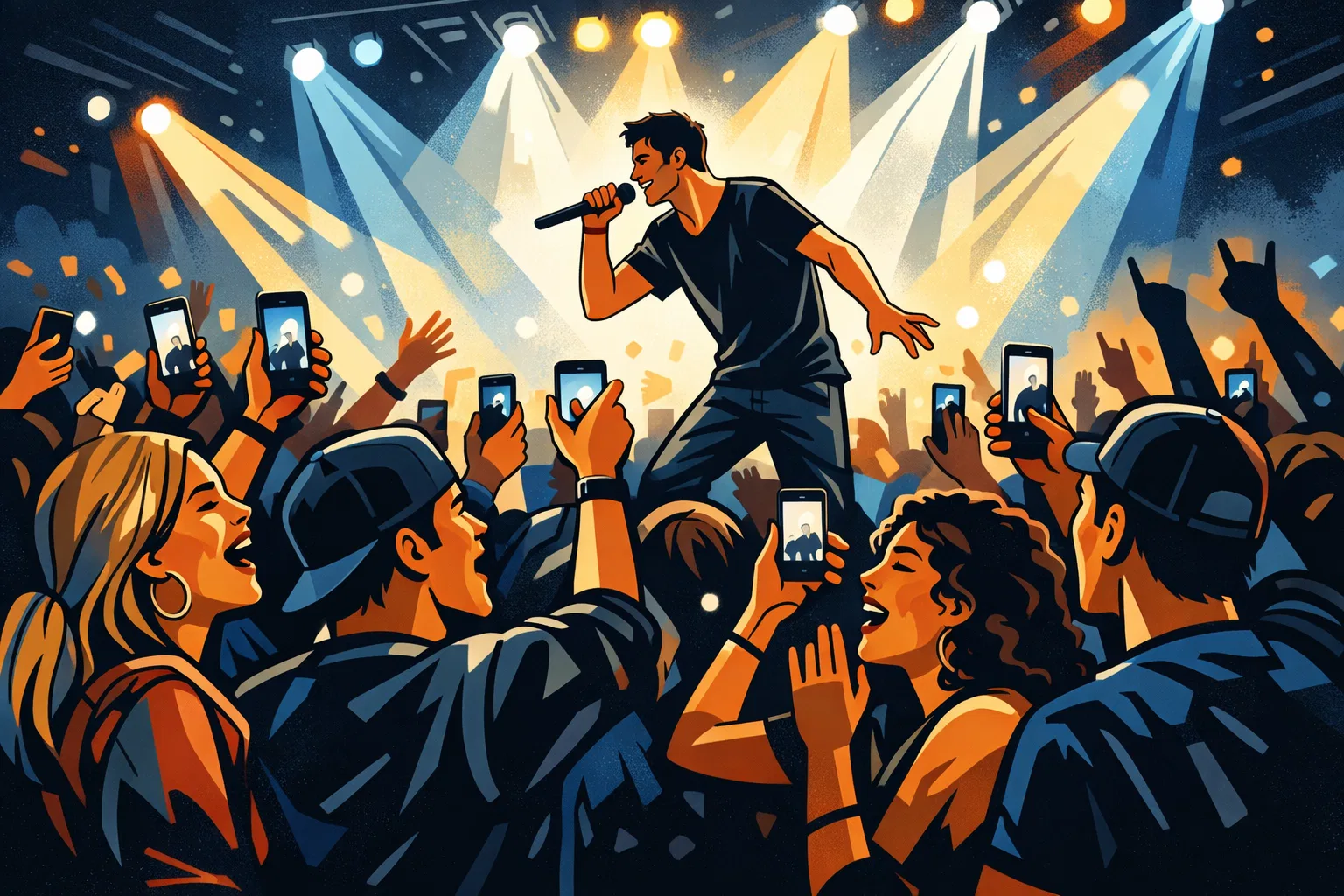
Concerts create fan memory because they make music happen as a risky, shared event rather than a clean repeat of a recording. A song on a stream can be replayed thousands of times; a concert gives the same song a date, a seat, a crowd, a weather system, a journey, a costume, a scream, a mistake, a surprise and a story. That is why fans often remember not only what was played, but who they went with, what the room felt like, what the artist changed, what the audience did together, and what could never happen in quite the same way again.
The best evidence points to three overlapping forces: bodily presence, social synchrony and the status of the live moment as unrepeatable. Studies of concert audiences have found synchrony in movement and physiology, while recent work on live music and “collective effervescence” links shared concert intensity with meaning, enjoyment and happiness that can last beyond the event itself.[Nature]nature.comAudience synchronies in live concerts illustrate the…by W Tschacher · 2023 · Cited by 67 — Clear evidence was found of physiolog…
Presence, risk and performance
A concert begins before the first note because the audience knows that something could go differently. The singer may change a lyric, lose their voice, speak directly to the crowd, bring out a guest, extend a solo, restart a song, react to a sign or miss a cue. That uncertainty is not a flaw in live music; it is part of its value. Fans are not only consuming songs. They are watching people attempt them in real time.
Research comparing live and mediated performance supports what many concertgoers already feel: physical co-presence changes emotional engagement. A 2025 study comparing a live performance with the same performance shown as a recording in the same theatre found stronger subjective and physiological emotional responses in the live condition, suggesting that performer-audience interaction matters even when the musical material is controlled.[ResearchGate]researchgate.netWatching live performances enhances subjective and…August 1, 2025 — 2 Aug 2025 — This study provides evidence that live pe… University of Zurich reporting on related neuroscience research similarly emphasised that live music can trigger stronger emotional responses than streamed music because performers and listeners respond to one another in real time.[UZH News]news.uzh.chNews Live MusikUZH NewsLive Musik - UZH News - Universität Zürich27 Feb 2024 — A study carried out at the University of Zurich has found that live perfo…
That live risk gives memory a sharper edge. A studio recording is designed to become stable: the same chorus, the same vocal take, the same mix. A concert version may be technically less perfect but more narratively powerful because it contains visible effort. Fans remember the breath before a difficult note, the grin after a mistake, the pause when the crowd sings back louder than expected. These are not detachable extras around the song; they are the cues that tell the brain and the fan community, “I was there for that version.”
This is also why concert memory often privileges moments that would look small on a setlist. A two-minute speech, an improvised dedication or a sudden lighting blackout may become the part fans retell most often. The song provides the frame, but the live encounter supplies the memory hook.
Crowds turn private listening into shared memory
Music can feel intensely private through headphones, but concerts make fandom visible. The room shows a listener that their attachment is not solitary. Thousands of people know the same bridge, anticipate the same beat drop, cry at the same lyric or laugh at the same in-joke. That visibility helps convert personal feeling into shared memory.
A major recent study of live music and collective effervescence examined four studies with 789 participants and found that the feeling of sacredness and connection in a crowd was strongly related to enjoyment, meaning during the event and happiness a week later. The researchers also found that collective effervescence helped explain why factors such as a bond with the artist, immersion in lyrics and attending with friends could lead to positive lasting outcomes.[ResearchGate]researchgate.netWatching live performances enhances subjective and…August 1, 2025 — 2 Aug 2025 — This study provides evidence that live pe…
This matters because fan memory is not just a record of sound. It is a record of belonging. The audience member remembers the concert partly as proof that a private relationship with songs was shared by other bodies in the same space. In popular music especially, this can be as important as musicianship. A crowd singing a chorus badly but together may produce a stronger fan memory than a flawless performance received in silence.
The same mechanism appears in more bodily research. A Scientific Reports study of live classical concerts found evidence of audience synchrony in heart rate, respiration rate, skin conductance response and movement. The point is not that every person becomes identical, but that live audiences can become temporarily coordinated through attention, emotion and bodily response.[Nature]nature.comOpen source on nature.com. For fan memory, that synchrony becomes a feeling: the sense that the room moved, shouted, held its breath or erupted as one.
Fandom is performed, not just felt
Concerts also create memory because they let fans perform fandom in front of one another. Clothes, chants, handmade objects, queue rituals, signs, light sticks, dance challenges and call-and-response moments turn spectators into participants. They make fandom legible.
Taylor Swift’s Eras Tour offers a clear recent example. Friendship bracelets became a fan-made concert ritual, usually made from beads and spelling out lyrics, song titles or inside jokes, then swapped between strangers before and during shows.[The Guardian]theguardian.comThe Guardian What's behind the Taylor Swift friendship bracelets trend?The Guardian What's behind the Taylor Swift friendship bracelets trend? The practice matters because it turns a ticketed event into a network of small exchanges. A fan may remember not only the acoustic surprise song, but the bracelet traded with someone in a queue, the outfit planned for months, or the moment a stranger recognised a lyric acronym.
Beyoncé’s Renaissance World Tour created a different kind of shared memory through visual and behavioural assignments. In 2023, she asked fans attending the final stretch of the tour to wear silver, turning arenas into a “human disco ball” effect around the performance.[EW.com]ew.comSource details in endnotes. The tour also generated the “mute challenge”, in which audiences attempted to go silent at a particular lyric in “Energy”; the success or failure of a city’s crowd became part of the tour’s online afterlife.[The Mary Sue]themarysue.comThe Mary Sue I Swear To Everything if You Interrupt the Mute ChallengeThe Mary Sue I Swear To Everything if You Interrupt the Mute Challenge
These rituals show why concerts are not simply music delivery systems. They are spaces where fans practise a culture. A recording can carry the artist’s work, but the concert carries evidence of the fan community’s imagination: what it wears, repeats, jokes about, polices, celebrates and remembers.
The setlist is only the skeleton
Setlists are important because they give fans a record of what happened. Sites such as setlist.fm, which describes itself as a setlist wiki and hosts millions of concert setlists, show how strongly fans want to document live music after the fact.[Setlist.fm]setlist.fmOpen source on setlist.fm. A setlist lets a fan say, “This was the night we got that deep cut,” or “This was the first time they played the new song.”
But a setlist is also incomplete. It captures sequence, not atmosphere. It can tell us that a song was played, but not whether the crowd screamed over the opening line, whether the artist cried, whether the sound failed, whether the performance felt tense, loose, reverent or chaotic. One criticism of setlist culture is that it can reduce a concert to a checklist of songs, encouraging fans to pre-judge the experience by its parts rather than by the live event as a whole.[Aesthetics for Birds]aestheticsforbirds.comAesthetics for Birds What's Wrong with Setlist.fm?Aesthetics for Birds What's Wrong with Setlist.fm?
Fan memory therefore works on two levels at once. The setlist provides a public archive, while the remembered experience supplies private and communal meaning. A fan may use the archive to verify the night, but the memory lives in details that are hard to database: the friend who cried during the encore, the stranger who lifted someone onto their shoulders, the moment the singer let the audience finish the chorus.
This is why two fans at the same concert can carry away different “main” memories. One remembers the rare song. Another remembers the crowd. Another remembers being seen by the artist. Another remembers feeling safe, overwhelmed, young, old, reunited or changed. The concert is one event, but fan memory is plural.

Why live moments resist perfect replay
Concert videos are valuable, but they rarely replace the memory of being there. A phone clip can preserve the image and sound of a moment, yet it cannot fully reproduce the pressure of the crowd, the anticipation before the song begins, the scale of the room, the bass in the body or the awareness that the event is unfolding without a rewind button.
Research on livestreamed and recorded concert viewing helps explain this gap. A 2024 study on social presence in live and recorded concert viewing found that the live component can contribute to social connection and enjoyment, with livestreams expected to heighten social presence compared with recordings.[Research Explorer]pure.uva.nlThe role of social presence in live and recorded concert viewingThe role of social presence in live and recorded concert viewing Digital access can widen participation, especially for fans who cannot attend, but it changes the kind of memory being formed. The remote viewer may share the event in real time, but the venue attendee also shares air, delay, discomfort, proximity and crowd behaviour.
The imperfection of memory is part of the point. Fans often remember a concert as a blend of fact, feeling and later retelling. Online clips, photos, reviews and fan posts then feed back into the memory, confirming some details and reshaping others. A concert becomes not only what happened, but what the fan community later agrees was the defining moment.
This is especially visible when a tour develops city-by-city lore. One city gets the best guest appearance. Another wins a crowd challenge. Another gets a rain show, a technical failure or a surprise song. The tour becomes a chain of local memories, each one tied to a specific audience. Fans who were not there can still participate through clips and discussion, but the phrase “I was there” retains power because it marks bodily presence inside the uncertainty of the original event.
The emotional afterlife of a concert
A concert continues after the lights come up. Fans compare videos, post outfits, debate the setlist, identify guests, trade photos, rewatch clips and fold the event into their personal timeline. The memory becomes a social object: something to tell, display, revisit and use as evidence of belonging.
Industry research should be read critically because promoters have commercial reasons to celebrate live music, but it still reflects a real cultural pattern. Live Nation’s global fandom report, based on 40,000 people across 15 markets, describes fans travelling, planning and building social calendars around live music experiences.[livingforlive.livenationforbrands.com]livingforlive.livenationforbrands.comSource details in endnotes. MIDiA’s work on post-pandemic live music similarly found fandom to be a major driver of ticket purchasing, even amid inflation and pricing pressures.[MIDiA Research]midiaresearch.comreturn to live post pandemic music fansreturn to live post pandemic music fans
The emotional afterlife is not always uncomplicated. High ticket prices, dynamic pricing, inaccessible venues, crowd crush fears, poor sound, phone obstruction and exclusion from sold-out events can all become part of fan memory too. A concert can create belonging, but it can also mark who could afford entry, who felt safe, who was close enough to see, and who experienced the show mostly through other people’s screens.
Even so, the durability of concert memory is hard to explain if concerts are treated as songs played loudly. The live event adds presence, risk, crowd synchrony, fandom performance and scarcity. It turns music from an object into an occasion. That is why fans save tickets, wristbands, confetti, blurry videos and handmade bracelets. These objects are not valuable because they sound like the concert. They are valuable because they point back to the night when the song briefly belonged to everyone in the room.



eBay marketplace picks
Marketplace Samples
Example marketplace items related to this page. Use the search link to explore similar finds on eBay.



Endnotes
1.
Source: nature.com
Link:https://www.nature.com/articles/s41598-023-41960-2
Source snippet
Audience synchronies in live concerts illustrate the...by W Tschacher · 2023 · Cited by 67 — Clear evidence was found of physiolog...
2.
Source: researchgate.net
Link:https://www.researchgate.net/publication/394325511_Watching_live_performances_enhances_subjective_and_physiological_emotional_responses_compared_to_viewing_the_same_performance_on_screen
Source snippet
Watching live performances enhances subjective and...August 1, 2025 — 2 Aug 2025 — This study provides evidence that live pe...
Published: August 1, 2025
3.
Source: news.uzh.ch
Title: News Live Musik
Link:https://www.news.uzh.ch/en/articles/media/2024/Livemusik.html
Source snippet
UZH NewsLive Musik - UZH News - Universität Zürich27 Feb 2024 — A study carried out at the University of Zurich has found that live perfo...
4.
Source: researchgate.net
Title: Research Gate(PDF) Let the Music Play: Live Music Fosters Collective
Link:https://www.researchgate.net/publication/385011758_Let_the_Music_Play_Live_Music_Fosters_Collective_Effervescence_and_Leads_to_Lasting_Positive_Outcomes
5.
Source: ew.com
Link:https://ew.com/music/beyonce-tells-fans-wear-silver-renaissance-tour-outfits/
6.
Source: setlist.fm
Link:https://www.setlist.fm/
7.
Source: livingforlive.livenationforbrands.com
Link:https://livingforlive.livenationforbrands.com/
8.
Source: researchgate.net
Title: 339489760 Sharing Music Social and Communal Aspects of Concert Going
Link:https://www.researchgate.net/publication/339489760_Sharing_Music_Social_and_Communal_Aspects_of_Concert-Going
9.
Source: researchgate.net
Link:https://www.researchgate.net/publication/349321504_Frequent_music_festival_attendance_festival_fandom_and_career_development
10.
Source: researchgate.net
Link:https://www.researchgate.net/publication/361720036_Development_of_the_Social_Experience_of_a_Concert_Scales_SECS_The_Social_Experience_of_a_Live_Western_Art_Music_Concert_Influences_People%27s_Overall_Enjoyment_of_an_Event_but_not_Their_Emotional_Respon
11.
Source: researchgate.net
Link:https://www.researchgate.net/publication/283742325_Live_concerts_and_fan_identity_in_the_age_of_the_Internet
12.
Source: researchgate.net
Link:https://www.researchgate.net/publication/263198430_Patterns_of_listening_through_social_media_Online_fan_engagement_with_the_live_music_experience
13.
Source: researchgate.net
Link:https://www.researchgate.net/publication/384867875Look_What_You_Made_Me_Do-Unveiling_the_impact_of_Taylor_Swift%27s_Eras_Tour_on_Parasocial_Relationships
14.
Source: researchgate.net
Link:https://www.researchgate.net/publication/374476218_Audience_synchronies_in_live_concerts_illustrate_the_embodiment_of_music_experience
15.
Source: researchgate.net
Link:https://www.researchgate.net/publication/379067778_The_role_of_social_presence_in_live_and_recorded_concert_viewing_Effects_on_enjoyment_and_emotional_well-being
16.
Source: setlist.fm
Title: Fan Concert Setlists Get Fan setlists
Link:https://www.setlist.fm/setlists/fan-4be29f0a.html
17.
Source: itsbetterlive.livenationforbrands.com
Title: study the state of fandom
Link:https://itsbetterlive.livenationforbrands.com/study-the-state-of-fandom/
18.
Source: nature.com
Link:https://www.nature.com/articles/s41598-026-38194-3
19.
Source: theguardian.com
Title: The Guardian What’s behind the Taylor Swift friendship bracelets trend?
Link:https://www.theguardian.com/music/2024/feb/07/taylor-swift-eras-tour-australia-friendship-bracelets-inspiration-beads-explained
20.
Source: themarysue.com
Title: The Mary Sue I Swear To Everything if You Interrupt the Mute Challenge
Link:https://www.themarysue.com/i-swear-to-everything-if-you-interrupt-the-mute-challenge-at-the-renaissance-movie/
21.
Source: aestheticsforbirds.com
Title: Aesthetics for Birds What’s Wrong with Setlist.fm?
Link:https://aestheticsforbirds.com/2023/10/19/whats-wrong-with-setlist-fm/
22.
Source: pure.uva.nl
Title: The role of social presence in live and recorded concert viewing
Link:https://pure.uva.nl/ws/files/181217286/The_role_of_social_presence_in_live_and_recorded_concert_viewing.pdf
23.
Source: midiaresearch.com
Title: return to live post pandemic music fans
Link:https://www.midiaresearch.com/reports/return-to-live-post-pandemic-music-fans
Additional References
24.
Source: pubmed.ncbi.nlm.nih.gov
Link:https://pubmed.ncbi.nlm.nih.gov/39417534/
Source snippet
Live Music Fosters Collective Effervescence and Leads to...by N Koefler · 2026 · Cited by 18 — This work examined the power of liv...
25.
Source: harpersbazaar.com.au
Link:https://harpersbazaar.com.au/taylor-swift-eras-tour-chants-rituals/
26.
Source: facebook.com
Link:https://www.facebook.com/NBCBayArea/posts/mute-challenge-a-viral-moment-from-beyonc%C3%A9s-renaissance-world-tour-has-made-its-/700970762065249/
27.
Source: reddit.com
Link:https://www.reddit.com/r/popheads/comments/15z70z1/beyonc%C3%A9_asks_fans_to_wear_silver_for_the/
28.
Source: reddit.com
Link:https://www.reddit.com/r/TaylorSwift/comments/124sofc/concert_traditions/
29.
Source: openresearch.newcastle.edu.au
Link:https://openresearch.newcastle.edu.au/articles/thesis/Concert_attendee_behaviour_the_influence_of_motivations_fan_identification_and_product_involvement/28959272
30.
Source: medium.com
Link:https://medium.com/%40dimmakriss/stereo-nova-fan-engagement-analytics-google-trends-and-spotify-[charts
31.
Source: danielle-moss.com
Link:https://www.danielle-moss.com/friendship-bracelets/
32.
Source: semanticscholar.org
Link:https://www.semanticscholar.org/paper/Let-the-Music-Play%3A-Live-Music-Fosters-Collective-Koefler-Naidu/5d149fbdac5cc62a36944c5c4c39419c68472d73
33.
Source: reddit.com
Link:https://www.reddit.com/r/psychology/comments/1jcwbz5/live_music_experiences_create_lasting_happiness/
Topic Tree