Music is both an art form and a global system for moving emotion, identity, money and technology. At its simplest, it is organised sound shaped by rhythm, pitch, texture, silence and cultural meaning; in practice, it is also a live experience, a recorded product, a social signal, a memory trigger, a livelihood and a political argument.
Page outline Jump by section
What makes music more than sound?
Music works because it joins structure to feeling. A beat gives the body something to anticipate; melody gives the ear a line to follow; harmony colours expectation; timbre tells us whether a sound feels intimate, rough, bright, synthetic or human. Yet none of those ingredients is fixed in meaning. A bassline that feels euphoric in a club may feel aggressive in a film scene; a sparse piano phrase may sound peaceful, lonely or ominous depending on context.
That is why music is never just a technical object. It becomes meaningful through use: lullabies calm children, protest songs gather people around a cause, hymns mark belief, dance music organises bodies in space, and pop songs turn private feelings into shared language. Recorded music added another layer by letting performances travel beyond their original time and place. Streaming intensified that shift: the listener no longer needs to own a record, CD or download to have instant access to a vast catalogue, but the trade-off is that discovery, payment and cultural visibility are increasingly shaped by platforms.
How the modern music economy actually works
The music business is often discussed as though it were one market, but it is really a set of overlapping rights and revenue streams. A single song can generate money from the recording, the composition, live performance, broadcast, streaming, synchronisation in film or games, physical sales, merchandise and publishing royalties. The people involved may include performers, songwriters, producers, session musicians, labels, publishers, managers, collecting societies, distributors, promoters, venues and platforms.
Recorded music has been growing for more than a decade after the deep disruption caused by piracy and the collapse of download-era sales. IFPI reported that global recorded music revenue reached US$31.7 billion in 2025, up 6.4%, with paid subscription streaming growing 8.8% and physical formats returning to growth. [IFPI]ifpi.orgIFPIGLOBAL MUSIC REPORT 2026: GLOBAL RECORDED…March 18, 2026 — 18 Mar 2026 — Total streaming revenues surpassed US$22 billion and acco… MIDiA’s 2024 analysis gives useful context for the previous year: it estimated the wider recorded music market at US$36.2 billion in 2024, up 6.5%, but also noted that streaming’s share of total revenue dipped slightly for the first time, suggesting a maturing market rather than endless acceleration. [MIDiA Research]midiaresearch.comrecorded music market 2024 362 billion up 65MIDiA ResearchRecorded music market 2024: $36.2 billion, up 6.5%March 13, 2025 — 14 Mar 2025 — Global recorded music growth has oscillate…
For listeners, the headline is convenience. For creators, the picture is more mixed. Streaming can make a track globally available within hours, but revenue depends on rights ownership, contract terms, territory, subscription mix, platform policy and the difference between being listened to occasionally and being listened to at scale. Spotify says it paid the music industry more than US$11 billion in 2025, while UK government work on streaming has continued to examine transparency and creator remuneration because many musicians argue that access has not translated into predictable income. [Spotify]newsroom.spotify.comSpotifyFrom $11B in 2025 Payouts to What We're Building for…January 28, 2026 — 28 Jan 2026 — Today, Spotify accounts for roughly 30% o…

Why streaming changed listening habits
Streaming did not simply replace the CD shop. It changed the unit of attention. The album still matters culturally, especially for major artists and dedicated fans, but everyday listening is now often organised around playlists, moods, short clips, recommendations and repeatable moments. That affects how songs are written, marketed and discovered. A strong opening hook, a distinctive vocal texture or a chorus that works in a short-form video can become commercially valuable because music now travels through social feeds as much as through radio or record stores.
The global scale is enormous. IFPI reported 837 million users of paid streaming subscription accounts worldwide in 2025, while Reuters reported that 2024 paid subscriptions rose to 752 million and helped push global recorded music revenue to US$29.6 billion that year. [IFPI]ifpi.orgGMR2025 SOTIGMR2025 SOTI This does not mean all music is becoming the same. In fact, streaming has helped regional scenes cross borders more easily. The same infrastructure that carries global pop also carries Afrobeats, Latin music, K-pop, dance subgenres, catalogue rock, devotional music, folk revivals and niche electronic scenes to listeners who would previously have struggled to find them.
The unresolved problem is discoverability. A platform can host millions of tracks, but attention remains scarce. Recommendation systems can help listeners find music they love, but they can also reward songs that fit existing consumption patterns. For artists, being available everywhere is not the same as being noticed.
Why live music and vinyl still matter
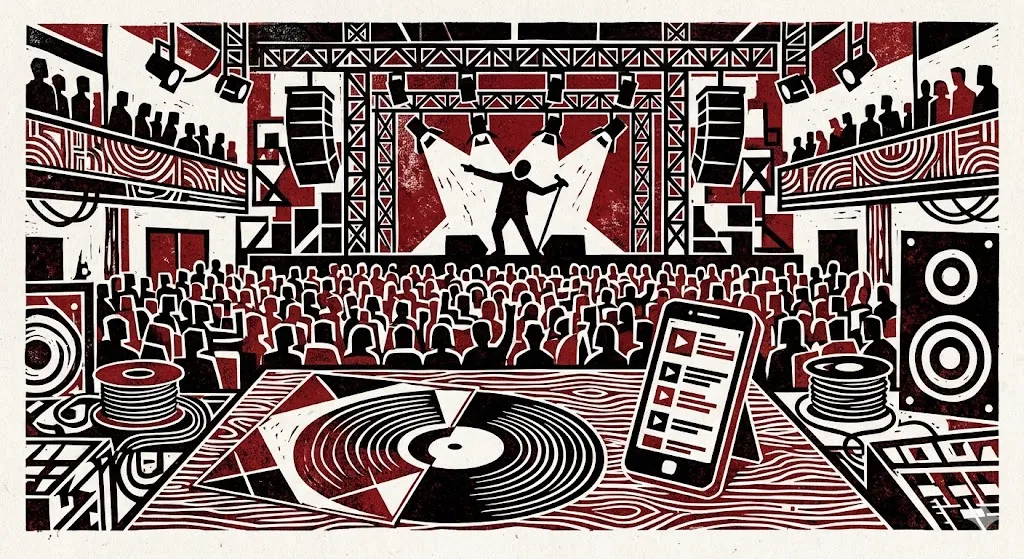
The persistence of live music shows that convenience is not the only thing listeners value. A concert is not just a delivery mechanism for songs; it is a social event, a memory, a display of fandom and a direct encounter with performance risk. For many artists, live work also remains essential because recorded streaming income may be fragmented or slow to build.
Creator royalty data supports the continuing importance of public performance and live use. CISAC’s Global Collections Report 2025 says music creator revenues rose 7.2% to €12.59 billion in 2024, with live and background collections exceeding €3.5 billion after 9.6% growth. [gema.de]gema.deSource details in endnotes. In the UK, PRS for Music reported a record £1.02 billion paid out to songwriters, composers and publishers in 2024, a reminder that songs generate value long after the moment of recording. [PRS for Music]prsformusic.com2024 financial results2024 financial results
Vinyl’s revival tells a related story. Its appeal is not that it is more convenient than streaming; it is precisely the opposite. It is tactile, collectible and slow. In the United States, RIAA reported that 2024 recorded music revenue rose to US$17.7 billion, with paid streaming subscriptions passing 100 million and vinyl continuing a long growth run. [RIAA]riaa.comRIAA 2024Year End Revenue ReportRIAA 2024Year End Revenue Report Physical formats now work best when they offer fans something streaming cannot: artwork, scarcity, ritual, sound-system culture, signed editions, deluxe packaging or a sense of belonging to an artist’s world.
The fairness debate behind the numbers
The central tension in music is that the industry can grow while many musicians still feel economically insecure. A rising market does not automatically mean fair distribution. Money may pass first through platforms, labels, publishers, distributors, collecting societies and contracts before it reaches the people who wrote, performed or produced the music.
The UK has been one of the clearest public arenas for this debate. Parliament’s inquiry into the economics of music streaming called for a “complete reset” of the streaming market in 2021, and government work has continued through transparency and creator remuneration initiatives. [UK Parliament Committees]committees.parliament.ukUK Parliament Committees Economics of music streaming: follow-upUK Parliament Committees Economics of music streaming: follow-up In July 2025, the UK government said major record companies had agreed voluntary measures intended to improve remuneration outcomes for UK music creators, including commitments from the UK divisions of Universal, Sony and Warner. [Hansard]hansard.parliament.ukCreator Remuneration From Music Streaming Label Led PrinciplesCreator Remuneration From Music Streaming Label Led Principles
There is also a practical data problem. Royalties depend on accurate metadata: who wrote the song, who performed it, who owns what share, where it was used and under which licence. When credits are incomplete or setlists are missing, money can be delayed, misallocated or placed into pools for later distribution. The Guardian reported concerns in 2025 that UK songwriters may have missed royalties from more than 100,000 gigs because of missing setlist data, showing how fairness can depend on administrative plumbing as much as headline market growth. [The Guardian]theguardian.comSource details in endnotes.
AI is forcing music to define authorship again
Artificial intelligence has introduced two connected questions. First, should AI companies be allowed to train systems on copyrighted music without permission or payment? Second, how should platforms, labels and collecting societies treat music generated partly or wholly by machines?
The issue is not simply whether AI-made music can sound convincing. It is about substitution, consent and market flooding. UNESCO warned in 2026 that creators could face projected global revenue losses of up to 24% by 2028 as digital transformation and AI reshape cultural markets. [UNESCO]unesco.orgcreators face projected global revenue losses 24 2028 new unesco report showscreators face projected global revenue losses 24 2028 new unesco report shows A separate UNESCO-linked report on artificial intelligence and culture cited projections that music sector workers could lose nearly a quarter of their income to generative AI by 2028. [UNESCO]unesco.orgArtificial Intelligence and CultureArtificial Intelligence and Culture
Streaming fraud makes the concern more concrete. The Guardian reported in 2025 that Deezer found up to 70% of streams of AI-generated music on its platform were fraudulent, even though AI-generated tracks represented a small share of total streams. [The Guardian]theguardian.comSource details in endnotes. That matters because streaming royalties are pooled and divided: if fraudulent or low-effort tracks capture attention or royalty share, legitimate creators can lose income. AI may become a useful tool for composition, production, restoration and accessibility, but the music sector is still negotiating the boundary between assistance and replacement.

How to understand music today
The most useful way to understand music now is to hold two truths together. First, music has never been easier to access, make, share or discover. A teenager can upload a track from a bedroom and reach listeners across continents; a listener can move from a 1970s soul record to a new underground dance track in seconds. Second, abundance has made attention, trust and payment harder to organise.
For listeners, that means the choice is not only what to hear, but how to support the music they value. Streaming, buying records, attending gigs, purchasing merchandise, following artists directly, listening beyond algorithmic recommendations and checking credits all participate in the wider ecosystem. For artists, the challenge is no longer only to make good music; it is to build a durable relationship with audiences across platforms, performances, rights systems and communities.
Music remains powerful because it does what data cannot fully explain: it turns time into feeling. The industry around it will keep changing, but the core human reason for music is stable. People use it to remember, mourn, celebrate, flirt, pray, dance, concentrate, belong and survive. The formats change; the need does not.
Amazon book picks
Further Reading
No matched book cards were available for Music, so this fallback keeps a direct Amazon reading path visible.
Topical books
UK streaming inquiry guide
Browse books, explainers and reference titles related to this topic.
Search AmazonRelated search
IFPI global music report books
Browse books, explainers and reference titles related to this topic.
Search AmazonRelated search
IFPI global music report guide
Browse books, explainers and reference titles related to this topic.
Search AmazonEndnotes
-
Source: ifpi.org
Link: https://www.ifpi.org/global-music-report-2026-global-recorded-music-revenues-grow-6-4-as-record-companies-drive-innovation/Source snippet
IFPIGLOBAL MUSIC REPORT 2026: GLOBAL RECORDED...March 18, 2026 — 18 Mar 2026 — Total [streaming revenues]({{ 'revenue-dbec50/' | relative_url }}) surpassed US$22 billion and acco...
Published: March 18, 2026
-
Source: newsroom.spotify.com
Link: https://newsroom.spotify.com/2026-01-28/2025-music-industry-payouts-whats-next-for-artists/Source snippet
SpotifyFrom $11B in 2025 Payouts to What We're Building for...January 28, 2026 — 28 Jan 2026 — Today, Spotify accounts for roughly 30% o...
Published: January 28, 2026
-
Source: reuters.com
Link: https://www.reuters.com/business/media-telecom/music-revenues-rise-again-2024-boosted-by-streaming-subscriptions-report-shows-2025-03-19/ -
Source: gema.de
Link: https://www.gema.de/de/w/cisac-global-collections-report-2025-creators-royalties-powered-by-digital-growth -
Source: riaa.com
Title: RIAA 2024Year End Revenue Report
Link: https://www.riaa.com/wp-content/uploads/2025/03/RIAA-2024Year-End-Revenue-Report.pdf -
Source: riaa.com
Title: 2024 year end music industry revenue report riaa
Link: https://www.riaa.com/reports/2024-year-end-music-industry-revenue-report-riaa/ -
Source: committees.parliament.uk
Title: UK Parliament Committees Economics of music streaming: follow-up
Link: https://committees.parliament.uk/work/7041/economics-of-music-streaming-followup/publications/ -
Source: hansard.parliament.uk
Title: Creator Remuneration From Music Streaming Label Led Principles
Link: https://hansard.parliament.uk/commons/2025-07-22/debates/25072227000013/CreatorRemunerationFromMusicStreamingLabel-LedPrinciples -
Source: unesco.org
Title: creators face projected global revenue losses 24 2028 new unesco report shows
Link: https://www.unesco.org/en/articles/creators-face-projected-global-revenue-losses-24-2028-new-unesco-report-shows -
Source: unesco.org
Title: Artificial Intelligence and Culture
Link: https://www.unesco.org/sites/default/files/medias/fichiers/2025/09/CULTAI_Report%20of%20the%20Independent%20Expert%20Group%20on%20Artificial%20Intelligence%20and%20Culture%20%28final%20online%20version%29%201.pdf -
Source: committees.parliament.uk
Link: https://committees.parliament.uk/writtenevidence/147767/pdf/ -
Source: ifpi.org
Title: GMR2025 SOTI
Link: https://www.ifpi.org/wp-content/uploads/2024/03/GMR2025_SOTI.pdf -
Source: ifpi.org
Title: GMR2026 SOTI
Link: https://www.ifpi.org/wp-content/uploads/2026/03/GMR2026_SOTI.pdf -
Source: cisac.org
Title: cisac global collections report 2025
Link: https://www.cisac.org/cisac-global-collections-report-2025 -
Source: cisac.org
Title: prs music expands reach royalties across industry
Link: https://www.cisac.org/Newsroom/society-news/prs-music-expands-reach-royalties-across-industry -
Source: cisac.org
Link: https://www.cisac.org/home -
Source: members.cisac.org
Title: Download File Search.do
Link: https://members.cisac.org/CisacPortal/cisacDownloadFileSearch.do?docId=45486&lang=en -
Source: riaa.com
Title: 2024 year end music industry revenue report riaa
Link: https://www.riaa.com/2024-year-end-music-industry-revenue-report-riaa/ -
Source: riaa.com
Title: RIAA 2024 Year End US Market [Latin Music]({{ ‘latin-music/’ | relative_url }}) Revenue Report
Link: https://www.riaa.com/wp-content/uploads/2025/03/RIAA-2024-Year-End-US-Market-Latin-Music-Revenue-Report.pdf -
Source: reuters.com
Title: streaming boosts global music revenues once again 2025 report shows 2026 03 18
Link: https://www.reuters.com/business/media-telecom/streaming-boosts-global-music-revenues-once-again-2025-report-shows-2026-03-18/ -
Source: midiaresearch.com
Title: recorded music market 2024 362 billion up 65
Link: https://www.midiaresearch.com/blog/recorded-music-market-2024-362-billion-up-65Source snippet
MIDiA ResearchRecorded music market 2024: $36.2 billion, up 6.5%March 13, 2025 — 14 Mar 2025 — Global recorded music growth has oscillate...
Published: March 13, 2025
-
Source: prsformusic.com
Title: 2024 financial results
Link: https://www.prsformusic.com/about-us/track-record/2024-financial-results -
Source: theguardian.com
Link: https://www.theguardian.com/business/2025/jul/04/songwriters-royalties-uk-gigs-prs-for-music -
Source: theguardian.com
Link: https://www.theguardian.com/technology/2025/jun/18/up-to-70-of-streams-of-ai-generated-music-on-deezer-are-fraudulent-says-report -
Source: musicbusinessworldwide.com
Link: https://www.musicbusinessworldwide.com/prs-for-music-paid-out-1-3bn-to-songwriters-composers-and-publishers-in-2024-up-8-1-yoy/ -
Source: musicindustryblog.wordpress.com
Title: midia research
Link: https://musicindustryblog.wordpress.com/category/midia-research/ -
Source: prsformusic.com
Title: prs for music 2024 financial results royalties
Link: https://www.prsformusic.com/m-magazine/business-and-money/prs-for-music-2024-financial-results-royalties -
Source: prsformusic.com
Title: prs annual report and financial statements 2024.ashx
Link: https://www.prsformusic.com/-/media/files/prs-for-music/corporate/financials/2024/prs-annual-report-and-financial-statements-2024.ashx -
Source: prsformusic.com
Link: https://www.prsformusic.com/about-us/track-record -
Source: linkedin.com
Link: https://www.linkedin.com/posts/international-authors-forum_creators-face-projected-global-revenue-losses-activity-7434572322549805056-UsiT -
Source: facebook.com
Link: https://www.facebook.com/PRSforMusic/posts/more-music-more-creators-more-paid-%EF%B8%8F-107-billion-paid-%EF%B8%8F-over-86000-prs-members-p/1495330898629261/ -
Source: scribd.com
Title: MIDiA Research 2024 2031 Global Music Forecasts
Link: https://www.scribd.com/document/795517500/MIDiA-Research-2024-2031-Global-Music-Forecasts -
Source: sjii.es
Link: https://sjii.es/index.php/journal/article/download/561/594/537 -
Source: midiaresearch.com
Link: https://www.midiaresearch.com/search/market%20share -
Source: midiaresearch.com
Title: equitable remuneration [artist income]({{ ‘artist-income/’ | relative_url }}) and unintended consequences
Link: https://www.midiaresearch.com/blog/equitable-remuneration-artist-income-and-unintended-consequences
Additional References
-
Source: GOV.UK
Title: The government’s work on music streaming
Link: https://www.gov.uk/guidance/the-governments-work-on-music-streamingSource snippet
Summary of the government's ongoing work addressing key issues identified by the DCMS Select Committee's Inquiry into the Economics of Mu...
-
Source: youtube.com
Title: How Music Influences our Emotions, Feelings, and Behaviors
Link: https://www.youtube.com/watch?v=jPDKi-i618USource snippet
How music affects the brain and emotion psychology How Music Affects The Brain And Your Emotions ICONIQ Psychology...
-
Source: musicbusinessworldwide.com
Link: https://www.musicbusinessworldwide.com/global-recorded-music-revenues-rose-6-5-to-36-2bn-in-2024-says-midia-research/Source snippet
Music Business WorldwideGlobal recorded music revenues rose 6.5% to $36.2bn in...13 Mar 2025 — According to MIDiA, Streaming revenue gre...
-
Source: youtube.com
Title: How playing an instrument benefits your brain
Link: https://www.youtube.com/watch?v=R0JKCYZ8hngSource snippet
How Music Influences our Emotions, Feelings, and Behaviors...
-
Source: facebook.com
Title: ai is transforming cultural and creative industries but many cultural profession
Link: https://www.facebook.com/unesco/posts/ai-is-transforming-cultural-and-creative-industries-but-many-cultural-profession/1358021503040061/ -
Source: instagram.com
Link: https://www.instagram.com/p/DU-cBt-j7Gb/ -
Source: mpaonline.org.uk
Link: https://mpaonline.org.uk/what-we-do/policy-outreach/economics-of-streaming/ -
Source: teosto.fi
Link: https://www.teosto.fi/wp-content/uploads/2025/11/CISAC-GlobalCollectionsReport2025-MUSICHIGHLIGHTS.pdf -
Source: linkedin.com
Link: https://www.linkedin.com/posts/dimastreaming_global-music-report-2026-global-recorded-activity-7440770290479038464-4Dg3 -
Source: recordoftheday.com
Link: https://www.recordoftheday.com/on-the-move/news-press/new-generation-of-british-artists-helped-uk-recorded-music-market-in-2025-surpass-15-billion-in-annual-revenue-for-the-first-time
Topic Tree